
 8.6/10
 94% Critics / 96% Audience
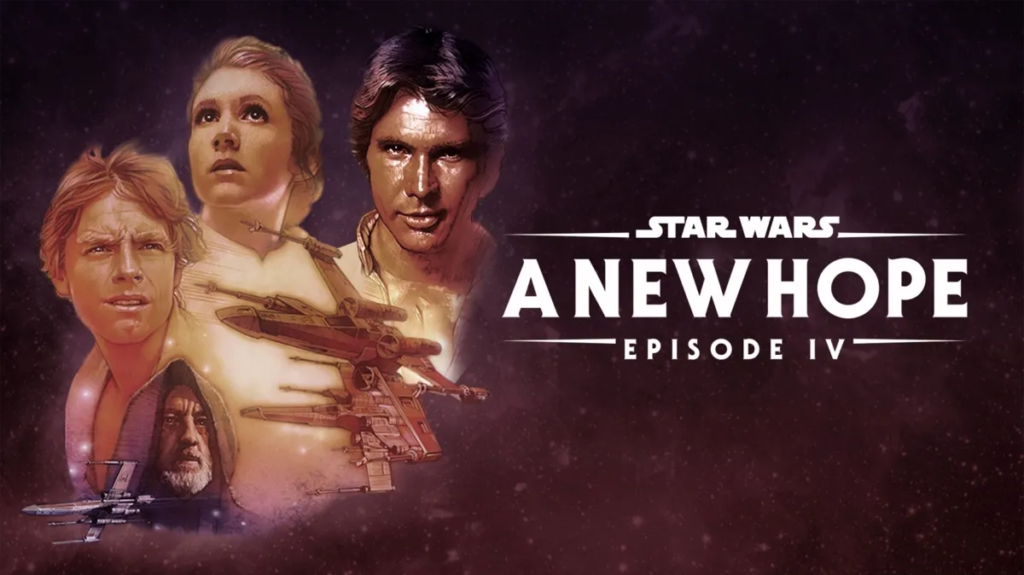
Released on May 25, 1977, Star Wars—later retitled Star Wars: Episode IV – A New Hope—is the film that launched one of the most iconic and enduring franchises in cinema history. Written and directed by George Lucas, and produced by Lucasfilm for Twentieth Century-Fox, this space opera redefined storytelling in science fiction and created a worldwide cultural phenomenon.
Set in a galaxy torn apart by civil war, the story follows Luke Skywalker, a young farm boy whose life changes forever after he discovers a mysterious message hidden in a droid. As Luke joins the Rebel Alliance and learns the ways of the mystical Force, he becomes part of a desperate mission to destroy the Empire’s ultimate weapon—the Death Star.
The film stars Mark Hamill as Luke Skywalker, Carrie Fisher as Princess Leia, and Harrison Ford as Han Solo, alongside Alec Guinness, Peter Cushing, Anthony Daniels, Kenny Baker, Peter Mayhew, and David Prowse. It also features the iconic voice of James Earl Jones as Darth Vader.
From humble beginnings and production struggles, A New Hope soared to historic box office success, earning $410 million in its original run and becoming a pillar of pop culture that continues to inspire generations.
A New Hope – Official Trailer
Relevant Questions Answered
What is Star Wars Episode IV: A New Hope about?
Set against the backdrop of a galactic civil war, the film centers on Luke Skywalker, who joins forces with Princess Leia, smuggler Han Solo, and Jedi Master Obi-Wan Kenobi to thwart the Galactic Empire’s grip on the galaxy. Their mission is to destroy the Death Star, a weapon capable of annihilating entire planets.
Why is it titled Episode IV if it’s the first film?
Although it was the first Star Wars film released, George Lucas envisioned the story as part of a larger saga. In 1981, during a re-release, the title was updated to Episode IV: A New Hope to reflect its place in the broader Skywalker Saga, which spans nine episodes in total.
How did the original Star Wars change cinema?
A New Hope pioneered groundbreaking special effects through the formation of Industrial Light & Magic, introduced the now-famous opening crawl, and merged mythology with futuristic sci-fi in a way that resonated across generations. Its use of merchandising, sequels, and cross-media storytelling set a new standard for Hollywood franchises.
Is Star Wars: A New Hope Worth Watching?
Absolutely. Even decades later, A New Hope stands as a masterclass in cinematic storytelling. Its pacing, world-building, character development, and emotional payoff have aged remarkably well. Whether you’re watching for the first time or revisiting it, the film’s balance of action, drama, and wonder remains unmatched.
It’s not just a cornerstone of Star Wars—it’s a defining piece of modern film history. Alec Guinness lends gravitas as Obi-Wan Kenobi, Harrison Ford’s Han Solo brings roguish charm, and John Williams’ score elevates every moment to legend. While some effects may feel dated, the film’s soul and spirit are timeless. This is essential viewing for any sci-fi fan or cinema lover.
Watch Order: Where Does A New Hope Fit?
Standard Movie Chronology:
-
- Episode I – The Phantom Menace
- Episode II – Attack of the Clones
- Episode III – Revenge of the Sith
- Solo: A Star Wars Story
- Rogue One: A Star Wars Story
- Episode IV – A New Hope
- Episode V – The Empire Strikes Back
- Episode VI – Return of the Jedi
- Episode VII – The Force Awakens
- Episode VIII – The Last Jedi
- Episode IX – The Rise of Skywalker
Expanded Chronological Watch Order (Including Shows):
- Andor
- Obi-Wan Kenobi
- Star Wars Rebels
- Rogue One: A Star Wars Story
- Episode IV – A New Hope
- The Empire Strikes Back
- Return of the Jedi
- (Followed by The Mandalorian, Book of Boba Fett, Ahsoka, etc.)
A New Hope FAQ
Why did George Lucas change the title after the film was released?
Lucas always envisioned Star Wars as part of a larger saga. Once he confirmed plans for sequels and prequels, he retroactively titled the film Episode IV: A New Hope to align with his multi-part narrative structure.
Was the movie expected to be a success?
Not at all. During filming, even the cast and crew were skeptical. Lucas faced technical setbacks and went over budget. However, after its limited release, it quickly became a phenomenon, shocking the industry with its success.
How did the special effects hold up?
While modern audiences might notice the dated techniques, A New Hope was revolutionary in 1977. It set the benchmark for visual effects and led to the founding of ILM, a studio that continues to influence visual effects today.
What awards did the film win?
A New Hope won six Academy Awards, including Best Art Direction, Costume Design, Visual Effects, and Original Score. It was also nominated for Best Picture and Best Director.
Has the film been changed since its release?
Yes. George Lucas re-released the film multiple times with visual and audio updates, including the controversial “Special Edition” in 1997, which added scenes and modified key moments (like the infamous “Han shot first” debate).
Conclusion: The Beginning of a Legacy
Star Wars Episode IV: A New Hope is more than just a movie—it’s the foundation of a universe. It introduced unforgettable characters, revolutionary visual effects, and a compelling story that continues to evolve. From the dusty plains of Tatooine to the climactic trench run on the Death Star, it’s an emotional and cinematic journey that stands the test of time.
Whether you’re a lifelong fan or a curious newcomer, A New Hope is the perfect gateway into a galaxy far, far away.
If you don’t know where to watch this Movie for FREE make sure to contact me via E-mail, or in the comments below. Thank you for reading and make sure to bookmark the site.
How useful was this post?
Click on a star to rate it!
Average rating 0 / 5. Vote count: 0
No votes so far! Be the first to rate this post.