
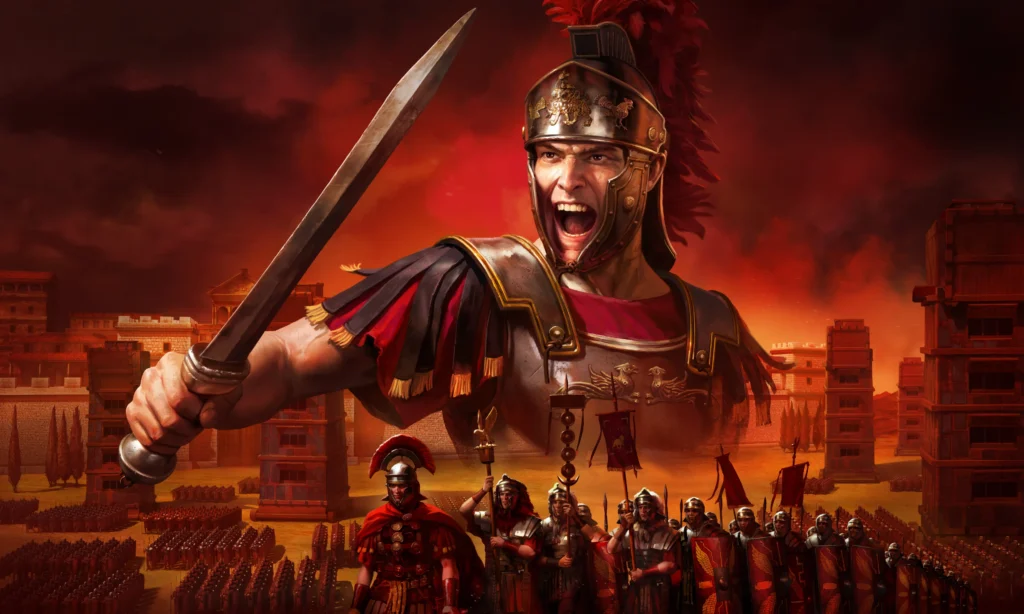
Originally released in 2004 for Microsoft Windows by The Creative Assembly and published by Activision, Rome: Total War became an instant classic in the world of strategy games. As the third installment in the Total War franchise, it transported players into the heart of the Roman Republic’s expansion from 270 BC to 14 AD. Combining deep turn-based empire management with dramatic real-time battles, the game set new standards for historical accuracy, tactical gameplay, and immersive visuals.
Over the years, it was ported to macOS, iOS, and Android, and even received a full remaster in 2021. With critical acclaim and millions of fans worldwide, Rome: Total War is widely regarded as one of the greatest strategy games of all time.
Rome: Total War – Official Trailer
What is Rome: Total War about?
Two Games in One: Campaign and Combat
At its core, Rome: Total War offers two distinct yet interconnected modes. The turn-based campaign puts players in control of a Roman family or a foreign faction, managing cities, armies, diplomacy, trade, and politics across Europe, North Africa, and the Near East. Every move on the campaign map influences the second mode: massive real-time 3D battles where players command legions on terrain that reflects real-world geography.
The objective is to expand your empire by conquering territories, managing resources, and outperforming rival factions—all while keeping your population under control and your armies loyal.
Is Rome: Total War worth playing today?
A Timeless Classic, Especially with the Remastered Edition
Yes—Rome: Total War is still one of the most beloved strategy games ever made. While some of the original mechanics may feel dated, the game’s scale, depth, and battlefield dynamics remain impressive. The 2021 remaster enhances visuals, adds factions, and modernizes the UI, making it a great entry point for new players while remaining faithful to the original.
If you’re a fan of strategy, history, or epic military campaigns, Rome: Total War is a must-play—especially with its vibrant modding community and long-lasting legacy.
Gameplay Overview
Turn-Based Strategy and Empire Building
Players begin with a single faction and a handful of cities. From there, they must grow their empire by building infrastructure, training armies, and navigating diplomacy. Cities generate income through taxes and trade, and each can be upgraded with temples, barracks, arenas, and aqueducts to improve morale and efficiency. Mismanaged cities may rebel, forcing players to maintain balance through public order and military presence.
Family members are central to governance and military leadership. Each character gains traits through experience or heredity, which can affect battlefield performance, management skills, or diplomatic success.
Real-Time Battles with Tactical Depth
The real-time battles are where Rome: Total War truly shines. With thousands of units on screen, players maneuver infantry, cavalry, archers, and siege weapons in battles that demand tactical foresight. Terrain, weather, morale, and formations—such as the Roman testudo or Greek phalanx—play a critical role in the outcome.
Victory isn’t just about numbers; flanking, ambushing, or holding high ground can change the tide of battle. Siege warfare adds another layer of strategy, requiring players to breach gates, scale walls, or hold the city center.
Expansion Packs and Additional Content
Barbarian Invasion
Set during the fall of the Western Roman Empire, this expansion lets players command barbarian factions or a divided Rome. It introduces religion as a gameplay factor, further complicating public order and faction loyalty.
Alexander
This expansion lets players relive the legendary campaigns of Alexander the Great. Focused on fast-paced conquest, it challenges players to replicate one of history’s most famous military campaigns in a tight time frame.
Modding and Community Support
A Game That Inspired a Modding Renaissance
Rome: Total War is highly moddable, and the community has taken full advantage. Popular mods like Europa Barbarorum, Roma Surrectum, and Imperium Surrectum aim to increase historical accuracy and overhaul gameplay mechanics, often turning the base game into entirely new experiences. The 2021 remaster also supports modding, helping to preserve the game’s long-term popularity.
Critical Reception and Awards
One of the Most Acclaimed Strategy Games of All Time
Upon release, Rome: Total War received near-universal acclaim. It holds a 92/100 score on Metacritic (PC), and was praised for its innovation, scale, and visual design. Major gaming publications gave it Editor’s Choice awards, and it won “Strategy Game of the Year” at the 8th Annual Interactive Achievement Awards.
IGN ranked it among the Top 20 Greatest Games of All Time, and PC Gamer listed it as one of the best PC games ever made. The game’s popularity led to strong sales, with hundreds of thousands of units sold across the US, UK, and Germany.
Sequel and Remaster
Total War: Rome II (2013)
Following the success of the original, Creative Assembly released Total War: Rome II in 2013. While the sequel expanded the campaign map and introduced new mechanics, it received mixed reviews at launch due to performance issues but has since been improved through updates and DLC.
Total War: Rome Remastered (2021)
Released in 2021 by Feral Interactive, the remastered edition modernizes the original with 4K visuals, enhanced UI, improved AI, and 16 new factions—bringing the total to 38 playable factions. Though some mechanics may feel dated compared to newer Total War games, the remaster is considered the definitive way to experience the original Rome: Total War.
Rome: Total War FAQ
What platforms is Rome: Total War available on?
Originally released on PC, the game is now available on macOS, iOS (iPad/iPhone), and Android, with the remastered edition available via Steam for modern PCs.
Can you play as non-Roman factions?
Yes. The base game includes three Roman factions and unlockable foreign factions. The remaster adds even more, allowing for deeper and more diverse campaigns.
Is Rome: Total War historically accurate?
While not perfect, the game strives for historical authenticity in faction design, unit types, and geography. Some creative liberties are taken for gameplay balance.
Are there multiplayer options?
Yes. Players can engage in custom battles or real-time skirmishes against others. The original relied on GameSpy (now defunct), but newer versions support modern online services.
Conclusion
Rome: Total War isn’t just a strategy game—it’s a milestone in video game history. Its perfect blend of tactical warfare and strategic empire-building has influenced countless titles in the genre. Whether you’re a newcomer drawn by the remaster or a veteran returning to conquer Europe once more, the legacy of Rome: Total War is as enduring as the empire it depicts.
Thank you for reading and make sure to bookmark the site and follow up on the newest posts!
How useful was this post?
Click on a star to rate it!
Average rating 0 / 5. Vote count: 0
No votes so far! Be the first to rate this post.