
 9.3/10
 95% Critics / 97% Audience
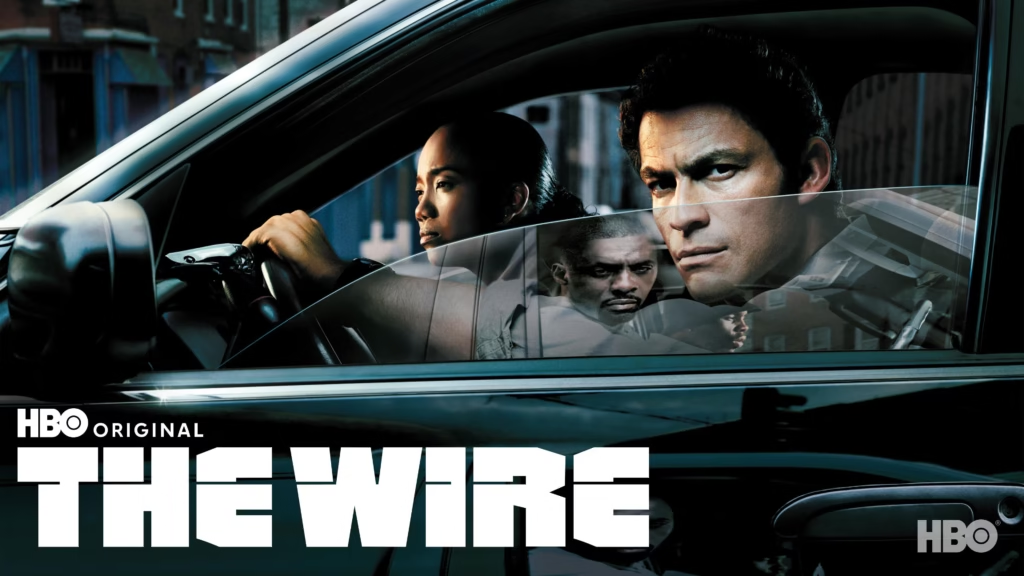
The Wire is an American crime drama television series created by David Simon, a former Baltimore Sun reporter, with stories co-written by Ed Burns, a former homicide detective and teacher. It premiered on HBO on June 2, 2002 and ran until March 9, 2008, covering 60 episodes across five seasons.
Unlike most police dramas, The Wire uses Baltimore, Maryland, as a stage for a broader exploration of American society, institutions, and systemic dysfunction. Each season focuses on a new societal sector while maintaining continuity of its ensemble cast. Although it initially struggled with ratings, it has since become one of the greatest and most studied TV dramas of all time.
The Wire – Official Trailer
What Is The Wire About?
The series chronicles both law enforcement and the people they investigate, offering perspectives from police officers, drug dealers, dockworkers, politicians, journalists, and schoolchildren.
-
Season 1: Focuses on the drug trade and the Barksdale crime family, introducing wiretap surveillance.
-
Season 2: Shifts to the Baltimore docks and international smuggling.
-
Season 3: Explores politics, reform, and policing with the radical “Hamsterdam” experiment.
-
Season 4: Examines public education and the cycle of poverty shaping the next generation.
-
Season 5: Investigates the media and how truth is shaped by journalism.
This layered structure creates a novel-like narrative, intertwining multiple lives while exploring how institutions compromise individuals.
Why Should You Watch The Wire?
The Wire is not a standard crime show — it’s a sociological portrait of a city and a deep critique of American institutions.
-
Authenticity: Inspired by real cases and figures from Baltimore.
-
Complex Characters: Everyone is morally gray; even criminals and cops are shown with nuance.
-
Dialogue & Vernacular: Authentic Baltimore slang and cultural detail immerse viewers.
-
Themes: Poverty, politics, corruption, and systemic failure are woven into every storyline.
-
Acclaim: Universally praised by critics, universities, and even politicians for its honesty and scope.
Is The Wire Worth Watching?
Yes — The Wire is widely considered one of the greatest TV shows ever made. While its pacing is slower than typical crime dramas, the payoff is profound.
-
If you enjoy realistic storytelling over flashy action, The Wire rewards patience with rich themes.
-
It’s frequently used in academic courses to analyze politics, sociology, and urban issues.
-
Its storytelling remains relevant two decades later, reflecting challenges still present in cities worldwide.
Simply put, if you value television that makes you think as much as it entertains, The Wire is essential viewing.
Cast and Characters
The show is known for its ensemble cast of both trained actors and real Baltimore locals.
-
Dominic West as Detective Jimmy McNulty — a brilliant yet self-destructive investigator.
-
Idris Elba as Stringer Bell — the ambitious and business-minded drug lieutenant.
-
Wood Harris as Avon Barksdale — ruthless leader of the West Baltimore drug trade.
-
Michael K. Williams as Omar Little — a stick-up man who robs drug dealers, one of TV’s most iconic antiheroes.
-
Sonja Sohn as Detective Kima Greggs — a tough and principled investigator.
-
Clarke Peters as Lester Freamon — a quiet detective with a sharp mind for detail.
-
Wendell Pierce as Detective Bunk Moreland — McNulty’s dry-witted partner.
-
Larry Gilliard Jr. as D’Angelo Barksdale — a conflicted lieutenant caught between loyalty and conscience.
Later seasons expanded the cast to include:
-
Chris Bauer as Frank Sobotka (Season 2, labor unions)
-
Aidan Gillen as Tommy Carcetti (Season 3–5, politics)
-
Jamie Hector as Marlo Stanfield (Season 3–5, rival drug kingpin)
-
Tristan Wilds as Michael Lee (Season 4, street youth)
-
Clarke Johnson as Gus Haynes (Season 5, newsroom editor)
Episodes / Seasons / Release Order
-
Season 1 (2002): 13 episodes — the drug trade and the Barksdale organization.
-
Season 2 (2003): 12 episodes — smuggling and the working-class docks.
-
Season 3 (2004): 12 episodes — politics, reform, and police strategies.
-
Season 4 (2006): 13 episodes — public schools and systemic poverty.
-
Season 5 (2008): 10 episodes — media and truth in journalism.
Each season builds on the last but tells a self-contained institutional story, making the show best experienced in chronological order.
Production and Development
-
Origins: Based on Simon and Burns’ real-world experiences in Baltimore.
-
Network: Chosen by HBO to avoid censorship and commercial pressure.
-
Writers: Included crime authors George Pelecanos, Dennis Lehane, and Richard Price.
-
Casting Philosophy: Avoided big-name stars, instead focusing on authenticity. Many roles went to Baltimore locals or lesser-known actors.
-
Style: Minimalistic direction, heavy use of diegetic music, and epigraphs opening each episode.
Reception and Critical Response
-
Critical Acclaim: Later seasons hold near-perfect ratings (Season 3 and 4 at 100% on Rotten Tomatoes).
-
Emmy Snub: Despite acclaim, it never won an Emmy — critics often cite its complexity and gritty tone as reasons.
-
Praise: Lauded for realism, writing, and cultural importance. Critics like Barack Obama and novelist Orson Scott Card called it one of the best shows ever.
-
Academic Value: Used as teaching material at Harvard, Brown, Johns Hopkins, and other universities.
Legacy and Impact
-
The Wire influenced later TV dramas like Breaking Bad and True Detective.
-
It elevated the careers of Idris Elba, Dominic West, Michael B. Jordan, and Michael K. Williams.
-
Frequently cited as a sociological masterpiece, not just entertainment.
-
Inspired debates on urban poverty, drug policy, and journalism.
-
Its authenticity has made it a case study in both television history and urban studies.
The Wire FAQ
Q: Is The Wire hard to follow?
A: Yes, at first — it demands close attention. But once immersed, the storytelling is deeply rewarding.
Q: Do I need to watch in order?
A: Absolutely. Each season builds upon the previous ones.
Q: How many episodes are there?
A: 60 episodes across five seasons.
Q: Why didn’t it win Emmys?
A: Many voters found it too dense, grim, or lacking Hollywood-style appeal. Its legacy, however, is far greater than awards.
Q: Is it realistic?
A: Very. Many storylines were inspired by real cases and people from Baltimore.
Conclusion
The Wire is more than a TV series — it’s a literary exploration of urban America. Its characters are unforgettable, its themes timeless, and its storytelling unmatched in ambition and realism. While it was underappreciated during its run, it now stands as one of the most influential and respected television dramas ever created, a show that changed how TV could tell stories.
If you don’t know where to watch this Series for FREE make sure to contact me via E-mail, or in the comments below. Thank you for reading and make sure to bookmark the site.
How useful was this post?
Click on a star to rate it!
Average rating 0 / 5. Vote count: 0
No votes so far! Be the first to rate this post.