
 8.7/10
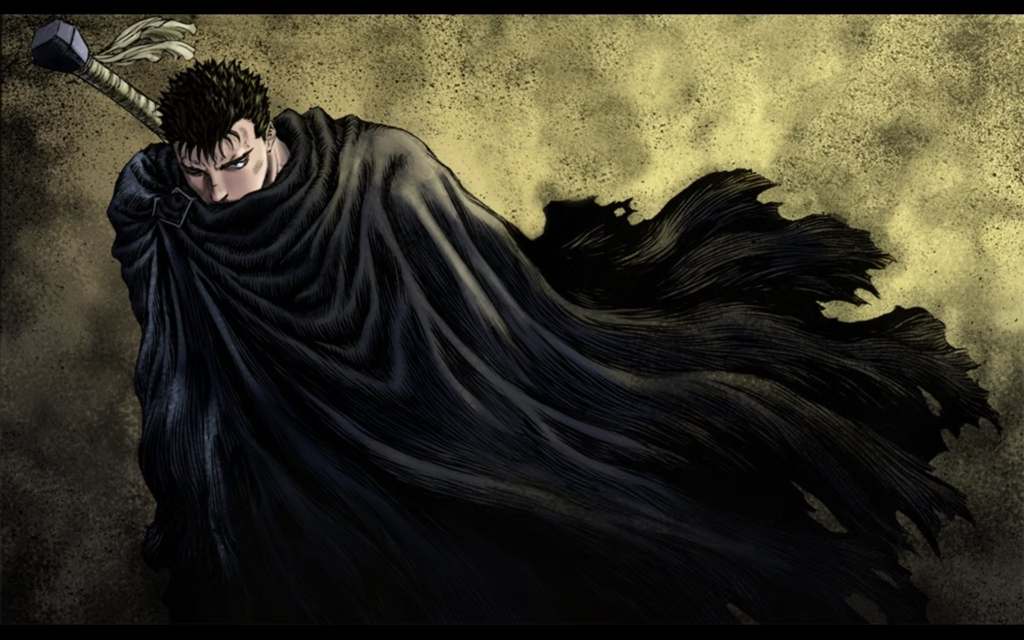
Berserk (剣風伝奇ベルセルク, Kenpū Denki Berserk) is a Japanese dark fantasy anime based on Kentaro Miura’s legendary manga. Produced by Nippon Television and VAP, animated by OLM, and directed by Naohito Takahashi, the series aired from October 1997 to April 1998 for a total of 25 episodes.
Though the manga spans decades, this adaptation focuses mainly on the Golden Age arc, offering a self-contained but devastating tale of ambition, betrayal, and fate. With its raw storytelling, atmospheric direction, and unforgettable soundtrack by Susumu Hirasawa, the 1997 anime is considered one of the most influential dark fantasy works in anime history.
Even decades later, despite newer adaptations, many fans still see the 1997 series as the definitive Berserk anime.
Berserk (1997 Anime) – Official Trailer
Why Should You Watch Berserk (1997)?
There are several reasons why Berserk (1997) continues to stand as a masterpiece of anime storytelling:
Unflinching Dark Fantasy: The anime dives deep into the cruelty of medieval warfare, political corruption, and supernatural horror. Unlike most fantasy anime of the time, it embraces tragedy instead of offering an easy escape.
Deep, Complex Characters:
Guts embodies resilience and pain, torn between survival and the search for meaning.
Griffith represents ambition and charisma, whose dream comes at a terrible cost.
Casca provides both strength and vulnerability, adding emotional weight to the Hawks’ story.
Mature Themes: Friendship, ambition, betrayal, morality, and the question of free will are all central.
Atmosphere and Direction: The muted colors, somber tone, and use of silence often hit harder than battles themselves.
Haunting Music: Susumu Hirasawa’s tracks elevate the story, blending electronic beats with medieval-like chants, making the world feel eerie yet epic.
Is Berserk (1997) Worth Watching in 2025?
Yes, without hesitation. The anime has aged remarkably well in terms of tone, direction, and narrative depth. While the animation is simple by today’s standards, it avoids the pitfalls of later CGI-heavy adaptations, giving it a timeless quality.
That said, new viewers should know:
The anime does not adapt the entire manga. It ends suddenly at the Eclipse, one of the darkest moments in anime history, without closure.
The violence and themes are graphic and disturbing, making it unsuitable for younger audiences.
Despite these drawbacks, the 1997 Berserk remains a powerful entry point into the franchise and one of the most emotionally impactful anime experiences ever created.
Voice Cast
The performances, both Japanese and English, have left a lasting impression:
Guts: Nobutoshi Canna (JP) / Marc Diraison (EN)
Griffith: Toshiyuki Morikawa (JP) / Kevin T. Collins (EN)
Casca: Yūko Miyamura (JP) / Carrie Keranen (EN)
Nosferatu Zodd: Kenji Utsumi (JP) / J. David Brimmer (EN)
The English dub, produced by NYAV Post, gained cult status for its gritty delivery that matched the anime’s tone.
Soundtrack
Music is one of the most defining aspects of the 1997 Berserk:
Opening Theme: “Tell Me Why” by Penpals – an upbeat track that contrasts the series’ grim narrative, making it strangely iconic.
Ending Theme: “Waiting So Long” by Silver Fins – melancholic and emotional, leaving viewers unsettled after each episode.
Insert Song: “Forces” by Susumu Hirasawa – the most famous track, still celebrated today for its haunting synths and battle intensity.
Hirasawa’s unconventional style gave Berserk a musical identity unlike any other anime of the 1990s.
Reception and Legacy
Upon release, the series received strong critical acclaim:
Praised for its mature storytelling, nuanced characters, and unflinching depiction of violence.
Criticized for its limited animation and abrupt ending at the Eclipse.
Over time, however, these issues became part of its cult status. The raw hand-drawn style aged better than later CGI versions, and the unfinished ending only added to its tragic aura.
Berserk (1997) is now recognized as one of the greatest dark fantasy anime, inspiring countless creators in anime, video games, and beyond. Series such as Attack on Titan, Claymore, Devil May Cry, and even Dark Souls owe a creative debt to Berserk.
Comparing Berserk (1997) to Later Adaptations
1. The Golden Age Arc Film Trilogy (2012–2013)
Covers the same story as the 1997 anime but with updated visuals.
The animation is polished and cinematic, with smoother battles and more gore.
However, the films condense the story heavily, removing character development and smaller details.
While visually striking, they lack the slow-burn atmosphere that made the 1997 anime impactful.
2. Berserk (2016–2017) Anime Series
Continues the story beyond the Eclipse, covering the Conviction and Falcon of the Millennium Empire arcs.
Widely criticized for its poor CGI animation, which felt stiff and awkward compared to the manga’s art.
Still, it adapts important storylines, making it relevant for fans seeking more Berserk in anime form.
The soundtrack and certain story beats were appreciated, but the execution disappointed many.
3. Why Fans Prefer the 1997 Anime
Strong direction, pacing, and emotional build-up.
Better focus on character interactions and the tragedy of the Hawks.
A darker, rawer atmosphere that captures Miura’s intent.
Holds a nostalgic place as the first introduction to Berserk for many fans worldwide.
Berserk Watching Order – How to Experience the Saga
Because Berserk spans different adaptations and mediums, newcomers often wonder where to start. Here’s a clear guide:
1. Berserk (1997 Anime – 25 episodes)
Covers the Golden Age Arc with emotional depth and strong atmosphere.
Best starting point for first-time viewers.
2. Berserk: The Golden Age Arc Film Trilogy (2012–2013)
Retells the Golden Age story with modern visuals.
Good as a supplement, but less detailed than the 1997 anime.
3. Berserk (2016–2017 Anime – 24 episodes)
Continues the story with the Conviction Arc and part of the Falcon of the Millennium Empire Arc.
Criticized for poor CGI, but important if you want to see the story animated past the Eclipse.
4. Manga by Kentaro Miura (1989–present, 43 volumes as of 2025)
The definitive version of Berserk’s story.
Picks up after the Eclipse, continuing through arcs never adapted into anime.
Still ongoing under Kouji Mori’s supervision after Miura’s passing.
Recommended Path for New Fans
Watch the 1997 Anime first for the most impactful emotional experience.
Then read the manga starting from the Black Swordsman Arc (Volume 1) to follow the complete saga.
If curious, watch the Golden Age films for alternate visuals, and the 2016–2017 anime only if you want animated coverage beyond the Eclipse.
This order ensures you get the strongest introduction while still experiencing everything Berserk has to offer.
Berserk (1997 Anime) FAQ
Q: How many episodes are in Berserk (1997)?
A: 25 episodes.
Q: Does it cover the entire manga?
A: No. It only adapts the Golden Age arc and ends at the Eclipse.
Q: Should I watch the 1997 anime or the films first?
A: Start with the 1997 anime if you want a deeper emotional connection to the characters. Watch the films afterward for expanded action and gore.
Q: Is Berserk (1997) beginner-friendly?
A: Yes, but be prepared—it is very mature, graphic, and unfinished.
Conclusion
Berserk (1997) is more than just an anime adaptation—it’s a tragic masterpiece that redefined dark fantasy for anime fans. Despite its abrupt ending and dated animation, its storytelling, atmosphere, and music have stood the test of time.
For anyone looking to explore the world of Berserk, the 1997 anime remains the most faithful and emotionally powerful adaptation. It is grim, unrelenting, and unforgettable—exactly what Kentaro Miura intended.
If you don’t know where to watch this Anime for FREE make sure to contact me via E-mail, or in the comments below. Thank you for reading and make sure to bookmark the site.
How useful was this post?
Click on a star to rate it!
Average rating 0 / 5. Vote count: 0
No votes so far! Be the first to rate this post.