
 6.3/10
 71% Critics / 50% Audience
When Beowulf premiered in November 2007, it wasn’t just another fantasy film—it was a bold experiment in storytelling and technology. Directed by Robert Zemeckis and written by Neil Gaiman and Roger Avary, this animated fantasy-action movie retold the Old English epic poem through groundbreaking motion-capture technology. Featuring a stellar cast including Ray Winstone, Anthony Hopkins, Robin Wright, John Malkovich, Crispin Glover, Brendan Gleeson, and Angelina Jolie, the film pushed the boundaries of digital filmmaking at the time.
The movie was both praised and criticized: hailed for its stunning visuals and ambitious reinterpretation of a medieval tale, yet questioned for its deviations from the source poem. With its heavy use of motion capture, lavish battle sequences, and psychological undertones, Beowulf carved out a unique space in fantasy cinema—balancing blockbuster spectacle with mythic reinterpretation.
Beowulf (2007) – Official Trailer
What is Beowulf (2007) About?
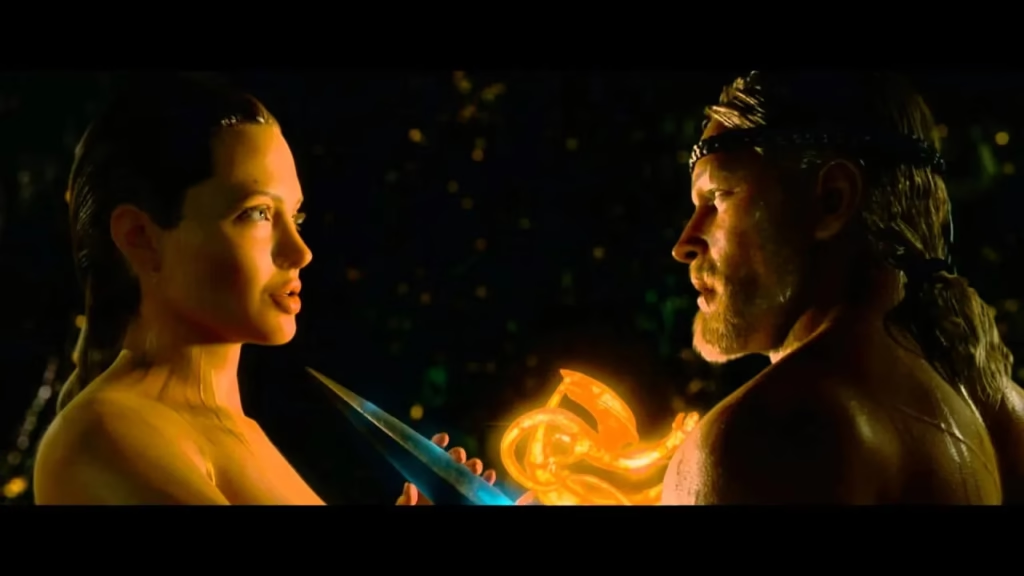
Set in 507 A.D., the film follows the legendary Geatish warrior Beowulf, who travels to Denmark to defeat the monster Grendel, terrorizing King Hrothgar’s mead hall, Heorot. But the battle against Grendel is only the beginning. After slaying the creature, Beowulf faces Grendel’s mother (Angelina Jolie), a seductive water-demon who tempts him with promises of power. His fateful decision to accept her bargain sets in motion a cycle of corruption and tragedy that haunts him for fifty years.
The film reimagines Beowulf not as a flawless hero but as a deeply flawed man driven by lust, pride, and ambition. By linking the monsters directly to human sins—Grendel as Hrothgar’s cursed child and the dragon as Beowulf’s own offspring—the film weaves a story of legacy, temptation, and the inevitable downfall of men who bargain with power beyond their control.
Is Beowulf Worth Watching?
Yes—though it depends on what you expect. If you’re looking for a faithful translation of the Old English poem, you may find the deviations frustrating. But if you enjoy dark fantasy retellings with a psychological edge, Beowulf offers a visually stunning, morally complex interpretation.
The film’s motion-capture technology was groundbreaking for 2007, particularly its 3D release, which stunned audiences with its immersive visuals. While some viewers criticized the “uncanny valley” effect of the characters, many critics praised the film for being bold, ambitious, and thought-provoking.
Why Should I Watch Beowulf?
You should consider watching Beowulf if you enjoy:
-
Epic fantasy battles – From Beowulf’s brutal fight with Grendel to the climactic dragon showdown, the action sequences are intense.
-
Reimagined mythology – The movie adds depth to the Old English tale by reframing Beowulf as a tragic, flawed figure.
-
Cutting-edge visuals (for its time) – Its use of motion capture paved the way for films like Avatar.
-
Philosophical themes – The story explores temptation, legacy, masculinity, and the blurred line between heroes and monsters.
Cast and Characters
-
Ray Winstone as Beowulf – portrayed with both heroism and hubris, also lending his likeness to the Dragon.
-
Anthony Hopkins as King Hrothgar – a drunken ruler haunted by his past sins.
-
Robin Wright as Queen Wealtheow – Hrothgar’s wife, later estranged from Beowulf.
-
Brendan Gleeson as Wiglaf – Beowulf’s loyal lieutenant.
-
John Malkovich as Unferth – an advisor, reimagined as a devout Christian.
-
Crispin Glover as Grendel – depicted as a childlike, grotesque creature.
-
Angelina Jolie as Grendel’s Mother – a seductive, golden-skinned demon who tempts kings and warriors alike.
Production and Development
The idea for the film dates back to 1997, when Neil Gaiman and Roger Avary wrote a screenplay. Originally envisioned as a gritty, low-budget medieval film, it evolved into a massive $150 million production when Robert Zemeckis took over.
-
Zemeckis used motion capture technology, previously explored in The Polar Express (2004).
-
Over 450 graphic designers and animators worked on the film, pushing CGI technology to new heights.
-
The fight scenes, particularly the dragon battle, were rewritten for maximum cinematic spectacle.
-
The team used Unreal Engine-inspired rendering methods to achieve lifelike animations.
The film was heavily marketed, with tie-in novelizations, comic adaptations, and a Ubisoft video game.
Differences from the Poem
Unlike the poem, where Beowulf is a steadfast hero, the film reframes him as morally compromised. Some of the key changes include:
-
Beowulf fathers the dragon, tying his lust to his downfall.
-
Grendel is portrayed as Hrothgar’s son, making the monster a direct consequence of sin.
-
Grendel’s mother is reimagined as a seductive succubus rather than a hag.
-
Pagan heroism is contrasted with the rise of Christianity, which is personified by Unferth.
-
The ending is ambiguous, with Wiglaf tempted by Grendel’s mother, suggesting the cycle may continue.
These changes reflect Zemeckis and Gaiman’s goal of making Beowulf’s tale more psychological, tragic, and morally complex.
Themes
The film explores themes of:
-
Desire and corruption – Beowulf’s downfall stems from lust and ambition.
-
Masculinity and power – Heroes are undone by their inability to control desire.
-
The monstrous feminine – Grendel’s mother represents temptation and emasculation.
-
Legacy and cycles – The sins of one generation echo in the next, embodied in Grendel and the dragon.
-
Faith and morality – Pagan heroism clashes with the rise of Christianity, questioning what defines true strength.
Release and Reception
-
Premiered in Westwood, Los Angeles on November 5, 2007, and released in theaters on November 16, 2007.
-
Released in 3D across 1,000 theaters, making it one of the earliest major 3D blockbusters.
-
Box Office: Grossed $196.4 million worldwide on a $150M budget.
-
Rotten Tomatoes: 71% approval rating.
-
Metacritic: 59/100, indicating mixed reviews.
Critics were divided:
-
Praised for groundbreaking visuals and bold reinterpretation (Rolling Stone, Time, Roger Ebert).
-
Criticized for uncanny CGI and deviations from the poem (The New York Times, NPR, academic scholars).
-
Some scholars argued the film was misogynistic, while others praised it as a psychological and symbolic exploration of myth.
Beowulf (2007) FAQ
Is Beowulf faithful to the original poem?
Not entirely. The film introduces major reinterpretations, particularly making Beowulf the father of the dragon and portraying Grendel’s mother as a seductress.
Why is the film animated instead of live-action?
Zemeckis wanted to use motion capture to create visuals impossible in live-action and push digital filmmaking forward.
Is Angelina Jolie really nude in the film?
Her character, Grendel’s mother, is portrayed as a golden-skinned seductress. While CGI, the scenes were considered controversial at the time for their suggestive imagery.
Is Beowulf part of a series?
No, it is a standalone film, though tie-in comics, a novelization, and a Ubisoft video game expanded the world.
Was the film successful?
Financially, it made close to $200M worldwide but wasn’t a runaway hit. Critically, it was praised for ambition but criticized for story choices.
Conclusion
Beowulf (2007) remains one of the most ambitious animated films of its era. By reimagining a medieval poem as a dark, psychological fantasy, Robert Zemeckis and his creative team turned the story into a cautionary tale about lust, power, and legacy. While its heavy use of motion capture divided audiences, the film’s visuals and reinterpretation continue to spark debate almost two decades later.
Whether viewed as a flawed experiment or a bold triumph, Beowulf stands as a milestone in digital cinema and mythic storytelling, pushing the boundaries of what fantasy adaptations could be.
If you don’t know where to watch this Animated Movie for FREE make sure to contact me via E-mail, or in the comments below. Thank you for reading and make sure to bookmark the site.
How useful was this post?
Click on a star to rate it!
Average rating 0 / 5. Vote count: 0
No votes so far! Be the first to rate this post.