
 8.2/10
 79% Critics / 83% Audience
Released in 2013, The Wolf of Wall Street is a cinematic spectacle of greed, corruption, and unchecked ambition. Directed by Martin Scorsese and written by Terence Winter, the film adapts Jordan Belfort’s 2007 memoir, chronicling his rise and fall as a fraudulent stockbroker in 1980s and 1990s New York.
Starring Leonardo DiCaprio in one of his most magnetic performances, the movie captures the intoxicating chaos of Wall Street’s most decadent years. Alongside DiCaprio are Jonah Hill, Margot Robbie, Matthew McConaughey, and Kyle Chandler, each bringing to life a world fueled by excess, deception, and addiction.
It is both a celebration and a condemnation — a film that shows the seductive power of money while laying bare the moral emptiness it leaves behind.
The Wolf of Wall Street – Official Trailer
What Is The Wolf of Wall Street About?
The film follows Jordan Belfort, a young, ambitious man who begins his career as a Wall Street broker in the late 1980s. When the financial crash hits, he loses his job but discovers a lucrative alternative in penny stocks — cheap, volatile shares that can be easily manipulated for massive profit.
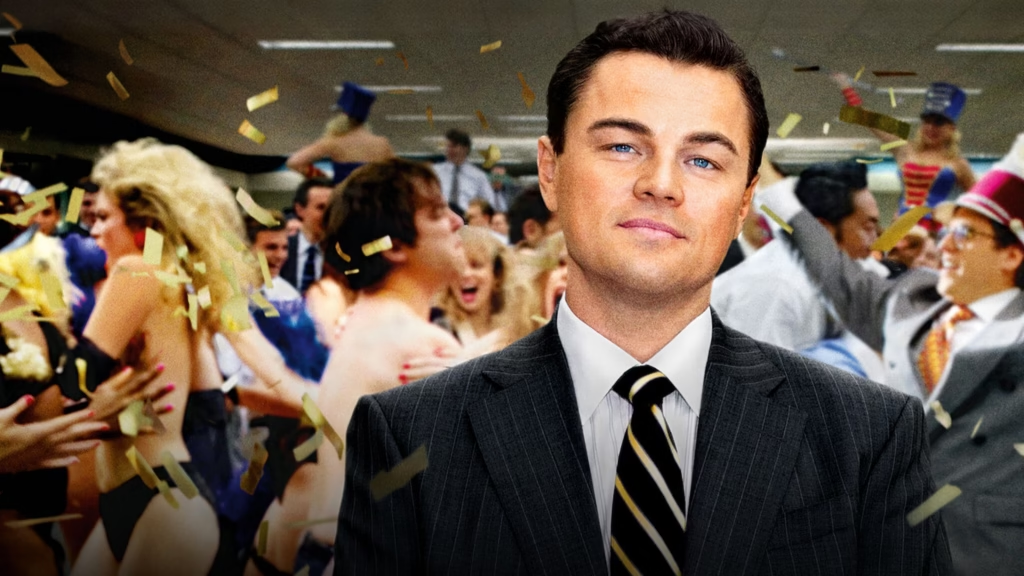
With his charisma and persuasive skills, Belfort builds Stratton Oakmont, a brokerage firm that becomes a breeding ground for excess. Surrounded by loyal but morally bankrupt associates, including his right-hand man Donnie Azoff, he engages in pump-and-dump schemes, drug-fueled orgies, and relentless self-indulgence.
As the wealth pours in, the lifestyle spirals out of control. Belfort buys yachts, helicopters, mansions, and loses himself in a haze of power, lust, and narcotics. But the higher he climbs, the harder he falls — as the FBI closes in, his empire begins to crumble under the weight of greed and ego.
The story, told through Belfort’s own unapologetic narration, oscillates between thrilling comedy and tragic self-destruction, capturing the fine line between ambition and corruption.
Is The Wolf of Wall Street Worth Watching?
Absolutely. The Wolf of Wall Street is not merely a film — it’s an experience. It’s outrageous, funny, disturbing, and brilliant all at once. Scorsese pushes boundaries of morality and filmmaking alike, creating a three-hour epic that is as much a psychological study as it is a satire.
The film’s energy never falters, carried by DiCaprio’s fearless portrayal of Belfort — a man so blinded by greed that he becomes both repulsive and hypnotically fascinating. The movie doesn’t ask you to like him; it asks you to witness him, and in doing so, forces you to confront society’s own obsession with wealth and success.
For its sheer audacity, craftsmanship, and unfiltered look at the dark side of capitalism, The Wolf of Wall Street remains one of Scorsese’s most talked-about works.
Why Should I Watch The Wolf of Wall Street?
Watching The Wolf of Wall Street is to watch a master filmmaker at the height of his power. The film’s fast-paced editing, infectious soundtrack, and dynamic camerawork make it as entertaining as it is shocking.
Beyond the surface spectacle, it’s also a biting critique of American greed and excess, exposing how ambition can rot into moral decay. It captures a culture where success is measured by indulgence — where loyalty, ethics, and empathy are consumed by ego.
Leonardo DiCaprio delivers one of the defining performances of his career, embodying Belfort’s intoxicating blend of charm and depravity. Margot Robbie’s breakthrough performance as Naomi Lapaglia adds both glamour and emotional weight, while Jonah Hill’s portrayal of Donnie Azoff injects comic absurdity into the chaos.
Ultimately, you watch The Wolf of Wall Street not to idolize its characters but to understand the extremes of human desire when power and consequence no longer coexist.
Cast and Performances
-
Leonardo DiCaprio as Jordan Belfort – an unrelenting and electrifying portrayal of a man who mistakes greed for greatness.
-
Jonah Hill as Donnie Azoff – a bizarre yet disturbingly loyal partner in crime whose comedic energy masks deep insecurity.
-
Margot Robbie as Naomi Lapaglia – the embodiment of seduction and strength, whose relationship with Belfort unravels into chaos.
-
Matthew McConaughey as Mark Hanna – a brief but unforgettable mentor who sets the tone for Belfort’s moral collapse.
-
Kyle Chandler as FBI Agent Patrick Denham – the film’s moral counterweight, quietly relentless in his pursuit of justice.
Supporting roles from Rob Reiner, Jean Dujardin, and Jon Bernthal add to the film’s world of eccentric and morally bankrupt characters.
Production and Direction
Development of The Wolf of Wall Street began as early as 2007, with DiCaprio acquiring the rights to Belfort’s memoir. After years of stalled production due to content restrictions, Red Granite Pictures took over, allowing Scorsese the creative freedom to make an unapologetically explicit film.
Shot primarily in New York, the production captured the opulence and absurdity of 1990s Wall Street culture. Scorsese balanced traditional 35mm film with digital cinematography, creating a visual texture that feels both authentic and heightened.
The editing by Thelma Schoonmaker deserves special praise; her pacing and rhythm transform three hours into a kinetic, near-hallucinatory ride. Scorsese’s signature storytelling style — voiceovers, fourth-wall breaks, and relentless camera movement — makes this film feel alive from the first frame to the last.
Reception and Legacy
Upon release, The Wolf of Wall Street became both a box-office hit and a lightning rod for controversy. Grossing over $407 million worldwide, it remains Scorsese’s highest-grossing film to date.
Critics praised its direction, performances, and dark humor, though opinions were divided over its moral stance. Some accused it of glorifying Belfort’s actions; others saw it as a scathing indictment of capitalism’s moral void.
The film was nominated for five Academy Awards, including Best Picture, Best Director, and acting nods for DiCaprio and Hill. DiCaprio later won the Golden Globe Award for Best Actor in a Musical or Comedy.
Over time, the film has gained recognition as one of the defining works of the 2010s — frequently appearing on lists of the greatest films of the 21st century. Critics from The New Yorker to The New York Times have hailed it as an “epic of moral blindness” and a “reflection of America’s addiction to excess.”
Controversies and Cultural Debate
Few films have sparked as much debate as The Wolf of Wall Street. Its graphic sexual content, rampant drug use, and record-breaking profanity earned it an initial NC-17 rating, later reduced to R after edits.
Beyond its explicit nature, the film became embroiled in the 1MDB corruption scandal, when it was revealed that its financier, Red Granite Pictures, had allegedly used embezzled Malaysian state funds. Producer Riza Aziz was later arrested in connection with the case.
Critics and victims of Belfort’s schemes also questioned whether the film romanticized criminals while ignoring those they defrauded. Scorsese defended his approach, insisting that the film’s intention was to expose greed, not glamorize it.
Despite the controversy, it remains a cultural mirror — a cautionary tale of unchecked indulgence and moral collapse disguised as comedy.
The Wolf of Wall Street FAQ
1. Is The Wolf of Wall Street based on a true story?
Yes, it’s based on the memoir of Jordan Belfort, a real former stockbroker convicted of fraud and money laundering in the 1990s.
2. Where can I watch The Wolf of Wall Street?
It’s widely available on Paramount+, Amazon Prime Video, and major streaming platforms.
3. How long is the film?
The theatrical cut runs 180 minutes. A rumored four-hour director’s cut was never released.
4. Did Leonardo DiCaprio win an Oscar for it?
No, he was nominated for Best Actor but lost; however, he did win the Golden Globe for his performance.
5. Is it appropriate for all audiences?
No — the film is rated R for graphic sexual content, strong language, and depictions of drug use.
Conclusion
The Wolf of Wall Street is Martin Scorsese’s most audacious work — a film that laughs at decadence even as it damns it. It’s a mirror reflecting both the allure and emptiness of excess, anchored by DiCaprio’s powerhouse performance and Scorsese’s unrelenting direction.
A story of greed, power, and human frailty, it challenges viewers to question their own fascination with wealth and success. Whether you see it as satire, tragedy, or pure entertainment, The Wolf of Wall Street remains an unforgettable cinematic statement about the price of ambition — and the cost of losing your soul to it.
If you don’t know where to watch this Movie for FREE make sure to contact me via E-mail, or in the comments below. Thank you for reading and make sure to bookmark the site.
How useful was this post?
Click on a star to rate it!
Average rating 0 / 5. Vote count: 0
No votes so far! Be the first to rate this post.