
 7.8/10
 100% Critics / 86% Audience
Kill la Kill (Japanese: キルラキル) is a Japanese anime television series produced by Studio Trigger, known for its bold animation, chaotic energy, and stylish storytelling. Airing from October 2013 to March 2014, the show marked Trigger’s first original anime project and was directed by Hiroyuki Imaishi, with writing by Kazuki Nakashima — the creative duo behind Gurren Lagann and later Promare.
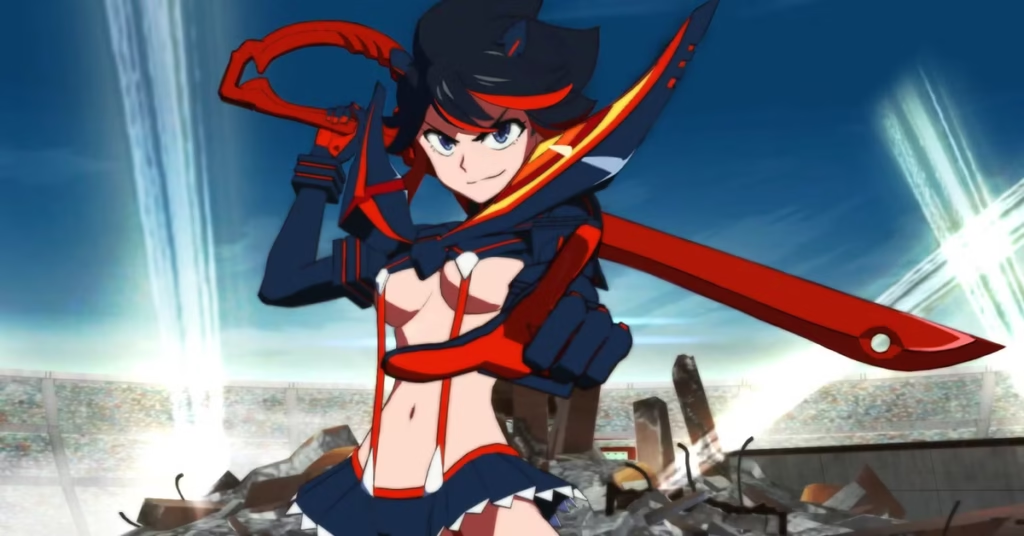
Set in the strange and hierarchical world of Honnouji Academy, the story follows Ryuko Matoi, a rebellious transfer student wielding a scissor-shaped blade and a sentient uniform named Senketsu. Her quest to find her father’s killer leads her into battle against Satsuki Kiryuin, the iron-fisted student council president, and eventually against Satsuki’s mother, Ragyo Kiryuin, whose fashion empire hides world-threatening secrets.
With its wild animation, fierce soundtrack by Hiroyuki Sawano, and themes blending fascism, freedom, and identity, Kill la Kill remains one of the most iconic and provocative anime of the 2010s.
Kill la Kill – Official Trailer
What Is “Kill la Kill” About?
The anime takes place in Honnouji Academy, a dystopian high school where social status is determined by one’s uniform. Students wear Goku Uniforms infused with Life Fibers, alien threads that grant superhuman abilities. The academy is ruled by Satsuki Kiryuin and her Elite Four, who enforce order with militant precision.
When Ryuko Matoi transfers to the academy seeking vengeance for her father’s murder, she discovers a powerful uniform named Senketsu, a sentient Kamui made entirely of Life Fibers. With Senketsu’s help, Ryuko challenges Satsuki’s rule and the corruption beneath Honnouji Academy.
As the story unfolds, Ryuko learns that the Life Fibers are parasitic alien organisms that manipulate humanity through clothing. Her battle evolves beyond revenge — it becomes a war for the freedom of humanity from these parasitic invaders. The shocking truth about her past and connection to the Kiryuin family redefines her mission, culminating in a cosmic battle that fuses emotional intensity with hyper-stylized action.
Setting and Symbolism
The world of Kill la Kill is both absurd and allegorical. The Academy’s structure mirrors fascist and capitalist hierarchies, where the powerful literally wear their superiority. Director Imaishi once explained that the story grew from Japanese linguistic puns — the words for “to wear” (kiru), “to cut” (kiru), and “kill” (kiru) all sound alike.
The anime’s satire is layered:
-
Fashion as control: The Kiryuin empire uses clothing to dominate society.
-
Nudity as liberation: The rebel group Nudist Beach fights oppression by rejecting Life Fibers — a literal stripping away of control.
-
Uniformity vs. individuality: Ryuko’s torn uniform becomes a symbol of resistance and identity in a world demanding conformity.
Through exaggerated humor and nonstop action, Kill la Kill critiques societal power structures while celebrating rebellion, individuality, and self-acceptance.
Main Characters
-
Ryuko Matoi – A tough, brash schoolgirl armed with a Scissor Blade and her sentient uniform, Senketsu. Her quest for vengeance leads her to uncover shocking truths about her origins.
-
Satsuki Kiryuin – The proud and commanding student council president of Honnouji Academy, whose strict demeanor hides her own rebellion against her mother’s tyranny.
-
Ragyo Kiryuin – Satsuki’s mother and the CEO of REVOCS Corporation, the true antagonist who plans to use Life Fibers to dominate humanity.
-
Mako Mankanshoku – Ryuko’s hyperactive best friend and emotional anchor, bringing comic relief and moral clarity amid chaos.
-
Aikuro Mikisugi – Ryuko’s eccentric teacher and a member of Nudist Beach, who helps guide her against the Life Fibers.
-
Nui Harime – The eccentric and sadistic wielder of the other Scissor Blade, serving as a playful yet terrifying antagonist.
Each character embodies extreme personality archetypes, yet all contribute to the show’s central message: power means nothing without self-determination.
Themes and Artistic Style
Kill la Kill is renowned for its mix of satirical storytelling, visual excess, and emotional sincerity. Beneath its over-the-top surface lies a sharp thematic core:
-
Freedom vs. Control: The struggle between individuality and uniformity defines every conflict.
-
Body Positivity and Empowerment: Despite the revealing outfits, the series subverts fanservice, portraying Ryuko’s comfort with Senketsu as a metaphor for accepting oneself.
-
Feminine Strength: Ryuko, Satsuki, and Ragyo represent different expressions of womanhood — rebellion, authority, and exploitation.
-
Fashion and Fascism: The show equates social power with clothing, mocking authoritarian systems disguised as elegance or order.
Visually, the series is kinetic and daring. Trigger’s animation exaggerates motion to absurd extremes, turning every battle into an explosion of color, speed, and symbolic chaos.
Soundtrack and Style
The music by Hiroyuki Sawano plays a huge role in shaping the anime’s identity. Tracks like “Before My Body Is Dry” and “Blumenkranz” became instant classics, mixing operatic vocals, German lyrics, and electronic beats to heighten emotional intensity.
Each battle sequence is choreographed like a musical performance — fast, theatrical, and dripping with personality. Combined with Sushio’s character designs and Imaishi’s direction, the soundtrack makes Kill la Kill a sensory overload in the best way possible.
Why You Should Watch “Kill la Kill”
If you enjoy high-energy anime with sharp commentary and emotional payoff, Kill la Kill is unmissable.
Reasons to watch:
-
Studio Trigger’s defining work: The perfect mix of comedy, chaos, and character-driven storytelling.
-
Unforgettable visuals: Every frame bursts with movement and attitude.
-
A powerful message: Beneath the absurdity lies a story about liberation and identity.
-
Iconic music: Sawano’s soundtrack elevates every scene.
-
Creative worldbuilding: A school hierarchy that doubles as a metaphor for social oppression.
It’s an anime that refuses to play it safe — funny, emotional, self-aware, and thrillingly unrestrained.
Is “Kill la Kill” Worth Watching?
Absolutely. Kill la Kill is one of the most distinctive anime of the 2010s — a fusion of shonen-style energy and biting satire. While its risqué humor and outrageous visuals may not appeal to everyone, those who embrace its madness will find one of the most empowering and visually stunning stories ever animated.
The show’s blend of humor, action, and social commentary makes it more than just eye candy; it’s a statement about personal freedom and fighting systems that define you. Whether you come for the fights or stay for the philosophy, Kill la Kill delivers an unforgettable experience.
Reception and Legacy
Kill la Kill received widespread critical acclaim upon release. Critics praised its animation, creativity, and bold narrative tone.
-
Japanator called it “uniquely fun and creative… a reminder of how exciting anime can be.”
-
IGN described it as “magical girl anime on speed.”
-
Kotaku commended its perfect balance of “comedy and action.”
-
UK Anime Network awarded it “Best Streaming Anime” in 2013.
At the Newtype Anime Awards, it won several categories including Best Script, Best Character Design, Best Sound, and Best Picture. The characters Ryuko and Mako were both ranked among the best female protagonists in anime that year.
The show’s influence continues through its manga adaptation, video game (Kill la Kill the Game: IF), and countless homages in anime and gaming culture. For Studio Trigger, it remains the series that defined their rebellious creative identity.
Kill la Kill FAQ
What does “Kill la Kill” mean?
The title plays on multiple Japanese words: “kill,” “to cut” (kiru), and “to wear” (kiru). It reflects the show’s mix of violence, fashion, and dual meanings.
Is it connected to Gurren Lagann or Promare?
Not directly, but all three share the same creative team and over-the-top, motivational style.
How many episodes does it have?
24 episodes plus one OVA special, completing the main story.
Where can I watch it?
Kill la Kill is available on Crunchyroll, Netflix, Hulu, and Adult Swim (Toonami).
Is it suitable for all audiences?
Due to its mature themes, stylized nudity, and intense action, it’s best suited for older teens and adults.
Conclusion
Kill la Kill stands as a landmark anime — a wild, fearless exploration of power, identity, and resistance. It’s both a parody and celebration of anime itself, turning tropes into tools for rebellion and empowerment.
With unforgettable characters, stunning animation, and a soundtrack that shakes the soul, this series remains one of Studio Trigger’s defining works. It’s a story about cutting through lies — and about wearing your truth proudly, no matter how chaotic or revealing it may be.
In the world of anime, few shows slice as deeply — or shine as brightly — as Kill la Kill.
If you don’t know where to watch this Anime for FREE make sure to contact me via E-mail, or in the comments below. Thank you for reading and make sure to bookmark the site.
How useful was this post?
Click on a star to rate it!
Average rating 0 / 5. Vote count: 0
No votes so far! Be the first to rate this post.