
 7.6/10
 100% Critics / 86% Audience
Last Samurai Standing (Ikusagami) is a 2025 Netflix Japanese original series that blends historical drama, intense action, political intrigue, and emotional storytelling into a single high-stakes narrative. Adapted from Shogo Imamura’s award-winning novel, the series takes the familiar samurai genre and reshapes it into something far more tense, personal, and morally complex. With a setting rooted in the Meiji period—a turbulent era when Japan was transitioning from the samurai age to modern governance—the series uses historical truth as the foundation for a story about survival, honor, and the harsh consequences of a changing world.
The series stars Junichi Okada, who not only leads the cast as Shujiro Saga but also serves as producer and action choreographer. His involvement gives the show a grounded physicality, with swordfighting sequences that look sharp, real, and emotionally driven. Premiering first at the 30th Busan International Film Festival to strong early momentum, the series quickly generated worldwide attention. When it landed on Netflix in November 2025, its six-episode run was praised for cinematic action, layered worldbuilding, and a deeply human story that anchors the violence. By bringing together political corruption, family tragedy, moral dilemmas, and large-scale competition, Last Samurai Standing achieves something that feels both classical and new.
Last Samurai Standing – Official Trailer
What Is Last Samurai Standing About?
Last Samurai Standing follows a deadly competition set during the Meiji era, where 292 swordsmen gather secretly at Tenryū-ji Temple in Kyoto. Each man carries a wooden tag and a chance to win a life-changing prize of ¥100,000, provided he can travel the Tōkaidō Road from Kyoto to Tokyo and survive long enough to pass seven checkpoints. To advance, participants must take other fighters’ tags—and with only a small number of potential winners possible, alliances, betrayals, ambushes, and moral compromises become unavoidable. The game quickly reveals itself not as a contest of honor but a brutal, carefully engineered blood sport overseen by powerful men who treat the participants as entertainment.
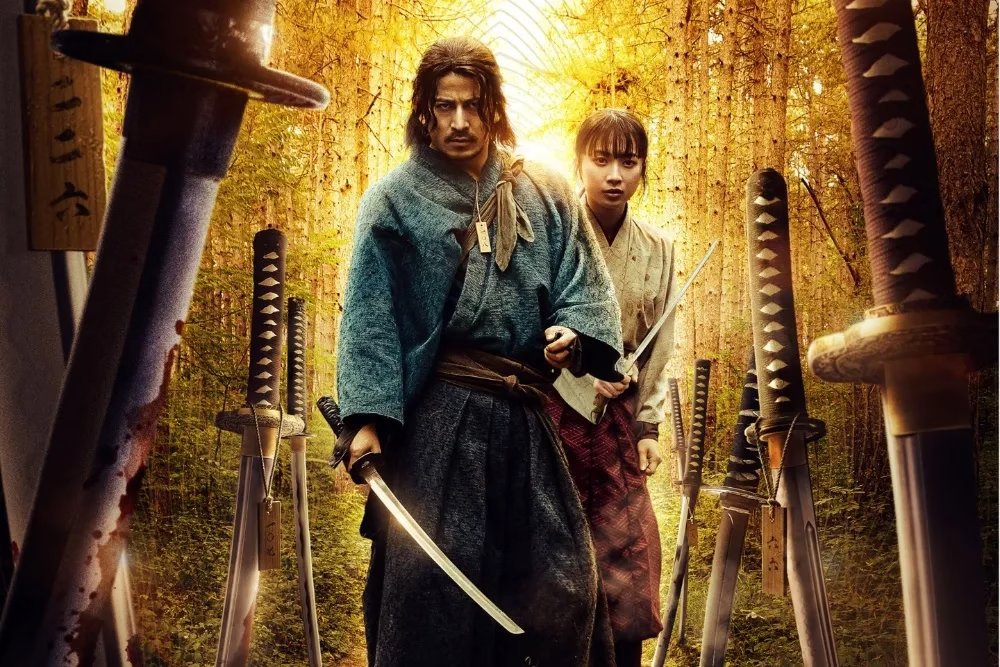
At the heart of the story is Shujiro Saga, a former samurai haunted by tragedy, who enters the contest to save his sick wife and child. His past as “Kokushu the Manslayer,” a feared swordsman of the Kyohachi-ryu school, returns to shape his fate as he navigates the competition. Along the way, he forms an uneasy alliance with Futaba Katsuki, a shrine maiden fighting for her own family, and Iroha Kinugasa, his adoptive sister drawn into the same deadly game. As the journey unfolds, the contestants confront corrupt officials, political conspiracies, and the dark forces manipulating the entire event. With every checkpoint closer to Tokyo, the themes of loyalty, sacrifice, and survival come into sharper focus, revealing a narrative that is equal parts action thriller and emotional drama.
Cast and Characters
Last Samurai Standing features a large ensemble cast, each contributing to the intensity and realism of the competition.
Shujiro Saga
Played by Junichi Okada, Shujiro is a grieving father, devoted husband, and former samurai whose reputation as “Kokushu the Manslayer” follows him across Japan. Haunted by his past and desperate to save his family, he enters the Kodoku game with a mixture of guilt, resolve, and suppressed rage. Okada brings heightened emotional depth to the character, portraying a man torn between the violence he wants to leave behind and the violence required to survive.
Futaba Katsuki
Yumia Fujisaki plays Futaba, a shrine maiden who joins the contest to protect the children and caretakers of her shrine. Despite her young age and lack of combat experience, she proves resourceful, determined, and morally grounded. Her bond with Shujiro creates some of the series’ most heartfelt moments, offering a counterbalance to the unrelenting brutality.
Iroha Kinugasa
Kaya Kiyohara portrays Iroha, Shujiro’s adoptive sister and a trained swordswoman of Kyohachi-ryu. Her motivations are complex, shaped by past trauma and complicated relationships within their former school. Her presence introduces tension, loyalty, and emotional stakes that deepen the unfolding conspiracy.
Supporting Cast
The supporting ensemble is extensive and filled with standout performances:
– Masahiro Higashide as Kyojin Tsuge, strategist and potential ally
– Shota Sometani as Kamuykocha, an Ainu warrior
– Hideaki Itō as Bukotsu Kanjiya, one of the story’s most dangerous antagonists
– Arata Iura as Home Minister Toshimichi Ōkubo
– Gaku Hamada as Superintendent-General Kawaji, a key figure in the conspiracy
– Riho Yoshioka as Shino Saga, Shujiro’s ailing wife
The cast brings emotional nuance and historical authenticity, shaping a story where nearly every character has a secret, a wound, or a moral conflict guiding their actions.
Production and Development
The production of Last Samurai Standing was ambitious in scale, combining period-accurate costuming, large-scale choreography, and complex staging across multiple historical locations. Netflix officially announced the series with Junichi Okada not only as the lead actor but also as producer and action choreographer. This dual involvement ensured that the fight sequences had a high level of realism, precision, and visual impact. Okada’s background in historical dramas allowed him to refine styles of swordsmanship, ensuring each character’s fighting technique reflected their background, school, and personality.
Director Michihito Fujii and writer-director Kento Yamaguchi worked closely with Okada to adapt Imamura’s novel into a six-episode drama. The challenge, as they described it, was equivalent to producing multiple feature-length films, given the number of characters, fight scenes, and shifting locations. Nearly 300 actors were costumed and choreographed, requiring coordinated teamwork across every department. Their goal was to keep the core emotional themes of the novel intact—honor, survival, corruption—while shaping a narrative that modern global audiences could follow effortlessly. The result is a series with cinematic scope, immersive detail, and a grounded portrayal of the Meiji-era tension between old traditions and modern power structures.
Themes
Last Samurai Standing explores several interwoven themes that give the series its dramatic and emotional force.
The End of the Samurai Era
Set during the Meiji period, the story illustrates how former samurai struggle to survive in a society that no longer needs them. The Kodoku game becomes a metaphor for their displacement, desperation, and loss of identity.
Corruption and Power
Political figures and wealthy industrialists manipulate the competition for entertainment and influence. Their involvement reveals the darker side of modernization and the exploitation of warriors who once held honor at the center of their lives.
Survival and Morality
Participants must decide whether survival is worth sacrificing their values. Shujiro’s reluctance to kill, Futaba’s compassion, and Iroha’s internal conflict highlight the emotional tension between morality and necessity.
Family and Redemption
Shujiro’s motivation to save his wife and memory of his daughter form the emotional core of the series. His grief and guilt push him into battles that test his humanity, even as he searches for redemption.
Fate and Loyalty
With old loyalties resurfacing—especially within the Kyohachi-ryu sword school—the series shows how past decisions, rivalries, and betrayals shape the fighters’ present struggles.
Why You Should Watch
Last Samurai Standing stands out as one of the most intense and cinematic Japanese dramas in years. The action choreography is grounded, visceral, and emotionally driven, avoiding exaggerated spectacle in favor of realism. The narrative offers both suspense and depth, balancing large-scale political intrigue with intimate human drama. Its characters are layered, flawed, and sympathetic, allowing viewers to connect with each participant’s motivations—even those who become antagonists. The series also brings fresh representation by including Ainu characters and highlighting diverse perspectives from within Meiji-era Japan. For fans of samurai films, historical dramas, or dark survival stories, this series offers a gripping and modern interpretation of the genre.
Is Last Samurai Standing Worth Watching?
Yes. The series delivers intense action, emotionally compelling storytelling, and a well-structured narrative that builds tension from start to finish. With only six episodes, it remains tightly focused while feeling substantial and complete. Critics have praised its direction, acting, worldbuilding, and thematic depth. Its combination of historical drama and survival thriller makes it accessible to both genre fans and newcomers. If you’re looking for a high-quality Japanese series that combines strong performances with cinematic visuals, this is absolutely worth watching.
Reception
Upon release, Last Samurai Standing received extremely positive reviews, with Rotten Tomatoes reporting a 100% approval rating among early critics. Reviewers noted the strong action choreography, grounded emotional performances, and the series’ ability to modernize historical drama while preserving cultural authenticity. Its presentation at the Busan International Film Festival further elevated its prestige, marking it as one of Netflix Japan’s most ambitious productions to date.
Watch Order
With only one season, the watch order is simple:
-
Last Samurai Standing – Season 1 (2025, 6 episodes)
There are no prequels, sequels, or related series currently released. The story is complete within its six-episode structure.
Last Samurai Standing FAQ
Is the series based on true history?
The story is fictional but grounded in real Meiji-era political shifts, social upheaval, and declining samurai influence.
Is it very violent?
Yes. The series features intense swordfighting, graphic injury, and death as part of its survival-based premise.
Is it connected to any anime or manga?
No. It is adapted from Shogo Imamura’s novel, not an anime or manga.
Is it suitable for viewers unfamiliar with Japanese history?
Absolutely. The series explains its world through story and character interaction, making it accessible to all viewers.
Will there be a Season 2?
As of now, no sequel has been announced, but strong reception could influence future decisions.
Conclusion
Last Samurai Standing is a modern samurai epic that blends emotional storytelling, large-scale survival action, and historical tension into a gripping six-episode journey. With its grounded portrayals, richly layered characters, and cinematic visuals, it offers a fresh perspective on an era often romanticized in popular media. The series explores what happens when honor clashes with desperation, when the old world collides with modernization, and when individuals are forced to confront the darkest parts of themselves to protect what they love. Its success lies not only in its thrilling action but in its powerful emotional core, transforming the story into something memorable long after the final episode.
As one of Netflix Japan’s standout releases, Last Samurai Standing sets a new standard for historical drama—intense, human, and unafraid to look directly into the chaos of a nation in transition.
If you don’t know where to watch this Series for FREE make sure to contact me via E-mail, or in the comments below. Thank you for reading and make sure to bookmark the site.
How useful was this post?
Click on a star to rate it!
Average rating 0 / 5. Vote count: 0
No votes so far! Be the first to rate this post.