
 7.8/10
 95% Audience / 86% Critics
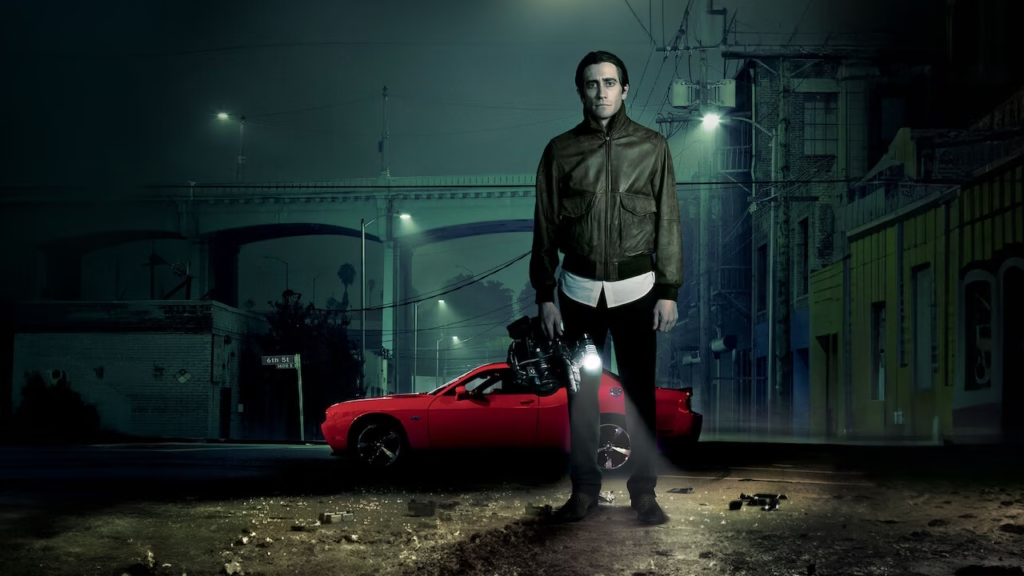
Nightcrawler is a 2014 American neo-noir psychological thriller written and directed by Dan Gilroy in his feature directorial debut. The film stars Jake Gyllenhaal in one of the most unsettling performances of the 21st century as Louis “Lou” Bloom, a freelance crime videographer—or “stringer”—who prowls the streets of Los Angeles at night, filming violent accidents and crimes to sell to local news stations.
Premiering at the Toronto International Film Festival in September 2014 and released theatrically on October 31, the film quickly developed a cult following. Made on a modest $8.5 million budget, Nightcrawler grossed over $50 million worldwide and received widespread critical acclaim. While the film earned an Academy Award nomination for Best Original Screenplay, Jake Gyllenhaal’s omission from the Best Actor Oscar category is still widely regarded as one of the most infamous snubs in modern awards history.
More than a thriller, Nightcrawler is a ruthless critique of capitalism, media ethics, and audience complicity—one that has only grown more disturbing with time.
Nightcrawler – Official Trailer
What Is Nightcrawler About?
Nightcrawler follows Lou Bloom, an unemployed drifter in Los Angeles who stumbles upon the underground world of stringers—freelance videographers who record graphic crime scenes and sell the footage to television news stations.
After acquiring a camera and police scanner through theft, Lou begins chasing crime scenes before authorities arrive. As his footage becomes more sensational, he forms a mutually exploitative relationship with Nina Romina, the desperate news director of a struggling TV station who prioritizes ratings over ethics.
Lou’s ambition quickly spirals into outright manipulation. He tampers with crime scenes, withholds evidence, engineers dangerous situations, and ultimately orchestrates violence to capture exclusive footage. The film charts his rise not as a tragedy, but as a success story—one made possible by a system that rewards amorality, spectacle, and consumer demand.
Cast & Characters
Main Cast
-
Jake Gyllenhaal as Louis “Lou” Bloom – A sociopathic opportunist whose obsession with success overrides all moral boundaries.
-
Rene Russo as Nina Romina – A local news director complicit in Lou’s rise, driven by ratings and professional desperation.
-
Riz Ahmed as Rick – Lou’s assistant, a vulnerable homeless man slowly pulled into moral catastrophe.
-
Bill Paxton as Joe Loder – A veteran stringer and Lou’s professional rival.
Supporting Cast
-
Michael Hyatt as Detective Frontieri – A homicide detective suspicious of Lou’s involvement in violent crimes.
-
Kevin Rahm as Frank Kruse – Nina’s boss at the news station.
The performances are deliberately restrained, allowing Lou’s eerie calm and manipulative language to dominate every interaction.
Major Themes Explained
The Commodification of Violence
Nightcrawler argues that violence is not just reported—it is manufactured, curated, and sold. Lou doesn’t create demand; he fulfills it. The film makes it clear that the audience, by consuming sensationalized news, is complicit in the system that enables him.
Capitalism Without Morality
Lou speaks entirely in self-help jargon, productivity mantras, and corporate language. He treats human beings as assets, leverage, or obstacles. His success is framed as logical within a system that rewards profit over ethics.
Media Ethics and Exploitation
Through Nina Romina, the film exposes how journalism can drift into exploitation under pressure. Her newsroom decisions consistently prioritize fear, racialized narratives, and shock value, mirroring real-world media trends.
The Antihero Without a Redemption Arc
Unlike most films, Nightcrawler does not punish its protagonist. Lou does not learn, change, or suffer consequences. This is intentional. Dan Gilroy designed Lou as a character who thrives precisely because society allows him to.
The Ending Explained ( SPOILER )
In the final act, Lou orchestrates a police shootout in a crowded diner, deliberately putting civilians—and his assistant Rick—in mortal danger to secure the perfect footage. Rick is fatally shot, and Lou films his dying moments without hesitation.
Rather than facing consequences, Lou is rewarded. His footage becomes a ratings sensation. The police cannot legally prosecute him. The news station protects him. The film ends with Lou expanding his business, hiring interns, and delivering a corporate-style motivational speech.
The message is chilling: the system works exactly as designed.
Is Nightcrawler Worth Watching Today?
Absolutely. Nightcrawler feels more relevant now than it did in 2014. In an era dominated by viral crime clips, outrage algorithms, and monetized tragedy, the film reads less like satire and more like prophecy.
Jake Gyllenhaal’s performance remains one of the most unsettling character studies in modern cinema—quiet, predatory, and disturbingly believable.
Watch Order
Nightcrawler is a standalone film and does not require any prior or follow-up viewing.
Recommended Order:
-
Nightcrawler (2014)
Nightcrawler FAQ
Is Nightcrawler based on a true story?
No, but it is inspired by the real-world profession of stringers and the legacy of crime photographer Weegee.
Why is Lou Bloom so unsettling?
Because he lacks emotional cues, remorse, or visible malice. His calm corporate language masks extreme sociopathy.
Why didn’t Jake Gyllenhaal get an Oscar nomination?
Despite near-universal acclaim, he was famously snubbed for Best Actor at the Academy Awards—still debated today.
Is Nightcrawler a critique of journalism or audiences?
Both. Dan Gilroy has stated that the film indicts viewers just as much as media institutions.
What genre is Nightcrawler?
Primarily a neo-noir psychological thriller, with elements of satire, horror, and dark comedy.
Conclusion
Nightcrawler is not an easy film—but it is an essential one. It exposes the uncomfortable truth that monsters don’t always hide in shadows. Sometimes they thrive in plain sight, armed with ambition, a camera, and an audience hungry for spectacle.
Nearly a decade later, Nightcrawler stands as one of the sharpest, most disturbing critiques of modern media and capitalism ever put to film—and its relevance shows no signs of fading.
If you don’t know where to watch this Movie for FREE make sure to contact me via E-mail, or in the comments below. Thank you for reading and make sure to bookmark the site.
How useful was this post?
Click on a star to rate it!
Average rating 0 / 5. Vote count: 0
No votes so far! Be the first to rate this post.