
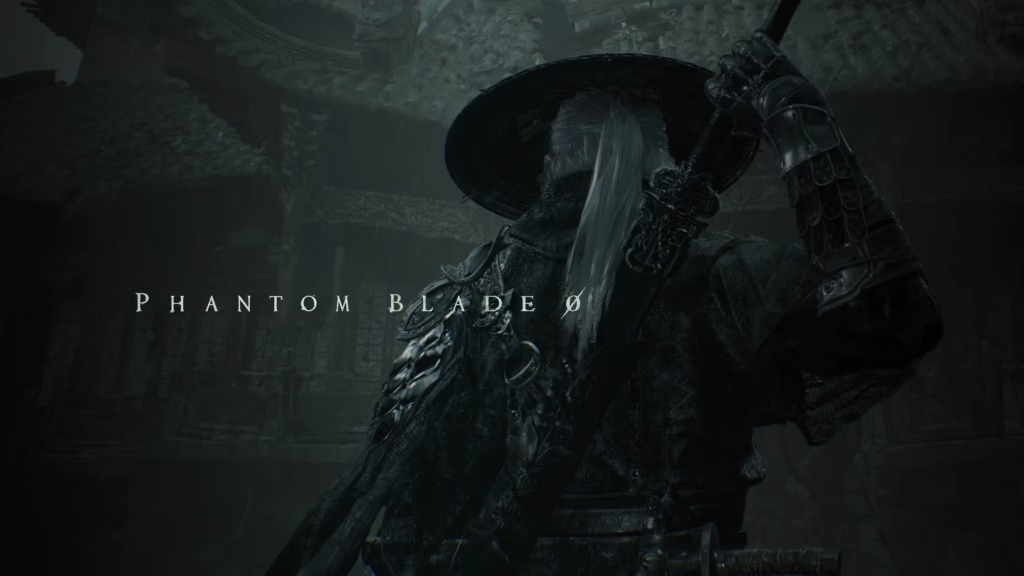
Phantom Blade Zero is an upcoming wuxia-inspired action role-playing game developed and published by S-GAME, and it is shaping up to be one of the most ambitious single-player action titles of the decade. Blending high-speed combat, traditional Chinese martial arts philosophy, and a dark, stylized world, the game aims to carve out an entirely new identity within the ARPG genre.
Scheduled to release on September 9, 2026, for PlayStation 5 and PC, Phantom Blade Zero has already attracted massive global attention. With over one million wishlists shortly after its digital storefront debut, the game has positioned itself alongside titles like Black Myth: Wukong as part of a new wave of high-profile Chinese-developed action games reaching worldwide audiences.
Phantom Blade Zero – Official Announce Trailer
What Is Phantom Blade Zero About?
At the heart of Phantom Blade Zero is a tightly focused personal story rather than a traditional world-saving epic. Players take on the role of Soul, an elite assassin serving a secretive organization known as The Order. When the organization’s patriarch is murdered, Soul is framed for the crime and hunted by those he once served.
Gravely wounded but kept alive through a mysterious temporary cure, Soul is given exactly 66 days to live. With time running out, he must uncover the truth behind the conspiracy while navigating a world where loyalty, power, and survival are constantly in conflict. The narrative emphasizes urgency, betrayal, and moral ambiguity rather than simple heroism.
A World Rooted in Wuxia and “Kungfupunk”
The game is set in the Phantom World, a fictional universe heavily inspired by Ming Dynasty China and the wuxia tradition. This is not a historically accurate recreation, but rather a stylized interpretation infused with dark fantasy, steampunk, cyberpunk, and horror elements.
The developers describe the game’s aesthetic as “kungfupunk,” a fusion of classical martial arts storytelling with mechanical and industrial design. The result is a world that feels ancient and futuristic at the same time—filled with shadowy towns, forbidden halls, and battle-scarred landscapes that reflect the instability of the jianghu, a realm existing outside imperial control.
Gameplay Overview: Speed, Precision, and Philosophy
Phantom Blade Zero is a third-person action RPG built around extremely fast-paced combat. Unlike traditional ARPGs that rely on stats or damage sponges, this game focuses on precision, timing, and player mastery.
Soul can equip two primary weapons and two secondary “phantom edge” weapons, each with unique mechanics and abilities. Combat revolves around managing sha-chi, a resource used for heavy attacks, defensive maneuvers, and special techniques. Blocking, parrying, dodging, and repositioning are all critical, with certain enemy attacks requiring specific defensive responses.
The game introduces advanced mechanics such as ghoststep, which allows Soul to reposition behind enemies when reacting perfectly to dangerous attacks. These systems reward skillful play and encourage players to engage enemies aggressively rather than defensively.
Martial Arts Authenticity and Action Design
One of Phantom Blade Zero’s defining features is its commitment to authentic martial arts philosophy. The developers worked closely with kung fu masters, martial arts instructors, and action choreographers to ensure that combat feels grounded in real movement principles rather than exaggerated animation alone.
Motion capture performances were recorded at full intensity, avoiding artificial speed-ups that often make action games feel weightless. The combat is designed to reflect the idea that offense and defense are inseparable—a core principle in many Chinese martial arts traditions.
Each weapon has its own distinct logic, animation set, and tactical role. This design choice ensures that no two combat styles feel interchangeable, encouraging experimentation and mastery rather than reliance on a single optimal build.
Semi-Open World and Multiple Endings
The Phantom World is structured as a semi-open environment, with interconnected regions that can be explored in non-linear ways. Certain areas become accessible only after acquiring specific weapons or abilities, reinforcing exploration and replayability.
The main story features eight distinct endings, shaped by side quests and player decisions. Rather than branching dialogue trees, outcomes are influenced by how players interact with the world, the characters they assist, and the paths they choose to pursue under time pressure.
Music, Atmosphere, and Cultural Identity
The game’s soundtrack plays a major role in shaping its atmosphere. Composer Caisheng Bo blends traditional Chinese instruments such as the erhu with electric guitars and electronic elements, creating a soundscape that mirrors the game’s fusion of tradition and modernity.
Environmental storytelling is reinforced through cultural details drawn from real Chinese traditions, including folk rituals, opera influences, ceremonial architecture, and regional customs. These elements are woven into the world naturally, enhancing immersion without relying on exposition.
Development Journey and Industry Impact
Development of Phantom Blade Zero began in earnest in 2022, though its conceptual roots date back to 2017. Built using Unreal Engine 5, the game represents a major leap from the studio’s earlier 2D titles and mobile projects.
Its reveal at the PlayStation Showcase in 2023 marked a turning point, prompting S-GAME to expand the project’s scope. The success of Black Myth: Wukong further increased international interest, raising expectations while also bringing additional resources and pressure.
Is Phantom Blade Zero Worth Playing?
If you enjoy action games that prioritize skill, atmosphere, and cultural identity over checklist-driven design, Phantom Blade Zero is absolutely one to watch. It promises intense combat, a focused narrative, and a setting rarely explored at this scale in mainstream gaming.
Rather than imitating Western action RPGs, the game confidently builds its own identity—one rooted in wuxia tradition and modern action design.
FAQ – Phantom Blade Zero
When does Phantom Blade Zero release?
The game is scheduled to release on September 9, 2026.
What platforms will it be available on?
PlayStation 5 and PC (Windows).
Is Phantom Blade Zero open world?
It features a semi-open world with interconnected regions and non-linear exploration.
Does the game have multiple endings?
Yes, the story includes eight different endings influenced by player choices and side content.
Conclusion
Phantom Blade Zero represents more than just another action RPG—it signals a shift in how culturally distinct games can compete on the global stage without compromise. By combining authentic martial arts philosophy, cutting-edge technology, and a tightly focused narrative, the game aims to deliver an experience that feels both fresh and deeply rooted in tradition.
If it delivers on its vision, Phantom Blade Zero could stand as one of the defining action games of its generation, proving that style, substance, and cultural identity can coexist at the highest level of game design.
Thank you for reading and make sure to bookmark the site, comment and follow up on the newest posts!
How useful was this post?
Click on a star to rate it!
Average rating 0 / 5. Vote count: 0
No votes so far! Be the first to rate this post.