
 7.7/10
Few anime series have influenced global pop culture as profoundly as Sailor Moon. First broadcast in Japan in 1992, the original television adaptation transformed Naoko Takeuchi’s manga into one of the most recognizable anime franchises ever created. Its combination of magical transformations, superhero action, romance, friendship, comedy, and emotional drama helped introduce countless viewers around the world to Japanese animation.
Produced by Toei Animation, the series follows Usagi Tsukino, an ordinary middle school student who discovers that she can transform into Sailor Moon. Alongside the other Sailor Soldiers, she protects Earth from increasingly dangerous enemies while gradually uncovering secrets about her past, her destiny, and the ancient Moon Kingdom.
Although the series became famous for its colorful transformations and memorable villains, its real strength lies in Usagi’s development. She begins as emotional, frightened, clumsy, and reluctant to accept responsibility, but gradually grows into a compassionate leader willing to protect others at enormous personal cost.
The original anime aired for five seasons and 200 episodes between March 1992 and February 1997. Its success created films, games, soundtracks, merchandise, international adaptations, and a later reboot titled Sailor Moon Crystal.
Highlights
- Produced by Toei Animation
- Based on Naoko Takeuchi’s manga
- Aired from 1992 to 1997
- Five seasons and 200 episodes
- Helped popularize magical girl anime worldwide
- Known for friendship, romance, action, and emotional storytelling
Sailor Moon – Official Trailer Season 1
What Is Sailor Moon About?
Sailor Moon follows 14-year-old Usagi Tsukino, an ordinary student living in Tokyo.
Her life changes when she encounters Luna, a talking cat who reveals that Usagi has the power to transform into Sailor Moon, a magical warrior destined to defend Earth.
At first, Usagi is frightened by danger and unsure whether she can handle the responsibility placed upon her. She frequently panics, cries, and relies on others for help. However, each battle teaches her more about courage, sacrifice, and leadership.
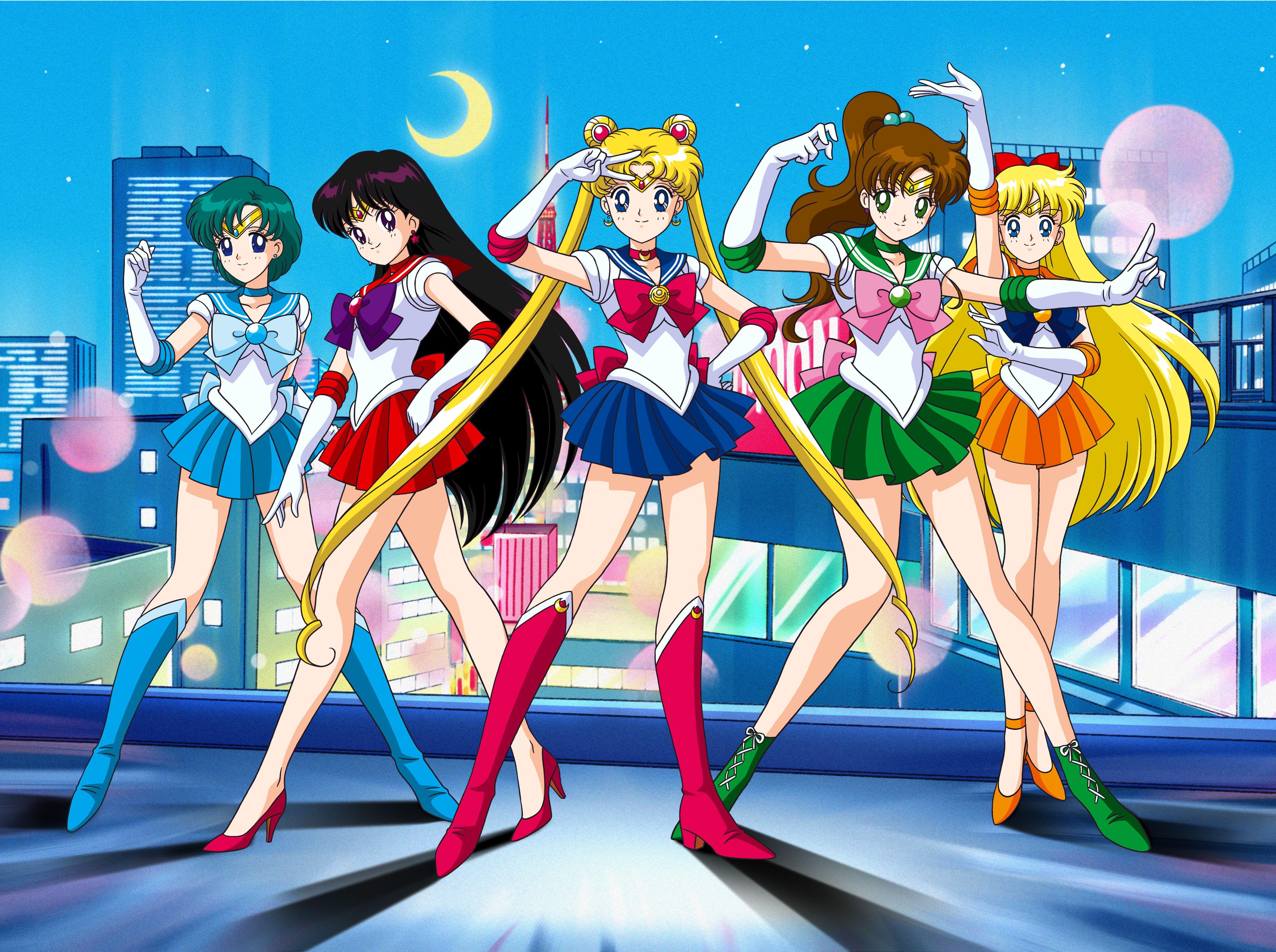
As the story develops, Usagi is joined by other Sailor Soldiers:
- Ami Mizuno as Sailor Mercury
- Rei Hino as Sailor Mars
- Makoto Kino as Sailor Jupiter
- Minako Aino as Sailor Venus
They are later joined by additional warriors including Sailor Pluto, Sailor Uranus, Sailor Neptune, Sailor Saturn, and Sailor Chibi Moon.
Together, they face enemies seeking energy, magical artifacts, dreams, Heart Crystals, Star Seeds, and control over the future.
Story Highlights
- Ordinary student becomes a magical warrior
- Team of powerful female heroes
- Secret past lives
- Ancient Moon Kingdom
- Romance between Usagi and Mamoru
- Battles spanning the present, future, and distant worlds
Is Sailor Moon Worth Watching?
Yes, especially for viewers interested in influential anime, magical girl stories, character-driven adventures, and long-form friendships.
The original series contains many elements associated with older television anime, including repeated transformation sequences, stock footage, episodic monsters, and slower pacing than many modern productions.
However, those features are also part of its identity.
The extended episode count gives the characters time to develop friendships, argue, reconcile, mature, and experience ordinary school life between major battles.
The series can move from broad comedy to tragedy, romance, horror, and emotional sacrifice within the same season.
Its most powerful moments often come not from the battles themselves but from the relationships between the Sailor Soldiers and their willingness to protect one another.
Reasons to Watch
- Iconic characters
- Strong female friendships
- Emotional character development
- Memorable villains
- Influential magical girl storytelling
- Blend of comedy, romance, and action
Why You Should Watch Sailor Moon
Sailor Moon is important not only because it became popular, but because it changed expectations for female-led action anime.
The Sailor Soldiers are not interchangeable heroes defined only by their powers. Each has a distinctive personality, ambition, insecurity, romantic outlook, and relationship with the rest of the group.
Usagi is compassionate but emotional.
Ami is intelligent and reserved.
Rei is passionate and argumentative.
Makoto is physically strong but deeply romantic.
Minako is energetic, ambitious, and experienced as a warrior.
This diversity allows viewers to connect with different characters while showing that strength can take many forms.
The series also places emotional connection at the center of heroic power. Friendship, love, loyalty, and forgiveness are not treated as weaknesses. They are often the forces that allow the characters to defeat enemies who rely on loneliness, hatred, and domination.
Biggest Strengths
- Distinctive female protagonists
- Emotional storytelling
- Strong team dynamics
- Positive treatment of friendship
- Memorable visual identity
- Major influence on later anime
Usagi Tsukino as Sailor Moon
Usagi Tsukino is one of anime’s most recognizable protagonists.
At the beginning of the series, she is not a naturally confident hero. She struggles with school, becomes frightened easily, complains about responsibility, and often wants someone else to solve her problems.
This makes her growth especially meaningful.
Usagi does not become powerful by losing her emotional nature. Instead, she learns that compassion, vulnerability, and love can be sources of strength.
Her instinct is often to save rather than destroy.
Even when facing dangerous enemies, she repeatedly looks for the pain or humanity hidden beneath their actions.
Across the five seasons, Usagi grows from a reluctant middle school student into a responsible young woman capable of accepting her destiny as Princess Serenity and the future Neo-Queen Serenity.
Usagi Highlights
- Main protagonist
- Transforms into Sailor Moon
- Reincarnation of Princess Serenity
- Emotional but deeply compassionate
- Future ruler of Crystal Tokyo
- Develops into a powerful leader
Mamoru Chiba and Tuxedo Mask
Mamoru Chiba is Usagi’s central romantic partner and the mysterious hero known as Tuxedo Mask.
Early in the story, he appears during battles to support Sailor Moon, often offering encouragement or creating an opening for her to defeat an enemy.
Mamoru is eventually revealed to be the reincarnation of Prince Endymion, the Earth prince who loved Princess Serenity during the era of the Silver Millennium.
His relationship with Usagi therefore connects the present-day story to an ancient tragedy.
Their romance faces repeated challenges including memory loss, brainwashing, separation, death, future responsibilities, and attacks from enemies attempting to rewrite history.
Despite these obstacles, their relationship remains one of the central emotional foundations of the series.
Mamoru Highlights
- Civilian identity of Tuxedo Mask
- Reincarnation of Prince Endymion
- Usagi’s romantic partner
- Future king of Crystal Tokyo
- Supports the Sailor Soldiers
- Central to the Silver Millennium story
The Inner Sailor Soldiers
The first major team surrounding Sailor Moon is commonly known as the Inner Sailor Soldiers.
Sailor Mercury
Ami Mizuno is intelligent, gentle, and academically gifted. As Sailor Mercury, she uses water- and ice-related abilities while frequently providing analysis during battles.
Sailor Mars
Rei Hino is a shrine maiden with a strong personality and spiritual abilities. She frequently argues with Usagi but remains one of her most loyal friends.
Sailor Jupiter
Makoto Kino combines physical strength with a caring and romantic personality. She enjoys cooking and domestic activities despite being one of the team’s strongest hand-to-hand fighters.
Sailor Venus
Minako Aino has previous experience as Sailor V before joining the team. She is cheerful and ambitious, but she also understands the responsibilities of being a Sailor Soldier.
Together, the Inner Soldiers create the emotional center of the series.
Inner Soldier Highlights
- Sailor Mercury
- Sailor Mars
- Sailor Jupiter
- Sailor Venus
- Distinct personalities and powers
- Strong friendship with Usagi
The Outer Sailor Soldiers
Later seasons introduce the Outer Sailor Soldiers, whose methods and responsibilities differ from those of Usagi’s original team.
Sailor Uranus
Haruka Tenoh is confident, determined, and willing to make difficult decisions for the greater good.
Sailor Neptune
Michiru Kaioh is elegant, artistic, and closely connected to Haruka. Their relationship became one of the most famous LGBTQ+ relationships in anime.
Sailor Pluto
Setsuna Meioh guards the Door of Space-Time and possesses knowledge connected to the future.
Sailor Saturn
Hotaru Tomoe is the reincarnation of Sailor Saturn, a warrior whose power can destroy entire worlds.
The Outer Soldiers sometimes clash with Sailor Moon because they are more willing to sacrifice individuals to protect the planet.
Usagi’s refusal to accept those sacrifices becomes an important part of her leadership.
Outer Soldier Highlights
- Sailor Uranus
- Sailor Neptune
- Sailor Pluto
- Sailor Saturn
- More severe approach to protecting the world
- Central to the later seasons
Sailor Moon Season 1
The first season introduces Usagi, the Inner Sailor Soldiers, Tuxedo Mask, and the Dark Kingdom.
Queen Beryl and her generals send monsters known as Youma to steal human energy and awaken Queen Metaria.
At the same time, both sides search for the Silver Crystal, an artifact possessing immense power.
As Usagi and her friends continue fighting, they discover that they were once part of the Silver Millennium, an ancient civilization on the Moon.
Usagi is revealed as Princess Serenity, while Mamoru is the reincarnation of Prince Endymion.
The season gradually shifts from lighthearted monster-of-the-week adventures into an emotionally intense final conflict involving sacrifice, lost memories, and the destruction of the Dark Kingdom.
Season 1 Highlights
- Formation of the original team
- Dark Kingdom
- Queen Beryl
- Silver Crystal
- Princess Serenity reveal
- Emotional final battle
Sailor Moon R
The second season begins with an anime-original storyline involving Ail, An, and the Makai Tree.
This arc was created to give Naoko Takeuchi additional time to develop the next manga storyline.
The season then introduces Chibiusa, a mysterious pink-haired girl who travels from the future in search of the Silver Crystal.
Usagi and the others eventually learn that Chibiusa is the future daughter of Usagi and Mamoru.
The Black Moon Clan attempts to alter history and destroy Crystal Tokyo, forcing the Sailor Soldiers to travel into the future.
The season expands the series’ mythology by introducing Neo-Queen Serenity, future Earth, Sailor Pluto, and the concept of time travel.
Sailor Moon R Highlights
- Ail and An
- Makai Tree arc
- Introduction of Chibiusa
- Black Moon Clan
- Crystal Tokyo
- Sailor Pluto
- Future version of Usagi
Sailor Moon S
Sailor Moon S is often regarded as one of the strongest seasons of the original series.
The Sailor Soldiers face the Death Busters, an organization connected to Mugen Academy.
Their enemies steal Heart Crystals while searching for three Talismans connected to the Holy Grail.
Haruka Tenoh and Michiru Kaioh appear as Sailor Uranus and Sailor Neptune, initially operating independently from Usagi’s group.
The season also introduces Hotaru Tomoe, a lonely and physically fragile girl who becomes Chibiusa’s friend.
Hotaru is eventually revealed as both the vessel of Mistress 9 and the reincarnation of Sailor Saturn.
The conflict creates one of the series’ most important moral disagreements, as the Outer Soldiers believe Hotaru must be killed to prevent destruction while Usagi insists on saving her.
Sailor Moon S Highlights
- Death Busters
- Heart Crystals
- Holy Grail
- Sailor Uranus and Neptune
- Hotaru Tomoe
- Sailor Saturn
- One of the darkest story arcs
Sailor Moon SuperS
Sailor Moon SuperS places greater emphasis on Chibiusa.
She forms a connection with Pegasus, a winged unicorn hiding inside beautiful dreams.
The Dead Moon Circus begins targeting people’s Dream Mirrors while searching for Pegasus and the Golden Crystal.
Queen Nehelenia leads the enemy faction from within a mirror, driven by vanity and fear of losing her beauty.
The season contains a lighter and more comedic tone than Sailor Moon S, although it still includes themes involving dreams, maturity, jealousy, and fear of aging.
The Outer Sailor Soldiers play a much smaller role than they do in the manga version of the same storyline.
Sailor Moon SuperS Highlights
- Focus on Chibiusa
- Pegasus
- Dead Moon Circus
- Queen Nehelenia
- Dream Mirrors
- Golden Crystal
- More comedic tone
Sailor Moon Sailor Stars
The fifth and final season begins by concluding Queen Nehelenia’s story.
The Outer Sailor Soldiers return, while Usagi transforms into Eternal Sailor Moon.
The main conflict then shifts toward Sailor Galaxia, one of the most powerful enemies in the franchise.
Galaxia’s Sailor Animamates steal Star Seeds, which represent the life force of humans and Sailor Soldiers.
Usagi also meets the Sailor Starlights, who disguise themselves as the idol group Three Lights while searching for Princess Kakyuu.
The final conflict reveals Galaxia’s connection to Chaos, the source of malice throughout the universe.
Rather than defeating her through destruction, Usagi uses compassion to free Galaxia from Chaos’s influence.
Sailor Stars Highlights
- Eternal Sailor Moon
- Sailor Galaxia
- Sailor Animamates
- Sailor Starlights
- Princess Kakyuu
- Chibi Chibi
- Final battle against Chaos
Characters and Relationships
The characters are one of the main reasons Sailor Moon remains popular.
The series allows the Sailor Soldiers to exist outside their battles.
They attend school, pursue hobbies, argue about romance, visit arcades, worry about exams, and support one another through ordinary personal problems.
These everyday scenes make later sacrifices more powerful because the characters feel like genuine friends rather than a collection of superheroes.
Usagi’s relationships also change over time.
Her early arguments with Rei become part of a deep friendship.
Her bond with Chibiusa develops from rivalry into a mother-daughter connection.
Her relationship with Mamoru matures as they learn more about their future.
The series succeeds because these relationships matter as much as the supernatural conflict.
Relationship Highlights
- Usagi and Mamoru
- Usagi and Chibiusa
- Friendship between the Inner Soldiers
- Uranus and Neptune
- Chibiusa and Hotaru
- Luna and Artemis
Themes and Character Development
Sailor Moon explores several major themes across its five seasons.
The most important is the idea that kindness can be a form of strength.
Usagi repeatedly succeeds because she refuses to abandon people, even when others believe sacrifice is the only solution.
The series also examines:
- Friendship
- Love
- Responsibility
- Identity
- Reincarnation
- Growing up
- Forgiveness
- Destiny
- Self-sacrifice
- Hope
Usagi’s development is especially important.
She does not become emotionally cold or traditionally fearless. She remains sensitive, but she learns how to act despite fear.
This allows the series to present maturity as accepting responsibility without losing compassion.
Theme Highlights
- Compassion as strength
- Female friendship
- Personal growth
- Destiny versus individual choice
- Love overcoming isolation
- Sacrifice and rebirth
Episodes and Seasons
The original Sailor Moon anime consists of 200 episodes divided across five seasons.
The seasons are:
- Sailor Moon
- Sailor Moon R
- Sailor Moon S
- Sailor Moon SuperS
- Sailor Moon Sailor Stars
Each season roughly corresponds to one of the five major manga story arcs, although the anime expands the material with additional episodes, original characters, and storylines.
Because the manga and anime were produced at roughly the same time, the anime occasionally needed original content to avoid overtaking the source.
The Makai Tree storyline in Sailor Moon R is the most notable example.
The longer adaptation gives the supporting cast considerably more screen time than in the manga, although it also creates more repetition and monster-of-the-week episodes.
Episode Highlights
- 200 total episodes
- Five seasons
- Aired over five years
- Mix of manga adaptation and original material
- Includes several special animated shorts
- Large amount of character-focused content
Production and Development
Naoko Takeuchi originally expected the manga and anime to last for only one season.
The success of the first storyline led Toei Animation to request additional material.
Takeuchi initially struggled to create a continuation, but her editor suggested introducing Sailor Moon’s future daughter, leading to the development of Chibiusa and the Black Moon storyline.
The first season was directed by Junichi Satō.
Kunihiko Ikuhara later directed major portions of Sailor Moon R, Sailor Moon S, and Sailor Moon SuperS, while Takuya Igarashi directed the final season.
Different character designers also influenced the visual identity of each period.
The anime remained relatively close to the manga’s general plot but made numerous changes due to its weekly production schedule and longer episode count.
Production Highlights
- Produced by Toei Animation
- Based on 52 manga chapters
- Initially planned as one season
- Expanded because of strong popularity
- Multiple directors and character designers
- Manga and anime developed simultaneously
English Dub and North American Broadcast
The original English-language release became a major part of the series’ international history.
DIC Productions licensed the first two seasons for North America in the 1990s.
The adaptation changed character names, dialogue, music, episode structure, and several story details.
The first 89 Japanese episodes were reduced through editing, with multiple episodes removed or combined.
The dub initially struggled in the United States because it aired in poorly suited morning and afternoon time slots.
It performed more successfully in Canada, where it was treated as locally produced content because the dubbing work took place there.
After the initial cancellation, fans organized a petition that gained more than 12,500 signatures. The campaign helped attract sponsorship and contributed to the dub’s return.
English Dub Highlights
- Produced initially by DIC
- Recorded in Canada
- Significant editing and localization
- Struggled in unsuitable U.S. time slots
- Became popular through Toonami reruns
- Fan activism helped revive production
Editing and Censorship
The original North American version was heavily edited.
Changes affected:
- Character names
- Dialogue
- Clothing
- Violence
- Nudity
- Romantic relationships
- Gender identity
- Episode length
- Background music
Some characters had their genders changed.
Certain romantic relationships were rewritten as friendships or family connections.
The most famous example involved Sailor Uranus and Sailor Neptune, whose romantic relationship was changed in some English-language versions by presenting them as cousins.
Other countries also altered material related to sexuality, gender expression, violence, and cultural references.
Modern releases have restored the content removed from the original Japanese version, allowing international audiences to watch the series more accurately.
Censorship Highlights
- Episodes removed or shortened
- Character genders altered
- LGBTQ+ relationships rewritten
- Violence reduced
- Nudity covered
- Dialogue changed
- Modern versions restore original material
LGBTQ+ Representation
The relationship between Haruka Tenoh and Michiru Kaioh became one of the most significant aspects of the series’ legacy.
Sailor Uranus and Sailor Neptune are portrayed as deeply committed partners.
Their confidence, intimacy, and importance to the plot made them unusually visible LGBTQ+ characters within a widely distributed female-led superhero series.
Because of censorship, some international viewers did not initially experience the relationship as originally written.
Certain adaptations changed them into cousins or removed romantic implications.
Modern uncut versions restore the original context.
Their relationship has since been described as one of anime’s best-known and most influential yuri pairings.
Representation Highlights
- Haruka and Michiru are romantic partners
- Major LGBTQ+ representation in 1990s anime
- Relationship censored internationally
- Restored in modern releases
- Remains highly influential
Music and Opening Themes
Takanori Arisawa composed the original anime score.
His music became a major part of the series’ identity, combining romantic melodies, magical transformation themes, dramatic battle music, and emotional character pieces.
The most famous opening theme is “Moonlight Densetsu.”
It was used for the first 166 episodes, initially performed by DALI and later by Moon Lips.
The fifth season introduced “Sailor Star Song” as the new opening.
The English adaptation retained the melody of “Moonlight Densetsu” but replaced the original romantic lyrics with a superhero-style anthem.
The soundtrack achieved major commercial and international success, earning Arisawa awards connected to its popularity and overseas royalties.
Music Highlights
- Score composed by Takanori Arisawa
- “Moonlight Densetsu”
- “Sailor Star Song”
- Award-winning soundtrack
- English version used rewritten lyrics
- Music remains closely associated with the franchise
Films and Related Media
Three theatrical films were produced during the original anime’s broadcast:
- Sailor Moon R: The Movie
- Sailor Moon S: The Movie
- Sailor Moon SuperS: The Movie
Each film tells an original story associated with the season airing at the time.
They were generally shorter than conventional theatrical features and were released during Japanese school winter vacations.
The franchise also expanded through:
- Video games
- Music albums
- Stage musicals
- Toys
- Fashion dolls
- Home video releases
- Specials
- Books
- Collectibles
A later animated reboot titled Sailor Moon Crystal began in 2014 and follows the manga more closely than the original series.
Related Media Highlights
- Three theatrical anime films
- Numerous video games
- Extensive soundtrack releases
- Stage adaptations
- Large merchandise range
- Later reboot through Sailor Moon Crystal
Reception and Critical Response
The original anime became a major success in Japan.
It aired in a prime-time Saturday evening slot and generally achieved strong audience ratings throughout much of its run.
The franchise generated enormous merchandise revenue, with thousands of products released during the height of its popularity.
Critics frequently praised the series for:
- Strong female friendships
- Distinctive characters
- Emotional relationships
- Heroic female team structure
- Ability to appeal to different audiences
- Fusion of magical girl and action anime
The first season later received a 90% approval rating on Rotten Tomatoes based on the reviews cited in the supplied source.
Criticism often focused on repeated stock footage, formulaic plots, monster-of-the-week episodes, and melodramatic storytelling.
Despite those weaknesses, its cultural influence remained far greater than that of most comparable series.
Critical Highlights
- Major Japanese ratings success
- Strong international popularity
- Praised female friendships
- Successful action and romance blend
- Criticized for repetition
- Remains widely respected
International Popularity
Sailor Moon became one of the first anime series to achieve widespread international recognition.
It aired across Europe, Asia, Latin America, North America, and numerous other markets.
Spain and France were among the first countries outside Japan to broadcast it, followed by regions including Italy, Germany, Poland, Mexico, Brazil, South Korea, the Philippines, Taiwan, Thailand, and many others.
The series was particularly successful in several countries where it became a major introduction to anime.
Localization quality varied widely.
Some territories aired relatively complete versions, while others made major edits to relationships, dialogue, violence, or cultural details.
Even with those differences, the characters and imagery became recognizable worldwide.
International Highlights
- Broadcast across numerous continents
- Strong popularity in Europe and Latin America
- Important early anime for international audiences
- Localized into many languages
- Different levels of censorship by region
- Global merchandising success
Legacy and Impact
The influence of Sailor Moon is difficult to overstate.
It helped redefine the magical girl genre by combining transformation stories with a team-based action structure similar to superhero and shōnen series.
Instead of focusing on a single magical heroine, it created a complete group of female warriors with distinct personalities and powers.
Later anime, cartoons, comics, fashion trends, music videos, and games drew inspiration from its visual style and themes.
The series also demonstrated that stories aimed at young women could include action, mythology, romance, tragedy, comedy, and large-scale commercial appeal.
Its representation of female friendships and LGBTQ+ characters continues to receive attention decades later.
For many viewers, Sailor Moon was not simply an anime series. It was their first experience seeing girls portrayed as emotional, stylish, flawed, romantic, powerful, and heroic at the same time.
Legacy Highlights
- Redefined magical girl anime
- Influenced animation worldwide
- Popularized female superhero teams
- Expanded international interest in anime
- Major LGBTQ+ legacy
- Remains a global cultural icon
FAQ
How many episodes does the original Sailor Moon anime have?
The original television series contains 200 episodes across five seasons.
What are the five Sailor Moon seasons?
The seasons are Sailor Moon, Sailor Moon R, Sailor Moon S, Sailor Moon SuperS, and Sailor Moon Sailor Stars.
Is Sailor Moon based on a manga?
Yes. The anime is based on Naoko Takeuchi’s manga, which was published from 1991 to 1997.
Is Sailor Moon Crystal the same series?
No. Sailor Moon Crystal is a later reboot that follows the manga more closely and uses faster pacing.
Was the original English dub censored?
Yes. The early North American version changed dialogue, removed episodes and scenes, altered relationships, and censored violence, nudity, gender identity, and LGBTQ+ content.
Are Sailor Uranus and Sailor Neptune a couple?
Yes. Haruka and Michiru are portrayed as romantic partners in the original Japanese version.
Is Sailor Moon worth watching today?
Yes. Although some pacing and animation techniques reflect its age, its characters, emotional storytelling, themes, and cultural importance remain highly effective.
Conclusion
The original Sailor Moon television series remains one of the most important anime productions ever made.
Its influence extends far beyond transformation sequences, magical attacks, and colorful costumes. The series showed that female characters could lead an action franchise without sacrificing friendship, romance, emotion, humor, or vulnerability.
Usagi Tsukino’s journey is central to that success. She does not begin as a fearless warrior, and she never becomes emotionally detached. Her strength comes from learning to accept responsibility while preserving her compassion.
Across five seasons and 200 episodes, the series introduces unforgettable friendships, tragic villains, cosmic conflicts, romantic destinies, and some of the most recognizable characters in anime history.
Its international versions were often heavily censored, but modern releases have allowed viewers to experience the story more accurately.
More than three decades after its debut, Sailor Moon continues to inspire new audiences because its core message remains powerful: kindness, friendship, and love are not weaknesses. They are forces capable of changing the world.
If you don’t know where to watch this Anime for FREE make sure to contact me via E-mail, or in the comments below. Thank you for reading and make sure to bookmark the site.
How useful was this post?
Click on a star to rate it!
Average rating 0 / 5. Vote count: 0
No votes so far! Be the first to rate this post.