
 8.0/10
Sports anime frequently tell stories about talented young athletes chasing impossible dreams, but Medalist approaches that familiar idea from a more emotionally complicated direction. Its protagonist, Inori Yuitsuka, desperately wants to become a world-class figure skater, yet she enters the sport at an age when serious competitors have already accumulated years of training. Her mother is reluctant to support the dream after watching Inori’s older sister struggle with skating, while Inori herself has spent much of her life believing that the opportunity she wants may already have passed her by.
Everything changes when she meets Tsukasa Akeuraji, a former ice dancer carrying his own history of disappointment. Rather than simply telling Inori that she started too late, Tsukasa recognizes something familiar in her desperation to skate. He becomes her coach, and their partnership transforms Medalist from a conventional story about athletic talent into something much more compelling: two people who understand what it feels like to have a dream dismissed deciding to pursue an extraordinary goal together.
Created by Tsurumaikada, Medalist began serialization in Kodansha’s Monthly Afternoon in May 2020 and had reached 15 collected Japanese volumes by July 2026. The manga’s reputation was already formidable before the anime arrived, winning the Next Manga Award in 2022, the 68th Shogakukan Manga Award in 2023, and the 48th Kodansha Manga Award in 2024.
The ENGI-produced anime premiered in January 2025, followed by a second season from January to March 2026. The franchise is now preparing for another major step: an anime film continuing after Season 2 is officially scheduled to open in Japan on February 19, 2027.
That growth is understandable. Beneath the competitions, jumps, spins, rankings, and technical details is an intensely human story about ambition, insecurity, mentorship, sacrifice, and the frightening decision to take your own dream seriously.
Medalist – Official Trailer
What Is Medalist About?
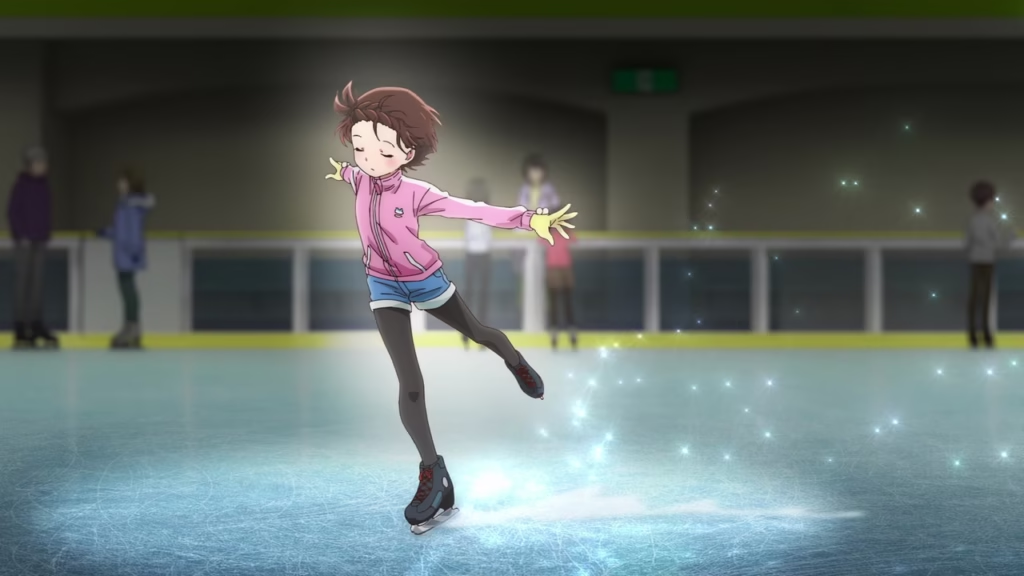
Medalist follows Inori Yuitsuka, an 11-year-old fifth-grade student who dreams of becoming an elite figure skater and ultimately winning Olympic gold. The problem is that competitive figure skating is a sport in which athletes commonly begin intensive training at a very young age, making Inori feel as though she is already behind before her journey has properly started.
Her circumstances at home make pursuing that dream even harder. Inori’s older sister previously attempted a skating career without achieving the hoped-for results, leaving their mother Nozomi understandably fearful that Inori could endure the same disappointment. Inori therefore practices secretly rather than confidently declaring what she wants.
Then she encounters Tsukasa Akeuraji.
Tsukasa knows what it means to arrive late. He pursued ice dancing but has reached a point where his own competitive ambitions appear to be disappearing. When he sees Inori’s determination and recognizes her natural ability, he refuses to treat her dream as something childish that should simply be abandoned.
He becomes her coach.
From there, Medalist follows their attempt to overcome an enormous gap in experience while Inori encounters increasingly talented competitors and Tsukasa develops into the coach capable of taking her further.
Their objective could hardly be more ambitious.
They want a medal at the highest level of figure skating.
Is Medalist Worth Watching?
Absolutely, particularly for viewers who enjoy sports anime in which the emotional journey matters as much as the competition itself.
Medalist understands that sporting achievement becomes meaningful when viewers understand exactly what it costs the athlete to reach that point. Inori does not begin as an unstoppable prodigy who effortlessly destroys everyone around her. Natural ability gives her potential, but potential does not replace years of training, technical knowledge, competitive experience, confidence, physical conditioning, or the psychological ability to perform under pressure.
That gap creates genuine tension.
Every improvement matters because Inori has so much ground to cover. Every mistake matters because competitions provide limited opportunities to demonstrate progress. Every rival represents another reminder that other children began building their skills long before she did.
The anime also benefits enormously from making Tsukasa almost as important as Inori. Rather than presenting coaching as something happening invisibly between competitions, Medalist explores the decisions behind an athlete’s development. Tsukasa must understand Inori technically, emotionally, and strategically.
That makes victories feel shared.
It also makes setbacks hurt both of them.
Why Should You Watch Medalist?
The strongest reason is the relationship between Inori and Tsukasa.
There are excellent rivals, impressive skating sequences, compelling competition arcs, and a surprisingly detailed approach to figure skating, but the emotional foundation remains the partnership between athlete and coach.
Inori needs someone who believes her ambition deserves to be taken seriously.
Tsukasa needs someone whose ambition reminds him why he loved skating.
Neither simply rescues the other. Instead, they give each other an opportunity that both were struggling to find alone.
That dynamic prevents the story from becoming a simple progression from beginner to champion. Tsukasa has to learn how to coach someone with Inori’s particular strengths and weaknesses, while Inori has to learn that wanting something desperately does not automatically make her prepared for it.
Their shared ambition is enormous.
The series earns its emotional moments by showing how much work is required even to move slightly closer to it.
Inori Yuitsuka Is an Excellent Sports Anime Protagonist
Inori’s greatest strength as a protagonist is that her ambition feels almost painfully sincere.
She does not want to skate because somebody has selected a destiny for her. She wants it even when the people around her believe another path would be safer. Before meeting Tsukasa, she practices secretly at a local rink because she has not been given a convincing reason to believe her dream can become reality.
That creates an important distinction between desire and confidence.
Inori desperately wants to become great, but she does not begin the story with the emotional certainty normally associated with a future champion. She can become intimidated, overwhelmed, frustrated, or afraid.
The competitive world quickly exposes those vulnerabilities.
Other skaters have better training histories. Some possess extraordinary natural talent. Others already understand competition in ways Inori has never experienced.
Her development therefore involves more than learning jumps.
She must gradually learn how to believe that she belongs on the same ice as everyone else.
Tsukasa Akeuraji Is More Than the Typical Anime Coach
Tsukasa could easily have been written as the eccentric mentor who immediately recognizes the protagonist’s hidden genius.
Medalist gives him much more depth.
He is a former ice dancer whose own competitive career has not developed as he once hoped. When he encounters Inori, he is himself standing near the point of abandoning competitive skating.
That shared experience is essential.
Tsukasa understands what people mean when they tell Inori she started too late because he has lived through similar judgments himself. His determination to help her is therefore not abstract optimism. He knows exactly how painful it is to wonder whether circumstances have already decided what you are allowed to become.
At the same time, he cannot simply encourage her.
Coaching requires difficult choices. He must decide which skills deserve attention, when Inori is ready to attempt something harder, how to structure programs around her strengths, and how to prepare a child emotionally for competitive pressure.
Watching Tsukasa become a better coach is consequently almost as satisfying as watching Inori become a better skater.
Inori and Tsukasa Are the Heart of Medalist
The title might suggest that the ultimate objective is obvious: win medals.
Yet the emotional reward comes from watching two people learn how to pursue that objective together.
Inori’s trust allows Tsukasa to become the mentor he might never otherwise have become. Tsukasa’s belief allows Inori to imagine a future she had previously been afraid to claim openly.
Importantly, the relationship does not eliminate conflict.
Athlete and coach do not always perceive progress in the same way. A skater may want to attempt something spectacular while a coach sees missing fundamentals. A coach may understand long-term development while the athlete feels the immediate pressure of competing against stronger opponents.
Medalist recognizes that good coaching is not merely motivational.
It is an enormous responsibility.
Tsukasa is helping shape both Inori’s athletic future and the way she understands herself.
Hikaru Kamisaki Changes the Scale of Inori’s Dream
Every memorable sports story needs someone who shows the protagonist how high the mountain really is.
For Inori, that person is Hikaru Kamisaki.
Voiced by Kana Ichinose in Japanese, Hikaru is already an exceptional novice skater when Inori encounters her. Rather than functioning merely as an unpleasant rival designed to create conflict, Hikaru represents the standard Inori eventually wants to reach.
That makes their relationship more interesting.
Inori can admire Hikaru while simultaneously wanting to defeat her.
Hikaru’s ability does not invalidate Inori’s dream. It gives the dream a visible form.
Seeing an extraordinary competitor can be terrifying because it exposes the distance still remaining between aspiration and reality. It can also be motivating because the impossible suddenly becomes something tangible.
Hikaru gives Inori both feelings.
Jun Yodaka Raises the Stakes Even Further
Hikaru’s coach, Jun Yodaka, creates another fascinating parallel.
Jun is voiced by Yuma Uchida and stands opposite Tsukasa not simply as another adult near the rink, but as someone representing a far higher established level of skating expertise.
This effectively creates two connected competitions.
Inori wants to reach Hikaru.
Tsukasa must become capable of coaching someone who can challenge a skater developed under Jun.
That is a huge distinction.
It would be much easier for Medalist to frame everything around Inori simply becoming more talented. Instead, the story acknowledges that elite athletes exist within systems of coaching, preparation, technical analysis, resources, and experience.
Inori cannot reach the top alone.
Neither can Tsukasa.
They both have to grow quickly enough to confront people who are already operating at an extraordinary level.
The Rivals Make Medalist Much Stronger
Hikaru may represent the largest target, but Medalist understands that one rival is not enough to portray competitive figure skating convincingly.
The wider cast introduces skaters with different personalities, technical strengths, insecurities, motivations, coaches, and approaches to competition. Characters such as Rioh Sonidori, Ryoka Miketa, Suzu Kamoto, Ema Yamato, and the many competitors introduced as the competitive level rises ensure that Inori’s journey never becomes a simple straight line toward one opponent.
That matters because real competition is unpredictable.
A skater is not competing only against a designated narrative rival.
Everyone on the ice has trained for the same opportunity.
A technically brilliant competitor can make a mistake. Someone overlooked can produce the performance of their life. Psychological pressure can alter what happens in seconds.
By building a substantial competitive field, Medalist makes tournaments feel like sporting events rather than predetermined confrontations between two important characters.
Medalist Understands That Talent Is Not Enough
Natural talent matters enormously in the story.
But it is never presented as a magical substitute for training.
Inori’s abilities attract attention because experienced skaters and coaches can see that she possesses unusual potential. The problem is that potential has to be transformed into repeatable performance.
That requires fundamentals.
It requires conditioning.
It requires technical progression.
It requires learning how to recover when something goes wrong.
Most importantly, it requires time—and time is exactly what Inori feels she does not have.
This is where Medalist creates much of its tension. Inori’s problem is not proving that she has talent.
It is discovering whether talent, extraordinary effort, intelligent coaching, and determination can close a gap created by starting later than her strongest competitors.
Starting “Too Late” Is One of Medalist’s Most Powerful Themes
The fear of being too late extends far beyond figure skating.
Inori experiences it as a child.
Tsukasa experiences another version of it as an adult.
That gives the series an unusually universal emotional core.
People are constantly told that certain opportunities have already passed them by. Sometimes those warnings are realistic. Certain competitive careers genuinely have narrow developmental windows, and Medalist does not need to pretend otherwise.
Its message is more nuanced.
Being behind does not automatically mean the attempt is meaningless.
Inori cannot change when she started.
Tsukasa cannot rewrite his own skating career.
What they can control is what they do next.
That makes the story inspirational without requiring the simplistic idea that wanting something badly guarantees success.
Medalist Takes Figure Skating Seriously
The sport itself is not merely decoration.
Tsurumaikada had no previous figure skating experience when developing the manga and reportedly enrolled in a month-long figure skating class at Nagoya Sports Center before beginning the work. The story is set in Nagoya, Aichi Prefecture, the same prefecture from which the creator originates.
That desire to understand the sport carries into the anime.
Competition levels, badge tests, program construction, jumps, spins, technical development, scoring pressure, coaching decisions, and the enormous importance of repetition all become part of the narrative.
The series does not expect every viewer to arrive knowing figure skating terminology.
Instead, much of that information is naturally introduced through Inori’s education.
As she learns, the audience learns.
The result is accessible without treating the sport superficially.
The Skating Animation Has an Important Advantage
Animating figure skating is particularly difficult because audiences are supposed to believe that the characters are exceptional athletes.
A beautiful static drawing cannot create that illusion by itself.
Movement matters.
Body position matters.
Timing matters.
Transitions matter.
The anime production therefore brought actual skating expertise into the creative process. The routines were choreographed with the involvement of retired figure skaters Akiko Suzuki and Yuhana Yokoi, alongside active skater Hinano Isobe.
That is an important detail because the competitive performances are storytelling.
A routine needs to communicate confidence, hesitation, technical ambition, personality, and development without stopping to explain every movement.
When the skating succeeds visually, viewers can understand the difference between athletes before anyone announces a score.
Medalist Is About Coaching as Much as Skating
Many sports anime focus overwhelmingly on athletes while coaches become tactical support characters.
Medalist treats coaching as a discipline of its own.
Tsukasa has to identify what Inori can realistically accomplish and determine the fastest responsible route toward improvement. He must understand competition rules, technical scoring, psychology, choreography, and the individual athlete standing in front of him.
That last element may be the most important.
A theoretically perfect training strategy is useless if the athlete cannot respond to it.
Tsukasa gradually learns what motivates Inori, what frightens her, when she needs reassurance, and when she needs to be challenged.
The story therefore portrays elite development as collaboration.
Inori performs alone on the ice.
She does not reach that ice alone.
Parents Matter More Than They Usually Do in Sports Anime
Nozomi Yuitsuka initially appears to be an obstacle standing between Inori and her dream.
Her perspective becomes much more understandable when the family’s history is considered.
She has already watched one daughter pursue skating without reaching the hoped-for outcome, and she understands that elite athletics can demand enormous amounts of time, money, emotional investment, and sacrifice. Her hesitation is therefore rooted in fear rather than indifference.
That makes the family conflict significantly better.
Nozomi does not need to hate skating to question whether it is the right future for Inori.
Parents and children can love each other while disagreeing profoundly about risk.
For Inori, becoming serious about skating consequently requires more than proving herself to judges.
She has to demonstrate to her own family that this is not a temporary fascination.
The Emotional Victories Matter as Much as the Medals
One of Medalist‘s greatest strengths is understanding that progress can happen before somebody stands on a podium.
Speaking confidently about an ambition can be progress.
Successfully performing a skill under pressure can be progress.
Recovering from a mistake can be progress.
Standing beside a competitor who once seemed impossibly superior can be progress.
Learning how to lose can be progress.
Sports stories become predictable when only the final ranking matters.
Medalist avoids that trap by making each stage of Inori’s development emotionally significant.
The Olympic dream remains far away.
The steps toward it matter right now.
Medalist Season 1
The first season of the anime aired from January 5 to March 30, 2025 on TV Asahi and other ANN affiliates through the NUMAnimation programming block. It was produced by ENGI and directed by Yasutaka Yamamoto, with Jukki Hanada handling series composition and scripts, Chinatsu Kameyama responsible for character design, and Yuki Hayashi composing the music.
Season 1 establishes Inori and Tsukasa’s partnership while gradually introducing the structure of competitive figure skating.
The early episodes are particularly effective because Inori’s objectives initially seem small compared with her eventual dream. Passing tests, learning techniques, preparing programs, and simply proving that she deserves to continue skating carry enormous emotional weight.
The season also introduces Hikaru and Jun, providing Inori and Tsukasa with a clearer understanding of the level they eventually need to reach.
Rather than rushing immediately toward elite competition, the anime allows viewers to understand the foundation being built.
That patience pays off when competition becomes more intense.
Medalist Season 2
Season 2 aired from January 25 through March 22, 2026, with the principal staff and cast returning.
By this point, the series no longer needs to establish why Inori wants to skate.
The question becomes how far she can actually go.
The competitive field grows stronger, the technical expectations rise, and the consequences of mistakes become increasingly significant. The expanding cast also demonstrates that every promising young skater arrives with a different history.
That makes Season 2 feel like a natural escalation rather than simply more of the same.
Inori has improved.
Therefore, the challenges must improve with her.
The coach-athlete relationship also becomes more compelling because Tsukasa now has to think beyond helping a beginner discover confidence. He is responsible for developing someone with genuine competitive ambitions.
How Many Episodes Does Medalist Have?
The anime currently consists of two completed television seasons.
The first aired during the January–March 2025 season, while Season 2 followed during January–March 2026.
More importantly, the anime story is not stopping there.
A theatrical film has already been announced and is positioned after the events of Season 2.
That makes the current anime an especially interesting watch in 2026 because viewers can catch up on both seasons before the next major chapter reaches Japanese theaters in early 2027.
Medalist Movie – What Do We Know?
The Medalist anime film will premiere in Japan on February 19, 2027. The official film site reconfirmed the date in August 2026 and has already released teaser material and character visuals.
The film takes place after Season 2 rather than functioning as an unrelated side story. The official synopsis continues Inori and Tsukasa’s competitive journey after earning qualification for the All-Japan Novice Championships, bringing them closer to another major confrontation with the standards represented by Hikaru and Jun.
Production is already well advanced. At the August 2026 Medalist Special Exhibition, the team revealed that voice recording for the movie had already been completed, with Natsumi Haruse describing how intensely she approached Inori’s performance.
The movie therefore looks positioned as a genuine continuation of the anime rather than optional supplementary material.
For anime-only viewers, it should be treated as the next major chapter after Season 2.
The Music Became Part of Medalist’s Identity
Season 1’s opening theme, “Bow and Arrow” by Kenshi Yonezu, became closely associated with the anime.
The connection with real figure skating became even stronger when two-time Olympic champion Yuzuru Hanyu appeared in the song’s music video.
That collaboration feels unusually appropriate for Medalist.
The series constantly attempts to bridge dramatic anime storytelling with recognizable figure skating culture, and involving one of the most famous skaters in modern history gave the opening an additional connection to the sport it celebrates.
Season 2 changed musical direction with “Cold Night” by HANA as its opening and “Rookies” by Conton Candy as its ending theme.
Together with Yuki Hayashi’s score, the music helps competitions feel larger without losing the intimate emotions driving Inori’s journey.
The Manga Came Before the Anime
Tsurumaikada began Medalist in Kodansha’s Monthly Afternoon on May 25, 2020, with the first collected volume following on September 23 of that year.
By July 22, 2026, the Japanese release had reached Volume 15.
Kodansha USA began publishing the series digitally in English in 2021 and later launched a physical English edition in 2024.
The manga’s success is particularly impressive because this was Tsurumaikada’s first commercial work.
Rather than gradually becoming respected only after receiving an anime adaptation, Medalist had already accumulated major industry awards beforehand.
The anime introduced that reputation to a much larger international audience.
Is the Medalist Manga on Hiatus?
Yes.
This is one of the most important current updates for readers in September 2026.
On September 4, 2026, the manga’s official account announced that Medalist would pause publication for a period of time because of production circumstances. No return date has been announced. The editorial team said it would support Tsurumaikada while preparations are made to resume serialization.
The creator also indicated an intention to prepare the upcoming material so that, once serialization resumes, the current Junior Grand Prix Final storyline can proceed toward its resolution without another interruption.
It is important not to turn that announcement into something it does not say.
There has been no announcement that the manga has been cancelled or ended. The currently confirmed situation is a hiatus with the production team preparing for serialization to resume.
Meanwhile, the anime film remains officially scheduled for February 19, 2027.
The Story Behind Tsurumaikada and Natsumi Haruse Is Almost Too Perfect
One of the most charming pieces of Medalist history happened years before the anime existed.
Tsurumaikada was already a fan of voice actress Natsumi Haruse and wrote publicly in 2018 about wanting to create a figure skating manga that might someday receive an anime adaptation with Haruse playing the protagonist.
At that point, Medalist had not even begun serialization.
Haruse later narrated a commercial for the manga’s first volume in 2020.
Then the anime happened.
And Natsumi Haruse became the Japanese voice of Inori Yuitsuka.
Knowing that history gives the adaptation an almost unbelievable full-circle quality. Medalist itself is about people daring to pursue ambitions that appear unrealistic from the outside, and its creator effectively experienced a version of that same journey.
Medalist Has Already Won Major Awards
The manga’s reputation is supported by an unusually strong sequence of major awards.
It won the Next Manga Award in the print category in 2022, followed by the 68th Shogakukan Manga Award in the general category in 2023 and the 48th Kodansha Manga Award in the general category in 2024.
Winning either the Shogakukan or Kodansha Manga Award would be a substantial achievement.
Winning both demonstrates how strongly the series was received within the Japanese manga industry before its anime adaptation had even completed its first season.
Those awards also help explain why expectations surrounding the anime were significant.
This was not an unknown sports manga receiving an experimental adaptation.
ENGI was adapting a work that had already established itself as one of the most decorated newer sports manga of the decade.
Is Medalist Similar to Yuri on Ice?
The obvious connection is figure skating, but the two series approach the sport very differently.
Yuri on Ice centers on adult competitive skaters and places substantial emphasis on relationships, performance, confidence, and elite international competition.
Medalist begins much earlier in an athlete’s development.
Inori is learning how to transform a childhood dream into a serious competitive pathway. That means viewers spend more time with foundational training, early competitions, coaching decisions, developmental categories, and the enormous distance separating a talented beginner from an internationally competitive skater.
The emotional structures are also different.
Medalist is primarily built around the bond between a young athlete and her coach as both attempt to overcome the consequences of having started later than others.
Fans of Yuri on Ice may naturally be attracted by the skating.
They should not expect Medalist to replicate it.
Is Medalist Similar to Haikyuu?
In spirit, there are stronger similarities.
Both stories understand that technical detail becomes exciting when viewers care about the people performing it. They also use rivals not merely as villains but as benchmarks showing protagonists how much further they can improve.
The major difference is structural.
Haikyuu is fundamentally a team sport story.
Medalist places one athlete alone on the competitive ice, even though an entire support structure exists behind her.
That isolation creates a different type of pressure.
Once Inori’s program begins, Tsukasa cannot skate beside her.
He has prepared her.
Now she has to perform.
That moment when coaching gives way to individual responsibility is one of the defining tensions of Medalist.
Where Can You Watch Medalist?
The anime has been distributed internationally through Disney+, with Hulu carrying it in the United States. The English dub also launched through Hulu alongside the international rollout of the first season.
Availability can vary by territory, so viewers should check the current catalog in their region.
The official Japanese Medalist site has also confirmed that both television seasons will receive rebroadcasts beginning in October 2026 ahead of the theatrical film’s February 2027 premiere.
That timing makes the remainder of 2026 an ideal opportunity for newcomers to catch up.
The two television seasons establish the central athlete-coach relationship and competitive progression, while the film will continue the story rather than restart it.
Reception and Critical Response
Medalist entered anime with an advantage many adaptations would envy: the manga was already highly decorated.
The three major manga awards accumulated between 2022 and 2024 demonstrate that praise for the story predates the television adaptation.
What makes the anime especially effective is how naturally the source material lends itself to movement and sound.
A manga can communicate the beauty of figure skating through composition, detailed artwork, expressions, and the reader’s imagination. Animation has the opportunity—and the burden—of making those routines actually move.
The involvement of figure skaters in choreography helps bridge that gap.
More importantly, the adaptation preserves the emotional reason those routines matter.
A difficult jump is never exciting solely because of its technical name.
It becomes exciting because viewers know what Inori sacrificed to attempt it.
Why Medalist Works Even If You Know Nothing About Figure Skating
You do not need to understand scoring systems or recognize jumps before watching.
In fact, beginning without much knowledge can make Inori an ideal perspective character.
She has enormous enthusiasm but still needs to learn the competitive structure surrounding the sport. Tsukasa’s coaching naturally explains why particular techniques matter and why apparently minor details can dramatically affect a performance.
The emotional stakes require no specialist knowledge.
Most people understand wanting something they fear they are not good enough to achieve.
Most understand comparing themselves with someone further ahead.
Most understand how transformative it can be when another person takes their ambition seriously.
Figure skating gives Medalist its language.
Those emotions give it universality.
Why Medalist Is More Than an Underdog Story
Calling Inori an underdog is accurate but incomplete.
The most interesting question is not simply whether the weaker competitor can defeat the stronger one.
Medalist asks what happens when somebody finally receives permission to pursue the thing they have desperately wanted.
That can be exhilarating.
It can also be frightening.
Once Inori has Tsukasa’s support, she loses the protection of saying she never had a chance.
Now she has to try.
Trying means she can fail.
Tsukasa faces something similar. Becoming Inori’s coach gives him a new purpose, but it also means accepting responsibility for another person’s dream.
Their partnership creates opportunity and pressure simultaneously.
That contradiction gives the story much of its emotional power.
Legacy and Impact
It is still too early to define Medalist‘s final legacy because both the manga and anime franchise remain active.
Its early impact, however, is already substantial.
The manga accumulated three significant awards before and during the period leading into its anime adaptation. It grew from Tsurumaikada’s first commercial work into a multimedia franchise with two television seasons and a theatrical movie scheduled for 2027.
The series has also developed an unusually authentic relationship with figure skating culture.
Its creator personally took skating lessons before drawing the manga. Real figure skaters participated in the anime’s choreography. Yuzuru Hanyu appeared in Kenshi Yonezu’s “Bow and Arrow” music video.
Most importantly, the franchise has found an emotional identity that can survive beyond novelty.
People may initially arrive because they want a figure skating anime.
They stay because they want Inori and Tsukasa to succeed.
Frequently Asked Questions
What is Medalist about?
Medalist follows 11-year-old Inori Yuitsuka, an aspiring figure skater who fears she has started too late to reach the highest level. She meets former ice dancer Tsukasa Akeuraji, who becomes her coach after recognizing both her talent and determination. Together, they pursue Inori’s enormous ambition of eventually winning Olympic gold.
What does Medarisuto mean?
Medarisuto is the Hepburn romanization of the Japanese title メダリスト, meaning Medalist.
Who created Medalist?
The manga is written and illustrated by Tsurumaikada. It is the creator’s first commercial manga work.
Who is the main character in Medalist?
The central athlete is Inori Yuitsuka, while her coach Tsukasa Akeuraji functions as a co-protagonist and is equally important to the story’s emotional development.
How old is Inori at the beginning of Medalist?
Inori is 11 years old and attending fifth grade when the story begins.
Who voices Inori?
Natsumi Haruse voices Inori in Japanese, while Madeline Dorroh provides her English voice.
Who voices Tsukasa?
Takeo Ōtsuka voices Tsukasa Akeuraji in Japanese, while Jonathon Ha voices him in English.
How many seasons does Medalist have?
As of September 2026, Medalist has two completed television anime seasons. Season 1 aired in 2025 and Season 2 aired in early 2026.
Is Medalist Season 3 confirmed?
The currently announced continuation is a theatrical anime film, not a third television season. The movie continues after Season 2 and opens in Japan on February 19, 2027.
Is there a Medalist movie?
Yes. The Medalist anime movie is officially scheduled to premiere in Japanese theaters on February 19, 2027.
Does the Medalist movie continue Season 2?
Yes. The film is positioned after the events of the second television season rather than being an unrelated standalone project.
Is the Medalist manga finished?
No. The manga has not been announced as finished. It entered a temporary hiatus in September 2026 because of production circumstances, with no return date announced at the time of writing.
Was Medalist cancelled?
No cancellation has been announced. The official September 2026 notice describes the situation as a hiatus and states that preparations are being made toward resuming serialization.
How many Medalist manga volumes are there?
The supplied source records 15 Japanese collected volumes as of July 22, 2026.
Is Medalist based on a manga?
Yes. The anime adapts Tsurumaikada’s manga, which began serialization in Monthly Afternoon in May 2020.
Did Medalist win any awards?
Yes. Among its major honors are the 2022 Next Manga Award in the print category, the 2023 Shogakukan Manga Award in the general category, and the 2024 Kodansha Manga Award in the general category.
Is Medalist realistic?
It is a fictional sports drama, but considerable effort has been made to ground its figure skating elements in real expertise. Tsurumaikada took skating lessons before creating the manga, while real figure skaters participated in choreographing the anime routines.
Is Yuzuru Hanyu involved with Medalist?
Two-time Olympic champion Yuzuru Hanyu appeared in the music video for Kenshi Yonezu’s “Bow and Arrow,” the opening theme of the anime’s first season.
Where can I watch Medalist?
The anime has streamed internationally through Disney+, while Hulu carries the series in the United States. Availability may differ depending on region.
Is Medalist worth watching if I do not like sports anime?
Potentially, yes. Figure skating drives the plot, but the core story concerns ambition, mentorship, family pressure, self-confidence, rivalry, and what happens when someone finally believes in a dream you had almost been persuaded to abandon.
Is Medalist worth watching?
Yes. Its combination of an emotionally strong athlete-coach relationship, meaningful rivals, detailed figure skating, gradual progression, and genuine respect for the difficulty of elite competition makes it much more than a conventional underdog anime.
Conclusion
Medalist begins with a dream that almost everyone has a sensible reason to discourage.
Inori started late. Other children have trained longer. Figure skating is brutally competitive. Her family has already experienced disappointment through the sport. Olympic gold is so distant that even discussing it seriously can sound unrealistic.
Tsukasa understands all of that.
He chooses to help her anyway.
That decision is the heart of Medalist.
The series does not need to pretend that ambition automatically defeats reality. Inori has talent, but she also has weaknesses. Tsukasa has passion, but he still has to develop as a coach. Hikaru and the other competitors are not obstacles waiting for the protagonist to arrive; they have dreams, talent, training, and people supporting them too.
Everyone wants something.
Only some of them can win.
That is why the competitions matter.
Yet Medalist ultimately becomes inspiring for a reason that has little to do with trophies. It understands the enormous difference one person can make by treating somebody else’s ambition seriously. Tsukasa cannot guarantee Inori an Olympic medal, but he can give her the chance to discover how far she is capable of going.
The franchise itself has followed an impressive trajectory. Tsurumaikada’s first commercial manga began in 2020, collected major manga awards, became an anime in 2025, returned for Season 2 in 2026, and will reach Japanese cinemas with a continuation movie on February 19, 2027.
There is one important uncertainty as of September 2026: the manga is currently on hiatus because of production circumstances, and no return date has been announced. However, the official message is focused on preparing for serialization to resume, while the anime movie remains firmly on the schedule.
For newcomers, that makes this an excellent time to discover Medalist.
Come for the beautifully realized figure skating.
Stay for the rivals, competitions, technical progression, and increasingly ambitious journey.
But the reason Medalist can become something genuinely special is much simpler.
It is the story of a girl who thinks she may already be too late and a coach who knows exactly how that feels.
Together, they decide to try anyway.
If you don’t know where to watch this Anime for FREE make sure to contact me via E-mail, or in the comments below. Thank you for reading and make sure to bookmark the site.
How useful was this post?
Click on a star to rate it!
Average rating 0 / 5. Vote count: 0
No votes so far! Be the first to rate this post.