
 8.2/10
Few historical films create the suffocating sense of inevitable collapse found in Downfall. Released in Germany as Der Untergang in 2004, Oliver Hirschbiegel’s historical war drama reconstructs the final days of Adolf Hitler and Nazi Germany as Berlin is encircled by Soviet forces in April 1945. Rather than presenting the end of the Third Reich through enormous battlefield sequences alone, the film spends much of its 150-minute theatrical runtime inside and around the Führerbunker, where Hitler and the remnants of his regime increasingly retreat into denial while the world they created collapses above them.
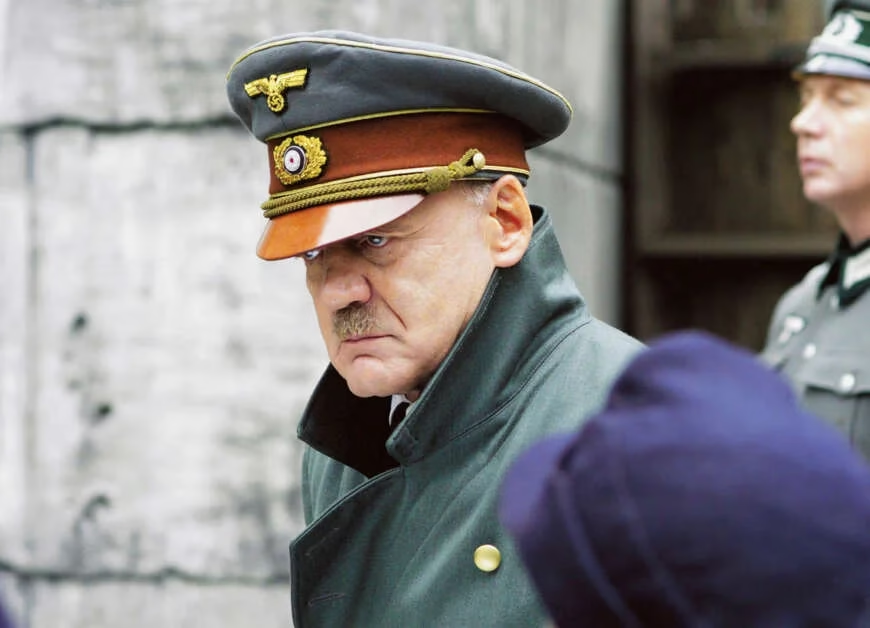
Bruno Ganz’s portrayal of Hitler became the film’s defining performance, but Downfall is not simply a Hitler biopic. Alexandra Maria Lara’s Traudl Junge provides one of the principal perspectives, while figures including Joseph and Magda Goebbels, Eva Braun, Albert Speer, Hermann Fegelein, Heinrich Himmler, military commanders, SS personnel, doctors, civilians, and children collectively create a broader portrait of a regime approaching annihilation. The result is deliberately uncomfortable because these historical figures are not presented as cartoon villains inhabiting some distant fantasy. They are depicted as human beings capable of ordinary conversation and affection while participating in, enabling, or remaining loyal to a criminal dictatorship responsible for catastrophic suffering.
That approach generated considerable controversy when Downfall premiered in 2004, particularly over whether showing Hitler behaving like an ordinary human being in private moments risked humanizing him excessively. Yet the film’s reputation has endured remarkably well. It received Germany’s nomination for Best Foreign Language Film at the Academy Awards, became an international commercial success, and currently holds a 90% critics score on Rotten Tomatoes and an 82 Metascore. More than two decades later, it remains one of the most widely discussed cinematic portrayals of the collapse of Nazi Germany.
Downfall (Der Undergang) – Official Trailer
What Is Downfall About?
Downfall primarily depicts the final stage of the Battle of Berlin in April 1945, when Nazi Germany’s military defeat has become unavoidable. Soviet forces are closing in, Berlin is being destroyed, German military formations exist increasingly on maps rather than as effective fighting forces, and the political leadership of the Third Reich is disintegrating.
At the center is Adolf Hitler, who has withdrawn into the Führerbunker beneath the Reich Chancellery. Despite overwhelming evidence that the war is lost, he continues issuing orders, demanding counterattacks from forces incapable of carrying them out, blaming generals for military failures, and shifting between delusion, rage, resignation, and preparations for his own death. Around him, different members of the regime react differently to the approaching end: some attempt to escape, some negotiate secretly, some continue obeying orders, some commit suicide, and others remain fanatically loyal until there is effectively nothing left to defend.
The story is partly filtered through Traudl Junge, Hitler’s young secretary. That perspective allows the film to place viewers inside the bunker without presenting Hitler himself as the conventional protagonist. Junge observes a political system destroying itself from within while Berlin’s civilians and remaining soldiers suffer the consequences above ground.
The movie ultimately becomes less about whether Nazi Germany will fall—the audience already knows the answer—and more about what people do when the ideology and authority to which they attached themselves reaches its terminal point.
Is Downfall Worth Watching?
Yes, particularly for viewers interested in historical dramas that prioritize atmosphere, performance, and psychological deterioration over conventional war-movie spectacle.
Downfall is not an easy film to watch. Its subject matter is inherently disturbing, its atmosphere becomes increasingly claustrophobic, and several sequences involving civilians and children are deliberately difficult. The film also assumes that viewers understand the broader historical context surrounding Nazi Germany, the Holocaust, and the European war rather than attempting to explain the entire Third Reich within one story.
What makes it exceptional is the feeling of witnessing a system collapse in real time. The bunker becomes a shrinking universe where reality is increasingly impossible to avoid but where many of its occupants continue behaving according to the hierarchy, rituals, loyalties, and ideological assumptions of a regime that is effectively already dead.
Bruno Ganz is extraordinary, but the ensemble around him prevents the movie from becoming a one-performance showcase. Downfall works because the audience sees different forms of complicity, fanaticism, denial, fear, self-preservation, duty, and disillusionment operating simultaneously.
Why Should You Watch Downfall?
The strongest reason to watch Downfall is that it refuses to make history emotionally comfortable.
It would have been considerably easier to depict Hitler as a permanently screaming monster whose evil visibly separates him from everyone around him. Instead, the film shows the disturbing contradiction between mundane human behavior and monstrous political responsibility. Hitler can speak calmly to his secretaries, interact affectionately with his dog, express concern toward people close to him, and moments later advocate destruction, condemn Germans for losing the war, or display complete indifference toward the lives being consumed by his decisions.
That does not absolve him. It makes the portrayal more unsettling because evil is not given a supernatural appearance that allows viewers to imagine that destructive political systems are created only by visibly inhuman monsters.
The film also offers one of cinema’s most immersive depictions of political and military collapse. Generals move markers across maps representing formations that barely exist, officials betray one another, civilians are sacrificed, and increasingly desperate orders continue to flow from a command structure that has lost meaningful control over events.
Bruno Ganz as Adolf Hitler
Bruno Ganz’s performance is the element most commonly associated with Downfall, and for good reason.
Ganz was initially reluctant to accept the role, and people close to him advised him against it. Once committed, he spent months researching Hitler’s behavior and voice. Particularly important was the rare recording of Hitler speaking privately with Finnish commander Carl Gustaf Emil Mannerheim in 1942, which provided Ganz with an opportunity to hear something closer to Hitler’s conversational voice rather than the deliberately theatrical delivery heard in public speeches.
Ganz also studied Hitler’s Austrian dialect and physical movements. Believing that Hitler showed symptoms consistent with Parkinson’s disease, he observed patients to help develop the physical deterioration visible in his performance.
The result avoids reducing Hitler to a single emotional register. Ganz can be quiet, exhausted, courteous, manipulative, delusional, trembling, affectionate, vicious, and explosively furious. Those changes make the infamous outbursts considerably more effective because they emerge from a character who does not spend every moment shouting.
Historian and Hitler biographer Ian Kershaw was particularly impressed by Ganz’s vocal work, describing its authenticity as chilling. Kershaw regarded the production as enormously powerful at making the period emotionally immediate, while also distinguishing cinema’s ability to make history felt from its more limited ability to fully explain historical causation.
Alexandra Maria Lara as Traudl Junge
Alexandra Maria Lara portrays Traudl Junge, one of Hitler’s secretaries and an important perspective through which the audience enters the bunker.
The film actually begins earlier than its main 1945 narrative, showing Junge being selected for the position in 1942. This provides an important contrast between the apparent confidence of Hitler’s headquarters earlier in the war and the shattered world in which Junge finds herself three years later.
Lara prepared using Junge’s memoir Until the Final Hour: Hitler’s Last Secretary. She had also watched André Heller’s documentary Im toten Winkel, which features the real Junge reflecting on her experience.
The real Traudl Junge appears through documentary footage incorporated into the film. This becomes especially important because the older Junge reflects critically on the idea that youth and ignorance excused her failure to recognize the nature of the regime she served.
That framing prevents Junge’s perspective from becoming a simple claim of innocence. Instead, the film leaves viewers considering the difference between ignorance, self-deception, political naivety, complicity, and responsibility.
Cast and Characters
The supporting cast is unusually deep because Downfall attempts to reconstruct an entire political and military environment rather than focus exclusively on Hitler.
Ulrich Matthes portrays Joseph Goebbels, while Corinna Harfouch plays Magda Goebbels. Their fanaticism becomes increasingly disturbing as the situation deteriorates. Juliane Köhler portrays Eva Braun, who remains with Hitler as the regime collapses, while Heino Ferch appears as Albert Speer.
Christian Berkel plays physician Ernst-Günther Schenck, Thomas Kretschmann portrays Hermann Fegelein, Ulrich Noethen appears as Heinrich Himmler, Michael Mendl plays General Helmuth Weidling, and André Hennicke portrays Wilhelm Mohnke. Other historical figures represented include Hermann Göring, Wilhelm Keitel, Alfred Jodl, Hans Krebs, Martin Bormann, Otto Günsche, Rochus Misch, Heinz Linge, Werner Haase, and numerous others.
This enormous cast could easily have made the film confusing. Instead, the density contributes to its documentary-like quality: viewers feel as though they are moving through a functioning historical environment rather than watching a handful of fictional characters positioned against a historical backdrop.
The Führerbunker Is Almost a Character Itself
One of Downfall’s greatest achievements is its use of physical space.
The bunker is initially filled with officers, secretaries, communications staff, visitors, maps, meetings, meals, and administrative routines. Yet as the film progresses, those spaces become increasingly claustrophobic. The world above is disappearing while the underground environment becomes a psychological refuge from reality.
The contrast between bunker and battlefield is crucial. Below ground, Hitler can still order divisions to move and speak as though military recovery remains possible. Above ground, Berlin is being destroyed and soldiers and civilians confront circumstances that cannot be corrected by moving markers across a map.
The production reconstructed the bunker and Hitler’s Wolf’s Lair at Bavaria Studios in Munich. The filmmakers deliberately limited computer-generated imagery, preferring physical sets and locations wherever practical because Hirschbiegel believed excessive artificiality would undermine the horror of the environment.
That decision contributes enormously to the film’s tactile realism.
How Historically Accurate Is Downfall?
Downfall has generally been regarded as unusually well researched for a major historical drama, although it should not be mistaken for a documentary.
The screenplay drew heavily from historian Joachim Fest’s Inside Hitler’s Bunker and Traudl Junge’s Until the Final Hour. Bernd Eichinger also consulted works associated with Albert Speer, Gerhard Boldt, Ernst-Günther Schenck, and Siegfried Knappe.
Academic discussion of the film’s international reception has noted how frequently reviewers emphasized its period detail, historical research, physical authenticity, and almost documentary-like realism.
However, dramatic reconstruction inevitably involves compression, interpretation, and disputed portrayals. The character Peter Kranz, for example, is fictional, although he was partly inspired by Alfred Zech, a young German decorated during the war. Some historians and writers also criticized the relatively sympathetic presentation of certain SS figures, particularly Wilhelm Mohnke and Ernst-Günther Schenck, because allegations and controversial aspects of their historical records are not central to their film portrayals.
Rochus Misch, who had actually served as Hitler’s bodyguard, considered the movie broadly factual but disputed some details and argued that Hitler did not scream inside the bunker in the manner depicted. Other eyewitness evidence, however, supports the occurrence of the furious reaction to the failure of Steiner’s proposed attack. Bunker nurse Erna Flegel regarded the film as generally accurate despite smaller inaccuracies.
The most useful way to approach Downfall is therefore as a meticulously researched historical drama rather than a literal recording of every conversation and event.
Why Was Downfall Controversial?
The largest controversy concerned a deceptively simple question: Should Hitler be depicted as recognizably human?
German discussion surrounding the film became particularly intense. Some critics worried that showing Hitler being courteous, vulnerable, affectionate, frightened, or physically deteriorating could encourage sympathy for him. The debate became prominent enough that the German newspaper Bild framed the issue around whether the “monster” should be shown as a human being.
Hirschbiegel rejected the idea that evil people must appear outwardly monstrous. His approach was that historical perpetrators remained human beings, and understanding that fact does not diminish their responsibility.
This distinction is essential to the movie. Humanization and exoneration are not the same thing.
Downfall shows Hitler behaving affectionately toward individuals while simultaneously presenting his willingness to sacrifice millions, his antisemitic and destructive ideology, his contempt for Germans he believed had failed him, and his refusal to accept responsibility for the catastrophe his regime created.
Ian Kershaw likewise argued that it was difficult to imagine ordinary viewers emerging from the film with sympathy for Hitler, despite its depiction of mundane human behavior.
Does Downfall Show the Holocaust?
The Holocaust is not the principal subject of Downfall, and the film does not attempt to dramatize the concentration and extermination camps.
Bernd Eichinger explained that the story’s specific focus was Hitler and Germany during the regime’s final collapse and that trying to incorporate the suffering of the camps into this particular narrative would have fundamentally changed its scope.
That creative decision is worth understanding because Downfall should never be viewed as a comprehensive account of Nazi Germany. Its timeframe and geographic perspective are deliberately narrow.
The film instead assumes that viewers understand the criminal nature of the regime whose destruction they are witnessing. Its subject is not a full explanation of Nazism or the Holocaust but the terminal collapse of Nazi political and military power in Berlin.
Production and Development
Producer and screenwriter Bernd Eichinger had wanted to make a film dealing directly with Hitler and the Nazi leadership for approximately two decades. The enormous historical and moral scale initially discouraged him, but Joachim Fest’s research on Hitler’s final days eventually provided the framework he needed.
Director Oliver Hirschbiegel was initially hesitant as well. As a German filmmaker, he regarded Nazism as an enormously difficult historical taboo and questioned whether he wanted to engage with it so directly. He ultimately decided that the discomfort itself was part of why the project needed to be confronted.
Principal photography lasted approximately twelve weeks between September and November 2003 under the working title Sunset. Production took place in Berlin, Munich, and Saint Petersburg. Areas around Saint Petersburg’s Obvodny Canal were used to recreate devastated wartime Berlin because their architecture and condition could convincingly represent the destroyed city.
The production budget was approximately €13.5 million, making its eventual international commercial success particularly impressive.
The Atmosphere During Filming Was Intense
Reconstructing the final days of Nazi Germany was not emotionally neutral for the cast and crew.
Hirschbiegel later described the atmosphere during filming as depressing, while Alexandra Maria Lara similarly recalled the intensity surrounding the production. Crew members found ways to relieve the pressure between scenes, including playing football, while Ganz reportedly tried not to carry Hitler’s emotional darkness continuously between takes.
That seriousness is visible in the finished film. Downfall rarely feels staged for conventional entertainment, even when it is functioning as an extremely effective drama.
Its production design, subdued visual language, crowded bunker interiors, damaged streets, exhausted characters, and restrained use of effects create a sense that viewers are observing history deteriorate rather than watching a polished war spectacle.
Theatrical and Extended Versions
The standard theatrical version of Downfall runs approximately 150 minutes, or roughly two and a half hours.
A longer television version was subsequently produced and first broadcast by Das Erste in October 2005. The extended cut adds approximately 25 minutes, bringing the story to around 175 minutes and expanding both the bunker material and scenes depicting devastated Berlin.
For first-time viewers, the theatrical cut remains the most straightforward introduction because it already provides an exceptionally detailed account. The extended version is more attractive for viewers who already appreciate the film and want additional historical and character material.
A German Ultra HD Blu-ray edition was also released in 2024, two decades after the film’s original theatrical release.
Reception and Critical Response
Downfall received strong international reviews despite the ethical debates surrounding its portrayal of Hitler.
Rotten Tomatoes currently reports a 90% Tomatometer from 137 critic reviews, while its audience score stands at 94%. Metacritic gives the film a Metascore of 82/100 from 35 critics, placing it within the site’s “Universal Acclaim” category.
Bruno Ganz received particularly widespread praise. Critics frequently highlighted his ability to create a historically recognizable Hitler without reducing the performance to impersonation. The film’s production design, claustrophobic atmosphere, ensemble cast, direction, and attention to historical detail were also repeatedly praised.
Not every response was unreservedly positive. Some critics remained uncomfortable with the film’s perspective, arguing that spending so much time among Hitler and his inner circle risked creating intimacy without sufficient moral framing. Others argued that precisely this refusal to simplify its subjects made the film more disturbing and historically valuable.
That debate has become part of Downfall’s legacy rather than something that disappeared after its theatrical release.
Academy Award Nomination and Other Recognition
Downfall represented Germany in the Academy Awards race and received a nomination for Best Foreign Language Film at the 77th Academy Awards. The Academy’s official records confirm its nomination alongside The Chorus, The Sea Inside, Yesterday, and eventual winner The Sea Inside—with the 2005 ceremony recognizing films from the preceding year.
The nomination substantially increased the film’s international profile.
It also won the BBC Four World Cinema competition in 2005 and was later included in Empire magazine’s ranking of the 100 best films of world cinema.
Those accolades helped establish Downfall not simply as a successful German historical production but as one of the internationally recognized European films of its period.
Box Office – Was Downfall Successful?
Yes, considerably so.
The film attracted approximately 4.5 million German cinema admissions during its first three months. Its North American theatrical gross eventually reached approximately $5.5 million, while international markets generated the overwhelming majority of its revenue.
Its worldwide theatrical total reached approximately $93 million against a production budget of roughly €13.5 million.
For a German-language historical drama lasting around two and a half hours and dealing with one of the darkest periods of twentieth-century history, that performance was substantial.
Its commercial success also demonstrated the international appetite for serious foreign-language historical cinema when accompanied by strong performances and critical attention.
Yes, This Is the Movie Behind the Famous Hitler Meme
There is an unusual chance that someone has encountered Downfall without ever realizing it.
The scene in which Hitler learns that the counterattack he expected from Felix Steiner cannot happen became one of the most famous templates in internet meme history. The original German dialogue is typically retained while completely invented subtitles make Hitler appear furious about football results, video games, movies, technology, politics, popular culture, or virtually any other subject imaginable.
The contrast became inherently comedic: Ganz performs the scene with extraordinary dramatic intensity while the subtitles claim Hitler is having a meltdown over some trivial modern inconvenience.
Director Oliver Hirschbiegel ultimately responded positively to many of the parodies and said he found some of them funny. Constantin Film took a less enthusiastic approach and attempted to remove parody videos from YouTube in 2010, which predictably inspired additional parodies about Hitler discovering that the Downfall parodies were being removed.
The meme became so culturally persistent that the scene has effectively developed two separate lives: one as an extremely serious dramatic moment inside the film and another as one of the internet’s longest-running subtitle-remix formats.
The Meme Should Not Overshadow Bruno Ganz’s Performance
The strange consequence of the meme’s popularity is that millions of people have watched one of Ganz’s most demanding scenes completely detached from its original dramatic context.
Within the actual film, the sequence is not funny. Hitler has been told that the military counterattack on which he has placed irrational hopes cannot occur because the necessary forces do not exist. After dismissing most of the room, he erupts at his commanders and begins openly acknowledging the reality of defeat.
Ganz moves from disbelief to fury, accusation, self-pity, despair, and resignation within a single sequence. It is the culmination of the movie’s portrayal of a dictator whose imaginary military reality can no longer survive contact with events outside the bunker.
Knowing the parody before watching Downfall can make the first few seconds strangely familiar, but the film quickly restores the scene’s original weight.
In some ways, that is the greatest evidence of Ganz’s performance: even after two decades of jokes, the scene remains disturbing when restored to its proper context.
Legacy and Impact
Downfall occupies an unusual position in film history because its serious historical legacy and its internet legacy developed almost independently.
As cinema, it remains an important German attempt to confront the final days of the Third Reich from within the collapsing regime itself. Its refusal to portray historical perpetrators as supernatural monsters provoked uncomfortable but valuable discussion about how cinema should depict evil, responsibility, complicity, and political fanaticism.
As a historical reconstruction, its production design and research established a standard frequently referenced when discussing screen portrayals of Hitler’s final days. The academic literature surrounding the movie’s international reception continues to examine its claims to authenticity, its emotional realism, and the ethical implications of its perspective.
As popular culture, meanwhile, the Steiner scene achieved a level of internet immortality that nobody involved in the production could possibly have anticipated.
Yet the meme has not destroyed the film’s reputation. If anything, the fact that Downfall remains critically respected despite one of its central scenes being endlessly parodied demonstrates the strength of the work surrounding it.
Frequently Asked Questions
What is Downfall about?
Downfall depicts the final days of Adolf Hitler and Nazi Germany during the Battle of Berlin in April 1945, focusing particularly on events inside and around the Führerbunker.
What does Der Untergang mean?
The German title Der Untergang can be translated as “The Downfall” or “The Collapse,” referring to the destruction of Hitler’s regime and Nazi Germany.
Who plays Hitler in Downfall?
Bruno Ganz portrays Adolf Hitler.
Who plays Traudl Junge?
Alexandra Maria Lara plays Traudl Junge, one of Hitler’s secretaries.
Is Downfall based on a true story?
Yes. The movie dramatizes real historical events and uses numerous historical figures. Its screenplay drew extensively from eyewitness accounts, memoirs, and historical research, although some characters and individual details were fictionalized or altered for dramatic purposes.
How historically accurate is Downfall?
The film is generally regarded as carefully researched and broadly accurate regarding the major events surrounding Hitler’s final days, although historians and eyewitnesses have disputed some individual portrayals and details.
Is Peter Kranz a real person?
Not exactly. Peter Kranz is a fictionalized character, although he was partly inspired by Alfred Zech, a young German who was decorated during the war.
How long is Downfall?
The theatrical version runs approximately 150 minutes. An extended television version adds roughly 25 minutes.
Is there an extended version?
Yes. The extended cut runs approximately 175 minutes and contains additional scenes involving both the bunker and Berlin.
Did Downfall win an Oscar?
No, but it was nominated for Best Foreign Language Film at the 77th Academy Awards as Germany’s submission.
What rating does Downfall have on Rotten Tomatoes?
It currently holds a 90% critics score from 137 reviews and a 94% audience score.
What is Downfall’s Metacritic score?
It holds an 82/100 Metascore, categorized as Universal Acclaim.
Why was Downfall controversial?
The primary controversy involved its decision to portray Hitler and other Nazi leaders as psychologically recognizable human beings rather than one-dimensional monsters. Critics debated whether that approach risked generating sympathy, while defenders argued that showing perpetrators as human makes their actions more disturbing rather than less condemnable.
Is Downfall the movie from the Hitler meme?
Yes. The famous internet meme using invented subtitles over Hitler’s furious reaction to Steiner’s failed counterattack comes directly from Downfall.
Did the director like the Downfall memes?
Oliver Hirschbiegel said he enjoyed many of the parodies and considered some of them very funny, although Constantin Film later attempted to remove some uploads from YouTube.
Is Downfall worth watching today?
Yes. For viewers comfortable with disturbing historical subject matter, Downfall remains an exceptionally performed, atmospheric, and carefully researched historical drama. Its strongest qualities—particularly Bruno Ganz’s performance, its production design, and its depiction of political collapse—have aged remarkably well.
Conclusion
Downfall remains powerful more than two decades after its release because it does not transform the collapse of Nazi Germany into a reassuring story about monsters finally receiving their punishment. Instead, it places viewers inside a dying political system and shows human beings continuing to lie, obey, rationalize, celebrate, betray, hope, murder, and follow routines while the consequences of years of dictatorship and war close around them. Hitler is not made less responsible by being shown as human; the disturbing implication is precisely that monstrous historical crimes are committed and enabled by human beings.
Bruno Ganz’s performance is central to that achievement. His Hitler can appear physically frail and privately courteous before revealing extraordinary cruelty, delusion, ideological fanaticism, and contempt for the lives being destroyed around him. Alexandra Maria Lara’s Traudl Junge provides a different but equally important perspective, especially when the film connects the dramatized young secretary with the real elderly Junge reflecting on her own failure to recognize what she had become part of. That combination gives Downfall something more complicated than simple historical recreation: it becomes a film about responsibility, denial, and the dangerous comfort of believing that proximity to evil without direct participation somehow makes a person untouched by it.
The film is not a complete history of Nazi Germany, nor does it attempt to be. Its focus is deliberately narrow, and some portrayals remain historically debated. Yet within that limited window—the final destruction of the Third Reich in Berlin—it creates an extraordinarily convincing sense of a regime discovering that ideology, propaganda, loyalty, and imaginary armies cannot indefinitely defeat reality. Its 90% Rotten Tomatoes score, 82 Metascore, Academy Award nomination, strong international box office, and continued historical discussion reflect how successfully it translated that moment into cinema.
The fact that its most famous scene later became one of the internet’s longest-running memes is an almost surreal addition to its legacy, but it should not obscure what the complete movie actually is. Removed from invented subtitles and restored to its original context, the famous bunker outburst is only one part of a much larger, darker portrait of political fanaticism reaching its inevitable end. For anyone interested in serious historical cinema, Downfall is still difficult, uncomfortable, and very much worth watching.
If you don’t know where to watch this Movie for FREE make sure to contact me via E-mail, or in the comments below. Thank you for reading and make sure to bookmark the site.
How useful was this post?
Click on a star to rate it!
Average rating 0 / 5. Vote count: 0
No votes so far! Be the first to rate this post.