
 7.5/10
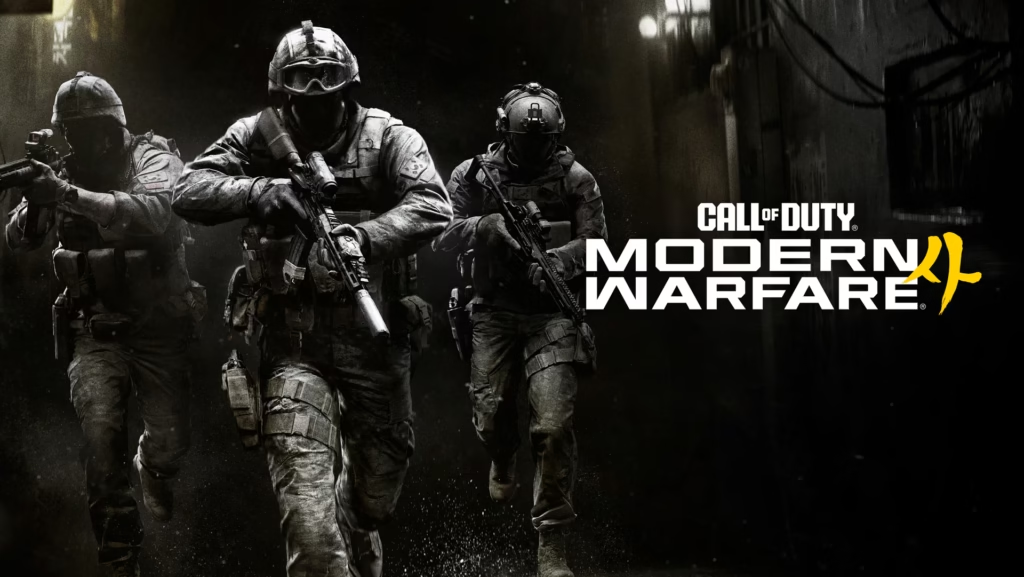
Call of Duty: Modern Warfare 4 is preparing to take one of gaming’s most recognizable military shooter franchises into another major international conflict, but this time the stakes extend far beyond the familiar battlefields and characters that defined its previous installments. Developed by Infinity Ward and published by Activision, the upcoming first-person shooter continues the rebooted Modern Warfare storyline after the events of Modern Warfare III (2023), introducing a full-scale war on the Korean Peninsula while following Captain John Price as he operates outside the military structure he once served. With a new generation of soldiers entering the conflict, familiar characters facing increasingly complicated loyalties, and an international threat capable of destabilizing multiple countries, the game is positioning itself as one of the franchise’s most ambitious modern military campaigns.
Scheduled for release on October 23, 2026, Modern Warfare 4 will launch on PlayStation 5, Xbox Series X|S, Windows PC, and Nintendo Switch 2. Beyond its campaign, the game introduces a redesigned multiplayer experience featuring 12 core launch maps, new movement mechanics, expanded Gunfight modes, and the adaptive Kill Block battleground. It also marks the return of DMZ, the extraction-based experience originally introduced in Modern Warfare II (2022), now expanded with persistent progression, a Forward Operating Base, and a dangerous new exclusion zone.
Perhaps the most interesting aspect of Modern Warfare 4 is its attempt to combine familiar Call of Duty gameplay with a more consequential narrative. Rather than relying entirely on established characters, Infinity Ward is introducing a South Korean protagonist whose experiences provide a different perspective on modern warfare, while Captain Price’s personal conflict continues the darker storyline established by the previous game. Whether these elements can come together successfully remains to be seen, but the combination of a substantial campaign, renewed multiplayer systems, and a much larger DMZ experience gives players several reasons to pay attention.
Call of Duty: Modern Warfare 4 – Official Campaign Trailer
What Is Call of Duty: Modern Warfare 4 About?
The campaign begins with a devastating military escalation on the Korean Peninsula, where North Korea launches a large-scale invasion of South Korea. As the conflict spreads, military forces struggle to contain the fighting, and the consequences threaten to destabilize the international political order. Rather than following a single special operations team throughout the entire story, Modern Warfare 4 introduces multiple perspectives, placing players in situations that range from desperate frontline combat to covert operations taking place thousands of miles away.
One of the central protagonists is Private Park Hyun-Jun, a young South Korean Marine serving alongside the soldiers of Sierra-1. Park is relatively inexperienced compared with the franchise’s veteran operatives, and his storyline focuses on the immediate human consequences of a military invasion. His missions take players into the chaos of a country attempting to defend itself, providing a perspective that differs considerably from the highly trained special forces teams usually associated with Modern Warfare.
Meanwhile, Captain John Price has become a fugitive following his actions at the conclusion of Modern Warfare III. No longer operating comfortably within the military and intelligence organizations that previously supported him, Price is pursuing a personal mission while avoiding the people attempting to capture him. His investigation eventually intersects with the forces responsible for the wider conflict, creating a connection between his personal vendetta and the international crisis unfolding elsewhere.
The campaign also introduces a mysterious figure known as the Archer, whose involvement with a powerful weapon suggests that the invasion may be part of a much larger threat. Although the complete storyline remains unrevealed, the premise establishes a conflict involving military intervention, political manipulation, intelligence operations, and characters whose loyalties may not remain straightforward.
Is Call of Duty: Modern Warfare 4 Worth Playing?
For players who enjoy cinematic military campaigns, competitive multiplayer, and tactical extraction experiences, Call of Duty: Modern Warfare 4 has the potential to offer a substantial package. Its three major gameplay components appeal to different audiences, allowing players to focus on a traditional single-player storyline, fast-paced online matches, or the more deliberate risk-and-reward structure of DMZ. The inclusion of these distinct experiences is particularly important because expectations surrounding annual Call of Duty releases have become increasingly varied.
The campaign appears especially promising for players interested in military storytelling. Its focus on South Korean soldiers provides an opportunity to explore a conflict from perspectives that have rarely occupied the center of the franchise, while Captain Price’s continuing storyline maintains a connection with previous Modern Warfare installments. The combination could create a more varied experience than a campaign built entirely around familiar special operations missions.
Multiplayer also introduces several changes that address long-running discussions about movement, gunplay, and map design. Infinity Ward has emphasized grounded combat while attempting to preserve fluidity and responsiveness, and the removal of hipfire bloom is intended to make weapon behavior more predictable. Kill Block adds another unusual element by changing its layout between rounds, potentially reducing the effectiveness of memorized routes and repetitive tactics.
Nevertheless, there are reasons to remain cautious. The quality of the finished campaign, multiplayer balance, technical performance, and long-term DMZ progression cannot be fully assessed before launch. Players who primarily enjoy the faster movement systems associated with recent Black Ops titles may also find Infinity Ward’s more grounded approach less appealing. For now, Modern Warfare 4 looks like a compelling prospect, particularly for audiences who prefer the traditional identity of the Modern Warfare franchise.
Why Should You Play Call of Duty: Modern Warfare 4?
One of the strongest reasons to consider Modern Warfare 4 is the scope of its campaign. The game moves between frontline warfare in Korea and international operations in locations such as New York, Paris, and Mumbai, giving the developers opportunities to create missions with very different atmospheres and tactical requirements. Large military assaults, close-quarters engagements, vehicle pursuits, and covert night operations are all part of the advertised experience, suggesting that the campaign will emphasize variety rather than repeating a single combat formula.
Another attraction is the return of Captain Price. His character has remained central to the rebooted Modern Warfare storyline, and the consequences of his actions in the previous game provide a natural foundation for further development. The decision to place him outside the organizations he previously served introduces an interesting conflict between personal convictions and institutional authority.
Multiplayer players have their own reasons to pay attention. Twelve new core maps, expanded Gunfight options, large-scale combined-arms battles, and redesigned movement systems create a substantial foundation for the competitive experience. The modular Kill Block environment is especially unusual because it challenges the expectation that players can eventually memorize every important sightline and rotation.
DMZ may be equally significant. Its expanded progression systems, operator customization, crafting mechanics, and changing environmental conditions suggest a more persistent extraction experience than the original version. For players who enjoy gathering valuable equipment, completing objectives under pressure, and deciding when to escape rather than continue fighting, the redesigned mode could become one of the game’s defining features.
The Campaign – War Breaks Out on the Korean Peninsula
The Korean Peninsula serves as the central location for Modern Warfare 4‘s campaign, with North Korea’s invasion of South Korea creating the military crisis around which the wider narrative develops. The setting allows Infinity Ward to explore large-scale conventional warfare alongside the covert operations traditionally associated with the franchise. Players can expect to experience the conflict through soldiers defending their homeland as well as experienced operatives pursuing objectives beyond the immediate front lines.
Private Park’s storyline introduces a particularly important change in perspective. Rather than beginning the game as an elite operative with years of experience, Park is a young Marine encountering the realities of combat during a national emergency. His presence gives the narrative an opportunity to examine fear, responsibility, loyalty, and the pressures placed on ordinary soldiers during extraordinary circumstances.
The Korean setting also carries considerable real-world historical significance. The Korean War ended in an armistice in 1953 rather than a comprehensive peace treaty, and the division of the peninsula remains a sensitive geopolitical issue. Fictionalizing a renewed conflict therefore requires careful consideration of the region’s history and the experiences of people affected by the original war.
Infinity Ward has indicated that it consulted regional specialists, North Korean defectors, and Korean members of its development team while preparing the setting. Those efforts do not automatically determine how the final story will be received, but they demonstrate an awareness that the game’s central conflict involves more than a convenient backdrop for military action.
Captain Price Returns – But Everything Has Changed
Captain John Price, portrayed by Barry Sloane, returns as one of the campaign’s principal characters. However, his circumstances have changed considerably since the earlier installments of the rebooted Modern Warfare series. Following his assassination of General Herschel Shepherd in Modern Warfare III, Price is operating outside the established military command structure and attempting to remain ahead of the forces pursuing him.
This development creates a different kind of challenge for a character traditionally associated with leadership, experience, and calculated military decision-making. Price has spent much of the rebooted storyline working through Task Force 141, but his actions have placed him in conflict with the institutions that once supported his operations. His personal mission now unfolds alongside a major international war, and the connection between those events appears central to the new narrative.
The situation also complicates his relationships with familiar characters. Simon “Ghost” Riley and Kyle “Gaz” Garrick return, but their involvement in the effort to locate Price introduces tension within the former Task Force 141 network. Kate Laswell also remains connected to the storyline, potentially providing an important link between Price and the intelligence community.
Rather than simply restoring the familiar team to its previous arrangement, Modern Warfare 4 appears interested in exploring what happens when long-standing loyalties are tested by conflicting responsibilities. That direction could provide meaningful character development if the campaign gives its central relationships sufficient attention.
Park Hyun-Jun – The New Face of Modern Warfare
Park Hyun-Jun, portrayed by Young Mazino, is one of the most important additions to the franchise. A South Korean Marine serving with Sierra-1, Park provides the campaign with a perspective rooted in the immediate consequences of the invasion. His experiences are fundamentally different from those of Captain Price, whose career has been defined by covert missions and international operations.
Park’s role creates an opportunity for the narrative to contrast experienced special forces personnel with soldiers who have not previously encountered warfare on such a scale. The resulting tension could influence how the campaign approaches combat, teamwork, and the emotional consequences of military decisions.
His squad also introduces several new characters who help establish the South Korean perspective. These soldiers are not simply background figures accompanying a familiar protagonist; they represent a military unit fighting to defend its country during a rapidly escalating crisis. Their relationships may become especially important if the campaign emphasizes the personal consequences of the invasion.
The decision to introduce Park alongside Price is one of the game’s most significant narrative choices. It allows Infinity Ward to expand the franchise’s identity without completely abandoning the characters and storylines that established the rebooted series.
The Archer – A Mysterious New Threat
The campaign introduces a mysterious individual known as the Archer, portrayed by Mads Mikkelsen. Although the complete nature of the character’s motivations remains undisclosed, the Archer is associated with the delivery of a powerful weapon and appears connected to the larger international threat.
Mikkelsen’s involvement is particularly notable because of his experience portraying complex antagonists and morally ambiguous characters. His presence gives the campaign an opportunity to introduce a memorable figure whose influence extends beyond conventional battlefield encounters.
The Archer’s exact role remains one of the campaign’s central mysteries. It is not yet clear how the character’s objectives intersect with the Korean invasion, Captain Price’s investigation, or the wider political circumstances surrounding the conflict. Revealing those connections will likely be an important part of the game’s storytelling.
For now, the character represents one of the strongest reasons for players interested in the campaign to avoid major spoilers before release.
Characters and Voice Cast
The campaign combines returning Modern Warfare characters with a substantial new cast. Alongside Barry Sloane as Captain Price and Young Mazino as Park Hyun-Jun, Samuel Roukin returns as Simon “Ghost” Riley, Elliot Knight portrays Kyle “Gaz” Garrick, and Rya Kihlstedt returns as Kate Laswell. These familiar characters help connect the new storyline to the events of the previous rebooted installments.
The South Korean military cast includes Jae Kim as Sergeant So Jae-Woo, Joon Lee as Private First Class Han “Chow” Cho, Daniel J. Kim as Private First Class Yun Jong-Moon, and Joseph Lee as Kwon “Kal” Hae-Soo. American Marines stationed in Korea include First Lieutenant Reggie West, portrayed by Luke Tennie, and Corporal Joseph Dunn, portrayed by William Lipton.
Other important characters include Prisca Kim as Ri Ju-Young, a commander in the Korean People’s Army, and Jeongmin Cho as Ri Seung-Ho, North Korea’s new supreme leader. Lanny Joon portrays Ko Jin-Hyuk, another high-ranking member of the KPA, while María Elisa Camargo returns as Valeria Garza, the Las Almas Cartel leader previously introduced in the rebooted series.
Together, these characters suggest that the campaign will move between military, political, intelligence, and criminal organizations rather than remaining focused exclusively on conventional battlefield operations.
Campaign Locations – Korea, New York, Paris, and Mumbai
Modern Warfare 4 expands its campaign across several international locations, each associated with different types of military operations. Korea provides the foundation for the game’s large-scale conflict, including trench warfare, frontline engagements, and attempts to reclaim occupied territory. These missions are expected to emphasize the scale and destructive consequences of the invasion.
New York introduces a different environment, with close-quarters combat taking place in dense urban surroundings. Such locations have historically allowed Call of Duty campaigns to create tense encounters where visibility, cover, and rapid decision-making are especially important.
Paris is associated with high-speed vehicle pursuits, suggesting a more cinematic approach to mission design. Mumbai, meanwhile, features SAS night operations, bringing the campaign back toward the stealth-oriented special forces gameplay that has long been associated with Modern Warfare.
The combination of these locations is significant because it creates opportunities for different pacing, mission structures, and visual environments. If Infinity Ward successfully connects these operations through a coherent narrative, the campaign could deliver both the spectacle of international warfare and the tension of smaller tactical engagements.
Multiplayer – A Return to Grounded Combat
Multiplayer remains one of the most important components of Call of Duty: Modern Warfare 4, and Infinity Ward has emphasized a return to grounded, precise combat. Rather than adopting every movement feature introduced in recent Black Ops installments, the game focuses on responsive controls, readable engagements, and weapon behavior designed to reward accuracy.
The launch experience includes 12 core 6v6 multiplayer maps, each featuring distinct environments and tactical layouts. The announced locations draw inspiration from the game’s wider international conflict, with environments such as Lotus, Rooftops, and Mumbai offering different approaches to map design.
Traditional multiplayer modes return alongside several new additions. Team Deathmatch, Domination, Hardpoint, Kill Confirmed, Free for All, and Search & Destroy remain part of the competitive foundation, while Counter Attack, Inflation, and Hijack introduce additional variations. Gun Game and Drop Zone are also included among the party modes available at launch.
For players interested in larger engagements, Ground War returns with Combat Outpost and additional large-scale modes involving armored vehicles and combined-arms warfare. This broader selection gives players the option to move between traditional small-team matches and more expansive battlefield experiences.
Kill Block – A Multiplayer Map That Never Stays the Same
One of the most unusual additions to Modern Warfare 4 is Kill Block, a modular multiplayer environment located within the fictional Westbridge Training Facility. Unlike conventional maps that maintain a consistent layout throughout every match, Kill Block uses interchangeable sections to create different combat configurations.
The environment is built around three modular areas, including two outer sections and a central combat space. Each section can appear in multiple variations, producing more than 500 possible configurations. The resulting changes affect routes, sightlines, cover positions, and the overall flow of combat.
This design has important implications for competitive gameplay. Traditional Call of Duty maps reward players who memorize advantageous positions, predictable rotations, and frequently contested areas. Kill Block introduces a different challenge by requiring players to reassess their surroundings as the environment changes.
The mode supports both 3v3 Gunfight and the new 10v10 Gunfight format at launch. Its larger team variation is especially interesting because a changing map layout could create considerably more unpredictable engagements when additional players are involved.
Whether Kill Block becomes a long-term multiplayer favorite will depend on the quality and balance of its individual configurations, but the concept represents a meaningful experiment within the franchise’s established formula.
Movement Changes – Faster, More Fluid, and More Controlled
Movement has become one of the most heavily discussed aspects of modern Call of Duty, particularly as different development studios have introduced increasingly elaborate traversal systems. Modern Warfare 4 takes a different approach from the Omnimovement mechanics featured in Black Ops 6 and Black Ops 7, emphasizing grounded movement while attempting to preserve speed and responsiveness.
Infinity Ward has introduced the ability to hang from ledges and move along certain edges and pipes, expanding the ways players can navigate combat environments. These additions may create opportunities for unexpected positioning without transforming the game into a movement system centered on unrestricted diving and sliding.
The developers have also acknowledged feedback surrounding the comparatively restrictive movement of Modern Warfare II (2022). The new system is intended to address those concerns while maintaining the deliberate combat identity associated with Infinity Ward’s games.
This balance will be important for the multiplayer experience. Faster movement can increase the skill ceiling and create more opportunities for aggressive play, but excessive mobility can also undermine map readability and tactical positioning. Modern Warfare 4 appears to be attempting a middle ground between those competing priorities.
Gunplay and the Removal of Hipfire Bloom
Another notable gameplay change is the removal of hipfire bloom, a mechanic that introduces additional uncertainty into weapon accuracy when firing without aiming down sights. By removing this behavior, Infinity Ward is attempting to make close-range engagements feel more consistent and predictable.
The change matters because weapon accuracy directly influences how players interpret successful and unsuccessful engagements. When bullets behave unpredictably, players may struggle to determine whether a missed shot resulted from their own aim or an underlying accuracy system. More consistent hipfire behavior could make certain close-range encounters feel more dependent on positioning and mechanical skill.
The game also introduces expanded weapon customization options, including Apex Attachments, alongside new equipment, perks, field upgrades, and killstreaks. These systems are intended to provide players with greater control over their preferred combat styles.
As with movement, the final impact will depend on balance. Increased consistency is generally appealing, but weapon handling, time-to-kill, attachment effectiveness, and map design must work together for gunplay to feel satisfying over hundreds of multiplayer matches.
DMZ Returns – A New Extraction Experience
The return of DMZ is one of the most significant announcements surrounding Modern Warfare 4. Originally introduced alongside Modern Warfare II in 2022, DMZ combined the familiar combat systems of Call of Duty with extraction-shooter mechanics, encouraging players to enter dangerous environments, complete objectives, collect equipment, and escape before losing valuable resources.
The new version expands that concept into a more substantial experience. Players deploy into a large exclusion zone where hostile NPCs, rival squads, environmental hazards, and mission objectives create overlapping risks. Instead of focusing exclusively on eliminating opponents, success often depends on deciding which objectives are worth pursuing and when continuing an operation becomes too dangerous.
DMZ supports 20 squads of up to three players, creating the possibility of encounters between numerous independent teams. Players can pursue narrative-driven Story Missions, complete randomized Dynamic Operations, or explore the environment while searching for valuable equipment and opportunities.
The mode also introduces a notoriety system that increases the visibility of players who repeatedly eliminate other operators. This mechanic creates an additional consequence for aggressive behavior, potentially encouraging different approaches to encounters between squads.
For players who enjoyed the original DMZ but wanted deeper progression and more meaningful long-term systems, the redesigned mode may become one of the strongest reasons to return to Call of Duty.
Hajin – The New DMZ Exclusion Zone
DMZ takes place in Hajin, a fictional South Korean exclusion zone affected by the aftermath of the Modern Warfare 4 campaign. The location is connected to a nuclear reactor disaster and the recovery of abandoned military technology, creating a setting where competing forces enter dangerous territory in search of valuable resources.
Hajin is designed as a large-scale environment containing multiple points of interest, hostile forces, and changing conditions. Rather than functioning as a conventional multiplayer map, the exclusion zone is intended to support exploration, mission completion, resource collection, and encounters that develop differently from one deployment to another.
Dynamic weather adds another layer of unpredictability. Rain and snow can intensify during matches, potentially affecting visibility and the atmosphere of an operation. Combined with the presence of enemy squads and hostile NPCs, these environmental changes reinforce the idea that players are entering a location where circumstances can deteriorate unexpectedly.
The setting also creates a narrative connection between the campaign and DMZ. Rather than treating the extraction experience as a completely unrelated activity, Infinity Ward is using the consequences of the single-player storyline to establish the circumstances surrounding Hajin.
The Forward Operating Base – DMZ’s New Progression Hub
The Forward Operating Base, commonly abbreviated as FOB, is one of the most important additions to the redesigned DMZ experience. It functions as a persistent preparation area where players can manage equipment, improve their operators, organize missions, and interact with systems that support future deployments.
The FOB includes stations dedicated to different activities. Players can manage their loadouts, customize weapons, craft equipment, interact with vendors, and review available objectives. Additional systems support the pursuit of high-value targets and the management of resources recovered from the exclusion zone.
One of the most interesting additions is the introduction of individual operator progression. Rather than relying exclusively on a single shared progression path, operators can develop through their own trait trees, unlocking abilities and bonuses suited to different playstyles.
This creates opportunities for specialization. One operator might become better suited to aggressive engagements, while another could prioritize survival, exploration, or resource management. Such differences may encourage players to approach deployments strategically instead of relying on identical equipment and abilities every time.
The FOB also gives DMZ a clearer sense of continuity between matches. Successful extractions can contribute to longer-term development, while failed operations create setbacks that players must overcome.
DMZ Story Missions, Dynamic Operations, and Player Encounters
The new DMZ mode offers several ways to approach each deployment. Story Missions provide structured objectives connected to the wider setting, allowing players to uncover information and progress through narrative-driven activities. These missions offer a more directed experience for players who prefer having clear goals.
Dynamic Operations introduce objectives that change between matches. Their randomized nature is intended to prevent deployments from becoming completely predictable, encouraging players to adapt their plans based on the opportunities available during each run.
Players can also explore Hajin more freely, searching for equipment, confronting hostile forces, or engaging other squads. This flexibility is central to the extraction-shooter format because the value of a deployment is not necessarily determined by the number of enemies defeated.
The most important decision often involves knowing when to leave. Valuable resources become meaningless if a player cannot successfully extract them, and every additional objective introduces another opportunity for something to go wrong. By combining structured missions with unpredictable encounters, Modern Warfare 4 is attempting to create a mode where risk management matters as much as shooting accuracy.
Nintendo Switch 2 – Call of Duty Returns to Nintendo
One of the most significant platform announcements is the arrival of Modern Warfare 4 on Nintendo Switch 2. This marks the franchise’s return to Nintendo hardware after a lengthy absence, with Call of Duty: Ghosts on Wii U in 2013 representing the previous major console release.
The Switch 2 version is being developed with assistance from Digital Legends, a studio previously associated with Call of Duty: Warzone Mobile. Infinity Ward has indicated that the game was brought to the platform relatively quickly during development, although the finished version’s performance will ultimately determine how successfully the experience translates to Nintendo’s hardware.
The game supports cross-play, allowing Switch 2 players to participate in the broader multiplayer ecosystem. Optional Joy-Con 2 mouse controls are also supported, providing an alternative input method that may appeal to players who prefer mouse-style aiming.
The significance of this release extends beyond a single game. Bringing a major contemporary Call of Duty installment to Nintendo hardware represents an important expansion of the franchise’s platform availability and could introduce the series to players who have primarily used Nintendo consoles.
Graphics, Technology, and PC Features
Modern Warfare 4 is being developed exclusively for current-generation hardware, with no planned versions for PlayStation 4 or Xbox One. This decision allows Infinity Ward to focus its technical development on newer systems rather than maintaining compatibility with the previous console generation.
The PC version is being developed with assistance from Beenox, which has contributed to numerous Call of Duty PC releases. The game includes expanded ray-tracing features, including ray-traced reflections, ambient occlusion, and shadows across its major modes.
These improvements are intended to enhance lighting, environmental detail, and visual consistency. However, graphical ambition must be balanced against the performance requirements of a competitive first-person shooter, where stable frame rates and responsive controls remain essential.
The Nintendo Switch 2 version presents an additional technical challenge because its hardware differs from conventional high-performance gaming PCs and home consoles. Its inclusion makes optimization particularly important, especially for maintaining competitive consistency across supported platforms.
The final technical results will only become clear through independent performance testing after launch.
Development – Infinity Ward Leads a Massive Collaboration
Development of Call of Duty: Modern Warfare 4 is led by Infinity Ward, with contributions from numerous Activision studios. The wider production involves teams such as Treyarch, Sledgehammer Games, Raven Software, Beenox, Digital Legends, High Moon Studios, Demonware, and additional Activision technology and support divisions.
This collaborative structure reflects the increasing scale of contemporary Call of Duty development. A single release now includes cinematic campaigns, competitive multiplayer, extraction-based gameplay, extensive customization, online infrastructure, and multiple hardware versions, requiring specialized teams to contribute across different systems.
Infinity Ward has also emphasized the importance of player feedback, particularly regarding movement and combat responsiveness. The studio’s approach to Modern Warfare 4 appears intended to address criticisms of previous installments without abandoning the grounded identity that distinguishes its games from Treyarch’s Black Ops series.
The campaign’s Korean setting has required additional research and consultation because of its historical and geopolitical sensitivity. The developers have discussed working with regional specialists and individuals familiar with Korean experiences to inform the fictional conflict.
Ultimately, the production’s success will depend on how effectively these different development priorities come together. A technically ambitious game with several major modes must deliver consistency across storytelling, gameplay, performance, and ongoing support.
Call of Duty: Modern Warfare 4 Release Date and Platforms
Call of Duty: Modern Warfare 4 is scheduled to launch worldwide on Friday, October 23, 2026. The game will be available on PlayStation 5, Xbox Series X|S, Windows PC, and Nintendo Switch 2. PC players can access the game through supported storefronts including Steam, Battle.net, and Xbox on PC.
The release also supports Xbox Play Anywhere, allowing eligible digital purchases within the Xbox ecosystem to be used across compatible Xbox consoles and Windows PCs. This provides additional flexibility for players who regularly switch between those platforms.
Unlike several recent Call of Duty releases, Modern Warfare 4 is not scheduled to join Xbox Game Pass on launch day. Players who want immediate access will therefore need to purchase the game through an eligible storefront.
The game also introduces an early-access schedule for digital pre-orders, allowing certain modes to become available before the official release date.
Campaign and DMZ Early Access
Players who digitally pre-order Modern Warfare 4 can begin the campaign on October 16, 2026, one week before the full game’s release. This gives story-focused players an opportunity to experience the narrative before the multiplayer launch brings the wider community into the game.
DMZ early access begins on October 20, 2026, allowing eligible players to explore Hajin and familiarize themselves with the extraction systems several days before the official release. The main launch follows on October 23, when the complete multiplayer experience becomes available.
The staggered schedule is particularly interesting because it separates the campaign and DMZ from the busiest period of the traditional multiplayer launch. Players interested in multiple modes may be able to experience each component without feeling immediately pressured to divide their attention.
However, the early-access benefits apply to qualifying digital pre-orders, and players purchasing physical editions should not assume they will receive identical access.
Multiplayer Beta – What Players Have Already Experienced
The Modern Warfare 4 multiplayer beta began with early access on August 21, 2026, before opening to all players on August 28. Testing continued through September 1, providing an opportunity to experience selected multiplayer systems before the full launch.
The beta featured portions of the game’s redesigned movement, gunplay, progression, and map selection. It also introduced players to the adaptive Kill Block environment and offered a closer look at the competitive direction Infinity Ward is pursuing.
Notably, the beta included content beyond traditional multiplayer testing. A campaign mission and a new Warzone Resurgence map were also made available, giving players an opportunity to experience different parts of the broader Call of Duty ecosystem.
Although beta impressions can provide useful early feedback, they do not necessarily represent the finished game’s balance or technical condition. Developers can adjust weapon behavior, movement, map elements, and progression systems between testing and release, meaning the launch experience may differ in important ways.
Pre-Order Bonuses and Editions
Modern Warfare 4 is available for pre-order through supported platform stores and participating retailers. The standard edition provides access to the base game, while additional editions and promotional offers include cosmetic items and other digital bonuses.
One announced digital pre-order reward is the Inner Circuit M4 Weapon Blueprint, with a special Xbox-themed visual variation celebrating the platform’s 25th anniversary. Other promotional offers may vary depending on the retailer and region.
The game’s Vault Edition includes additional cosmetic content, including operator and weapon customization items. These extras are intended for players interested in expanding their collection of in-game cosmetics rather than changing the fundamental structure of the campaign, multiplayer, or DMZ.
Players considering a pre-order should compare the included content carefully, particularly because early-access eligibility, edition bonuses, and retailer promotions may differ.
How Does Modern Warfare 4 Compare With Previous Games?
The rebooted Modern Warfare series began in 2019 with a renewed focus on contemporary military operations, cinematic presentation, and grounded combat. Modern Warfare II (2022) expanded the franchise’s systems and introduced DMZ, while Modern Warfare III (2023) continued the storyline and brought significant changes to multiplayer movement and map design.
Modern Warfare 4 appears to combine elements from these previous installments while introducing its own priorities. Its campaign continues the story of Captain Price but expands the conflict to a scale that includes conventional warfare on the Korean Peninsula. The new South Korean protagonist also provides a different narrative perspective from the established Task Force 141 characters.
In multiplayer, Infinity Ward is attempting to balance the deliberate combat identity of Modern Warfare II with the responsiveness players increasingly expect from modern shooters. The result is a system that avoids the full Omnimovement approach of recent Black Ops games while introducing additional traversal options.
DMZ represents another major point of differentiation. Rather than returning as a largely unchanged secondary activity, the mode has been expanded with persistent systems, individual operator progression, and a new setting connected to the campaign.
These changes suggest that Modern Warfare 4 is attempting to establish a more distinct identity rather than simply repeating the structure of its immediate predecessor.
Early Reception and Community Expectations
As of October 11, 2026, Modern Warfare 4 has not yet reached its official release date, meaning there is no complete critical consensus regarding the finished game. Previews, developer demonstrations, and beta testing have provided information about its systems, but final reviews will need to evaluate the complete campaign, multiplayer experience, technical performance, and DMZ progression.
Several aspects of the game have attracted attention ahead of launch. The return of DMZ is particularly significant for players who enjoyed extraction-based gameplay, while Kill Block’s changing layouts represent an unusual experiment within the franchise’s competitive multiplayer formula.
The Korean Peninsula setting has also prompted discussion because of its relationship to real historical events and contemporary geopolitical tensions. Although military fiction frequently draws inspiration from international conflicts, the decision to portray a renewed Korean war carries cultural and political implications that extend beyond entertainment.
Expectations are therefore varied. Some players are primarily interested in Captain Price’s continuing storyline, others want improvements to competitive gunplay, and a separate audience is watching to see whether DMZ can become a more substantial long-term experience.
The finished game’s ability to satisfy these different groups will play a major role in determining its reception.
Legacy and Potential Impact
Call of Duty remains one of the most recognizable franchises in the video game industry, and each new installment carries expectations shaped by more than two decades of military shooters. Modern Warfare 4 enters that history at an interesting moment because it combines the continuation of a major rebooted storyline with substantial changes to multiplayer and the return of an extraction mode that previously developed its own dedicated audience.
The Nintendo Switch 2 release is particularly important for the franchise’s wider accessibility. Returning to Nintendo hardware after more than a decade could introduce contemporary Call of Duty gameplay to an audience that has not traditionally had access to the series’ newest installments on its preferred platform.
DMZ may also influence the game’s long-term identity. If its expanded progression systems and persistent Forward Operating Base provide meaningful reasons to continue playing, the mode could become a more substantial pillar of the franchise rather than a secondary experiment.
The campaign’s international setting and emphasis on multiple protagonists may likewise shape how future Modern Warfare games approach storytelling. Introducing new characters while maintaining connections to familiar figures creates opportunities for the series to evolve without abandoning its established identity.
Whether Modern Warfare 4 ultimately becomes a defining installment will depend on execution rather than ambition alone. Nevertheless, its combination of technical changes, new platform support, expanded modes, and a consequential storyline makes it one of the most significant upcoming releases in the franchise.
Frequently Asked Questions
When Does Call of Duty: Modern Warfare 4 Release?
Call of Duty: Modern Warfare 4 is scheduled to release on October 23, 2026, worldwide.
Who Is Developing Modern Warfare 4?
The game is being developed by Infinity Ward, with additional contributions from multiple Activision studios, including Treyarch, Sledgehammer Games, Raven Software, Beenox, and Digital Legends.
What Platforms Will Modern Warfare 4 Be Available On?
The game will launch on PlayStation 5, Xbox Series X|S, Windows PC, and Nintendo Switch 2.
Is Modern Warfare 4 Coming to PS4 or Xbox One?
No. Modern Warfare 4 is not scheduled for PlayStation 4 or Xbox One.
What Is the Modern Warfare 4 Campaign About?
The campaign follows a major conflict on the Korean Peninsula after North Korea launches an invasion of South Korea. It also continues Captain Price’s storyline as he operates outside the military system while pursuing a personal mission.
Is Captain Price Returning in Modern Warfare 4?
Yes. Captain John Price returns as one of the central protagonists, portrayed by Barry Sloane.
Who Is the New Main Character in Modern Warfare 4?
One of the new protagonists is Private Park Hyun-Jun, a South Korean Marine portrayed by Young Mazino.
Who Plays the Archer in Modern Warfare 4?
The mysterious character known as the Archer is portrayed by Mads Mikkelsen.
Does Modern Warfare 4 Have Multiplayer?
Yes. The game features competitive multiplayer with 12 core 6v6 maps at launch, returning modes, new gameplay options, and large-scale battles.
What Is Kill Block?
Kill Block is a modular multiplayer battleground that changes its layout between rounds. It supports more than 500 possible configurations and includes expanded Gunfight modes.
Is DMZ Returning in Modern Warfare 4?
Yes. DMZ returns as a major extraction-based mode featuring the Hajin exclusion zone, Story Missions, Dynamic Operations, persistent progression, and a Forward Operating Base.
How Many Players Can Join a DMZ Match?
The announced format supports 20 squads of up to three players, allowing as many as 60 operators to deploy into the exclusion zone.
What Is the Forward Operating Base?
The FOB is a persistent DMZ hub where players prepare equipment, customize operators, manage resources, craft items, and organize future deployments.
Does Modern Warfare 4 Have Omnimovement?
No. The game uses Infinity Ward’s own grounded movement system rather than the full Omnimovement mechanics associated with recent Black Ops installments.
Is Modern Warfare 4 Coming to Nintendo Switch 2?
Yes. The game is scheduled to launch on Nintendo Switch 2 on October 23, 2026, with cross-play and optional Joy-Con 2 mouse controls.
Will Modern Warfare 4 Be on Xbox Game Pass?
The game is not scheduled to be available through Xbox Game Pass on launch day. A later addition has been reported, but players should not assume a specific subscription release date without an official announcement.
When Does Modern Warfare 4 Campaign Early Access Begin?
Eligible digital pre-orders provide campaign early access beginning October 16, 2026.
When Does DMZ Early Access Begin?
Eligible digital pre-orders provide DMZ early access beginning October 20, 2026.
Is Modern Warfare 4 Worth Buying?
The game offers several promising features, including a new campaign, revised multiplayer systems, and an expanded DMZ mode. However, players who are uncertain should consider waiting for launch reviews and technical performance testing before making a purchase.
Conclusion
Call of Duty: Modern Warfare 4 is shaping up to be one of the most ambitious entries in the rebooted Modern Warfare series, combining a major international conflict with substantial changes to multiplayer and the return of DMZ. Its campaign moves beyond the familiar structure of Task Force 141 operations by introducing Park Hyun-Jun, a young South Korean Marine whose experiences place players directly into the consequences of a devastating invasion. At the same time, Captain Price’s continuing storyline provides a connection to previous installments while exploring the consequences of his increasingly controversial decisions.
The game’s multiplayer experience also reflects an attempt to address competing expectations within the Call of Duty community. Infinity Ward is emphasizing grounded combat without returning entirely to the restrictive movement systems that frustrated some players in earlier releases. The addition of more consistent hipfire behavior, expanded traversal mechanics, 12 core launch maps, and the modular Kill Block environment suggests a deliberate effort to combine familiarity with meaningful experimentation. Whether those systems remain satisfying over time will depend on balance, map quality, and the studio’s willingness to respond to player feedback.
DMZ may ultimately become one of the game’s most important features. Its return brings a new exclusion zone, persistent operator progression, expanded objectives, dynamic weather, and a Forward Operating Base designed to give players greater control over their long-term development. These additions could help the mode establish a more durable identity within the franchise, particularly for players who prefer tactical decision-making and high-risk extraction gameplay over conventional competitive matches.
The decision to release Modern Warfare 4 on Nintendo Switch 2 is another significant development, expanding the franchise’s availability while introducing new technical challenges. Combined with current-generation exclusivity, enhanced PC graphics, and a development effort involving numerous Activision studios, the game represents a substantial production designed to serve several different audiences simultaneously. That ambition is impressive, but it also creates considerable expectations regarding performance, content quality, and consistency across platforms.
With its official launch scheduled for October 23, 2026, Call of Duty: Modern Warfare 4 is approaching a critical moment. Its campaign promises a darker continuation of the rebooted storyline, multiplayer is attempting to refine the series’ competitive identity, and DMZ is returning with systems intended to make every deployment more meaningful. The full experience has yet to prove itself, but if Infinity Ward can successfully deliver on these promises, Modern Warfare 4 could become an important turning point for the franchise rather than simply another annual installment.
Thank you for reading and make sure to bookmark the site, comment and follow up on the newest posts!
How useful was this post?
Click on a star to rate it!
Average rating 0 / 5. Vote count: 0
No votes so far! Be the first to rate this post.