
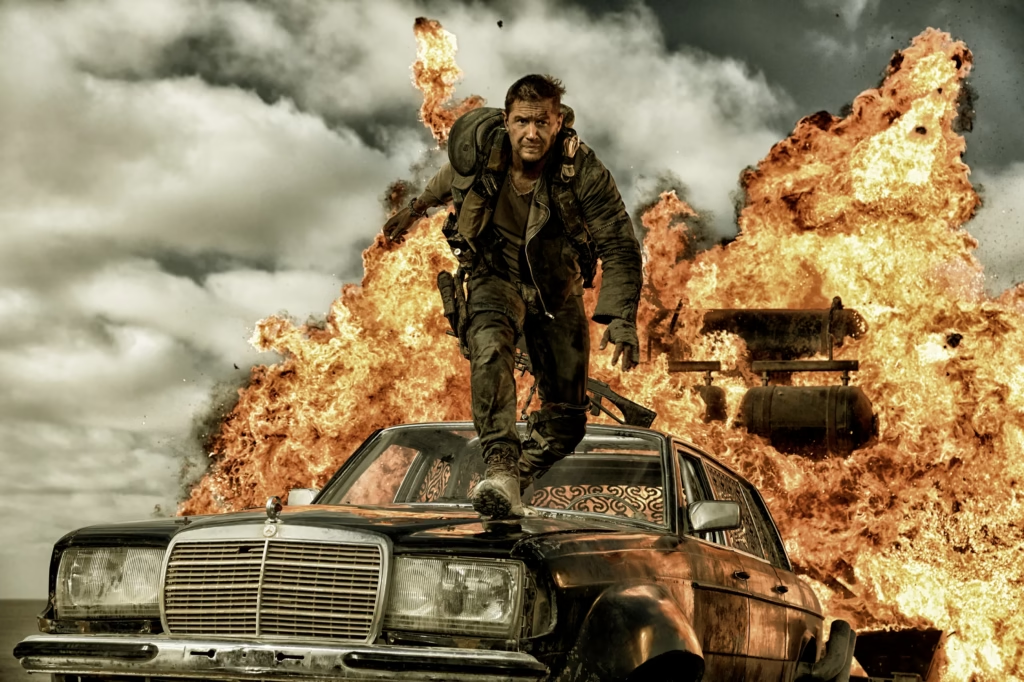
 8.1/10
Few action movies have managed to redefine an entire genre quite like Mad Max: Fury Road, George Miller’s extraordinary return to the post-apocalyptic universe he first introduced in 1979. Released in 2015, the film transformed a seemingly straightforward desert pursuit into one of the most visually ambitious, technically accomplished, and emotionally compelling action experiences of modern cinema. With Tom Hardy taking over the role of Max Rockatansky and Charlize Theron delivering a defining performance as Imperator Furiosa, the movie demonstrated that spectacular action and meaningful storytelling do not have to compete for attention. Instead, they can strengthen each other when every movement, explosion, and character decision contributes to a larger narrative.
Set in a devastated world where water, fuel, and basic human dignity have become instruments of power, Mad Max: Fury Road follows two unlikely allies attempting to escape a ruthless warlord and his heavily armed followers. The premise is remarkably simple, but its execution is anything but ordinary. George Miller builds an entire civilization through its vehicles, costumes, rituals, landscapes, and fleeting conversations, allowing audiences to understand the rules of his world without relying on lengthy explanations. The result is a film that rarely slows down yet still manages to explore survival, freedom, exploitation, redemption, and the consequences of environmental collapse.
What makes Fury Road especially remarkable is the extraordinary journey behind its creation. After spending decades in development, surviving repeated delays, and undergoing an exceptionally demanding production in the Namibian desert, the film finally premiered in May 2015. It went on to earn widespread critical acclaim, collect ten Academy Award nominations, and win six Oscars, becoming one of the most celebrated action films of the twenty-first century. More than a decade later, its influence remains visible in discussions about practical filmmaking, visual storytelling, and what modern blockbusters can accomplish when creative ambition takes priority over conventional formulas.
Mad Max: Fury Road – Official Trailer
What Is Mad Max: Fury Road About?
Mad Max: Fury Road takes place in a post-apocalyptic wasteland where civilization has collapsed and surviving communities struggle over increasingly scarce resources. Water and gasoline are particularly valuable, allowing powerful individuals to control entire populations through access to the necessities of life. Among these rulers is Immortan Joe, a brutal warlord who commands a fortified settlement known as the Citadel and maintains his authority through a fanatical army of young warriors.
The story begins with Max Rockatansky, a wandering survivor haunted by memories of people he could not save. After being captured by Immortan Joe’s forces, Max becomes entangled in a dangerous escape attempt led by Imperator Furiosa, one of the warlord’s most capable commanders. Furiosa has secretly abandoned her assigned mission and is attempting to transport a group of women away from the Citadel, hoping to reach a place where they can live beyond Joe’s control.
When Immortan Joe discovers what has happened, he launches a massive pursuit across the desert, sending heavily modified vehicles and armed followers after Furiosa’s enormous War Rig. Max initially becomes involved through circumstances beyond his control, but the desperate situation gradually forces him to cooperate with Furiosa and the people she is protecting. Their journey takes them through hostile territories, violent sandstorms, treacherous terrain, and encounters with individuals whose survival depends on the same limited resources.
Although the film is built around a prolonged vehicle chase, its central conflict is about much more than escaping an enemy. The characters are searching for freedom, security, and the possibility of rebuilding their lives in a world that has nearly forgotten those ideas. Without revealing the outcome, Fury Road uses its relentless momentum to explore whether people shaped by violence and loss can still find reasons to trust one another.
Is Mad Max: Fury Road Worth Watching?
Mad Max: Fury Road is absolutely worth watching, particularly for viewers who appreciate action cinema that prioritizes visual creativity, physical spectacle, and storytelling through movement rather than excessive dialogue. The film has an extraordinary ability to communicate information without interrupting its momentum, allowing audiences to understand relationships, motivations, and conflicts through the way characters behave under pressure. Even its quieter moments feel purposeful because they provide emotional context for the dangerous decisions that follow.
One of the movie’s greatest strengths is its remarkable visual clarity. Despite featuring enormous convoys, explosions, high-speed collisions, and simultaneous fights involving multiple characters, the action rarely becomes difficult to follow. George Miller carefully controls framing, movement, and editing so that viewers can understand where characters are positioned and what they are attempting to accomplish. This approach makes the film’s most elaborate sequences feel exciting rather than overwhelming.
The performances also provide an emotional foundation that prevents the spectacle from becoming empty. Tom Hardy portrays Max as a deeply damaged survivor who communicates more through physical reactions than lengthy speeches, while Charlize Theron gives Furiosa a commanding presence defined by determination, vulnerability, and moral conviction. Their contrasting personalities create a compelling partnership that develops naturally through shared danger.
However, Fury Road may not appeal equally to every viewer. Its story is intentionally economical, its world is brutal, and its action sequences occupy a substantial portion of the runtime. Audiences looking for extensive political explanations, conventional dialogue-driven drama, or a slower narrative may find its approach unusual. Nevertheless, for anyone interested in understanding why the film is so frequently discussed as a landmark of modern action cinema, it remains essential viewing.
Why Should You Watch Mad Max: Fury Road?
The most compelling reason to watch Mad Max: Fury Road is that it offers an experience few other action movies have successfully replicated. Rather than building toward occasional spectacular sequences, George Miller structures the entire film around continuous physical movement, with every confrontation contributing to the characters’ larger struggle. The action becomes the language of the story, revealing personality, loyalty, fear, and desperation through decisions made in the middle of combat.
Another reason is the film’s commitment to practical filmmaking. Although computer-generated effects play an important supporting role, many of the vehicles, explosions, stunts, and mechanical creations were physically constructed or performed during production. This gives the action a sense of weight and danger that is difficult to reproduce through entirely digital environments. The vehicles feel like enormous machines capable of inflicting real damage, and the performers appear to inhabit a world where every mistake could have serious consequences.
The film is also visually distinctive. Its intense orange deserts, contrasting blue night scenes, elaborate costumes, and bizarre mechanical designs establish an atmosphere that feels both fantastical and disturbingly believable. Instead of presenting the apocalypse as a collection of generic ruins, Miller imagines a civilization that has developed its own religions, economies, hierarchies, and cultural traditions from the remains of the old world.
Finally, Fury Road offers more thematic substance than its straightforward premise initially suggests. Beneath the explosions and vehicle pursuits lies a story about reclaiming autonomy, resisting exploitation, and finding meaning through cooperation. These ideas are not delivered through lengthy speeches but emerge naturally from the characters’ circumstances, making the film rewarding even after its most spectacular moments have become familiar.
Mad Max: Fury Road Cast and Characters
The cast of Mad Max: Fury Road combines internationally recognized actors with performers whose distinctive physical presence helps bring the wasteland to life. Because the film relies heavily on visual storytelling, characterization frequently depends on expressions, movement, costume design, and behavior rather than conventional exposition. This approach allows even relatively minor characters to establish recognizable identities within the enormous ensemble.
Tom Hardy as Max Rockatansky takes over the role originally made famous by Mel Gibson. Hardy portrays Max as a former police officer who has become an isolated survivor, carrying the psychological consequences of a world destroyed by violence. His performance is deliberately restrained, emphasizing exhaustion, suspicion, and instinctive survival rather than traditional heroic confidence.
Charlize Theron as Imperator Furiosa delivers one of the film’s most important performances. Furiosa is a formidable warrior who has earned a position of authority within Immortan Joe’s forces, but her decision to rebel reveals a determination to challenge the system that once gave her power. Theron shaved her head for the role and portrays Furiosa with a combination of physical intensity, emotional restraint, and unmistakable authority.
Nicholas Hoult as Nux plays a young War Boy whose devotion to Immortan Joe is shaped by the belief system governing the Citadel. Nux is physically vulnerable, desperate for recognition, and convinced that serving his ruler will give his existence meaning. Hoult’s performance introduces moments of unexpected humanity into a character who initially appears defined by fanaticism.
Hugh Keays-Byrne as Immortan Joe portrays the tyrannical ruler of the Citadel. Joe maintains control over his followers through access to water, military strength, and a carefully constructed religious mythology. Keays-Byrne previously appeared as Toecutter in the original Mad Max (1979), making his return to the franchise especially significant. Fury Road was also his final film role.
Rosie Huntington-Whiteley as The Splendid Angharad, Riley Keough as Capable, Zoë Kravitz as Toast the Knowing, Abbey Lee as The Dag, and Courtney Eaton as Cheedo the Fragile portray the five women attempting to escape Immortan Joe’s control. Although they share a common objective, each character has a different personality, emotional response, and understanding of the dangers surrounding them.
The supporting cast includes Nathan Jones as Rictus Erectus, Josh Helman as Slit, John Howard as the People Eater, Richard Carter as the Bullet Farmer, and iOTA as the Doof Warrior. These characters help establish the wasteland’s strange political and military structures, where control over resources determines status and survival.
Max Rockatansky – A Hero Who Has Almost Forgotten How to Be Human
Max Rockatansky is one of action cinema’s most recognizable post-apocalyptic characters, but Fury Road presents him in a particularly damaged state. Rather than functioning as a confident hero who immediately takes control of every situation, Max begins the story as an exhausted survivor whose primary objective is simply to remain alive. He has witnessed the collapse of civilization, lost people who mattered to him, and developed a deep distrust of human relationships.
Tom Hardy’s interpretation emphasizes the character’s psychological isolation. Max speaks relatively little, often communicating through suspicious glances, defensive movements, and instinctive reactions to danger. His behavior suggests that survival has become an automatic response rather than a meaningful purpose, leaving him emotionally disconnected from the world around him.
This characterization is important because it prevents Max from dominating the narrative in a conventional heroic fashion. Although he possesses valuable combat and survival skills, he is not always the most capable person in the group, nor does he automatically understand the motivations of those around him. His relationship with Furiosa develops through practical cooperation, allowing mutual respect to emerge without unnecessary romantic conventions.
Max’s journey therefore becomes an exploration of whether someone who has lost almost everything can still choose to help others. The film never abandons his damaged personality, but it gradually demonstrates that survival and humanity do not have to be mutually exclusive.
Imperator Furiosa – The Character Who Changed the Franchise
Imperator Furiosa is arguably the defining character of Mad Max: Fury Road, despite the film carrying Max Rockatansky’s name. Charlize Theron’s performance introduces a protagonist whose personal mission drives the central conflict, transforming what could have been a conventional pursuit narrative into a story about liberation and resistance. Furiosa is physically formidable, tactically intelligent, and willing to challenge an authority structure that has shaped much of her life.
Her characterization is particularly effective because the film does not present her as invulnerable. Furiosa is experienced and capable, but she also carries emotional wounds connected to her past and the world she has been forced to inhabit. Her determination emerges from those experiences, giving her actions a sense of personal urgency that extends beyond simple rebellion.
The character’s prosthetic left arm is another important part of her visual identity. Rather than treating her disability as a defining weakness, the film presents Furiosa as an accomplished warrior whose physical differences are integrated naturally into her capabilities. Her competence is established through action, leadership, and decision-making rather than through explanations about overcoming adversity.
Furiosa’s influence eventually extended beyond Fury Road itself. Her popularity and narrative importance led George Miller to develop Furiosa: A Mad Max Saga, a 2024 prequel exploring the character’s earlier life. The existence of that film demonstrates how successfully Theron’s portrayal expanded the franchise’s possibilities.
Immortan Joe – One of Modern Cinema’s Most Disturbing Villains
Immortan Joe is more than a conventional post-apocalyptic warlord. He represents a system of power built around the deliberate control of essential resources, human bodies, and religious belief. By controlling the Citadel’s water supply, Joe determines who receives the necessities of survival, allowing him to maintain authority over a desperate population.
His military followers, known as War Boys, are raised within a belief system that glorifies sacrifice and promises spiritual rewards for dying in his service. This ideology transforms ordinary soldiers into fanatical warriors who willingly risk their lives for a ruler who views them primarily as instruments of power. The resulting society is both grotesque and disturbingly coherent.
Hugh Keays-Byrne’s performance gives Joe an imposing presence despite the character’s physical vulnerabilities. His elaborate breathing apparatus, armor, and ceremonial appearance create an image of authority that conceals the fragility of the individual beneath it. The contrast between his public image and his dependence on technology reinforces the film’s criticism of leaders who construct myths around their own supposed superiority.
Joe’s importance extends beyond his role as the antagonist. Through him, Fury Road examines how scarcity, fear, and ideology can be manipulated to create systems of exploitation that appear impossible to challenge.
The War Boys and the Religion of the Wasteland
The War Boys are among the most distinctive elements of Mad Max: Fury Road. These young warriors serve Immortan Joe with extraordinary devotion, believing that heroic death in battle will earn them a place in an imagined afterlife. Their pale appearance, ritualistic behavior, and repeated references to mechanical mythology establish a belief system that combines religious fanaticism with the remains of automotive culture.
The group’s ideology is closely connected to the Citadel’s social structure. Many War Boys suffer from serious illnesses or physical deterioration, making the promise of spiritual recognition particularly powerful. Joe exploits their vulnerability by presenting sacrifice as an opportunity for greatness rather than acknowledging the human cost of his military ambitions.
Nux provides the audience with a closer perspective on this system. His desire for approval and recognition demonstrates how thoroughly the War Boys have internalized their ruler’s expectations. Rather than portraying every follower as inherently cruel, the film suggests that individuals can become trapped within belief systems designed to exploit their desperation.
This attention to cultural detail helps make the wasteland feel like a functioning society rather than a random collection of violent characters. Even its most bizarre customs serve recognizable political and psychological purposes.
The Vehicles of Mad Max: Fury Road – Machines With Their Own Personalities
The vehicles in Mad Max: Fury Road are not merely transportation or decorative background elements. They are essential components of the film’s worldbuilding, communicating the personalities, resources, and priorities of the groups that operate them. Every machine appears to have been assembled from the remains of a destroyed civilization, combining practical engineering with extravagant visual design.
The most important vehicle is Furiosa’s War Rig, an enormous armored truck designed to transport valuable resources across dangerous territory. Its scale and durability make it the centerpiece of the film’s action, while its mechanical complexity creates numerous opportunities for elaborate stunt choreography. The War Rig becomes more than a vehicle because the characters depend on it for protection, mobility, and survival.
Immortan Joe’s forces operate an equally memorable collection of machines, including modified cars, motorcycles, monster trucks, and specialized combat vehicles. The Doof Wagon, which carries musicians into battle, is particularly distinctive because it transforms the idea of military accompaniment into an absurd but memorable spectacle.
Production designer Colin Gibson oversaw the creation of these mechanical designs, with approximately 150 vehicles constructed for the film. Many were fully operational and deliberately engineered to withstand the demands of physical stunt work. Only 88 survived filming, illustrating the extraordinary scale of the destruction involved in the production.
The vehicles contribute to the film’s atmosphere because they feel like objects with histories. Their mismatched components suggest generations of scavenging, adaptation, and survival, allowing the machinery itself to communicate the consequences of civilization’s collapse.
Practical Effects and Stunts – How Fury Road Created Its Impossible Action
One of the most frequently discussed achievements of Mad Max: Fury Road is its extensive use of practical effects and stunt work. At a time when many large-scale blockbusters relied increasingly on computer-generated environments, George Miller committed to filming a substantial amount of the movie’s action with real vehicles, physical explosions, and performers working in demanding desert conditions.
Second-unit director and supervising stunt coordinator Guy Norris oversaw an enormous stunt operation involving more than 150 performers, including individuals with experience in circus performance and specialized physical disciplines. Their work allowed the production to create elaborate sequences involving moving vehicles, aerial movements, collisions, and coordinated combat.
The practical approach gives the film a distinctive sense of physical weight. Vehicles visibly respond to uneven terrain, explosions disturb real environments, and performers interact with machines that occupy actual space. These details make the action feel tangible even when the situations themselves become extraordinary.
However, the film should not be described as entirely free of CGI. Its finished imagery includes approximately 2,000 visual-effects shots, many of which were used to alter landscapes, combine footage, adjust weather conditions, remove safety equipment, and enhance practical sequences. The achievement lies in how successfully physical filmmaking and digital technology were combined.
The result is an action experience that feels unusually convincing because its most spectacular moments are grounded in genuine mechanical movement and carefully coordinated physical performances.
The Doof Warrior – Why the Guitarist Became an Instant Icon
Among the many unforgettable images in Mad Max: Fury Road, few are as immediately recognizable as the Doof Warrior, portrayed by Australian musician iOTA. Positioned on a massive vehicle accompanying Immortan Joe’s convoy, the character performs on a guitar capable of projecting flames while enormous drums provide a relentless musical rhythm.
At first glance, the concept appears completely absurd. However, within the film’s world, the Doof Warrior functions as a form of military accompaniment, transforming the convoy’s pursuit into something resembling a ritualistic procession. His music reinforces the War Boys’ fanaticism while contributing to the film’s overwhelming sensory atmosphere.
The production went to considerable lengths to make the character’s equipment functional. The Doof Wagon was physically constructed, and the guitar was designed to produce real flames. This commitment to practical spectacle helped turn what could have been a brief visual joke into one of the film’s defining images.
The Doof Warrior also illustrates George Miller’s unusual approach to worldbuilding. Rather than explaining every aspect of the wasteland through dialogue, the film presents striking cultural details and allows audiences to infer their purpose. The result is a world that feels bizarre but internally consistent.
Cinematography and Visual Storytelling
The cinematography of Mad Max: Fury Road plays a central role in making its elaborate action understandable. Veteran cinematographer John Seale, who came out of retirement to work on the film, collaborated with George Miller to create images that maintain clarity even during extremely complicated sequences. The production used digital cameras, including multiple ARRI Alexa models, alongside smaller cameras positioned in dangerous locations.
One of the most important techniques involved keeping the primary point of interest near the center of the frame. Because the film moves rapidly between shots, this approach reduces the amount of time viewers need to locate the important action after each cut. It is a deceptively simple decision that contributes enormously to the film’s readability.
The movie also uses color in unusually expressive ways. Its deserts frequently appear in intense orange and yellow tones, while nighttime scenes emphasize deep blues and contrasting sources of light. These choices create a heightened visual atmosphere that makes the wasteland feel simultaneously realistic and mythological.
Miller’s approach demonstrates that fast editing does not necessarily have to produce visual confusion. By carefully controlling composition, movement, and the relationship between consecutive shots, Fury Road creates sequences that are both extraordinarily energetic and surprisingly easy to follow.
Editing – The Secret Behind Fury Road’s Relentless Pace
Editing is one of the most important reasons Mad Max: Fury Road feels so distinctive. George Miller entrusted the film to editor Margaret Sixel, who assembled an enormous quantity of footage into a tightly structured action narrative. Sixel reportedly worked with approximately 480 hours of material, creating a finished film containing roughly 2,700 cuts.
That amount of editing could easily have produced an exhausting or incoherent experience. Instead, Sixel carefully controls the relationship between action, character reactions, environmental details, and brief moments of emotional development. The result is a film that maintains momentum without sacrificing the audience’s understanding of what is happening.
The editing also uses variations in speed to emphasize particular movements and actions. Certain shots are accelerated or slowed to clarify events, intensify impacts, or create an almost exaggerated sense of motion. These techniques contribute to the film’s distinctive visual rhythm.
Sixel’s achievement was recognized with the Academy Award for Best Film Editing, one of the movie’s six Oscar victories. Her work remains an important example of how editing can function as a central storytelling tool rather than merely a method of connecting individual shots.
The Soundtrack – How Junkie XL Turned Chaos Into Music
The musical score for Mad Max: Fury Road was composed by Junkie XL, also known as Tom Holkenborg. His music combines aggressive percussion, electronic textures, orchestral elements, and powerful rhythmic structures to match the film’s relentless action. Rather than simply accompanying the images, the score frequently becomes part of the experience’s physical intensity.
The soundtrack is particularly effective during the enormous vehicle pursuits, where music, engine noise, explosions, and environmental sounds combine into a carefully constructed wall of sound. These elements create the impression that the wasteland itself is constantly moving, grinding, and threatening to collapse.
However, the score is not exclusively loud or aggressive. Quieter passages provide emotional contrast, allowing the characters’ exhaustion, grief, and determination to emerge between confrontations. These moments are essential because they prevent the film’s intensity from becoming monotonous.
The soundtrack was released by WaterTower Music in May 2015 and remains closely associated with the film’s identity. Its combination of industrial energy and orchestral drama helped establish a recognizable musical atmosphere that complements the movie’s mechanical world.
Themes and Meaning – What Is Mad Max: Fury Road Really About?
Although Mad Max: Fury Road is frequently celebrated for its action, the film explores several interconnected themes that give its story lasting significance. Survival is the most obvious, but George Miller uses the devastated wasteland to examine what happens when basic necessities become tools of political and social control.
Water is particularly important because it represents both life and power. Immortan Joe’s authority depends on controlling access to resources that everyone needs, allowing him to create a society where dependence becomes a form of obedience. The resulting hierarchy demonstrates how scarcity can be exploited by individuals who benefit from keeping others desperate.
Freedom is another central theme. Furiosa’s mission challenges a system that treats human beings as possessions, while the women accompanying her struggle to reclaim control over their own lives. Their escape becomes an assertion of personal autonomy in a world where powerful individuals attempt to determine the value and purpose of everyone beneath them.
The film also examines redemption and the possibility of rebuilding trust. Max begins as a man almost entirely disconnected from human relationships, while other characters carry the consequences of their own experiences within the wasteland. Their interactions suggest that survival becomes more meaningful when individuals recognize responsibilities beyond themselves.
Environmental collapse provides the broader context for these struggles. The wasteland is not simply an exotic setting but a vision of civilization after the destruction of the systems that once supported it. Through that environment, the film connects personal desperation with larger questions about resource consumption, inequality, and the fragility of social order.
Feminism and Female Empowerment in Fury Road
One of the most widely discussed aspects of Mad Max: Fury Road is its treatment of female characters. Rather than placing women exclusively in supporting roles, the film gives Furiosa and the five women escaping Immortan Joe’s control a central position within the narrative. Their decisions establish the primary conflict and influence the direction of the story.
Furiosa is particularly significant because her authority is never presented as dependent on romantic involvement with Max. She is an experienced commander whose skills, judgment, and determination are essential to the group’s survival. Max becomes an important ally, but the film does not require him to replace her as the central decision-maker.
The five women also challenge the idea that their identities can be reduced to their circumstances under Immortan Joe. Although they have experienced exploitation, they possess different personalities, priorities, and abilities. Their interactions demonstrate that freedom involves more than physically escaping captivity; it also requires the opportunity to make independent choices.
The film’s feminist themes attracted considerable critical and academic attention following its release. While viewers may interpret individual elements differently, the movie’s emphasis on bodily autonomy, resistance to exploitation, and cooperation provides a meaningful foundation for discussing gender and power within action cinema.
Production and Development – A Movie That Took Decades to Make
The journey to Mad Max: Fury Road was almost as extraordinary as the finished film. George Miller began considering another Mad Max installment during the late 1980s, eventually developing the idea of a story structured around an almost continuous chase. By the late 1990s, the concept had evolved into a narrative involving violent groups fighting over human beings rather than simply fuel or territory.
The project encountered repeated obstacles throughout the following years. Financial complications, international events, changing production arrangements, and difficulties securing suitable filming locations delayed the movie numerous times. Early versions were expected to feature Mel Gibson returning as Max Rockatansky, but the prolonged development process eventually led Miller to recast the role.
Tom Hardy was announced as the new Max in 2010, with Charlize Theron joining the production as Furiosa. Even after the principal cast had been assembled, filming continued to face delays. Unexpected rainfall transformed the intended Australian desert locations into landscapes unsuitable for the film’s devastated setting, forcing the production to relocate.
Principal photography finally began in Namibia in July 2012. The demanding shoot involved enormous practical vehicles, elaborate stunt coordination, harsh environmental conditions, and an unusually complicated production schedule. Additional filming took place in Australia during 2013 to complete important sequences.
Miller’s commitment to the project is particularly remarkable because the film retained its unusual creative identity despite these difficulties. Rather than simplifying the concept into a more conventional action movie, he continued developing the visual language and mechanical world that ultimately defined Fury Road.
Behind-the-Scenes Challenges and the Difficult Relationship Between the Stars
The production of Mad Max: Fury Road was famously difficult, with its demanding schedule and physically exhausting conditions creating tension among members of the cast and crew. Filming in the Namibian desert required performers to spend extended periods working around enormous vehicles, complicated stunt arrangements, and challenging environmental conditions.
Tom Hardy and Charlize Theron experienced significant disagreements during production, a subject both actors later discussed publicly. Their contrasting approaches to the work, combined with the pressure of the shoot, contributed to a strained professional relationship. These difficulties became part of the film’s production history, although they should not overshadow the broader collaboration required to complete such an ambitious project.
Hardy also acknowledged that he initially struggled to understand George Miller’s overall creative vision. Because the film relied so heavily on visual storytelling and fragmented action sequences, the finished result was difficult to imagine while individual scenes were being filmed. After seeing the completed movie, Hardy publicly praised Miller and apologized for not fully understanding his approach during production.
These accounts reveal an important distinction between the experience of making a film and the experience of watching it. What appears seamless on screen can emerge from an extraordinarily complicated process involving uncertainty, disagreement, and constant problem-solving.
Mad Max: Fury Road Release Date and Runtime
Mad Max: Fury Road held its world premiere in Los Angeles on May 7, 2015, before opening in Australian theaters on May 14. It was released in the United States on May 15, 2015, following a screening at the Cannes Film Festival.
The film has a runtime of approximately 120 minutes, making its sustained action particularly impressive. Despite spending a substantial portion of those two hours on vehicle pursuits and physical confrontations, the movie maintains a clear narrative direction and provides enough quieter moments to establish emotional stakes.
Its theatrical release also represented the first new Mad Max feature film in three decades, following Mad Max Beyond Thunderdome in 1985. The long gap created considerable anticipation, particularly among audiences familiar with the franchise’s earlier installments.
Rather than functioning as a direct continuation requiring detailed knowledge of the original trilogy, Fury Road presents a story that can be understood independently. This accessibility helped introduce the franchise to a new generation of viewers.
Mad Max: Fury Road Box Office – Was It a Financial Success?
Mad Max: Fury Road earned approximately $380.4 million worldwide, including around $154.3 million in the United States and Canada and $226.1 million from international markets. Its reported production budget ranged from approximately $154.6 million to $185.1 million, reflecting the substantial cost of its extended development and technically demanding production.
The film opened in North America with approximately $45.4 million during its first weekend, finishing behind Pitch Perfect 2. Although it ultimately became the highest-grossing installment in the Mad Max franchise, its theatrical earnings were not as overwhelmingly profitable as its critical reputation might suggest.
Industry reporting indicated that the movie’s substantial production and marketing expenses complicated its financial performance. The Hollywood Reporter estimated that it may have generated a net loss of approximately $20 million to $40 million during its initial financial assessment.
However, theatrical box office does not represent the complete commercial history of a film. Fury Road subsequently benefited from home entertainment sales, digital distribution, licensing, and continued audience interest. Its long-term cultural value also proved considerably greater than its initial box office ranking might have suggested.
The film therefore provides an interesting example of how commercial performance and artistic influence can develop along very different trajectories.
Reception and Critical Response
Mad Max: Fury Road received extraordinary critical acclaim following its release, with reviewers praising its action choreography, visual storytelling, direction, performances, editing, production design, and thematic depth. The film was widely recognized as an unusually ambitious blockbuster that successfully combined spectacular entertainment with distinctive artistic craftsmanship.
On Rotten Tomatoes, the film holds a 97% positive critics’ score based on hundreds of reviews, while Metacritic assigned it a score of 90 out of 100, indicating universal acclaim. These ratings reflect the exceptionally strong critical consensus surrounding the movie.
Critics frequently emphasized the clarity and creativity of its action sequences. Rather than relying on chaotic editing to create an illusion of intensity, Fury Road carefully organizes its visual information, allowing audiences to appreciate the scale and complexity of its stunts. The performances of Charlize Theron and Tom Hardy also received substantial praise, particularly for communicating character development through physical behavior.
Not every response was equally enthusiastic. Some reviewers considered the film’s prolonged chase structure exhausting or felt that its minimal dialogue limited the narrative. However, those criticisms remained relatively uncommon compared with the overwhelming praise it received.
The movie’s reputation continued to strengthen in subsequent years as critics, filmmakers, and audiences revisited its technical achievements. It is now frequently included in discussions about the greatest action films ever made.
Mad Max: Fury Road Oscars and Major Awards
The film received ten nominations at the 88th Academy Awards, including Best Picture and Best Director for George Miller. Its recognition was particularly significant because large-scale action movies have historically struggled to receive comparable attention in major Oscar categories.
Fury Road ultimately won six Academy Awards, more than any other film at that year’s ceremony. Its victories included Best Film Editing, Best Production Design, Best Costume Design, Best Makeup and Hairstyling, Best Sound Mixing, and Best Sound Editing.
These awards highlighted the importance of technical craftsmanship in the movie’s success. Rather than treating production design, costumes, editing, and sound as secondary elements, Fury Road used those disciplines to establish its world, communicate character, and structure its action.
The film also received recognition from the British Academy Film Awards, Critics’ Choice Awards, National Board of Review, and numerous critics’ organizations. Its inclusion on many year-end and decade-end lists further reinforced its reputation as a major cinematic achievement.
The Oscar results remain especially memorable because they demonstrated that an action film built around vehicle pursuits and post-apocalyptic spectacle could achieve widespread recognition for its artistic and technical accomplishments.
Mad Max: Fury Road Black & Chrome Edition – Is It Better Than the Original?
In 2016, George Miller released Mad Max: Fury Road – Black & Chrome Edition, an alternate version of the film presented in black and white. Miller had expressed interest in this approach because he believed removing color could emphasize the movie’s composition, textures, and dramatic contrasts.
The Black & Chrome Edition changes the viewing experience considerably. Without the intense orange deserts and blue nighttime imagery of the theatrical version, audiences become more aware of the shapes, silhouettes, mechanical details, and contrasts between light and darkness. The result is a more austere visual presentation that gives the wasteland a different atmosphere.
Some viewers prefer the original color version because its vivid palette is an essential part of the movie’s identity. Others appreciate the black-and-white edition for drawing attention to the underlying cinematography and the almost mythological quality of its imagery.
Neither version fundamentally changes the story, but each emphasizes different artistic qualities. For first-time viewers, the theatrical color edition remains the most natural introduction, while Black & Chrome offers an interesting alternative for those already familiar with the film.
Furiosa: A Mad Max Saga – How the Prequel Connects to Fury Road
The success and popularity of Imperator Furiosa eventually led George Miller to develop Furiosa: A Mad Max Saga, a prequel released in May 2024. Rather than continuing the story after Fury Road, the film explores Furiosa’s earlier experiences and the circumstances that shaped her into the formidable warrior audiences encounter in the 2015 movie.
Anya Taylor-Joy portrays a younger Furiosa, taking over the character from Charlize Theron. The cast also includes Chris Hemsworth as Dementus and Tom Burke as Praetorian Jack, with George Miller returning as director and co-writer.
The prequel expands the wasteland’s mythology by examining additional characters, territories, and power struggles. It also provides more context for Furiosa’s personal history, although viewers do not need to watch it to understand the central conflict of Fury Road.
For newcomers, either release order or chronological order can work, but watching Fury Road first preserves the original introduction to Furiosa and the mysteries surrounding her past. The prequel can then deepen the audience’s understanding of the character without replacing the impact of her original appearance.
Will There Be Another Mad Max Movie?
George Miller has discussed several potential stories set within the Mad Max universe, including a project commonly referred to as Mad Max: The Wasteland. The proposed story would explore Max Rockatansky’s experiences before the events of Fury Road, providing additional context for the character’s journey through the wasteland.
However, the project’s development has remained uncertain. Although Tom Hardy previously discussed the possibility of returning for additional films, he later expressed doubt that The Wasteland would move forward. Miller has continued to show interest in the concept while acknowledging that other projects may take priority.
The release of Furiosa: A Mad Max Saga demonstrated that the franchise can expand beyond Max himself, but its commercial performance also complicated expectations for future installments. As a result, discussions about another movie should not be confused with confirmation of an active production schedule.
As of October 2026, there is no confirmed theatrical release date for Mad Max: The Wasteland. The franchise’s future remains open, but audiences should wait for an official announcement before treating any proposed sequel or prequel as guaranteed.
Legacy and Impact – How Fury Road Changed Action Cinema
The legacy of Mad Max: Fury Road extends far beyond its box office performance and Academy Award victories. The film has become a benchmark for action filmmaking, particularly because of its ability to combine practical stunt work, elaborate production design, digital effects, and exceptionally clear editing into a coherent cinematic experience.
One of its most important contributions is the demonstration that action sequences can carry substantial narrative meaning. Rather than separating character development from spectacle, George Miller integrates emotional decisions into physical confrontations. The audience learns about characters through the way they fight, cooperate, hesitate, and respond to danger, allowing the film to communicate complex ideas without interrupting its momentum.
Its visual design has also remained influential. The combination of heavily modified vehicles, intense desert colors, grotesque costumes, and distinctive mechanical imagery established an aesthetic that is immediately recognizable. The film’s world feels culturally developed despite the limited exposition, offering an example of how production design can function as a form of storytelling.
Critical recognition has reinforced its reputation. Fury Road appeared on numerous lists of the greatest films of the 2010s, and major publications have continued to rank it among the most important movies of the twenty-first century. In 2025, it placed eleventh on The New York Times list of the century’s greatest films and seventh on a comparable Rolling Stone ranking.
Perhaps its greatest achievement is that it challenged assumptions about what a large-budget action movie could be. It demonstrated that spectacle does not have to come at the expense of artistic ambition, and that a film with relatively little dialogue can still explore meaningful ideas about freedom, power, survival, and human connection.
Frequently Asked Questions
What Is Mad Max: Fury Road About?
Mad Max: Fury Road follows Max Rockatansky and Imperator Furiosa as they attempt to escape a ruthless warlord across a devastated desert wasteland. The story combines prolonged vehicle pursuits with themes of survival, freedom, and resistance against exploitation.
When Was Mad Max: Fury Road Released?
The film premiered on May 7, 2015, and received its major theatrical releases in Australia on May 14 and the United States on May 15.
Who Directed Mad Max: Fury Road?
The film was directed by George Miller, the Australian filmmaker who created the Mad Max franchise.
Who Plays Max in Fury Road?
Tom Hardy portrays Max Rockatansky, taking over the role originally played by Mel Gibson in the first three Mad Max movies.
Who Plays Furiosa?
Charlize Theron portrays Imperator Furiosa in Mad Max: Fury Road. Anya Taylor-Joy plays a younger version of the character in the 2024 prequel.
Is Mad Max: Fury Road a Sequel or a Reboot?
The film is the fourth installment in the Mad Max franchise and functions as a standalone continuation with a recast protagonist. It does not require detailed knowledge of the previous movies.
Do You Need to Watch the Other Mad Max Movies First?
No. Fury Road can be enjoyed independently because its central conflict, characters, and setting are established within the film itself.
How Long Is Mad Max: Fury Road?
The movie has a runtime of approximately 120 minutes.
Was Mad Max: Fury Road Filmed in a Real Desert?
Yes. Much of the film was shot in Namibia, with additional filming taking place in Australia and South Africa.
Were the Stunts in Mad Max: Fury Road Real?
Many of the vehicles, explosions, and stunt sequences were physically performed or constructed. However, the movie also used extensive digital visual effects to enhance and combine footage.
How Many Oscars Did Mad Max: Fury Road Win?
The film won six Academy Awards from ten nominations at the 88th Academy Awards.
How Much Money Did Mad Max: Fury Road Make?
The movie earned approximately $380.4 million worldwide against a reported production budget of roughly $154.6 million to $185.1 million.
What Is the Black & Chrome Edition?
The Black & Chrome Edition is an alternate black-and-white presentation of Mad Max: Fury Road, released in 2016.
Is Furiosa: A Mad Max Saga Connected to Fury Road?
Yes. Furiosa: A Mad Max Saga is a 2024 prequel exploring the earlier life of Imperator Furiosa.
Is Mad Max: Fury Road Worth Watching in 2026?
Yes. Its action choreography, practical filmmaking, visual storytelling, performances, and thematic depth remain impressive more than a decade after its original release.
Is There Going to Be a Mad Max: Fury Road Sequel?
George Miller has discussed additional projects, including Mad Max: The Wasteland, but no confirmed release date has been announced.
Conclusion
Mad Max: Fury Road remains one of the clearest examples of what action cinema can accomplish when extraordinary technical craftsmanship is combined with a strong creative vision. George Miller took a concept that had spent decades struggling to reach production and transformed it into a film that feels remarkably focused despite its enormous scale. Its prolonged desert pursuit becomes the foundation for an experience built around movement, visual storytelling, and characters whose emotional journeys unfold through decisions made under extreme pressure. Rather than relying on complicated exposition or conventional blockbuster formulas, the film trusts audiences to understand its world through carefully constructed images and physical action.
The performances of Tom Hardy and Charlize Theron are central to that achievement. Max is a damaged survivor who has almost abandoned the possibility of meaningful human connection, while Furiosa is a determined warrior attempting to challenge the system that has shaped her existence. Their partnership gives the film its emotional foundation without reducing either character to a conventional heroic stereotype. The supporting cast, particularly Nicholas Hoult as Nux and Hugh Keays-Byrne as Immortan Joe, further strengthens the story by illustrating how desperation, ideology, and the pursuit of power influence life within the wasteland.
From a technical perspective, Fury Road continues to stand apart from many contemporary blockbusters. Its combination of practical stunts, elaborate vehicles, digital enhancements, distinctive cinematography, and Margaret Sixel’s extraordinary editing creates action sequences that remain both spectacular and understandable. Every explosion and collision contributes to a larger sense of danger, while the film’s visual design communicates the history and values of its devastated civilization. The six Academy Awards it received were recognition not simply of impressive spectacle, but of the extraordinary coordination required to make that spectacle meaningful.
The film’s themes also explain why its reputation has continued to grow. Beneath the mechanical chaos lies a story about the control of resources, the exploitation of vulnerable people, the struggle for autonomy, and the possibility of recovering humanity in a world that appears to have lost it. These ideas give the action emotional consequences and ensure that the movie offers more than temporary excitement. Its influence on discussions about visual storytelling, female protagonists, disability representation, and practical filmmaking has helped establish it as an important work within modern cinema.
More than a decade after its release, Mad Max: Fury Road remains an exceptional achievement and an essential recommendation for anyone interested in the possibilities of action filmmaking. Its world is brutal, its characters are damaged, and its spectacle is deliberately overwhelming, yet the film ultimately finds meaning in cooperation, resilience, and the refusal to surrender personal freedom. George Miller did not simply revive a beloved franchise; he created a movie that continues to influence how audiences and filmmakers understand the relationship between action and storytelling. For viewers discovering it for the first time or returning to its wasteland years later, Fury Road still feels like a film operating at a level of ambition that few others have matched.
If you don’t know where to watch this Movie for FREE make sure to contact me via E-mail, or in the comments below. Thank you for reading and make sure to bookmark the site.
How useful was this post?
Click on a star to rate it!
Average rating 0 / 5. Vote count: 0
No votes so far! Be the first to rate this post.