
 9/10
9/10
Bleach: Thousand-Year Blood War – Final Two Episodes Release Date and Time
EPISODE 49
Monday, October 19, 2026
8:30 AM PT · 11:30 AM ET
EPISODE 50 · SERIES FINALE
Monday, October 26, 2026
8:30 AM PT · 11:30 AM ET
English-subtitled U.S. streaming schedule. Availability and local release times vary by region.
The official release schedule confirms that the remaining episodes will arrive one week apart, bringing the final arc to its conclusion before the end of October. The revised dates replace the previously planned September finale and establish a special Monday release pattern rather than the Saturday schedule used for earlier installments.
For viewers in different regions, the announced U.S. subtitled release time corresponds to 3:30 PM UTC and 5:30 PM Central European Summer Time on the respective October dates. Fans should remember that these are the subtitled streaming times announced by VIZ Media, rather than the Japanese television broadcast times.
In Japan, TV Tokyo will broadcast Episode 49 at 24:00 JST on October 19 and Episode 50 at 24:00 JST on October 26. In conventional calendar terms, those broadcasts begin at midnight on October 20 and October 27. Japanese subscription streaming follows its own schedule, beginning at noon JST on those Tuesdays.
Why Were Bleach TYBW Episodes 49 and 50 Delayed?
The postponement was officially announced on September 12, 2026, after the broadcast of Episode 48. Rather than proceeding immediately with the remaining installments, the production committee decided to revise the schedule to allow additional work on the anime’s concluding episodes.
The official explanation emphasized improving production quality as the series approaches its climax. The committee also apologized to viewers for the extended wait and reaffirmed its commitment to delivering the strongest possible conclusion. Importantly, the announcement did not identify a particular animation problem, production emergency, or creative disagreement as the cause.
This distinction matters because online discussions frequently interpret anime delays as evidence of serious behind-the-scenes difficulties. In this case, the confirmed explanation is that the staff wanted more time to refine the final episodes. Any more specific claims about unfinished animation, extensive rewrites, or internal production problems would require additional evidence.
The decision also reflects the unusual importance of the material being adapted. The Thousand-Year Blood War is the concluding major story arc of Bleach, and the final episodes carry expectations built over more than two decades of manga and anime history. With the adaptation already known for its elaborate visual effects and ambitious battle sequences, additional production time could be particularly valuable.
While the delay understandably disappointed fans hoping for a September conclusion, the revised schedule provides a clear endpoint. October 19 marks the beginning of the final two-episode event, while October 26 will bring the story to its long-awaited conclusion.
Bleach: The Calamity Final Trailer Released – One Last Look at the Ultimate Battle

On October 16, 2026, the official Bleach accounts released a final promotional video titled THE LAST PV, offering audiences one more preview before the anime’s concluding episodes. The trailer arrives at an especially important moment, following the September postponement and immediately before the revised broadcast schedule begins.
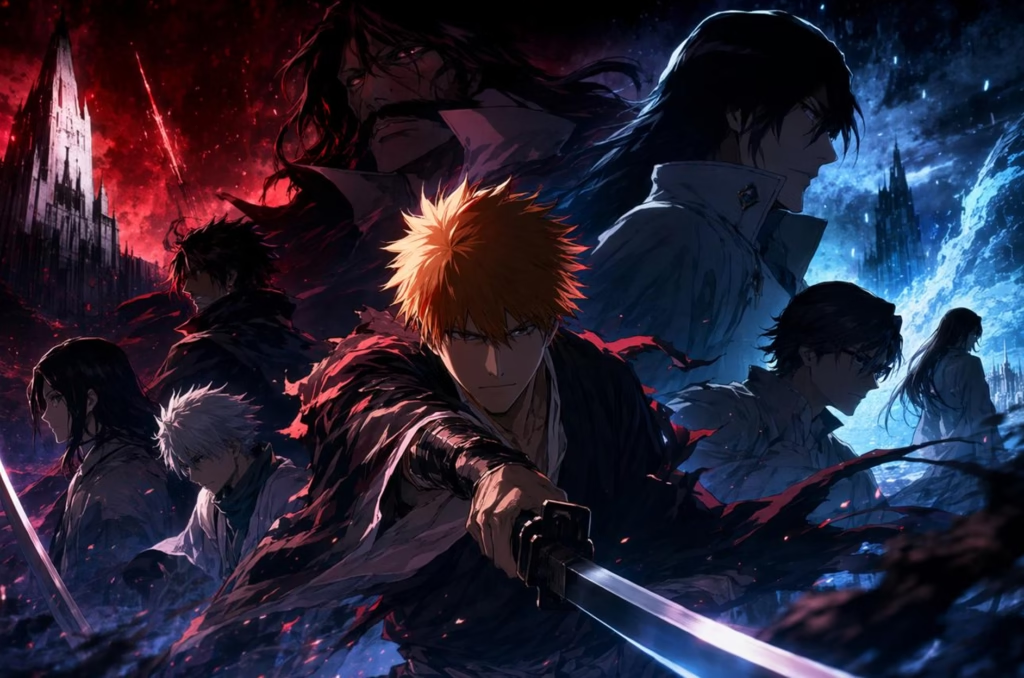
The promotional video revisits the conflict between Ichigo Kurosaki and Yhwach, emphasizing the extraordinary stakes of the Thousand-Year Blood War. Rather than functioning merely as another collection of action scenes, it draws attention to the journey that has brought the characters to this final confrontation.
The trailer also highlights the escalating conflict involving the Soul Society, the World of the Living, and Hueco Mundo. These three realms have been fundamental to Bleach’s mythology, and their involvement reinforces the scale of the concluding battle. The conflict has grown far beyond a conventional struggle between individual warriors, placing the stability of the series’ supernatural world at stake.
For longtime viewers, the emotional significance is difficult to overstate. Ichigo’s story has involved countless confrontations, transformations, and revelations about his identity, but the Thousand-Year Blood War brings together many of the franchise’s most important themes. The final trailer positions the remaining episodes as the culmination of those developments rather than simply another spectacular fight.
What Is Bleach: Thousand-Year Blood War – The Calamity About?
Bleach: Thousand-Year Blood War – The Calamity is the fourth and final part of the anime adaptation of Tite Kubo’s concluding manga arc. The story centers on the devastating war between the Soul Reapers and the Quincy forces led by Yhwach, whose ambitions threaten the established order of the supernatural world.
Throughout the Thousand-Year Blood War, Ichigo Kurosaki and his allies have faced enemies possessing extraordinary abilities, while long-hidden aspects of Soul Society’s history have gradually come to light. The conflict has forced familiar characters to confront their limitations, question their understanding of the past, and discover new dimensions of their powers.
The Calamity brings those developments into their final stage. The surviving combatants face increasingly dangerous circumstances as the consequences of Yhwach’s actions extend beyond individual battles. The series continues to explore the relationship between life, death, identity, and the balance connecting its different realms.
One of the defining characteristics of the final arc is the enormous scale of its conflict. Earlier Bleach storylines frequently revolved around rescuing particular characters, protecting communities, or defeating powerful enemies. The Thousand-Year Blood War expands those concerns into a struggle over the fundamental structure of existence within the franchise’s universe.
Without revealing the manga’s ending or the outcomes of the remaining confrontations, The Calamity represents the point at which the characters’ personal journeys and the larger mythology of Bleach finally converge.
Bleach: The Calamity Has Incredible Ratings – Is It One of 2026’s Best Anime?
Ratings snapshots reported in October 2026; scores and vote totals may change. MyAnimeList and AniList figures were recorded on October 13.
One of the most remarkable aspects of Bleach: Thousand-Year Blood War – The Calamity is the overwhelmingly enthusiastic audience reception it has received before its final episodes have even aired. The fourth part has maintained exceptionally high ratings across major anime databases, reinforcing the sense that the franchise’s long-awaited conclusion has become one of the standout anime events of 2026.
According to an October 13 ratings compilation, The Calamity held a 9.01/10 score on MyAnimeList and 89/100 on AniList. IMDb has also displayed a score around 9.0/10 for the separately listed The Calamity title, while the broader Thousand-Year Blood War series has maintained a similarly impressive 9.0/10 rating. These are audience-generated scores rather than professional critic averages, but their consistency across platforms illustrates the strength of the positive response.
Individual episodes have attracted even more attention. IMDb episode-rating data collected on October 11 identified “Defend You,” the fifth episode of the fourth part, with a 9.7/10 rating, making it the highest-rated episode in that particular compilation. Other installments, including “The Perfect Crimson,” also received exceptionally strong scores, suggesting that the enthusiastic reception extends beyond the opening episodes.
IMDb episode-rating snapshot reported October 11, 2026. Ratings can change.
The significance of these ratings becomes clearer when considering the series’ history. Bleach originally ended its television run in 2012, leaving the manga’s final major arc without an anime adaptation for a decade. When the Thousand-Year Blood War finally premiered in 2022, expectations were enormous, and the production faced the difficult challenge of satisfying longtime fans while introducing the franchise to a new generation.
The strong response to The Calamity suggests that the revival has succeeded in maintaining audience interest across four separate parts. However, high scores do not mean every viewer agrees on the quality of every episode. Some installments have received more mixed reactions, and the final two episodes will be particularly important in shaping the completed adaptation’s reputation.
The Calamity So Far – How the Final Part Has Built Toward Its Conclusion
The fourth part of Bleach: Thousand-Year Blood War premiered on July 25, 2026, continuing the escalating conflict between the Soul Reapers and Yhwach’s Quincy forces. By this stage, the war has already transformed the balance of power across the supernatural realms, and the surviving characters face consequences far greater than those associated with the earlier invasions of Soul Society.
One of the most compelling aspects of The Calamity has been its focus on bringing long-established character journeys toward their conclusions. Ichigo remains central to the story, but the final part also gives considerable attention to the allies, rivals, and former enemies whose decisions influence the larger conflict. This ensemble approach reflects one of Bleach’s defining strengths: its ability to create memorable characters whose personal histories and abilities contribute to the wider mythology.
The season has also continued the adaptation’s emphasis on distinctive battles. Rather than treating every confrontation as a simple competition of physical strength, Bleach frequently builds its action around unusual abilities, psychological pressure, and the tactical consequences of understanding an opponent’s powers. This approach gives the combat an element of unpredictability even when the larger outcome appears increasingly urgent.
Visually, The Calamity continues the dramatic presentation established by the earlier parts of the Thousand-Year Blood War. Intense lighting, expressive color choices, elaborate supernatural effects, and carefully staged confrontations give the series a cinematic atmosphere. These qualities help explain why the adaptation has attracted attention from viewers who may not have followed the original television series during its initial broadcast.
By Episode 48, the story has reached a point where the remaining conflicts can no longer be postponed. The episode, titled “THE END TWO WORLD,” establishes the immediate context for the final two installments, with the danger extending across the three realms central to the franchise. Without revealing its specific developments, the episode serves as the transition into the concluding battle that the final trailer now emphasizes.
Why the Thousand-Year Blood War Has Been Such a Successful Anime Revival
The return of Bleach in 2022 was significant because it addressed one of the most prominent unfinished stories in mainstream shōnen anime. The original television adaptation, which aired from 2004 to 2012, concluded before the manga’s Thousand-Year Blood War arc could be animated. For years, readers knew how the manga ended, while anime-only audiences had no official television adaptation of its final major storyline.
The revival changed that situation by adopting a seasonal production structure rather than returning to the original continuous weekly broadcast format. This allowed the creative team to organize the concluding arc into separate parts, each with its own visual identity and dramatic progression. The approach also gave the adaptation room to present major confrontations with a level of technical ambition that distinguished it from the earlier series.
Another important factor has been Tite Kubo’s involvement in the new adaptation. His participation has helped connect the anime more closely to the original creative vision while supporting the development of material that expands upon the manga. For longtime fans, this has been especially valuable because the Thousand-Year Blood War’s original publication generated discussion about pacing and the amount of attention given to certain developments.
The adaptation’s success is therefore not simply a matter of improved animation. It represents an opportunity to revisit the final arc with additional production resources, modern presentation techniques, and a creative structure suited to a major concluding storyline. The Calamity is the final expression of that approach, carrying the responsibility of bringing the entire revival to a satisfying conclusion.
All Four Parts of Bleach: Thousand-Year Blood War Explained
The Thousand-Year Blood War adaptation has been divided into four major parts, each representing a different stage of the conflict. Together, they form a continuous narrative that adapts the concluding major arc of Tite Kubo’s manga.
|
Part |
Title |
Original premiere |
|---|---|---|
|
Part 1 |
The Blood Warfare |
October 2022 |
|
Part 2 |
The Separation |
July 2023 |
|
Part 3 |
The Conflict |
October 2024 |
|
Part 4 |
The Calamity |
July 25, 2026 |
The first part, The Blood Warfare, reintroduced Ichigo and the Soul Reapers while establishing the Quincy invasion and the scale of the threat posed by Yhwach. Its story emphasized the vulnerability of previously powerful characters and revealed that the conflict involved unresolved history extending far beyond the immediate invasion.
The second part, The Separation, expanded the war through additional confrontations, character revelations, and changes in the relationships between opposing factions. Its title reflected the divisions created by the conflict, including questions of loyalty, identity, and the consequences of decisions made long before the current generation of fighters.
The third part, The Conflict, raised the stakes further by bringing the struggle closer to the foundations of Soul Society’s supernatural order. The adaptation continued introducing elaborate abilities and major confrontations while emphasizing the increasingly dangerous consequences of Yhwach’s ambitions.
Finally, The Calamity brings the conflict toward its conclusion. With the last two episodes scheduled for October 19 and 26, the four-part adaptation will reach 50 episodes, completing the animated Thousand-Year Blood War storyline.
Ichigo Kurosaki and Yhwach – The Final Confrontation That Defines Bleach


At the center of the Thousand-Year Blood War stands the conflict between Ichigo Kurosaki and Yhwach. Their confrontation represents more than a conventional battle between protagonist and antagonist because it draws upon fundamental questions about identity, destiny, power, and the structure of the supernatural world.
Ichigo’s journey has always been defined by his determination to protect the people around him. From his earliest experiences as a Substitute Soul Reaper, his actions have frequently been motivated by personal responsibility rather than a desire for authority. As the series developed, revelations about his origins complicated that identity, forcing him to confront the different forces that shaped his abilities and his place within the world.
Yhwach represents a very different understanding of power. As the leader of the Quincy forces, his ambitions challenge the established order and threaten the balance connecting the realms. His influence extends far beyond individual combat encounters, making him one of the most consequential antagonists in the franchise’s history.
The final episodes will bring these opposing perspectives into their concluding stage. The exact execution of the anime’s final confrontation remains something viewers will have to experience when the episodes premiere, but the narrative stakes have already been established through the previous installments.
For longtime fans, the emotional weight of this conflict comes from watching Ichigo’s journey reach the point toward which the entire final arc has been building. The remaining episodes are expected to provide the definitive animated conclusion to that struggle.
Will The Calamity Expand or Change the Manga Ending?
One of the most interesting questions surrounding the final episodes is whether the anime will expand upon the concluding material from Tite Kubo’s manga. The Thousand-Year Blood War adaptation has already demonstrated a willingness to introduce additional scenes, develop certain confrontations, and provide more context for events that received less attention in the original publication.
This approach has encouraged speculation that the final episodes could contain meaningful additions to the manga’s ending. Such expectations are understandable because the anime has been developed with Kubo’s involvement, and earlier installments have shown that the adaptation is not restricted to reproducing every manga scene exactly as originally published.
However, there is no basis for treating a completely rewritten ending as confirmed. The production committee has announced the final episodes and emphasized their importance, but the specific content of the conclusion remains unreleased. Viewers should distinguish between established examples of expanded anime material and predictions about what the creative team might change in the final two installments.
The additional production time could allow the staff to refine animation, pacing, sound, or other aspects of the episodes, but the official delay announcement does not confirm that the ending itself has been rewritten.
For anime-only viewers, the best approach is to avoid discussions that reveal the manga’s conclusion. Even if the adaptation introduces new material, knowing the original ending could diminish the impact of the remaining episodes.
Bleach: The Calamity Animation and Production
The Thousand-Year Blood War adaptation has become closely associated with the modern visual presentation developed by Pierrot’s production team, including PIERROT FILMS. Compared with the original television series, the revival uses more elaborate digital compositing, dramatic lighting, and a cinematic approach to supernatural combat.
Tomohisa Taguchi has been an important creative figure in the revival, with Hikaru Murata also contributing to its direction. The production combines traditional character animation with modern visual-effects techniques, allowing battles involving enormous spiritual attacks and complex supernatural abilities to maintain a distinctive visual identity.
The final part continues the franchise’s emphasis on carefully designed character silhouettes, striking transformations, and the contrast between darkness and intense supernatural energy. These visual elements are particularly important to Bleach because its characters’ abilities frequently communicate aspects of their personalities and histories.
Shirō Sagisu’s music remains another essential part of the franchise’s identity. His compositions have helped define Bleach’s atmosphere for years, combining orchestral intensity, electronic textures, and memorable thematic material. The Thousand-Year Blood War continues to benefit from that musical foundation, particularly during confrontations where sound and imagery work together to emphasize dramatic revelations.
The decision to postpone the final episodes for additional quality improvements also demonstrates the importance placed on the concluding production. Although the exact work completed during the delay has not been publicly detailed, the official explanation makes clear that the staff wanted more time before delivering the climax.
Bleach: The Calamity Opening and Ending Songs
Music has always played a distinctive role in Bleach, and the fourth part continues that tradition with new opening and ending themes. The opening song is “I-BULL” by jo0ji, while the ending theme is “Rasen” by 9Lana. Both tracks were introduced through promotional material ahead of the final part’s July 2026 premiere.
The opening contributes to the final season’s energetic identity, complementing the increasingly intense battles and dramatic developments. Like many memorable anime openings, it functions as both a musical introduction and a visual expression of the themes that define the season.
The ending theme provides a contrasting emotional atmosphere. Where the opening emphasizes momentum and anticipation, the ending offers an opportunity to reflect on the consequences of the conflict and the characters’ experiences. That contrast is particularly appropriate for a story approaching its conclusion.
For longtime fans, the music also forms part of the emotional connection between the original Bleach television series and its modern revival. The franchise has a long history of memorable opening and ending themes, and the final part adds another pair of songs to that legacy.
Where to Watch Bleach: Thousand-Year Blood War – The Calamity
The official international distribution arrangements for Bleach: Thousand-Year Blood War – The Calamity differ depending on region. In the United States, the anime is available through Hulu, including Hulu on Disney+ for eligible subscribers. Disney+ distributes the series internationally in supported markets, with language availability depending on the territory.
VIZ Media has confirmed that the final two English-subtitled episodes will arrive on October 19 and October 26 at 8:30 AM Pacific Time. The same announcement also provides separate dates for dubbed versions, which will arrive later than the original subtitled releases.
The announced English and Spanish dub dates for Episodes 49 and 50 in the United States are November 23 and November 30, respectively. Disney+ has also published later schedules for selected international dubs, including French-language releases in December. These differences are important because viewers searching for the finale may encounter different availability depending on their preferred audio language.
Although Crunchyroll has published news coverage about the final trailer and release schedule, that does not mean Crunchyroll is the confirmed streaming destination for the series in every region. Viewers should consult Hulu, Disney+, or the official regional distributor to confirm access.
Why Bleach’s Ending Is Such an Important Moment for Anime Fans
The conclusion of Bleach: Thousand-Year Blood War represents a major moment in anime history because it closes a chapter that began long before the current generation of seasonal anime productions. The original manga debuted in 2001, while the television adaptation began in 2004 and became one of the defining international anime series of its era.
Alongside Naruto and One Piece, Bleach helped establish the enormous global popularity of long-running battle shōnen anime. Its distinctive character designs, supernatural mythology, elaborate sword techniques, and memorable soundtrack contributed to a recognizable identity that influenced fan culture throughout the 2000s and beyond.
When the original anime ended in 2012, the absence of an adaptation for the final manga arc left an important part of the franchise unfinished on television. The announcement of the Thousand-Year Blood War revival therefore carried unusual significance, offering the opportunity to complete a story that many fans had waited years to see animated.
The revival has also introduced Bleach to younger viewers who may have discovered the series through streaming services rather than its original television broadcasts. Its modern production values and seasonal structure have helped make the final arc accessible as a contemporary anime event, even while preserving the characters and mythology that established the franchise’s reputation.
The October 26 finale will therefore mark more than the end of a successful 2026 anime season. It will represent the completion of a long-delayed adaptation and a major milestone for one of the most influential action anime franchises of the twenty-first century.
Bleach: Thousand-Year Blood War – The Calamity FAQ
When Does Bleach TYBW Episode 49 Release?
Episode 49 is scheduled for Monday, October 19, 2026, at 8:30 AM Pacific Time for the English-subtitled U.S. streaming release.
When Does Bleach TYBW Episode 50 Release?
Episode 50, the series finale, is scheduled for Monday, October 26, 2026, at 8:30 AM Pacific Time for the English-subtitled U.S. streaming release.
Why Were the Final Two Bleach Episodes Delayed?
The production committee postponed Episodes 49 and 50 to allow additional time to improve production quality ahead of the anime’s conclusion.
Is Episode 50 the Final Episode of Bleach?
Episode 50 is the announced finale of the Bleach: Thousand-Year Blood War anime adaptation. No additional continuation beyond this conclusion has been confirmed through the finale announcements.
When Did Bleach: The Calamity Premiere?
The fourth and final part premiered on July 25, 2026.
How Many Episodes Does Bleach: Thousand-Year Blood War Have?
The complete four-part adaptation is scheduled to reach 50 episodes with the release of its final installment.
Is Bleach: The Calamity Highly Rated?
Yes. An October 13 ratings snapshot reported 9.01/10 on MyAnimeList and 89/100 on AniList. The series has also maintained strong IMDb ratings.
What Is the Highest-Rated Bleach TYBW Episode?
In an October 11 IMDb episode-rating compilation, the fourth part’s “Defend You” held a 9.7/10 rating, making it the highest-rated episode in that snapshot. Rankings may change as additional viewers submit ratings.
Where Can I Watch the Bleach Finale?
Hulu distributes the anime in the United States, while Disney+ provides international access in supported regions. Availability depends on location and subscription.
Will the Bleach Finale Be Dubbed in English?
Yes. VIZ Media lists November 23 and November 30, 2026, for the U.S. English-dubbed releases of Episodes 49 and 50.
Is the Bleach Anime Ending Different From the Manga?
The Thousand-Year Blood War adaptation has included expanded material, but the exact treatment of the final manga events in Episodes 49 and 50 has not yet been revealed.
Is There a New Bleach Trailer?
Yes. The official final promotional video, titled THE LAST PV, was released on October 16, 2026.
Will There Be More Bleach Anime After The Calamity?
No new anime continuation has been confirmed as part of the final-episode announcements. Future projects remain possible, but they should not be treated as official until announced.
Conclusion
Bleach: Thousand-Year Blood War – The Calamity is approaching a conclusion that fans have anticipated for more than a decade, and the final two episodes now have confirmed release dates. Episode 49 arrives on October 19, 2026, while Episode 50 will bring the adaptation to its conclusion on October 26. Although the September postponement extended the wait, the production committee’s decision to prioritize quality reflects the importance of delivering a memorable ending to one of anime’s most recognizable franchises. The release of the final trailer on October 16 has only intensified anticipation for the last confrontation.
The fourth part has already established an impressive reputation through its ambitious visual presentation, character-driven battles, and extraordinary audience ratings. With scores around 9/10 across major anime platforms and individual episodes receiving even higher ratings, The Calamity has demonstrated that Bleach’s revival remains capable of generating enormous enthusiasm. Its strongest moments have combined spectacular action with the emotional weight of character journeys developed over many years, allowing the final arc to feel like a genuine culmination rather than simply another season.
The concluding episodes also carry significant expectations because of the anime’s expanded approach to adapting Tite Kubo’s manga. Viewers are eager to discover how the remaining confrontations will be presented and whether the creative team will introduce additional material to strengthen the final narrative. However, the exact content of the finale remains unreleased, and speculation about major changes should not be confused with official confirmation. What is certain is that the production team has placed considerable importance on the last two installments, making their arrival one of October 2026’s most anticipated anime events.
For longtime fans, the finale represents the completion of a journey that began with Ichigo Kurosaki’s introduction more than two decades ago. For newer audiences, it demonstrates how a classic shōnen franchise can return with modern production values while retaining the characters, mythology, and emotional themes that made it successful. The Thousand-Year Blood War has already secured its place as an ambitious anime revival, and the final episodes will determine how its complete adaptation is remembered.
With the last trailer released, the delay nearly over, and only two episodes remaining, Bleach: Thousand-Year Blood War – The Calamity is entering its defining moment. October 19 and October 26 will mark the final steps in an extraordinary journey, bringing Ichigo, Yhwach, and the world of Bleach toward the conclusion fans have waited years to experience. Whatever the final reception may be, the return of Bleach has already demonstrated the enduring influence of Tite Kubo’s creation and its remarkable ability to captivate anime audiences across generations.
If you don’t know where to watch this Anime for FREE make sure to contact me via E-mail, or in the comments below. Thank you for reading and make sure to bookmark the site.