
 6.1/10
What if the Wild West wasn’t a glorious era of fearless gunslingers, legendary outlaws, and heroic adventures, but instead one of the most dangerous and unpleasant places imaginable? That is the question at the center of A Million Ways to Die in the West, a 2014 Western comedy that transforms the romanticized American frontier into a chaotic landscape filled with disease, violence, ridiculous accidents, and people who seem completely unaware of how dangerous their everyday lives really are. Directed by Seth MacFarlane, the film approaches the traditional Western with a distinctly modern sense of humor, combining outrageous situations, crude jokes, and surprisingly sincere romantic storytelling.
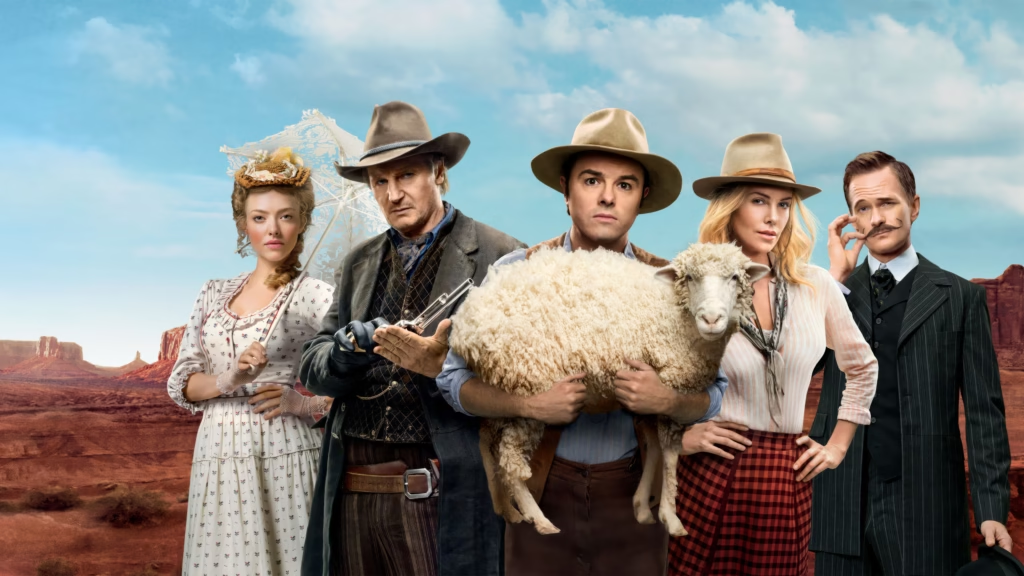
Released in the United States on May 30, 2014, A Million Ways to Die in the West features an ensemble cast led by Seth MacFarlane, Charlize Theron, Amanda Seyfried, Neil Patrick Harris, Giovanni Ribisi, Sarah Silverman, and Liam Neeson. The story follows Albert Stark, a timid sheep farmer who desperately wants to escape his miserable frontier existence after his girlfriend abandons him. However, his plans change when he meets a mysterious woman who teaches him how to defend himself, leading to an unexpected romance and a dangerous confrontation with one of the West’s most notorious outlaws.
The film marked MacFarlane’s second live-action directorial effort following the commercial success of Ted in 2012. While audiences familiar with Family Guy and American Dad! immediately recognized his signature comedic style, the movie also represented an attempt to combine that humor with the visual grandeur of a traditional Hollywood Western. Its sweeping desert landscapes, elaborate costumes, and orchestral soundtrack create an atmosphere that occasionally resembles a serious frontier adventure, even as the characters deliver jokes that deliberately undermine the genre’s conventions.
Despite its recognizable cast and ambitious production, A Million Ways to Die in the West received mixed-to-negative reviews and performed below commercial expectations. Nevertheless, its unusual combination of Western parody, romantic comedy, celebrity cameos, and deliberately outrageous humor has given it a recognizable place within MacFarlane’s filmography. More than a decade after its release, the movie remains an interesting example of how modern comedy can reinterpret a genre traditionally associated with courage, masculinity, and heroic mythology.
A Million Ways to Die in the West – Official Trailer
What Is A Million Ways to Die in the West About?
Set in 1882 in the fictional frontier town of Old Stump, Arizona, A Million Ways to Die in the West introduces Albert Stark, a sheep farmer who possesses almost none of the qualities typically associated with a Western hero. He dislikes violence, avoids confrontation, and considers the American frontier an unnecessarily dangerous place to live. While the other residents of Old Stump appear accustomed to gunfights, deadly illnesses, unpredictable animals, and questionable medical practices, Albert constantly questions why anyone would willingly remain in such an environment.
His already frustrating existence becomes even more miserable when his girlfriend, Louise, ends their relationship after he refuses to participate in a potentially fatal gunfight. Humiliated and convinced that he has little reason to remain in town, Albert begins considering a move to San Francisco, where he hopes to escape the dangers and social expectations of frontier life. However, his situation becomes increasingly complicated when Louise begins spending time with Foy, a wealthy and arrogant local businessman who takes considerable pleasure in demonstrating his supposed superiority.
Albert’s fortunes begin to change after he meets Anna, a confident and mysterious woman who arrives in Old Stump under unusual circumstances. Unlike Albert, Anna is comfortable handling firearms and understands how to survive in a world where violence is frequently unavoidable. Their friendship gradually develops as she offers to teach him how to shoot, helping him prepare for a confrontation that could restore his confidence and challenge the town’s perception of him.
However, Anna has secrets of her own, and her past is connected to Clinch Leatherwood, a ruthless outlaw whose reputation inspires fear throughout the territory. As Albert becomes increasingly attached to Anna, he finds himself drawn into a conflict far more dangerous than the personal rivalry that originally motivated his attempts to become a better gunslinger.
The film uses this premise to combine romantic comedy with Western adventure, presenting a protagonist whose greatest strength is not his ability to shoot but his willingness to recognize the absurdity of the world around him. Rather than celebrating the traditional frontier lifestyle, the story repeatedly highlights its dangers while exploring whether courage necessarily requires becoming the kind of violent hero Albert has always disliked.
Is A Million Ways to Die in the West Worth Watching?
A Million Ways to Die in the West is worth watching for audiences who enjoy irreverent comedies, unconventional Westerns, and Seth MacFarlane’s particular approach to humor. The movie combines exaggerated violence, crude jokes, pop-culture references, and occasional moments of genuine emotional warmth, creating an experience that feels very different from a conventional Western adventure. Its greatest appeal lies in the contrast between the elaborate historical setting and characters who frequently behave as though they possess a distinctly modern understanding of the world.
One of the film’s strongest elements is its central premise. Albert’s refusal to accept the romanticized image of the Wild West creates numerous opportunities for comedy, particularly when he points out the dangers that everyone around him seems willing to ignore. His observations about medical care, personal hygiene, violence, and everyday survival transform familiar Western conventions into sources of absurd humor. For viewers who appreciate satire built around historical misconceptions and genre expectations, these sequences can be especially entertaining.
Charlize Theron also contributes significantly to the film’s appeal. Her performance as Anna provides a grounded emotional presence amid the increasingly ridiculous situations, and her chemistry with MacFarlane helps make the romantic storyline more engaging than it might otherwise have been. Liam Neeson brings intimidating seriousness to the villainous Clinch Leatherwood, while Neil Patrick Harris embraces the exaggerated arrogance of Foy with theatrical enthusiasm.
However, the movie is far from universally appealing. Its humor frequently relies on sexual references, bodily functions, deliberately offensive material, and jokes that extend considerably longer than necessary. Some viewers may find the comedic style exhausting, particularly during sequences where the film temporarily abandons its central storyline in favor of unrelated gags. The lengthy running time also contributes to uneven pacing, making the movie feel less focused than MacFarlane’s earlier success, Ted.
Ultimately, the film is best approached as an outrageous comedy rather than a historically accurate Western or sophisticated genre satire. Viewers who enjoy Family Guy, Ted, and broad adult humor are more likely to appreciate its strengths, while audiences seeking subtle comedy or tightly structured storytelling may find it disappointing.
Why Should You Watch A Million Ways to Die in the West?
One of the main reasons to watch A Million Ways to Die in the West is its willingness to challenge the traditional image of the American frontier. Western movies frequently celebrate courage, independence, and the ability to survive through determination and skill. MacFarlane reverses that perspective by presenting the frontier as a place where even ordinary activities can result in sudden death. The result is a comedic examination of how dangerous life could be without modern medicine, reliable infrastructure, and contemporary standards of safety.
The film also benefits from its impressive ensemble cast. Seth MacFarlane may be the central performer, but Charlize Theron, Liam Neeson, Neil Patrick Harris, Sarah Silverman, and Giovanni Ribisi contribute distinct comedic personalities. Their interactions create a mixture of romantic tension, absurd misunderstandings, exaggerated villainy, and deliberately uncomfortable situations. Several unexpected celebrity appearances further contribute to the movie’s playful relationship with popular culture.
Another attraction is the production’s commitment to recreating the visual atmosphere of a traditional Western. The expansive New Mexico landscapes, carefully designed frontier town, period costumes, and sweeping orchestral music create a surprisingly convincing historical environment. This visual authenticity makes the modern dialogue and ridiculous situations even more effective because the film often looks like a serious Western while behaving like an outrageous contemporary comedy.
The relationship between Albert and Anna also gives the story a more conventional emotional foundation. Beneath the exaggerated jokes and violent encounters is a narrative about confidence, self-acceptance, and recognizing the difference between someone who values you and someone who merely enjoys the attention you provide. Although these themes are presented through broad comedy, they help the movie maintain a recognizable sense of direction.
Finally, the film offers an entertaining collection of references to Western cinema and other popular movies. From familiar genre conventions to unexpected cameo appearances, A Million Ways to Die in the West frequently rewards viewers who recognize the films and television programs being referenced. These details add another layer of enjoyment for audiences interested in Hollywood history and cinematic parody.
Cast and Characters
The ensemble cast is one of the most recognizable aspects of A Million Ways to Die in the West. Rather than relying exclusively on its central protagonist, the film introduces an assortment of eccentric frontier residents, dangerous criminals, romantic rivals, and supporting characters whose personalities contribute to its deliberately chaotic atmosphere.
Seth MacFarlane as Albert Stark
Seth MacFarlane portrays Albert Stark, a timid sheep farmer whose personality contradicts almost every expectation associated with a traditional Western protagonist. Albert is intelligent, sarcastic, and remarkably aware of the dangers surrounding him, but his reluctance to fight makes him an object of ridicule within Old Stump. Unlike conventional gunslingers, he would rather avoid a confrontation than prove his masculinity through violence.
MacFarlane’s performance relies heavily on contemporary dialogue and observational humor, allowing Albert to function as the audience’s perspective on the absurdities of frontier life. His frequent complaints about the West create some of the movie’s most recognizable comedic moments, particularly when he describes ordinary activities as unnecessarily dangerous. However, the character also experiences a more personal journey involving rejection, friendship, and the development of confidence.
Albert’s relationship with Anna becomes central to that transformation. Through their interactions, he gradually learns that courage does not necessarily require abandoning his personality or becoming a ruthless killer. This distinction provides the emotional foundation for a character who initially appears designed almost entirely around jokes.
Charlize Theron as Anna Barnes-Leatherwood
Charlize Theron plays Anna Barnes-Leatherwood, a confident and skilled gunfighter whose arrival changes Albert’s life. Anna is capable of defending herself in dangerous situations and possesses a practical understanding of the frontier that Albert lacks. Her personality contrasts sharply with his anxiety, creating an entertaining dynamic in which she frequently becomes the more traditionally heroic figure.
Theron’s performance is particularly effective because she approaches Anna with sincerity rather than treating every scene as an opportunity for exaggerated comedy. Her confidence, warmth, and occasional vulnerability make the character believable within the film’s otherwise ridiculous world. As Anna and Albert become closer, their relationship introduces emotional stakes that help balance the movie’s outrageous humor.
Anna’s connection to Clinch Leatherwood also adds tension to the story. Her past creates a conflict between personal freedom and the dangerous consequences of escaping a violent relationship. Without revealing the resolution, her storyline gives the film one of its more substantial dramatic elements.
Liam Neeson as Clinch Leatherwood
Liam Neeson portrays Clinch Leatherwood, a notorious outlaw whose violent reputation makes him one of the most feared individuals in the territory. Unlike the movie’s more comically exaggerated characters, Clinch is presented as a genuinely intimidating figure whose actions create serious consequences. His presence introduces a more traditional Western antagonist into a story otherwise dominated by absurdity.
Neeson’s casting is especially effective because of the contrast between his established action-film persona and the movie’s comedic atmosphere. His imposing physical presence and restrained delivery allow Clinch to remain threatening even when the surrounding narrative becomes increasingly ridiculous.
An interesting production detail is that Neeson agreed to play the character while retaining his natural Irish accent. This decision was connected to an earlier Family Guy joke about the idea of Neeson portraying a cowboy without disguising his accent, creating an amusing connection between MacFarlane’s television work and his feature film.
Amanda Seyfried as Louise
Amanda Seyfried portrays Louise, Albert’s former girlfriend, whose decision to end their relationship provides the initial motivation for his personal journey. Louise is dissatisfied with Albert’s reluctance to fight and becomes attracted to Foy, a wealthy local businessman whose confidence and social standing appear more impressive.
Although Louise is not presented as a particularly sympathetic romantic partner, her role is important because she represents Albert’s desire for approval. His attempts to win her back initially motivate him to confront situations that he would normally avoid.
As the story progresses, the relationship also raises questions about whether personal growth should be driven by the desire to impress someone who does not appreciate you. Seyfried plays the character with enough exaggerated self-interest to complement the film’s broad comedic tone.
Neil Patrick Harris as Foy
Neil Patrick Harris plays Foy, Louise’s wealthy and arrogant new boyfriend. Foy is a prominent resident of Old Stump who enjoys demonstrating his supposed sophistication and superiority over Albert. His elaborate appearance, excessive confidence, and theatrical behavior make him one of the movie’s most deliberately ridiculous characters.
Harris embraces the exaggerated nature of the role, turning Foy into a caricature of vanity and social pretension. His rivalry with Albert provides the setup for several memorable comedic sequences, including an increasingly absurd confrontation involving firearms and public humiliation.
The character also participates in the musical number “If You’ve Only Got a Moustache,” one of the film’s most distinctive examples of combining period-inspired entertainment with modern parody.
Giovanni Ribisi as Edward
Giovanni Ribisi portrays Edward, Albert’s closest friend and a local cobbler whose gentle personality contrasts with the aggressive behavior of many frontier residents. Edward is loyal, optimistic, and remarkably innocent, making him one of the film’s more sympathetic supporting characters.
His relationship with Ruth provides a recurring source of comedy because their romantic expectations exist alongside her unconventional profession. Edward’s sincerity and lack of judgment create an amusing contrast with the attitudes of the surrounding community.
Although his storyline is primarily comedic, Edward also represents a different kind of masculinity within the film. Like Albert, he does not fit the traditional image of the fearless Western hero, yet his kindness and emotional loyalty remain important qualities.
Sarah Silverman as Ruth
Sarah Silverman portrays Ruth, Edward’s girlfriend and a prostitute working in Old Stump. Ruth’s storyline revolves around the unusual contrast between her professional activities and her deeply affectionate relationship with Edward.
Silverman’s performance uses the character’s matter-of-fact attitude toward her profession to create deliberately uncomfortable humor. Much of the comedy emerges from the couple’s innocent conversations about romance and intimacy, which frequently contradict the realities of Ruth’s working life.
The character is one of the clearest examples of the film’s reliance on adult humor, making her scenes particularly representative of MacFarlane’s comedic sensibility.
Supporting Cast and Memorable Appearances
The supporting cast includes Wes Studi as Chief Cochise, Evan Jones as Lewis, John Aylward as Pastor Wilson, Matt Clark as the Old Prospector, and Alex Borstein as Millie, the madam of the local brothel. These characters help populate Old Stump with the dangerous, eccentric, and occasionally unfortunate residents who contribute to the movie’s central joke about frontier life.
The film also features several unexpected appearances by recognizable performers. Ryan Reynolds briefly appears as an unfortunate saloon patron, while Ewan McGregor plays a cowboy at the fair. Christopher Lloyd reprises his iconic role as Doc Brown from Back to the Future, and Jamie Foxx appears as Django Freeman in a post-credits sequence referencing Django Unchained.
Additional appearances include Gilbert Gottfried as Abraham Lincoln, Bill Maher as a traveling comedian, and Dennis Haskins as a snake oil salesman. These cameos reinforce the movie’s willingness to interrupt its Western setting with deliberately unexpected references to other films, television personalities, and popular culture.
The Comedy and Satire – Making Fun of the Wild West
The central comedic idea behind A Million Ways to Die in the West is remarkably simple: the American frontier was an extremely dangerous place, and modern audiences often overlook that reality because of the romanticized image created by Western movies. Seth MacFarlane builds the film around this contrast, presenting familiar frontier situations through the perspective of someone who recognizes how absurdly hazardous everyday life can become.
Albert frequently points out that the people around him seem unusually comfortable with the possibility of sudden death. Whether discussing medical treatment, gunfights, dangerous animals, or the absence of modern conveniences, he approaches the West with the skepticism of a contemporary observer. This creates a deliberate anachronism, allowing the movie to examine historical conditions through modern attitudes.
The film also parodies traditional Western masculinity. Classic genre protagonists often establish their authority through physical courage, quick reflexes, and the willingness to confront dangerous opponents. Albert possesses almost none of these qualities, yet his intelligence and emotional awareness eventually become important parts of his personal development.
However, the movie’s satire is not always subtle. Many jokes rely on exaggerated violence, sexual references, bodily functions, and intentionally offensive situations rather than sustained commentary on Western mythology. This approach creates an uneven mixture of clever genre observations and broad shock humor.
For audiences familiar with MacFarlane’s television work, the style will feel immediately recognizable. The movie frequently uses the same combination of unexpected references, deliberately uncomfortable conversations, and absurd escalation that characterizes Family Guy and Ted.
The Wild West Setting – Why the Film Looks Surprisingly Authentic
One of the more impressive aspects of A Million Ways to Die in the West is the attention given to its visual presentation. Despite being an outrageous comedy, the movie often resembles a traditional Hollywood Western through its expansive landscapes, detailed frontier environments, and carefully constructed period atmosphere.
The fictional town of Old Stump provides the central setting, featuring saloons, dusty streets, small businesses, and other familiar elements associated with nineteenth-century frontier communities. These locations create a convincing environment for the characters, even when their dialogue and behavior deliberately contradict the historical setting.
The film’s cinematography also emphasizes the scale of the American landscape. Wide shots of desert terrain, mountains, and open plains evoke the visual traditions of classic Western cinema, creating a sense of grandeur that contrasts with the absurd situations unfolding within those environments.
This contrast is essential to the film’s comedic identity. If the production looked intentionally cheap or cartoonish, many of the jokes would lose their impact. By presenting the setting seriously, the movie allows its modern dialogue and exaggerated behavior to become the primary sources of humor.
The result is a film that demonstrates genuine affection for Western cinema even while repeatedly mocking its conventions. MacFarlane’s admiration for the genre is evident in the visual presentation, soundtrack, and references to classic films.
Production and Development
The development of A Million Ways to Die in the West began during conversations between Seth MacFarlane and his frequent collaborators Alec Sulkin and Wellesley Wild. While watching Western movies during the development of Ted, the writers began joking about how unpleasant and dangerous life in the American frontier must have been.
One important influence was the 1968 Western Hang ‘Em High, which helped inspire the idea of approaching the genre from the perspective of someone who would find its everyday realities terrifying rather than heroic. The concept gradually developed into a feature-length comedy built around a protagonist who openly questions the romanticized image of the West.
MacFarlane also researched historical frontier life while developing the screenplay. Among the materials he consulted was Jeff Guinn’s nonfiction book The Last Gunfight: The Real Story of the Shootout at the O.K. Corral—and How It Changed the American West. The research helped inform the film’s recurring jokes about the many dangers associated with nineteenth-century life.
Several classic Westerns influenced the movie’s characters and visual style. The decision to make Albert a sheep farmer was partly inspired by Montana (1950), while his timid personality drew inspiration from 3:10 to Yuma (1957). Other influences included Oklahoma! (1955), The Man Who Shot Liberty Valance (1962), and El Dorado (1966).
The project was officially announced in December 2012, shortly after the success of Ted. MacFarlane directed the film and co-wrote the screenplay with Sulkin and Wild, while production involved Media Rights Capital, Fuzzy Door Productions, and Bluegrass Films. Universal Pictures handled worldwide distribution.
Casting – How Seth MacFarlane Assembled the Ensemble
Casting for A Million Ways to Die in the West took place primarily between late 2012 and early 2013. Charlize Theron was announced in January 2013, becoming one of the earliest major additions to the production. Her involvement was particularly noteworthy because she was better known for dramatic and action-oriented performances, although she had previously demonstrated considerable comedic ability.
Theron later explained that she actively pursued the opportunity because she wanted to work in comedy. Her enthusiasm for the role helped establish the film’s central romantic dynamic, providing MacFarlane with a co-star capable of balancing the screenplay’s outrageous humor with a more grounded emotional performance.
Amanda Seyfried joined in February 2013, followed by Liam Neeson and Giovanni Ribisi in March. Sarah Silverman was also announced in March, while Neil Patrick Harris joined the production in May. Their casting brought together performers with very different comedic and dramatic backgrounds.
Neeson’s participation was especially memorable because of his insistence on using his Irish accent. The decision referenced a joke from Family Guy, creating a self-aware connection between the actor’s public image and MacFarlane’s established comedic universe.
The production also attracted several performers for smaller roles and cameo appearances. These additions contributed to the film’s unpredictable atmosphere, allowing familiar faces to appear unexpectedly throughout the story.
Filming Locations – Where Was A Million Ways to Die in the West Filmed?
Principal photography began on May 6, 2013, with filming taking place across several locations in New Mexico. The production used areas around Albuquerque and Santa Fe, including Santa Fe Studios, to recreate the fictional Arizona frontier town and its surrounding landscapes.
New Mexico provided an ideal environment for the production because of its extensive desert terrain, mountain scenery, and established infrastructure for Western filmmaking. The region has hosted numerous productions involving historical frontier settings, making it particularly suitable for a movie that required both authentic-looking landscapes and large-scale production facilities.
The filming process was not without difficulties. The cast and crew encountered challenging weather conditions, including intense heat, hailstorms, strong winds, and heavy rainfall. These unpredictable conditions created practical obstacles for a production that relied heavily on outdoor locations.
Principal photography concluded on August 9, 2013, after approximately three months of filming. The production’s commitment to location shooting contributed significantly to the movie’s visual identity, allowing its comedic storyline to unfold against landscapes associated with classic Western cinema.
The finished film demonstrates how much effort went into recreating the genre’s atmosphere. Even when the humor becomes deliberately ridiculous, the surrounding environment remains visually convincing, reinforcing the contrast between the seriousness of the setting and the absurdity of the characters.
Soundtrack and Music – A Surprisingly Traditional Western Score
The musical score for A Million Ways to Die in the West was composed by Joel McNeely, whose work provides the film with a surprisingly traditional Western atmosphere. Rather than relying exclusively on comedic musical cues, McNeely created an orchestral score that frequently treats the story with the seriousness of a conventional frontier adventure.
This approach is particularly effective during sequences involving wide landscape shots, romantic developments, and dramatic confrontations. The music helps establish a sense of scale and emotional importance, even when the surrounding dialogue deliberately undermines the situation.
The soundtrack album was released on May 27, 2014, through Back Lot Music. It includes instrumental compositions such as “Main Title,” “Old Stump,” “The Shooting Lesson,” “Anna and Albert,” “Clinch Hunts Albert,” and “The Showdown.”
The film’s theme song, “A Million Ways to Die,” is performed by country music artist Alan Jackson. Released as a single in April 2014, the song complements the movie’s Western identity while embracing its comedic premise.
Another memorable musical moment involves “If You’ve Only Got a Moustache,” a humorous song performed during a sequence involving Foy. The movie also incorporates a brief reference to Alan Silvestri’s Back to the Future theme during Christopher Lloyd’s cameo, reinforcing the film’s playful relationship with popular cinema.
Hidden References, Easter Eggs, and Celebrity Cameos
One of the most entertaining aspects of A Million Ways to Die in the West is its collection of unexpected references and celebrity appearances. These moments reflect Seth MacFarlane’s long-standing interest in popular culture, a characteristic that has also defined much of his television work.
Christopher Lloyd’s appearance as Doc Brown is among the most recognizable references. The character is briefly shown working on the famous DeLorean time machine, connecting the film to the Back to the Future franchise. The cameo is especially amusing because it introduces a familiar science-fiction character into a nineteenth-century Western setting.
Ryan Reynolds also makes a brief appearance as a saloon patron who encounters Clinch Leatherwood. The scene plays with Reynolds’ recognizable screen presence by giving him an unexpectedly short appearance.
Ewan McGregor appears as a cowboy at the county fair, while Gilbert Gottfried portrays Abraham Lincoln during one of the film’s more surreal sequences. Bill Maher and several other recognizable performers also contribute brief appearances.
The movie’s post-credits scene features Jamie Foxx reprising his role as Django Freeman from Quentin Tarantino’s Django Unchained. The sequence references a racially offensive shooting-gallery attraction and gives Django an opportunity to respond in character. Although the cameo is intended as a surprise, it also demonstrates the film’s willingness to reference other Western productions directly.
These appearances are not essential to understanding the main story, but they provide additional entertainment for viewers who recognize the actors and their associated films.
The Unrated Version – What Is Different From the Theatrical Cut?
A Million Ways to Die in the West was originally released theatrically with a runtime of approximately 116 minutes. However, the film later received an extended unrated version running approximately 135 minutes, adding nearly twenty minutes of material.
The unrated edition includes additional jokes, expanded scenes, and material that did not appear in the original theatrical release. These additions provide more examples of MacFarlane’s deliberately outrageous comedic style, although they also extend a movie that some critics already considered excessively long.
For viewers who particularly enjoy the film’s humor, the unrated version offers additional content and a more extensive look at the characters’ interactions. However, audiences who prefer tighter pacing may find the theatrical version more accessible.
The film was released on DVD and Blu-ray on October 7, 2014, with the Blu-ray edition offering both versions. This allowed viewers to choose between the original theatrical presentation and the extended cut.
The existence of two versions is worth considering when discussing the movie’s pacing. Some criticism of the theatrical release focused on its length, and the unrated edition naturally amplifies that aspect of the experience. Nevertheless, fans of MacFarlane’s comedy may appreciate the opportunity to see additional material.
Release Date and Distribution
A Million Ways to Die in the West held its world premiere at the Regency Village Theater in Los Angeles on May 16, 2014. The film subsequently received a nationwide theatrical release in the United States on May 30, 2014, with Universal Pictures handling distribution.
The release followed the major commercial success of Ted, which had established Seth MacFarlane as a filmmaker capable of attracting large audiences beyond his television projects. As a result, expectations for his second live-action feature were considerable, particularly given the recognizable ensemble cast and substantial marketing campaign.
The movie’s marketing emphasized its outrageous humor, celebrity performers, and unusual Western premise. Trailers highlighted Albert’s complaints about frontier life, the romantic storyline involving Anna, and the dangerous reputation of Clinch Leatherwood.
MacFarlane also wrote a novelization based on the screenplay, which was published on March 4, 2014, before the film’s theatrical release. An audiobook version narrated by Jonathan Frakes was also produced, providing another unusual connection between the project and recognizable entertainment personalities.
Despite the extensive promotional campaign, the film ultimately struggled to match the commercial performance of Ted. Its release nevertheless established it as a distinctive entry within the adult comedy genre during the summer of 2014.
Reception and Critical Response
A Million Ways to Die in the West received mixed-to-negative reviews from professional critics, with much of the criticism focusing on its uneven humor, excessive running time, and reliance on jokes that did not always contribute to the central storyline.
On Rotten Tomatoes, the film holds a 33% critics’ approval rating based on 212 reviews in the supplied review snapshot, with an average score of approximately 4.9/10. Metacritic assigned the movie a score of 44 out of 100, based on 43 critics, indicating mixed or average reviews.
These figures illustrate the divide between the film’s recognizable comedic ambition and the critical response to its execution. Some reviewers appreciated MacFarlane’s willingness to challenge Western conventions and combine contemporary humor with a traditional genre setting. Others felt that the screenplay relied too heavily on crude jokes, repetitive situations, and extended sequences that weakened the overall narrative.
Several critics praised Charlize Theron’s performance, noting that her presence helped provide emotional balance within the movie’s exaggerated atmosphere. The supporting cast also received attention, particularly Neil Patrick Harris and Liam Neeson, whose contrasting performances contributed to the film’s mixture of comedy and conventional Western storytelling.
However, MacFarlane’s performance as the central protagonist received a more divided response. Some reviewers appreciated his sarcastic delivery and modern perspective, while others questioned whether his acting style could sustain a feature-length romantic comedy.
Audience reactions were somewhat more favorable than the critical consensus. CinemaScore reported an average audience grade of B, suggesting that opening-weekend viewers found more enjoyment in the movie than many professional reviewers did.
The critical response ultimately established A Million Ways to Die in the West as a divisive comedy. Its humor appealed strongly to certain audiences while leaving others frustrated by its lack of restraint and inconsistent pacing.
Box Office – Was A Million Ways to Die in the West a Flop?
Despite its recognizable cast and the commercial success of Seth MacFarlane’s previous film, A Million Ways to Die in the West underperformed at the box office.
The movie was produced with an estimated budget of $40 million and earned approximately $86–87 million worldwide, depending on the reporting source and accounting snapshot. The supplied box-office breakdown lists approximately $43.1 million in North America and $43.3 million internationally, for a total of roughly $86.4 million.
Its opening weekend generated approximately $16.8 million in North America, placing the film third behind Maleficent and X-Men: Days of Future Past. This result fell below pre-release expectations of approximately $26 million, indicating that the movie had difficulty attracting the audience anticipated by its marketing campaign.
The film continued to decline during subsequent weekends, earning approximately $7.3 million during its second weekend and $3.2 million during its third. By its fourth weekend, its earnings had fallen to approximately $1.6 million.
Although the worldwide gross exceeded the production budget, theatrical revenue must also account for distribution expenses, marketing costs, and the percentage retained by cinemas. Consequently, a worldwide gross of more than twice the production budget does not automatically guarantee profitability.
Compared with Ted, which became a major commercial success, A Million Ways to Die in the West represented a disappointing theatrical result. Nevertheless, its later home-media release generated additional revenue, with reported United States DVD and Blu-ray sales exceeding $15 million.
The film’s performance demonstrates the difficulty of translating an established comedic style into a different genre. While MacFarlane’s humor had proven commercially successful in television and contemporary comedy, audiences were less enthusiastic about its combination with a lengthy Western adventure.
Why Did A Million Ways to Die in the West Receive Such Mixed Reviews?
One of the main reasons for the film’s divided reception was its inconsistent balance between satire, romantic comedy, and outrageous humor. The central premise offered considerable potential for examining the dangers and contradictions of frontier mythology, but the screenplay frequently shifted away from that idea to focus on unrelated jokes.
The movie’s length also became a recurring criticism. At approximately 116 minutes in its theatrical version, it was considerably longer than many mainstream comedies, and some sequences were perceived as unnecessarily extended. The additional material in the unrated edition further emphasizes how much the film relies on the audience’s tolerance for MacFarlane’s particular comedic rhythm.
Another issue involved the contrast between its ambitious visual presentation and its deliberately juvenile humor. The production invested considerable effort in recreating the atmosphere of classic Western cinema, but the screenplay often interrupted that atmosphere with modern references and bodily-function jokes. For some viewers, the contrast was entertaining; for others, it prevented the movie from developing a consistent identity.
MacFarlane’s central performance also influenced critical opinion. His sarcastic dialogue and contemporary sensibility were essential to the film’s concept, but not every reviewer found him convincing as a romantic leading man.
However, these criticisms do not mean the movie lacks strengths. Its cast, production design, orchestral music, and occasional moments of clever genre satire demonstrate considerable creative ambition. The problem was less a complete absence of good ideas than an inability to develop those ideas consistently across the entire film.
Themes – Courage, Masculinity, Romance, and Survival
Beneath its outrageous humor, A Million Ways to Die in the West explores several recognizable themes associated with traditional Western storytelling. Courage is perhaps the most important, particularly because Albert begins the film convinced that his inability to fight makes him inadequate.
The frontier society surrounding Albert places considerable value on physical bravery, aggression, and the willingness to confront danger. His refusal to participate in gunfights is interpreted as cowardice, even though his reluctance often reflects a perfectly reasonable desire to remain alive.
This creates an interesting distinction between courage and recklessness. Albert’s journey suggests that bravery does not necessarily require seeking danger or proving superiority through violence. Instead, courage can involve recognizing what genuinely matters and choosing to act when circumstances demand it.
The film also examines romantic expectations and self-worth. Albert initially believes that winning back Louise will restore his confidence, but his growing friendship with Anna challenges that assumption. Their relationship encourages him to reconsider what he wants from life and whether the approval of others should determine his identity.
Survival provides another recurring theme, although it is usually expressed through comedy. The movie repeatedly emphasizes that frontier life was dangerous, unpredictable, and frequently unfair. By presenting these realities through exaggerated situations, it questions the idealized mythology that has traditionally surrounded the American West.
How Does A Million Ways to Die in the West Compare to Blazing Saddles?
Comparisons between A Million Ways to Die in the West and Mel Brooks’ Blazing Saddles are understandable because both films use comedy to challenge the conventions of Western cinema. However, their approaches to satire differ considerably.
Blazing Saddles, released in 1974, is widely regarded as one of the most influential Western comedies ever made. Its humor frequently targets racism, political corruption, Hollywood storytelling conventions, and the artificial mythology surrounding the American frontier. The film uses deliberate absurdity to expose the contradictions within traditional Western narratives.
A Million Ways to Die in the West approaches the genre from a more contemporary perspective. Rather than focusing primarily on social institutions or the construction of Western mythology, it emphasizes the dangers of frontier life and the absurdity of romanticizing a period characterized by violence, disease, and limited medical knowledge.
MacFarlane’s film also relies more heavily on modern pop-culture references, crude humor, and romantic comedy. Its protagonist is not a conventional hero confronting a corrupt social system but an ordinary individual who questions why anyone would willingly live in such a dangerous environment.
While Blazing Saddles remains the more influential and critically celebrated work, A Million Ways to Die in the West offers a different interpretation of Western parody. Its appeal depends less on sophisticated genre deconstruction and more on the combination of historical absurdity and MacFarlane’s established comedic style.
Legacy and Impact
More than a decade after its release, A Million Ways to Die in the West occupies an unusual position within Seth MacFarlane’s filmography. It followed the enormous success of Ted but failed to achieve comparable commercial or critical recognition, making it an important example of the challenges involved in expanding a successful comedic formula into a different cinematic genre.
The movie also represents a relatively uncommon attempt to produce a large-scale Western comedy during a period when traditional Westerns were no longer dominant at the box office. Its substantial production values, recognizable cast, and commitment to the genre’s visual traditions distinguish it from lower-budget parodies that rely primarily on exaggerated costumes and familiar stereotypes.
Although the film did not establish a major new comedy franchise, it remains recognizable because of its unusual premise and memorable supporting performances. Charlize Theron’s portrayal of Anna, Liam Neeson’s intimidating villain, and Neil Patrick Harris’ exaggerated Foy contribute to a collection of characters that continue to define the movie’s identity.
Its numerous celebrity cameos have also contributed to its continued visibility in discussions about unexpected film appearances. Christopher Lloyd’s return as Doc Brown and Jamie Foxx’s brief appearance as Django Freeman are particularly memorable examples of MacFarlane’s willingness to incorporate references from unrelated cinematic universes.
The film’s reception also illustrates how difficult it can be to balance parody with conventional storytelling. Its strongest moments demonstrate genuine affection for Western cinema, while its weaker sequences reveal the limitations of relying too heavily on shock humor and extended comedic digressions.
Ultimately, A Million Ways to Die in the West remains a divisive but distinctive comedy. It may not have achieved the reputation of Ted or the cultural influence of Blazing Saddles, but its ambitious production and unusual interpretation of frontier mythology ensure that it remains an interesting entry within the modern Western comedy genre.
Frequently Asked Questions
What Is A Million Ways to Die in the West About?
The film follows Albert Stark, a timid sheep farmer living in the American West in 1882. After his girlfriend leaves him, he befriends a mysterious woman who teaches him how to shoot, eventually becoming involved in a dangerous confrontation with a notorious outlaw.
Is A Million Ways to Die in the West Worth Watching?
Yes, particularly for audiences who enjoy Seth MacFarlane’s humor, adult comedies, Western parodies, and celebrity cameos. However, viewers who dislike crude jokes or lengthy comedic sequences may find the film less enjoyable.
Who Directed A Million Ways to Die in the West?
The movie was directed by Seth MacFarlane, who also co-wrote the screenplay with Alec Sulkin and Wellesley Wild.
Who Plays Albert Stark?
Seth MacFarlane portrays Albert Stark, the film’s central protagonist.
Who Plays Anna in A Million Ways to Die in the West?
Charlize Theron portrays Anna Barnes-Leatherwood, a skilled gunfighter who becomes Albert’s friend and romantic interest.
Who Is the Main Villain?
Liam Neeson portrays Clinch Leatherwood, a dangerous outlaw whose reputation makes him one of the most feared men in the territory.
Is A Million Ways to Die in the West Based on a True Story?
No. The film is a fictional Western comedy, although its creators researched historical frontier life and drew inspiration from several classic Western movies.
When Was A Million Ways to Die in the West Released?
The movie premiered in Los Angeles on May 16, 2014, and received its nationwide United States theatrical release on May 30, 2014.
How Long Is A Million Ways to Die in the West?
The theatrical version runs approximately 116 minutes, while the unrated extended edition runs approximately 135 minutes.
Where Was A Million Ways to Die in the West Filmed?
The movie was filmed primarily in New Mexico, including locations around Albuquerque and Santa Fe.
Is A Million Ways to Die in the West Connected to Family Guy?
The film is not part of the Family Guy storyline, but it shares Seth MacFarlane’s comedic style and features several performers associated with his television projects.
Does Ryan Reynolds Appear in the Movie?
Yes. Ryan Reynolds makes a brief, uncredited appearance as a man who encounters Clinch Leatherwood in a saloon.
Is Christopher Lloyd in A Million Ways to Die in the West?
Yes. Christopher Lloyd briefly reprises his role as Doc Brown from Back to the Future, appearing alongside the famous DeLorean time machine.
Does Jamie Foxx Appear in the Film?
Yes. Jamie Foxx appears as Django Freeman in a post-credits scene referencing Django Unchained.
Was A Million Ways to Die in the West a Box Office Success?
The movie earned approximately $86–87 million worldwide against a reported $40 million production budget. Although its gross exceeded its production costs, it performed below expectations and was considered a commercial disappointment compared with Ted.
Why Did Critics Dislike A Million Ways to Die in the West?
Critics frequently criticized its uneven humor, lengthy runtime, reliance on crude jokes, and inconsistent pacing. However, some praised its cast, visual presentation, and unconventional approach to Western comedy.
Is There an Unrated Version of A Million Ways to Die in the West?
Yes. The unrated version includes additional material and runs approximately 135 minutes, compared with the 116-minute theatrical cut.
Is A Million Ways to Die in the West Suitable for Children?
No. The film contains strong language, sexual humor, graphic violence, and other mature content. It is intended for adult audiences.
Is There a Sequel to A Million Ways to Die in the West?
No official sequel has been released or confirmed.
Conclusion
A Million Ways to Die in the West is an ambitious but uneven Western comedy that combines Seth MacFarlane’s unmistakable humor with the visual style of a traditional Hollywood frontier adventure. Its central premise is both simple and entertaining: instead of celebrating the Wild West as an era of fearless heroes and legendary gunfights, the film presents it as an extraordinarily dangerous environment where even ordinary activities can become fatal. Through Albert Stark’s sarcastic observations and reluctance to embrace frontier violence, MacFarlane challenges familiar Western conventions while creating opportunities for absurd situations, unexpected references, and deliberately outrageous comedy.
The film’s greatest strengths come from its ensemble cast and surprisingly polished production. Charlize Theron provides an engaging emotional presence as Anna, while Liam Neeson brings genuine menace to Clinch Leatherwood. Neil Patrick Harris, Amanda Seyfried, Giovanni Ribisi, and Sarah Silverman contribute additional comedic personalities, helping create a world populated by eccentric characters whose behavior frequently contradicts the seriousness of their surroundings. The expansive New Mexico landscapes, detailed period environments, and orchestral soundtrack also demonstrate a genuine appreciation for Western cinema, making the movie visually impressive even when its jokes become intentionally ridiculous.
However, the film’s weaknesses are equally difficult to ignore. Its lengthy runtime, inconsistent pacing, and reliance on crude humor prevent the central premise from reaching its full potential. Although several sequences offer clever observations about frontier life and traditional masculinity, others feel disconnected from the main storyline or continue longer than necessary. These issues contributed to the movie’s mixed-to-negative critical reception and disappointing box-office performance, particularly when compared with the success of MacFarlane’s earlier film, Ted.
Nevertheless, A Million Ways to Die in the West remains an entertaining option for viewers who appreciate irreverent comedy and unconventional interpretations of familiar genres. Its combination of romantic storytelling, exaggerated violence, celebrity cameos, and Western parody gives it a distinctive identity within MacFarlane’s filmography. While it may not achieve the satirical sophistication of Blazing Saddles or the consistent comedic momentum of his strongest work, it still contains enough memorable moments to appeal to audiences willing to embrace its particular style.
Ultimately, the movie is best understood as a deliberately outrageous love letter to Western cinema that simultaneously mocks many of the genre’s most recognizable traditions. It may not be a universally successful comedy, but its willingness to question the romanticized image of the American frontier gives it a premise that remains entertaining and relevant. For fans of Seth MacFarlane, Charlize Theron, and unconventional Western adventures, A Million Ways to Die in the West offers a chaotic, occasionally clever, and unmistakably distinctive journey through one of cinema’s most enduring genres.
If you don’t know where to watch this Movie for FREE make sure to contact me via E-mail, or in the comments below. Thank you for reading and make sure to bookmark the site.
How useful was this post?
Click on a star to rate it!
Average rating 0 / 5. Vote count: 0
No votes so far! Be the first to rate this post.