
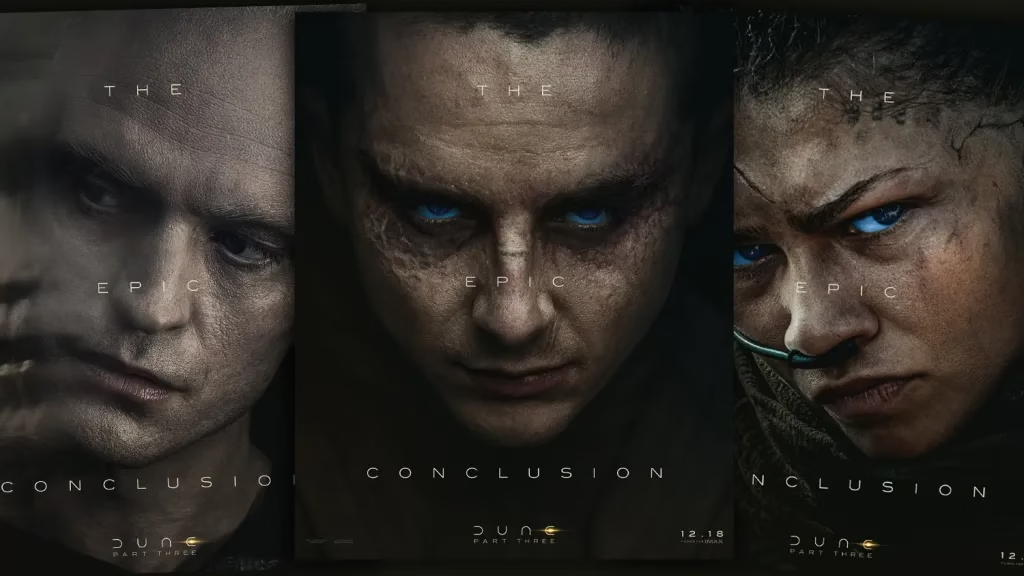
The desert has a new emperor. The prophecy has been fulfilled. The great houses have been brought to their knees, and Paul Atreides has claimed the throne of the known universe. But what happens when the man once hailed as a messiah becomes the very ruler whose power threatens to destroy everything he once believed in?
That is the question at the heart of Dune: Part Three, the highly anticipated final chapter of Denis Villeneuve’s science fiction trilogy. Following the extraordinary success of Dune (2021) and Dune: Part Two (2024), the acclaimed filmmaker returns to Arrakis for a darker, more politically charged conclusion to Paul Atreides’ story.
Scheduled for theatrical release on December 18, 2026, Dune: Part Three draws primarily from Frank Herbert’s 1969 novel Dune Messiah, continuing the story of Paul after his transformation from an exiled nobleman into the all-powerful Padishah Emperor.
However, this is no longer the story of a young man discovering his destiny.
Nearly two decades have passed since Paul’s rise to power. The universe has changed under his rule, and the consequences of his decisions have spread far beyond the deserts of Arrakis. His empire faces growing instability, old allies are questioning their loyalty, and powerful enemies are preparing to exploit the weaknesses of a ruler who can see possible futures but cannot necessarily prevent them.
Timothée Chalamet returns as Paul Atreides, joined by Zendaya as Chani, Florence Pugh as Princess Irulan, Rebecca Ferguson as Lady Jessica, Javier Bardem as Stilgar, Josh Brolin as Gurney Halleck, and Anya Taylor-Joy as Alia Atreides.
Jason Momoa also returns to the franchise, although his role introduces one of the story’s most fascinating science fiction concepts. Meanwhile, Robert Pattinson joins the ensemble as Scytale, a mysterious and morally ambiguous figure whose involvement could threaten the foundations of Paul’s empire.
Behind the camera, Villeneuve reunites with composer Hans Zimmer and editor Joe Walker, while cinematographer Linus Sandgren brings a new visual approach to the franchise. For the first time in Villeneuve’s Dune trilogy, selected sequences were captured using 15/70 mm IMAX film cameras, alongside extensive 65 mm photography.
The result promises to be a visually ambitious conclusion that expands the franchise’s scale while exploring the psychological and political consequences of absolute power.
With a new generation of Atreides heirs, dangerous conspiracies, religious conflict, and a ruler haunted by visions of catastrophe, Dune: Part Three has the potential to become the most emotionally devastating installment of the trilogy.
But how closely will it follow Dune Messiah? Why is Paul now portrayed as a ruthless emperor? What does Robert Pattinson’s Scytale want? And will the film finally reveal the true cost of the prophecy that transformed Arrakis forever?
Here is everything you need to know about Dune: Part Three, including its story, cast, characters, production, soundtrack, IMAX presentation, release date, and the future of Denis Villeneuve’s Dune universe.
Dune: Part Three (2026) – Official Final Trailer
What Is Dune: Part Three About?
Dune: Part Three continues the story of Paul Atreides after his rise to the Imperial throne.
The film takes place approximately seventeen years after the events that established Paul as the ruler of the Imperium.
His transformation into the Padishah Emperor has fundamentally changed the political and religious landscape of the known universe.
The young man who once sought justice for the destruction of House Atreides now possesses extraordinary power, commanding an empire whose future is shaped by his decisions.
However, the consequences of his reign have become increasingly difficult to control.
Religious fanaticism, political resentment, and rebellion threaten the stability of his rule.
Old allies return with complicated loyalties, while new enemies seek opportunities to remove him from power.
Paul is also haunted by visions of possible futures.
His prescient abilities allow him to perceive events that ordinary people cannot comprehend, but this knowledge creates a terrible burden.
He can see the consequences of his choices, yet avoiding one catastrophe may lead directly toward another.
At the center of the unfolding crisis is Chani, the Fremen warrior whose relationship with Paul has been one of the emotional foundations of the trilogy.
Their connection is complicated by the political consequences of Paul’s imperial marriage and the transformation of his identity.
As conspiracies develop and the stability of the empire begins to fracture, Paul must confront the possibility that becoming the messiah has cost him the freedom to determine his own destiny.
Is Dune: Part Three Worth Watching?
Dune: Part Three is one of the most compelling upcoming science fiction releases of 2026, particularly for audiences who appreciated the philosophical complexity and visual ambition of the first two films.
The movie has not yet been released, so its final quality cannot be judged. However, its premise, returning creative team, and source material provide several strong reasons for anticipation.
Unlike the first two installments, which primarily follow Paul’s journey toward political and religious power, the third film explores the consequences of achieving that power.
This creates an opportunity for a more psychologically complex story.
Paul is no longer simply a hero attempting to survive against overwhelming odds. He has become a ruler whose decisions affect countless lives, and whose followers may commit terrible acts in his name.
The return of Timothée Chalamet and Zendaya also promises an emotionally significant continuation of the relationship between Paul and Chani.
Meanwhile, the addition of Robert Pattinson as Scytale introduces a new kind of antagonist, one whose threat may depend more on manipulation and deception than conventional military strength.
The film’s use of large-format photography and Hans Zimmer’s returning score further raises expectations.
For viewers invested in the trilogy, Dune: Part Three is positioned as an essential conclusion rather than an optional continuation.
Why Should You Watch Dune: Part Three?
One of the biggest reasons to anticipate Dune: Part Three is its exploration of what happens after the supposed hero wins.
Many science fiction epics conclude when their protagonist defeats an enemy and claims power. Frank Herbert’s Dune Messiah challenges that structure by examining the consequences of a charismatic leader becoming the center of a religious empire.
The third film also promises a different atmosphere from its predecessors.
Villeneuve has described the story as more tense and action-packed, while its political conspiracies introduce psychological uncertainty and moral ambiguity.
Another major attraction is the cast.
Timothée Chalamet returns to a substantially transformed version of Paul Atreides, while Zendaya, Florence Pugh, Jason Momoa, and Anya Taylor-Joy receive opportunities to explore important developments in their characters’ lives.
Robert Pattinson’s arrival as Scytale is particularly intriguing because the character introduces the mysterious Bene Tleilax and their ability to manipulate human identity.
The cinematography is another significant reason for anticipation. Villeneuve’s decision to incorporate 65 mm film and selected IMAX film sequences marks a major technical evolution for the trilogy.
Finally, Dune: Part Three is intended to conclude Villeneuve’s interpretation of Paul’s journey, making it a potentially defining moment for modern science fiction cinema.
Dune: Part Three (2026) – Quick Facts
| Category | Details |
|---|---|
| Movie Title | Dune: Part Three |
| Release Year | 2026 |
| Genre | Epic Science Fiction, Space Opera, Drama |
| Director | Denis Villeneuve |
| Screenplay | Denis Villeneuve and Brian K. Vaughan |
| Source Material | Frank Herbert’s Dune novels, primarily Dune Messiah |
| Main Star | Timothée Chalamet |
| Main Cast | Zendaya, Jason Momoa, Florence Pugh, Rebecca Ferguson |
| Additional Cast | Robert Pattinson, Anya Taylor-Joy, Javier Bardem, Josh Brolin |
| Composer | Hans Zimmer |
| Cinematographer | Linus Sandgren |
| Editor | Joe Walker |
| Production Company | Legendary Pictures |
| Distributor | Warner Bros. Pictures |
| Principal Photography | July–November 2025 |
| Filming Locations | Hungary and United Arab Emirates |
| U.S. Release Date | December 18, 2026 |
| Premium Formats | IMAX, with other premium formats following |
| Franchise Position | Final installment of Villeneuve’s Dune trilogy |
Dune: Part Three Release Date – When Is It Coming Out?
Dune: Part Three is scheduled to arrive in United States theaters on December 18, 2026.
Warner Bros. Pictures is handling the theatrical release.
The date places the film in the highly competitive holiday movie season, a period traditionally associated with major franchise releases and large-scale cinematic events.
The release strategy also emphasizes premium theatrical presentation.
The movie is scheduled to receive an exclusive three-week IMAX engagement before expanding into additional premium formats such as Dolby Cinema and ScreenX.
Insider screenings are scheduled to begin on December 14, 2026.
The December release represents the culmination of a project that Villeneuve had been considering since the early development of the trilogy.
Although he initially contemplated taking a longer break before adapting Dune Messiah, the film moved into production sooner than originally expected.
Principal photography began in July 2025 and concluded that November, allowing the production to prepare for its planned late-2026 theatrical debut.
Dune: Part Three Story – A Darker Future for Arrakis
The world of Dune: Part Three is very different from the one audiences encountered in the original film.
When Dune began, House Atreides was a powerful noble family attempting to navigate the political dangers of the Imperium.
Paul was the son of Duke Leto Atreides, a young man whose future seemed uncertain despite the expectations surrounding his bloodline.
By the conclusion of Dune: Part Two, everything had changed.
Paul had embraced his identity as the Fremen messiah, challenged the established political order, and claimed the Imperial throne.
However, his victory also unleashed forces that he could not fully control.
The third film explores the aftermath of that transformation.
Nearly seventeen years have passed, and Paul’s empire has become the center of enormous political and religious tensions.
The ruler who once fought against oppression now finds himself maintaining a system of absolute authority.
His enemies see opportunities to challenge him, while some of his former supporters have become disillusioned.
The central conflict is therefore not simply whether Paul can defeat another enemy.
It is whether the empire he created can survive the consequences of his own rise to power.
Why Is Paul Atreides Now a Ruthless Emperor?
Paul Atreides’ transformation is one of the most important elements of the Dune saga.
In the first film, he is introduced as a thoughtful young nobleman who struggles with expectations placed upon him.
He possesses extraordinary potential, but he is also frightened by visions of violence and destruction.
During Dune: Part Two, Paul gradually accepts the religious identity that the Fremen have associated with him.
His ascent gives him the power to challenge the Imperium, but it also turns him into the center of a dangerous political and religious movement.
The third film examines what happens when that movement becomes an empire.
Paul’s authority is no longer theoretical.
He controls the political structure of the known universe, and his decisions carry enormous consequences.
The title of emperor does not simply represent victory.
It represents responsibility, coercion, and the possibility that the person who once resisted tyranny has become an instrument of it.
This transformation is central to Frank Herbert’s original themes.
Dune is not merely a celebration of a chosen hero.
It is also a warning about charismatic leaders, religious fanaticism, and the danger of surrendering individual judgment to a seemingly infallible figure.
Dune: Part Three and Dune Messiah – How Are They Connected?
Dune: Part Three is primarily inspired by Frank Herbert’s second Dune novel, Dune Messiah, published in 1969.
The novel continues Paul’s story after his rise to the Imperial throne.
Rather than presenting another conventional adventure about conquering enemies, Dune Messiah explores the political and psychological consequences of Paul’s reign.
The book is particularly interested in the dangers of absolute power and the burden of prescience.
Paul can perceive possible futures, but his extraordinary abilities do not provide simple solutions.
Instead, they trap him within a network of consequences that become increasingly difficult to escape.
The novel also introduces important conspirators and characters who challenge Paul’s control.
Among them is Scytale, a member of the Bene Tleilax whose abilities make him particularly dangerous.
However, Villeneuve’s adaptation is not expected to reproduce the novel exactly.
The filmmaker has already made significant changes to the chronology and character relationships established in the earlier movies.
The third film extends the time jump to approximately seventeen years, rather than the twelve years associated with the original novel.
These changes suggest that the adaptation will continue prioritizing cinematic storytelling while preserving the broader philosophical themes of Herbert’s work.
How Much Time Passes Between Dune: Part Two and Dune: Part Three?
Approximately seventeen years pass between the events of Dune: Part Two and Dune: Part Three.
This extended time jump is one of the most significant structural differences between the upcoming film and its literary inspiration.
In Dune Messiah, the principal story takes place approximately twelve years after Paul’s rise to power.
Villeneuve’s film expands that interval.
The longer period allows the consequences of Paul’s reign to become more deeply established.
His empire is no longer a recent political development.
It has existed long enough to reshape institutions, loyalties, and the lives of people across the Imperium.
The time jump also allows several characters to return in substantially different circumstances.
Alia Atreides is now an adult, while Paul and Chani’s children introduce a new generation into the story.
These developments make the third installment feel like a new chapter in the history of the universe rather than an immediate continuation of the previous film.
Dune: Part Three Cast and Characters
Dune: Part Three brings together an extensive ensemble of returning stars and new additions.
The cast includes some of the most recognizable actors working in contemporary cinema.
Timothée Chalamet leads the film as Paul Atreides, while Zendaya returns as Chani.
Florence Pugh reprises her role as Princess Irulan, and Rebecca Ferguson returns as Lady Jessica.
Jason Momoa’s appearance introduces an important development involving the legacy of Duncan Idaho.
Anya Taylor-Joy takes on a more substantial role as Alia Atreides, while Robert Pattinson joins the franchise as Scytale.
Javier Bardem and Josh Brolin also return as Stilgar and Gurney Halleck.
The ensemble reflects the film’s expanded political and familial scope.
Rather than concentrating exclusively on Paul’s rise, the story now explores the people affected by his reign and the forces attempting to shape the future of his empire.
Timothée Chalamet as Paul Atreides
Timothée Chalamet returns as Paul Atreides, now the Padishah Emperor and head of House Atreides.
Paul has undergone one of the most dramatic transformations in modern science fiction cinema.
In the original Dune, he was a young nobleman attempting to understand his extraordinary abilities and survive the destruction of his family.
By the end of Dune: Part Two, he had become a powerful religious and political leader.
The third film presents him after nearly two decades of imperial rule.
His power is immense, but his position is increasingly unstable.
He faces rebellion, conspiracy, and the consequences of decisions made in pursuit of his destiny.
Paul’s prescient abilities also continue to shape his understanding of the universe.
However, seeing possible futures does not necessarily mean he can avoid their consequences.
Chalamet’s performance will be central to the film’s success because Paul must now function as both protagonist and a deeply troubling figure of authority.
The character’s journey challenges audiences to reconsider the meaning of heroism within the Dune universe.
Zendaya as Chani
Zendaya returns as Chani, the Fremen warrior whose relationship with Paul has been central to the trilogy.
Chani was introduced as a fiercely independent character with a deep connection to the traditions and struggles of her people.
Her relationship with Paul developed through their shared experiences on Arrakis.
However, Dune: Part Two ended with a major emotional rupture.
Paul’s decision to embrace his messianic identity and enter a political marriage with Princess Irulan placed him in direct conflict with Chani’s beliefs and expectations.
The third film explores the consequences of that separation.
Chani remains one of the most important figures in Paul’s life, but their relationship now exists within the dangerous political environment of his empire.
The premise also positions her at the center of an unfolding mystery.
Her role is particularly significant because she represents a perspective that challenges Paul’s transformation into an authoritarian ruler.
Zendaya’s performance has the potential to provide the emotional foundation for the trilogy’s conclusion.
Jason Momoa as Hayt – The Return of Duncan Idaho
Jason Momoa returns to the Dune franchise as Hayt, a ghola created in the image of Duncan Idaho.
Duncan was one of the most beloved characters in the original film.
A loyal swordmaster of House Atreides, he served as a mentor and protector to Paul.
His death was one of the emotional turning points of the first installment.
However, the Dune universe contains technologies and biological practices that challenge conventional ideas about death and identity.
Hayt is a ghola, an artificial recreation associated with the Bene Tleilax.
Although he resembles Duncan Idaho, his existence introduces complicated questions about memory, personality, and identity.
Is Hayt truly Duncan?
Can a recreated individual recover the experiences of a previous life?
And what happens when a ruler encounters someone who looks exactly like a trusted friend who died years earlier?
Momoa’s return provides an opportunity to explore some of the strangest and most philosophical aspects of Herbert’s science fiction universe.
Florence Pugh as Princess Irulan
Florence Pugh reprises her role as Princess Irulan, the daughter of former Emperor Shaddam IV.
At the conclusion of Dune: Part Two, Paul enters a political marriage with Irulan as part of his consolidation of power.
The marriage establishes a connection between House Atreides and the former Imperial dynasty.
However, it also creates significant personal and political complications.
Irulan occupies a unique position within the empire.
She is Paul’s wife, but their relationship is shaped by political necessity rather than the emotional bond he shares with Chani.
She also possesses knowledge of the Imperial court and the Bene Gesserit’s influence over political affairs.
These connections make her an important figure in the conspiracies surrounding Paul’s reign.
Pugh’s character has the potential to become substantially more complex in the third installment.
Rather than remaining a symbol of political legitimacy, Irulan may become an active participant in the struggle over the future of the Imperium.
Rebecca Ferguson as Lady Jessica
Rebecca Ferguson returns as Lady Jessica, Paul’s mother and a Reverend Mother of the Bene Gesserit.
Jessica has played a crucial role throughout the trilogy.
Her decisions shaped Paul’s upbringing, while her Bene Gesserit training provided him with abilities that ordinary members of the Imperium do not possess.
During Dune: Part Two, Jessica became increasingly involved in the religious transformation of the Fremen.
Her actions helped establish the conditions that allowed Paul to embrace his messianic identity.
In the third film, Jessica returns to a universe transformed by her son’s reign.
Her relationship with Paul is complicated by their shared history and the consequences of the religious movement surrounding him.
As a Reverend Mother, she also possesses knowledge of the political and genetic ambitions of the Bene Gesserit.
Her presence reinforces the connection between Paul’s personal journey and the larger forces that have manipulated the history of the Imperium.
Anya Taylor-Joy as Alia Atreides
Anya Taylor-Joy portrays Alia Atreides, Paul’s younger sister.
Alia was introduced in an unusual way during Dune: Part Two, reflecting her extraordinary circumstances within the Atreides family.
The third film’s extended time jump allows her to appear as an adult.
Alia possesses a unique relationship with the Bene Gesserit and the ancestral memories associated with their abilities.
Her existence challenges conventional boundaries between childhood, adulthood, identity, and inherited knowledge.
As Paul’s sister, she also occupies a significant position within the Imperial family.
Her role introduces another dimension to the political and psychological complexity of House Atreides.
Taylor-Joy’s casting provides the character with a recognizable screen presence, and Alia is expected to be one of the most intriguing figures in the trilogy’s conclusion.
Robert Pattinson as Scytale – The New Villain
Robert Pattinson joins Dune: Part Three as Scytale, a member of the Bene Tleilax and a dangerous figure involved in a conspiracy against Paul Atreides.
Scytale is a Face Dancer, a being capable of changing appearance.
This ability makes him particularly dangerous within a political environment built around secrecy, deception, and competing loyalties.
Unlike conventional antagonists who rely primarily on military power, Scytale operates through manipulation and carefully planned schemes.
His objective involves undermining Paul’s authority and contributing to a plot against the Emperor.
However, Pattinson has described the character as morally ambiguous rather than simply evil.
This distinction is important because the Dune universe rarely presents political conflict through straightforward divisions between heroes and villains.
Scytale’s motivations may challenge audiences to question whether opposing Paul necessarily makes someone morally wrong.
Pattinson’s involvement also introduces a new dynamic to the ensemble.
His reputation for unusual and psychologically complex roles makes him a compelling choice for a character associated with deception and uncertain identity.
Who Are the Bene Tleilax?
The Bene Tleilax are one of the most mysterious groups in Frank Herbert’s Dune universe.
They are associated with advanced biological manipulation and technologies that challenge conventional understandings of human identity.
Their abilities include the creation of gholas, artificially recreated individuals who may resemble people who have died.
The Bene Tleilax are also associated with Face Dancers, beings capable of changing their appearance.
These abilities make them uniquely suited to political manipulation.
In a universe where noble houses, religious organizations, and secret societies compete for influence, the ability to alter identity can become an extraordinarily powerful weapon.
Scytale’s presence in Dune: Part Three introduces this faction more directly into Villeneuve’s cinematic universe.
The Bene Tleilax also provide an important thematic contrast to the Bene Gesserit.
Both groups manipulate humanity through specialized knowledge, but their methods and objectives differ considerably.
Javier Bardem as Stilgar
Javier Bardem returns as Stilgar, the Fremen leader associated with Sietch Tabr.
Stilgar played an essential role in Paul’s rise to power.
Initially, he was a respected leader who helped Paul understand the traditions and survival methods of the Fremen.
However, his relationship with Paul gradually became shaped by religious devotion.
By the conclusion of Dune: Part Two, Stilgar had become one of Paul’s most committed believers.
The third film explores the consequences of that loyalty.
As Paul’s empire faces political instability and rebellion, Stilgar’s faith may be tested by the realities of imperial rule.
His character represents the complicated relationship between genuine belief and political power.
Bardem’s performance has been one of the memorable elements of the trilogy, combining intensity, humor, and sincere religious conviction.
Josh Brolin as Gurney Halleck
Josh Brolin reprises his role as Gurney Halleck, the veteran weapons master of House Atreides.
Gurney served as one of Paul’s mentors during his youth.
His loyalty to House Atreides survived the destruction of the family’s original political position.
During Dune: Part Two, he reunited with Paul and helped support his campaign against their enemies.
The third film brings Gurney into a political landscape transformed by Paul’s imperial authority.
As someone who knew Paul before his rise to power, Gurney possesses a perspective that differs from those who see him primarily as a messiah.
His history with the Atreides family makes him an important connection to Paul’s past.
Brolin’s return also reinforces the continuity between the trilogy’s earlier conflicts and its final chapter.
Isaach de Bankolé as Farok
Isaach de Bankolé joins the cast as Farok, a former member of Paul’s Fedaykin death commandos.
Farok’s background places him among the fighters who helped establish Paul’s power.
However, he has become disillusioned with the Emperor.
This makes him an especially important character within the film’s political themes.
Unlike enemies who oppose Paul because they belong to rival factions, Farok represents disappointment from within the movement that once supported him.
His perspective raises difficult questions.
What happens when people who fought for liberation discover that the new political order has created its own forms of oppression?
Can former supporters challenge the ruler they helped establish?
Farok’s presence suggests that the film will explore the human consequences of Paul’s empire through characters who have experienced its rise firsthand.
Charlotte Rampling as Reverend Mother Mohiam
Charlotte Rampling returns as Reverend Mother Gaius Helen Mohiam.
Mohiam is a powerful member of the Bene Gesserit and previously served as Truthsayer to Emperor Shaddam IV.
She was introduced in the original film as one of the figures evaluating Paul’s extraordinary potential.
Her organization has spent generations attempting to influence political and genetic developments across the Imperium.
However, Paul’s rise disrupted the Bene Gesserit’s carefully constructed plans.
The third film places Mohiam within a world where the consequences of those plans have become increasingly dangerous.
Her involvement connects the political conspiracy to the deeper history of the Bene Gesserit’s manipulation of noble bloodlines.
Rampling’s commanding presence makes Mohiam an effective representative of the secretive organization’s influence.
Nakoa-Wolf Momoa as Leto II Atreides
Nakoa-Wolf Momoa portrays Leto II Atreides, one of Paul and Chani’s twin children.
The character introduces a new generation into the Atreides family.
His existence also expands the emotional stakes of Paul’s reign.
The Emperor is no longer responsible only for his own future or the political survival of House Atreides.
He must also confront the implications of his decisions for his children.
Leto II is an especially significant name within Frank Herbert’s larger Dune mythology.
However, viewers unfamiliar with the novels should avoid assuming that every event associated with the literary character will occur in this adaptation.
The film may modify or reinterpret elements of the source material.
The role also marks Nakoa-Wolf Momoa’s acting debut.
Ida Brooke as Ghanima Atreides
Ida Brooke portrays Ghanima Atreides, the twin sister of Leto II.
Ghanima’s introduction further expands the importance of family and inheritance within the trilogy.
The Atreides bloodline has always been central to the political and religious struggles of the Dune universe.
However, the arrival of a new generation raises questions about the future of Paul’s empire.
Will his children inherit the consequences of his decisions?
Can they escape the expectations associated with their family?
And how will Paul’s visions influence his understanding of their possible futures?
Ghanima’s role contributes to the film’s broader exploration of destiny, identity, and the burden of inherited power.
The Meaning of Paul and Chani’s Children
The introduction of Leto II and Ghanima represents a major development in the story.
Throughout the first two films, Paul’s decisions were driven by survival, revenge, political ambition, and his relationship with Chani.
The presence of children changes those priorities.
Paul must now consider the future of individuals whose lives are directly connected to his own.
Their existence also introduces questions about inheritance.
In the Dune universe, bloodlines are not merely family histories.
They are political instruments, religious symbols, and the focus of generations of genetic manipulation.
The Atreides twins therefore represent more than a personal development.
They symbolize the future of a dynasty whose influence has transformed the known universe.
Denis Villeneuve’s Vision for the Dune Trilogy
Denis Villeneuve began considering a three-film adaptation of Frank Herbert’s universe during the development of the original Dune.
His initial commitment involved adapting the first novel across two films.
However, he recognized that Paul’s story did not truly conclude with his ascent to power.
The ending of the original novel establishes Paul as a dominant political figure, but Dune Messiah examines the consequences of that victory.
Villeneuve therefore viewed a third film as an opportunity to complete the central character arc.
Rather than adapting every novel in Herbert’s series, his goal was to create a cohesive trilogy centered on Paul’s transformation.
This distinction is important.
Dune: Part Three is intended to conclude Villeneuve’s story about Paul, not necessarily every narrative possibility within the wider Dune universe.
The filmmaker has described the third installment as different in tone from its predecessors.
Its emphasis on conspiracy, tension, and imperial power reflects the darker implications of Paul’s journey.
How Dune: Part Three Was Developed
The development of Dune: Part Three began before the second film reached theaters.
Villeneuve started working on the screenplay in August 2023.
His primary objective was to construct a satisfying conclusion to Paul’s story while adapting the complex political and philosophical material of Dune Messiah.
Following the success of Dune: Part Two, Legendary Pictures approved development of the third installment in April 2024.
Warner Bros. subsequently announced a December 18, 2026 release date for an untitled Villeneuve project.
Industry publications quickly connected the date to the anticipated continuation of Dune.
The screenplay continued developing through at least September or October 2024.
The finished script credits Villeneuve and Brian K. Vaughan.
The production ultimately moved forward in 2025, with filming beginning in July.
This schedule allowed Villeneuve to continue the trilogy without the lengthy break he had previously considered.
Brian K. Vaughan – The Co-Writer of Dune: Part Three
Brian K. Vaughan is credited alongside Denis Villeneuve as a writer of Dune: Part Three.
Vaughan is widely recognized for his work in comics and speculative fiction.
His storytelling frequently explores complex societies, political conflict, identity, and the consequences of extraordinary circumstances.
These themes make him an interesting creative collaborator for a film based on Dune Messiah.
The third installment requires the screenplay to balance political intrigue with the emotional consequences of Paul’s transformation.
It must also introduce new characters and concepts while concluding the trilogy’s central narrative.
Vaughan’s involvement suggests an emphasis on adapting the source material into a coherent cinematic story rather than reproducing every detail of the novel.
However, the precise division of writing responsibilities between Vaughan and Villeneuve has not been established in the supplied information.
Dune: Part Three Filming – When Did Production Begin?
Principal photography began on July 8, 2025.
The production started at Origo Film Studios in Budapest, Hungary.
Hungary had already served as an important production location for the earlier films, making it a familiar environment for the creative team.
The filmmakers also returned to the United Arab Emirates for desert photography.
In August 2025, the Abu Dhabi Film Commission confirmed that filming would take place in Liwa Oasis later that year.
The location provides the expansive desert landscapes essential to the visual identity of Arrakis.
Principal photography concluded on November 11, 2025.
The production therefore spent approximately four months capturing the material required for the trilogy’s final installment.
Where Was Dune: Part Three Filmed?
Dune: Part Three was filmed primarily in Hungary and the United Arab Emirates.
Origo Film Studios in Budapest served as a major production base.
The studio environment allowed the filmmakers to construct elaborate sets and control the technical requirements of large-scale science fiction filmmaking.
The production also used Liwa Oasis in Abu Dhabi.
This region is known for its enormous sand dunes and dramatic desert landscapes.
Its environment provides a natural foundation for the fictional planet Arrakis.
The decision to return to real desert locations reflects Villeneuve’s commitment to physical environments.
Although the Dune films rely on extensive visual effects, their landscapes often begin with real-world locations.
This approach helps establish the immense scale and physical presence associated with the franchise.
Linus Sandgren – The New Cinematographer
Linus Sandgren served as cinematographer on Dune: Part Three.
He replaced Greig Fraser, who photographed the first two installments.
Fraser was unable to return because of a prior commitment to Sam Mendes’ The Beatles – A Four-Film Cinematic Event.
Sandgren brings considerable experience with large-format filmmaking.
His involvement also coincides with a significant change in the trilogy’s visual approach.
Where the first two films relied on IMAX-certified digital cameras, the third installment incorporates extensive 65 mm film photography.
Selected sequences were also captured using 15/70 mm IMAX film cameras.
This represents the first time Villeneuve has used that format for a feature film.
The change creates opportunities for a different visual texture while preserving the monumental scale associated with the franchise.
Dune: Part Three IMAX – Why the Format Matters
IMAX has been an important part of the Dune franchise’s theatrical identity.
The first two films used expanded image formats to emphasize the enormous scale of Arrakis, its architecture, and its desert landscapes.
However, Dune: Part Three introduces a significant technical development.
Selected sequences were photographed using 15/70 mm IMAX film cameras.
The production also used 65 mm film stock for much of the movie.
This differs from the earlier installments, which were captured digitally using IMAX-certified cameras.
The decision to use large-format film can influence texture, detail, and the visual presentation of certain sequences.
However, it is important to distinguish between IMAX exhibition and IMAX film photography.
Not every scene in Dune: Part Three was captured using 15/70 mm IMAX film cameras.
The production combines different formats according to the creative and practical requirements of individual sequences.
Was Dune: Part Three Entirely Shot in IMAX?
No. The film was not entirely photographed using IMAX film cameras.
Although early comments suggested that the entire production might use IMAX cameras, subsequent reporting clarified the situation.
The movie was primarily captured on 65 mm film.
Selected sequences used 15/70 mm IMAX film cameras.
Desert scenes continued to use IMAX-certified digital cameras.
Villeneuve explained that digital photography remained particularly suitable for preserving the harsh visual qualities of the desert environment.
The combination of formats allows the filmmakers to choose different technical approaches for different settings.
This makes Dune: Part Three a hybrid production rather than an exclusively IMAX-film project.
What Is the Psychedelic Unit in Dune: Part Three?
One of the more unusual production details concerns a third filmmaking unit described as a psychedelic unit.
The team consisted of two French-Canadian filmmakers.
According to the supplied production information, their work contributed unusual and visually ambitious imagery to the movie.
The precise sequences created by this unit have not been fully detailed.
However, the concept is particularly appropriate for the Dune universe.
Paul’s prescient visions, the influence of spice, and the psychological experiences associated with heightened consciousness have always been important elements of the franchise.
The inclusion of a specialized visual unit suggests that the third film may explore these experiences through distinctive cinematic imagery.
Until the film is released, the exact nature of those sequences remains uncertain.
Joe Walker Returns as Editor
Joe Walker returns as editor for Dune: Part Three.
Walker previously edited the first two films, helping establish their distinctive rhythm and storytelling structure.
Editing is particularly important in a franchise that combines enormous visual spectacle with complex political and philosophical material.
The films must move between intimate character moments, large-scale action, and information about unfamiliar institutions.
Walker’s experience with the earlier installments provides valuable continuity.
His return also helps maintain the trilogy’s overall cinematic identity despite changes in cinematography and story structure.
The third film’s emphasis on conspiracy and psychological tension may require a different editing rhythm from the large-scale warfare of Dune: Part Two.
Hans Zimmer Returns for Dune: Part Three
Hans Zimmer returns to compose the score for Dune: Part Three.
Zimmer’s music has been one of the defining elements of Villeneuve’s adaptation.
The earlier films used unusual vocal textures, powerful percussion, and atmospheric sound design to establish the cultural and spiritual identity of Arrakis.
Rather than relying exclusively on conventional orchestral themes, Zimmer created a musical environment that feels ancient, unfamiliar, and monumental.
His return provides continuity across the trilogy.
However, the third film’s darker story may require a different emotional approach.
Paul is no longer discovering the power associated with his destiny.
He is confronting the consequences of that power.
The music therefore has the opportunity to reflect a world transformed by religious devotion, political violence, and the psychological burden of prescience.
Dune: Part Three Soundtrack – Desert Chant
The first soundtrack single from Dune: Part Three, titled “Desert Chant,” was released on October 20, 2026.
The track was issued through WaterTower Music.
Its release provided audiences with an early opportunity to experience Hans Zimmer’s musical direction for the third installment.
The title evokes the desert environment and religious atmosphere associated with the Dune universe.
However, the full soundtrack’s structure and its relationship to individual scenes cannot be evaluated until additional material becomes available.
The track’s release also forms part of the promotional buildup toward the film’s December premiere.
Dune: Part Three Trailer – What Has Been Revealed?
Promotional material for Dune: Part Three has emphasized the continuation of Paul’s story and the scale of Villeneuve’s final installment.
The campaign has also highlighted the film’s large-format theatrical presentation.
A short preview was shown during IMAX 70 mm screenings of Christopher Nolan’s The Odyssey.
The preview included a message from Villeneuve thanking Nolan.
This promotional strategy connected two major filmmakers associated with ambitious theatrical experiences.
It also introduced Dune: Part Three to audiences already interested in large-format cinema.
However, promotional footage should not be treated as confirmation of every major plot development.
The full nature of the film’s conspiracies, character relationships, and ending remains unknown before release.
Dune: Part Three IMAX Tickets – Why Demand Is So High
Advance ticket sales for Dune: Part Three have attracted considerable attention.
IMAX 70 mm tickets initially went on sale at nineteen locations in April 2026.
Those tickets reportedly sold out within minutes.
Another ticket sale took place on August 18, 2026.
Demand was strong enough to produce long waiting times and website crashes.
The response reflects the popularity of premium large-format screenings among fans of Villeneuve’s filmmaking.
It also demonstrates the importance of IMAX presentation to the franchise’s theatrical identity.
For audiences interested in experiencing the movie in its most expansive available format, early ticket demand has become an important part of the release campaign.
Dune: Part Three Presales – A Major Box Office Signal
Dune: Part Three reportedly generated more than $1.2 million in early ticket presales.
This exceeded the first-day presale benchmark associated with Christopher Nolan’s The Odyssey, which had reached approximately $1 million in the supplied information.
At London’s BFI IMAX, approximately 33,000 advance tickets were reportedly sold within the first 24 hours.
These figures indicate strong enthusiasm for premium screenings.
However, advance ticket sales do not guarantee a particular worldwide box-office result.
The movie’s eventual commercial performance will depend on factors including audience reception, general ticket sales, international markets, and competition from other releases.
For now, the presale figures demonstrate substantial early demand.
Dune: Part Three vs. Avengers: Doomsday
The December 2026 release period places Dune: Part Three in direct competition with another major franchise event, Avengers: Doomsday.
Both films are designed to attract large theatrical audiences.
However, they represent different approaches to blockbuster storytelling.
Dune: Part Three is positioned as the conclusion of Villeneuve’s character-driven science fiction trilogy.
Its appeal centers on visual scale, political drama, philosophical themes, and the conclusion of Paul’s story.
Avengers: Doomsday, by contrast, belongs to the interconnected Marvel Cinematic Universe.
Its appeal is tied to superhero spectacle and the continuation of an established franchise narrative.
The competition is especially notable in premium theatrical formats.
According to the supplied release information, Dune: Part Three secured an initial three-week exclusive IMAX engagement.
That arrangement gives the film an important advantage for audiences specifically seeking IMAX screenings during the opening holiday period.
Will Dune: Part Three Be the Final Dune Movie?
Dune: Part Three is intended to be the final installment of Denis Villeneuve’s trilogy.
The director has repeatedly framed the third film as the conclusion of his adaptation of Paul’s central character arc.
However, that does not necessarily mean the end of the entire Dune franchise.
Frank Herbert wrote additional novels exploring the long-term consequences of the Atreides dynasty and the evolution of humanity across enormous periods of time.
The fictional universe therefore contains substantial material beyond Dune Messiah.
Legendary Pictures could potentially pursue additional adaptations or related projects.
Nevertheless, no future film should be treated as confirmed solely because more source material exists.
Villeneuve’s stated objective is to complete his trilogy with Dune: Part Three.
Why Dune: Part Three Could Be the Darkest Film in the Trilogy
The first two Dune films contained considerable violence, tragedy, and political manipulation.
However, their narrative structure still followed a recognizable journey of survival and ascent.
The third film moves beyond that structure.
Paul has already achieved the power that many protagonists spend entire stories pursuing.
Instead of fighting to become emperor, he must confront the consequences of being emperor.
This creates a darker psychological foundation.
His visions may reveal catastrophic futures, but his ability to prevent them remains uncertain.
His closest relationships are complicated by political obligations.
His former supporters may now question the legitimacy of his rule.
The conspiracy surrounding him also introduces a constant atmosphere of uncertainty.
Villeneuve’s description of the movie as more tense and action-packed suggests that these conflicts will be presented through both psychological drama and large-scale cinematic spectacle.
The Political Themes of Dune: Part Three
One of the most important themes of Dune: Part Three is the danger of absolute political power.
Paul Atreides begins the trilogy as a victim of imperial manipulation.
His family is destroyed through political conspiracy, forcing him into exile.
However, his eventual victory places him at the center of the same system of authority that once threatened him.
The third film explores this transformation.
Paul’s position as emperor gives him extraordinary control, but it also creates a system in which his decisions can affect entire populations.
The story raises questions about the relationship between authority and morality.
Can a ruler who believes he is preventing catastrophe justify actions that cause enormous suffering?
Does the ability to foresee possible futures provide moral legitimacy?
And what happens when a population treats its leader as an unquestionable religious figure?
These questions are central to Frank Herbert’s work and remain highly relevant to the cinematic adaptation.
Religion and the Messiah Myth in Dune
Religion has been central to Villeneuve’s Dune trilogy from the beginning.
The Bene Gesserit have spent generations influencing cultures and belief systems to create opportunities for political manipulation.
Among the Fremen, these influences helped establish expectations surrounding a prophetic figure.
Paul’s arrival on Arrakis eventually placed him at the center of those beliefs.
However, Dune: Part Two demonstrated the dangers of his transformation into a religious leader.
His followers interpreted his actions through prophecy, while his political ambitions became increasingly inseparable from spiritual authority.
The third film explores the consequences of that development.
Paul is no longer simply someone believed to fulfill a prophecy.
He is the ruler of an empire shaped by the religious movement surrounding him.
The story therefore challenges the assumption that a messianic figure necessarily produces liberation or justice.
Prescience – Can Paul Atreides Change the Future?
Paul’s prescient abilities are among the most important concepts in the Dune universe.
Through his unique genetic heritage, training, and exposure to spice, Paul can perceive possible futures.
However, prescience is not the same as unlimited control.
The future is influenced by countless decisions, relationships, and political forces.
Paul may recognize potential catastrophes, but avoiding them can create new consequences.
This produces one of the central paradoxes of his character.
The more he understands the future, the more trapped he may become by that knowledge.
The third film places this burden at the center of his reign.
As emperor, Paul must make decisions affecting an enormous population while confronting visions of possible collapse.
His extraordinary abilities therefore become a source of psychological suffering rather than a simple advantage.
The Relationship Between Paul and Chani
Paul and Chani’s relationship has been one of the emotional foundations of the trilogy.
Their connection developed through shared hardship and mutual understanding.
Chani initially encountered Paul as an outsider attempting to survive within Fremen society.
Over time, their relationship became increasingly intimate.
However, Paul’s transformation into a messianic political figure created a fundamental conflict.
Chani’s independence and skepticism placed her at odds with the religious movement surrounding him.
The conclusion of Dune: Part Two left their relationship deeply fractured.
The third film must now address the consequences of that separation.
Their connection remains emotionally important, but Paul’s imperial responsibilities and political marriage complicate any possibility of returning to their earlier relationship.
The presence of their children also raises the stakes.
Their story is no longer simply about two individuals in love.
It concerns the future of a family whose decisions may shape the entire Imperium.
The Bene Gesserit and the Struggle for Control
The Bene Gesserit remain one of the most influential organizations in the Dune universe.
Their members possess extraordinary training in physical control, observation, political manipulation, and psychological influence.
For generations, the organization has attempted to shape the development of humanity through carefully managed bloodlines.
Paul’s existence is connected to these ambitions.
However, his rise to power disrupted the organization’s plans.
The third film brings several important Bene Gesserit figures back into the story.
Lady Jessica and Reverend Mother Mohiam represent different aspects of the organization’s influence.
Princess Irulan also possesses connections to the Bene Gesserit’s political world.
Their involvement suggests that the struggle for control over Paul’s empire extends far beyond conventional military conflict.
It also involves secret knowledge, inherited abilities, and competing visions of humanity’s future.
The Future of House Atreides
House Atreides has undergone an extraordinary transformation across the trilogy.
In the first film, it was a respected noble family destroyed by political betrayal.
In the second, Paul restored its power through the Fremen and claimed the Imperial throne.
The third installment explores the consequences of that victory.
House Atreides is now the ruling dynasty of the Imperium.
However, its future is threatened by conspiracy, political resentment, and the psychological burden of Paul’s prescience.
The introduction of Leto II and Ghanima also shifts attention toward the next generation.
Their existence raises questions about succession and the inheritance of political power.
The central issue is no longer simply whether House Atreides can survive.
It is whether the dynasty can escape the consequences of the forces that created its empire.
Dune: Part Three Awards and Early Recognition
Although Dune: Part Three has not yet been released, its promotional campaign has already received awards attention.
At the 2026 Astra Midseason Movie Awards, the film was nominated for Most Anticipated Film of the Second Half of 2026.
Its promotional material also received recognition at the Golden Trailer Awards.
The supplied awards information lists nominations for Best Fantasy/Adventure and Best Summer 2026 Blockbuster Trailer.
The campaign also won Best Original Score at the Golden Trailer Awards.
These honors reflect anticipation for the film and recognition of its promotional presentation.
However, they should not be confused with awards for the completed movie.
Critical reception, audience response, and major film awards will only become clear after release.
Will Dune: Part Three Be Better Than Dune: Part Two?
It is too early to determine whether Dune: Part Three will surpass its predecessor.
Dune: Part Two received substantial acclaim for its scale, action, performances, and adaptation of Herbert’s novel.
The third installment faces a different challenge.
Rather than escalating the conflict toward a conventional victory, it must examine the consequences of that victory.
This requires a more complicated portrayal of Paul Atreides.
The film must also balance new characters, political conspiracies, and the emotional resolution of relationships established across the trilogy.
Villeneuve’s returning creative team provides continuity, while the introduction of new cinematographic techniques offers opportunities for visual experimentation.
Ultimately, the third film’s success will depend on how effectively it transforms the philosophical complexity of Dune Messiah into a compelling cinematic conclusion.
Frequently Asked Questions
What Is Dune: Part Three About?
Dune: Part Three follows Paul Atreides approximately seventeen years after becoming Emperor, as he confronts political conspiracies, rebellion, and the consequences of his reign.
When Is Dune: Part Three Coming Out?
The film is scheduled for release in United States theaters on December 18, 2026.
Who Is Directing Dune: Part Three?
Denis Villeneuve returns as director.
Who Wrote Dune: Part Three?
The screenplay is credited to Denis Villeneuve and Brian K. Vaughan.
Is Dune: Part Three Based on Dune Messiah?
Yes. The film draws primarily from Frank Herbert’s 1969 novel Dune Messiah, with changes to the timeline and story.
How Many Years After Dune: Part Two Does Part Three Take Place?
The film takes place approximately seventeen years later.
Who Plays Paul Atreides?
Timothée Chalamet returns as Paul Atreides.
Does Zendaya Return as Chani?
Yes. Zendaya reprises her role as Chani.
Is Jason Momoa in Dune: Part Three?
Yes. Jason Momoa returns as Hayt, a ghola created in the image of Duncan Idaho.
How Can Duncan Idaho Return After Dying?
The Dune universe includes gholas, artificially recreated individuals associated with Bene Tleilax technology. Hayt resembles Duncan Idaho, although questions of identity and memory are central to the concept.
Who Plays Scytale in Dune: Part Three?
Robert Pattinson portrays Scytale.
Is Scytale the Main Villain?
Scytale is an important conspirator working against Paul, but the full structure of the film’s antagonists remains uncertain before release.
Who Is Alia Atreides?
Alia is Paul’s younger sister, portrayed by Anya Taylor-Joy.
Does Florence Pugh Return?
Yes. Florence Pugh returns as Princess Irulan.
Is Rebecca Ferguson in Dune: Part Three?
Yes. She reprises her role as Lady Jessica.
Does Javier Bardem Return as Stilgar?
Yes. Javier Bardem returns as Stilgar.
Is Josh Brolin Returning?
Yes. Josh Brolin reprises his role as Gurney Halleck.
Who Plays Leto II Atreides?
Nakoa-Wolf Momoa portrays Leto II.
Who Plays Ghanima Atreides?
Ida Brooke portrays Ghanima.
Who Are the Bene Tleilax?
The Bene Tleilax are a mysterious faction associated with biological manipulation, gholas, and Face Dancers.
Where Was Dune: Part Three Filmed?
Principal photography took place in Hungary and the United Arab Emirates, including Budapest and Liwa Oasis.
When Did Filming Begin?
Filming began on July 8, 2025.
When Did Filming End?
Principal photography wrapped on November 11, 2025.
Who Is the Cinematographer?
Linus Sandgren served as cinematographer, replacing Greig Fraser.
Was Dune: Part Three Shot on IMAX Film?
Selected sequences were shot using 15/70 mm IMAX film cameras. Much of the movie was photographed on 65 mm film, while some desert sequences used IMAX-certified digital cameras.
Who Composed the Soundtrack?
Hans Zimmer returns as composer.
What Is the First Dune: Part Three Soundtrack Single?
“Desert Chant” was released on October 20, 2026.
Will Dune: Part Three Be Available in IMAX?
Yes. The film is scheduled for a major IMAX theatrical release, including an initial three-week exclusive engagement.
Is Dune: Part Three Competing With Avengers: Doomsday?
Yes. Both films are major releases associated with the December 2026 theatrical period.
How Much Has Dune: Part Three Made in Presales?
The supplied information reports more than $1.2 million in early presales, primarily reflecting strong demand for premium screenings.
Is Dune: Part Three the Final Movie?
It is intended to conclude Denis Villeneuve’s Dune trilogy and Paul’s central story arc.
Will There Be a Dune: Part Four?
No fourth film has been confirmed in the supplied information. The wider literary universe contains additional stories, but Villeneuve has positioned the third installment as his conclusion.
Is Dune: Part Three Worth Watching?
For fans of the first two films, it is one of the most anticipated releases of 2026. Its actual quality can only be assessed after its theatrical debut.
Conclusion
Dune: Part Three represents the culmination of one of the most ambitious science fiction trilogies in modern cinema. Denis Villeneuve’s adaptation of Frank Herbert’s universe began with the destruction of House Atreides, continued through Paul’s transformation into a religious and political leader, and now approaches its conclusion with a story about the devastating consequences of absolute power.
The third installment promises to challenge the assumptions established by the earlier films. Paul Atreides is no longer the young nobleman audiences first encountered in 2021. He is now the Padishah Emperor, a ruler whose extraordinary abilities and political authority have transformed the known universe. However, the power he once pursued has become inseparable from the suffering, instability, and conspiracies surrounding his reign.
This transformation gives Dune: Part Three an unusually compelling foundation. Rather than celebrating the triumph of a chosen hero, the film explores the danger of charismatic leadership and the consequences of treating an individual as a messianic figure. These themes were central to Frank Herbert’s original writing, and their adaptation provides Villeneuve with an opportunity to deliver a more psychologically complex conclusion.
The returning cast further strengthens the film’s potential. Timothée Chalamet faces the challenge of portraying a substantially darker Paul, while Zendaya’s Chani remains essential to the emotional stakes. Florence Pugh, Rebecca Ferguson, Javier Bardem, and Josh Brolin bring continuity to the political and personal conflicts established across the trilogy. Jason Momoa’s return as Hayt introduces fascinating questions about identity, while Anya Taylor-Joy’s Alia and the new generation of Atreides heirs expand the story’s scope.
Robert Pattinson’s introduction as Scytale is another major attraction. His character brings the mysterious Bene Tleilax into the cinematic narrative and introduces a form of antagonism built around deception, biological manipulation, and political conspiracy. These elements could make the third film feel significantly different from the large-scale military conflict of Dune: Part Two.
Behind the camera, Villeneuve continues to pursue ambitious filmmaking techniques. The use of 65 mm photography, selected 15/70 mm IMAX film sequences, real desert locations, and Hans Zimmer’s returning score demonstrates the production’s commitment to theatrical spectacle. The addition of Linus Sandgren as cinematographer also creates opportunities for a new visual approach while preserving the franchise’s established identity.
The early response to ticket sales suggests substantial anticipation. Rapidly selling IMAX 70 mm screenings, reported presale records, and awards recognition for the promotional campaign demonstrate that audiences are eager to experience the trilogy’s conclusion on the largest available screens. However, commercial enthusiasm alone cannot determine whether the film will achieve its creative ambitions.
Ultimately, the most important question surrounding Dune: Part Three is not whether Paul Atreides can defeat another enemy. It is whether a man who has achieved seemingly unlimited power can escape the consequences of the destiny he embraced.
That question makes the film more than another science fiction blockbuster. It positions the trilogy’s conclusion as a story about authority, sacrifice, love, religious devotion, and the dangerous illusion that one extraordinary individual can control the future of an entire civilization.
When Dune: Part Three arrives in theaters on December 18, 2026, audiences will finally discover how Denis Villeneuve chooses to conclude Paul’s journey—and whether the emperor who conquered the universe can survive the empire he created.
If you don’t know where to watch this Movie for FREE once it’s out, make sure to contact me via E-mail, or in the comments below. Thank you for reading and make sure to bookmark the site.
How useful was this post?
Click on a star to rate it!
Average rating 0 / 5. Vote count: 0
No votes so far! Be the first to rate this post.