
 7.3/10
Ten strangers. One isolated motel. A relentless rainstorm. And a mysterious killer who seems determined to ensure that nobody survives the night.
At first glance, Identity (2003) appears to be a classic murder mystery built around a familiar premise: a group of strangers becomes trapped in a remote location, only to discover that someone among them is a killer. However, what begins as a seemingly straightforward thriller gradually transforms into something far more unsettling.
Directed by James Mangold and written by Michael Cooney, Identity stars John Cusack, Ray Liotta, Amanda Peet, Alfred Molina, and an impressive ensemble cast. Inspired by Agatha Christie’s legendary mystery novel And Then There Were None, the film combines psychological horror, slasher elements, and an increasingly unpredictable narrative that challenges viewers’ understanding of everything happening on screen.
Released on April 25, 2003, the film earned approximately $90.3 million worldwide against a production budget of $28 million. Although critical reactions were somewhat divided, Identity developed a following among audiences who appreciate psychological thrillers with elaborate mysteries and unexpected revelations.
What makes the film particularly fascinating is how carefully it manipulates expectations. Every character appears suspicious, every death raises new questions, and seemingly insignificant details gradually become essential to understanding the bigger picture.
But who is responsible for the murders? Why are these strangers connected? And what does a convicted serial killer awaiting execution have to do with the events unfolding at the motel?
Let’s explore the story, characters, production, hidden clues, and shocking ending of Identity, one of the more unusual psychological thrillers of the early 2000s.
Identity – Official Movie Trailer
What Is Identity (2003) About?
The story begins during a violent rainstorm in the Nevada desert, where a series of unfortunate circumstances brings ten strangers to an isolated roadside motel.
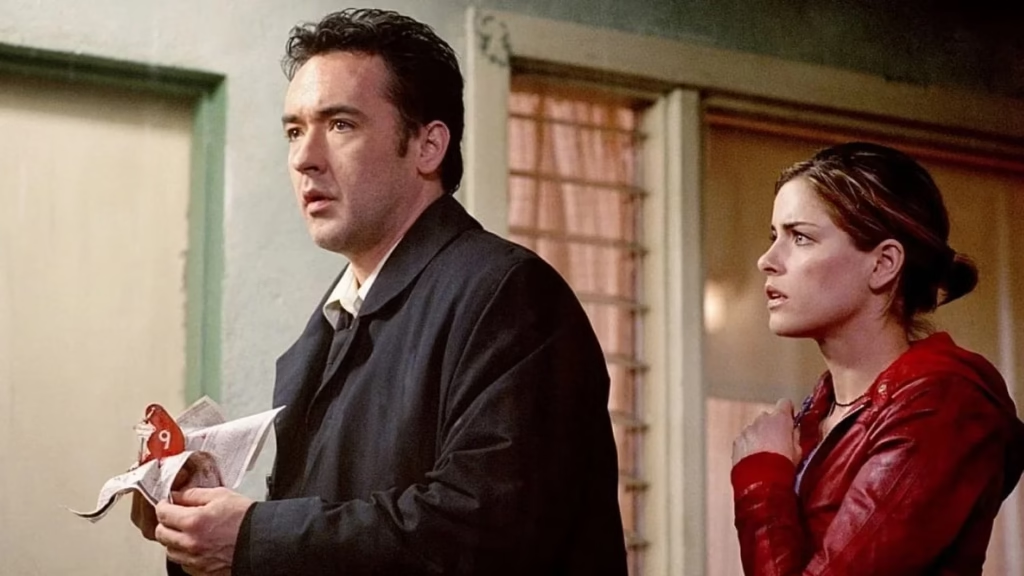
Among them is Ed Dakota, a former police officer working as a limousine driver; Caroline Suzanne, a fading television actress; Paris Nevada, a woman hoping to leave her troubled past behind; and Samuel Rhodes, a correctional officer transporting a convicted murderer.
Other guests include a newlywed couple, a family dealing with a serious accident, and the motel’s increasingly suspicious manager.
Initially, their biggest concern is surviving the storm and finding a way to continue their journeys. However, the situation takes a horrifying turn when one of the guests is brutally murdered.
As the bodies begin piling up, the survivors realize that the killer is leaving behind a disturbing pattern involving numbered motel room keys.
With the roads flooded, communications disrupted, and no immediate possibility of escape, suspicion spreads throughout the group. Nobody knows whom to trust, and every attempt to identify the murderer creates further confusion.
Meanwhile, a separate storyline follows Malcolm Rivers, a convicted serial killer whose execution is approaching. His psychiatrist, Dr. Malick, believes that newly discovered evidence could fundamentally change the outcome of his case.
The connection between these seemingly unrelated events becomes the central mystery of the film.
The less you know about that connection before watching, the better. Identity is designed to reward viewers who pay attention to details while remaining uncertain about what is actually happening.
Identity (2003) – Quick Facts
| Category | Details |
|---|---|
| Movie Title | Identity |
| Release Date | April 25, 2003 |
| Genre | Psychological Thriller, Mystery, Slasher |
| Director | James Mangold |
| Screenwriter | Michael Cooney |
| Main Cast | John Cusack, Ray Liotta, Amanda Peet, Alfred Molina |
| Country | United States |
| Primary Setting | An isolated motel in Nevada |
| Production Budget | Approximately $28 million |
| Worldwide Box Office | Approximately $90.3 million |
| Composer | Alan Silvestri |
| Main Inspiration | And Then There Were None by Agatha Christie |
| Distributor | Sony Pictures Releasing |
Identity Cast and Characters – Who Is Trapped at the Motel?
One of Identity‘s greatest strengths is its ensemble cast. Rather than relying entirely on a single protagonist, the film introduces several characters whose personalities, secrets, and suspicious behavior keep the audience guessing.
Each character appears to have a reason for being at the motel, but their circumstances become increasingly difficult to explain as the story progresses.
John Cusack as Edward “Ed” Dakota
Ed Dakota is a former Los Angeles police officer who now works as a limousine driver. When the storm strands him at the motel, his experience in law enforcement makes him one of the few people capable of responding calmly to the unfolding crisis.
As the murders begin, Ed takes an active role in investigating the deaths and protecting the remaining guests. His practical approach makes him a natural protagonist, particularly when the other characters become overwhelmed by fear and suspicion.
However, Ed also carries emotional baggage from his previous career, giving his character a vulnerability beneath his seemingly controlled exterior.
John Cusack delivers a grounded performance that helps anchor the film’s increasingly surreal events.
Ray Liotta as Samuel Rhodes
Samuel Rhodes arrives at the motel while transporting a convicted murderer named Robert Maine.
His apparent authority as a correctional officer initially makes him seem like someone the other guests can trust. However, Rhodes has an aggressive personality, frequently clashes with the survivors, and becomes increasingly controlling as the situation deteriorates.
Ray Liotta’s intimidating screen presence makes Rhodes one of the film’s most unpredictable characters.
Whether he’s attempting to maintain order or hiding something far more sinister remains an important question throughout the mystery.
Amanda Peet as Paris Nevada
Paris Nevada is a woman attempting to escape her past and build a different future.
After leaving Las Vegas, she hopes to settle in Florida and purchase a citrus grove, where she can begin a quieter and more peaceful life.
Unlike several other guests, Paris demonstrates considerable emotional resilience. Although frightened by the murders, she remains observant and resourceful.
Her desire for a fresh start gives the story an important emotional dimension, particularly as the possibility of survival becomes increasingly uncertain.
Amanda Peet’s performance helps make Paris one of the film’s most sympathetic characters.
John Hawkes as Larry Washington
Larry Washington is the manager of the isolated motel.
Initially, he appears to be an ordinary employee attempting to accommodate stranded travelers during a dangerous storm. However, his nervous behavior and questionable decisions quickly attract suspicion.
As the murders continue, Larry becomes increasingly desperate to convince the other guests that he isn’t responsible.
John Hawkes gives the character an uneasy, unpredictable quality that makes it difficult to determine whether Larry is frightened, guilty, or simply overwhelmed.
Alfred Molina as Dr. Malick
Dr. Malick is a psychiatrist involved in the case of Malcolm Rivers, a convicted serial killer awaiting execution.
He believes that Malcolm’s psychological condition may provide an explanation for his violent behavior and potentially justify a stay of execution.
Unlike the characters trapped at the motel, Malick operates within the film’s parallel courtroom storyline.
His role becomes increasingly significant as the relationship between the two narratives begins to emerge.
Pruitt Taylor Vince as Malcolm Rivers
Malcolm Rivers is a convicted murderer whose execution is scheduled to take place shortly after the events depicted in the film.
Newly discovered journals raise questions about his psychological condition, prompting an emergency hearing.
Although Malcolm initially appears disconnected from the motel storyline, his character eventually becomes essential to understanding the film’s central mystery.
Pruitt Taylor Vince brings a disturbing vulnerability to the role, making Malcolm both frightening and deeply troubled.
Rebecca De Mornay as Caroline Suzanne
Caroline Suzanne is a former television actress being transported by Ed Dakota.
Accustomed to attention and special treatment, she struggles to adapt to the uncomfortable circumstances at the motel.
Her demanding personality creates tension almost immediately, but her presence also helps establish the film’s early atmosphere of danger.
Clea DuVall as Ginny Isiana
Ginny Isiana arrives at the motel with her new husband, Lou.
Their relationship appears troubled, and the increasingly terrifying situation places additional pressure on their marriage.
Ginny’s superstitious nature leads her to consider supernatural explanations for the mysterious deaths.
William Lee Scott as Lou Isiana
Lou Isiana is Ginny’s husband.
Their disagreements and unstable relationship introduce another layer of tension among the stranded guests.
As suspicion spreads, the couple’s personal problems become intertwined with the escalating violence.
Jake Busey as Robert Maine
Robert Maine is a convicted murderer being transported by Samuel Rhodes.
Given his criminal background, he quickly becomes one of the most obvious suspects when the killings begin.
However, Identity repeatedly challenges the audience’s assumptions about who appears dangerous and who might actually be responsible.
John C. McGinley as George York
George York arrives at the motel with his wife Alice and young stepson Timmy after a serious accident.
His primary concern is protecting his family, particularly his injured wife.
George’s increasingly desperate circumstances contribute to the emotional intensity of the film.
Leila Kenzle as Alice York
Alice York is seriously injured in a road accident before the family reaches the motel.
Her condition forces the other guests to confront an immediate medical emergency even before the murders begin.
Bret Loehr as Timmy York
Timmy York is Alice’s young son and George’s stepson.
Quiet and seemingly vulnerable, Timmy becomes caught in the terrifying events surrounding the motel.
Although he initially appears to be one of the least threatening characters, his presence becomes increasingly important as the story unfolds.
The Mystery of the Motel – Why Identity Is So Suspenseful
The motel setting is essential to Identity‘s effectiveness.
Surrounded by flooded roads and an unforgiving desert landscape, the building becomes a temporary prison for the stranded travelers. The relentless rain creates a sense of isolation, while the limited number of rooms ensures that every character remains within reach of the mysterious killer.
What makes the setting particularly unsettling is how quickly ordinary details become suspicious.
A misplaced key, a strange noise, an unexplained absence, or an inconsistent story can suddenly appear to be evidence of murder.
The film uses these small uncertainties to encourage viewers to investigate alongside the characters. Just when one suspect seems obvious, another revelation undermines that assumption.
This approach creates an atmosphere where almost nobody feels entirely trustworthy.
The storm itself also becomes a powerful visual element. Its constant presence makes the motel feel disconnected from the outside world, almost as though the characters have entered a nightmare from which they cannot escape.
Identity and Agatha Christie – The Inspiration Behind the Story
Identity was inspired by Agatha Christie’s 1939 mystery novel And Then There Were None, one of the most influential works in detective fiction.
The similarities are immediately recognizable. A group of strangers becomes isolated in a remote location, murders begin occurring, and the survivors gradually realize that the killer must be connected to their group.
Both stories use the disappearance of possible suspects to increase paranoia.
However, Identity takes the concept in a different direction by combining the traditional murder mystery with psychological horror and an unconventional narrative structure.
Rather than focusing exclusively on identifying the murderer, the film eventually asks viewers to reconsider the nature of the entire situation.
That distinction is what separates Identity from a straightforward adaptation of Christie’s formula.
How Identity Uses Its Nonlinear Storytelling
Another distinctive feature of Identity is its use of nonlinear storytelling.
Instead of presenting every event in chronological order, the film reveals important details about the characters’ arrival through flashbacks and carefully placed transitions.
This structure allows the audience to understand certain events only after their consequences have already been established.
For example, the circumstances surrounding the York family’s accident become clearer as the film revisits earlier moments.
Meanwhile, the courtroom storyline involving Malcolm Rivers develops separately, creating the impression that two different mysteries are unfolding simultaneously.
The narrative eventually brings these elements together, transforming details that initially seemed unrelated into essential pieces of the larger puzzle.
It’s a technique that encourages repeat viewings, particularly for audiences interested in identifying clues they may have overlooked.
Identity (2003) Production – How James Mangold Created the Thriller
Development and Screenplay
The screenplay for Identity was written by British screenwriter Michael Cooney, who drew inspiration from Agatha Christie’s And Then There Were None.
Producer Cathy Konrad brought the project to director James Mangold, who had been interested in making a claustrophobic thriller.
Mangold was attracted to the challenge of creating suspense within a confined setting, drawing inspiration from films that relied on atmosphere, psychological tension, and carefully controlled environments.
Rather than constructing a conventional slasher film, the production aimed to create a mystery in which the audience’s interpretation of events would change as the story progressed.
The screenplay’s elaborate twists were a major selling point, particularly for John Cusack, who reportedly found himself repeatedly surprised while reading it.
Casting John Cusack and the Ensemble
Mangold and Konrad pursued John Cusack for the leading role because they believed his approachable screen presence would make Ed Dakota a convincing central character.
Cusack’s ability to portray an ordinary man under extraordinary pressure helped establish an emotional connection between the audience and the film’s mystery.
Other casting decisions also reflected Mangold’s previous professional relationships.
Pruitt Taylor Vince had starred in Mangold’s directorial debut Heavy (1995), while Clea DuVall previously appeared in his 1999 drama Girl, Interrupted.
The resulting ensemble brought together actors with different screen personas, making the film’s suspects feel distinct and unpredictable.
Where Was Identity Filmed?
Although the story takes place in the Nevada desert, much of Identity was filmed in California.
Principal photography occurred largely on Stage 27 at Sony Pictures Studios in Culver City, where the production team constructed an elaborate motel environment.
Production designer Mark Friedberg helped create the setting, including motel rooms, surrounding desert areas, and a swimming pool.
The extensive use of studio sets allowed the filmmakers to control the constant rainfall and maintain the film’s oppressive atmosphere.
Additional filming took place at the Four Aces Movie Ranch in Palmdale, as well as locations in Los Angeles, Lancaster, and surrounding areas.
Mangold estimated that approximately 95% of the movie was filmed on constructed sets, demonstrating how extensively the production relied on controlled environments to achieve its visual style.
Identity Soundtrack and Music
The film’s score was composed by Alan Silvestri, known for his work on numerous major Hollywood productions.
Angelo Badalamenti was originally attached to compose the music, but his score was ultimately replaced.
Silvestri’s music supports the film’s unsettling atmosphere without overwhelming its mystery.
Rather than relying entirely on dramatic musical cues, the soundtrack works alongside the rain, silence, and environmental sounds to maintain tension.
Identity Box Office – Was the Movie Successful?
Identity was released in the United States and Canada on April 25, 2003, opening in 2,733 theaters.
The film debuted at number one at the domestic box office, earning approximately $16.2 million during its opening weekend.
Its strong initial performance demonstrated audience interest in the film’s unusual premise and recognizable cast.
Although competition from major releases such as X2 affected its subsequent weekends, Identity maintained a respectable theatrical run.
Its final worldwide earnings reached approximately $90.3 million, compared with a production budget of $28 million.
| Box Office Category | Earnings |
|---|---|
| Production Budget | $28 million |
| Opening Weekend | $16.2 million |
| United States and Canada | $52.1 million |
| International Markets | $38.1 million |
| Worldwide Total | $90.3 million |
The film’s worldwide gross was more than three times its reported production budget, making it a commercially successful release.
Identity Reviews and Critical Reception
Identity received generally favorable but divided reviews upon release.
Critics frequently praised its atmosphere, performances, and willingness to challenge conventional thriller storytelling. However, its elaborate narrative revelations proved controversial.
On Rotten Tomatoes, the film holds a reported 63% approval rating based on 168 reviews, while Metacritic lists a score of 64 out of 100 based on 34 reviews. These figures reflect the ratings reported in the available source material and may change as review databases are updated.
Audiences surveyed by CinemaScore gave the film a B grade.
Roger Ebert awarded Identity three out of four stars, praising how its final act forces viewers to reconsider the events that came before.
Other critics were less enthusiastic, arguing that the central revelation undermined the suspense established during the earlier portions of the film.
That disagreement remains one of the most interesting aspects of its reception.
For some viewers, the ending elevates Identity beyond a conventional murder mystery. For others, it makes the story feel overly dependent on a single narrative trick.
Regardless of where audiences fall in that debate, the film’s willingness to take such an unusual approach helps explain its lasting appeal.
Identity Awards and Nominations
Although Identity was not a major awards-season contender, it received recognition from several genre-focused organizations.
Notable nominations included:
-
Bram Stoker Awards (2003): Best Screenplay for Michael Cooney.
-
Saturn Awards (2004): Best Action, Adventure or Thriller Film.
-
Saturn Awards (2004): Best DVD Special Edition Release.
-
International Horror Guild Awards (2004): Best Film.
-
Golden Trailer Awards (2004): Best Horror/Thriller Trailer.
-
Teen Choice Awards (2003): Choice Movie – Horror/Thriller.
The film also won the Most Underrated Movie of the Year category at the 2004 Golden Schmoes Awards.
While these accolades did not transform Identity into a mainstream awards favorite, they reflected appreciation for its unusual combination of psychological suspense and mystery storytelling.
Identity Ending Explained – Who Is the Real Killer?
Major Spoiler Warning: Everything below reveals the central twist, the killer’s identity, and the ending of Identity (2003). If you haven’t watched the movie, consider skipping directly to the FAQ or conclusion.
The central revelation of Identity completely changes the meaning of the motel storyline.
The ten strangers aren’t actually independent individuals trapped together during a storm.
Instead, they represent distinct personalities within the mind of Malcolm Rivers, the convicted serial killer awaiting execution.
The Truth About Malcolm Rivers
Malcolm Rivers is portrayed as having dissociative identity disorder, a condition that the film uses as the foundation for its psychological mystery.
His psychiatrist, Dr. Malick, believes that Malcolm’s violent behavior is associated with one of his alternate identities.
During an emergency hearing, Malick attempts an experimental intervention designed to bring Malcolm’s personalities into confrontation with one another.
The motel scenario represents this internal psychological struggle.
Each character embodies a different personality, and their apparent deaths symbolize the elimination of those identities.
The objective is to identify and remove the murderous personality, allowing Malcolm to survive without continuing his violent behavior.
It’s important to recognize that this is a fictionalized and highly sensationalized portrayal of dissociative identity disorder. The film’s depiction should not be interpreted as an accurate representation of people living with the condition, who are not inherently violent.
Why Do the Characters Share the Same Birthday?
One of the film’s most significant clues emerges when the survivors discover that they all share the same birthday: May 10.
This coincidence initially appears impossible.
However, once the characters are revealed to be representations of Malcolm’s identities, the shared birthday becomes easier to understand.
They aren’t unrelated strangers who happened to arrive at the same motel.
They’re connected because they originate from the same individual.
Why Are the Characters Named After American States?
Another important clue involves the characters’ surnames.
Names such as Ed Dakota, Paris Nevada, Larry Washington, and George York reflect locations associated with American states.
This pattern reinforces the idea that the characters have been constructed around a common psychological framework rather than existing as entirely separate individuals.
The shared naming convention is one of several details that become more meaningful during a second viewing.
Was Samuel Rhodes the Killer?
Samuel Rhodes initially appears to be a correctional officer transporting Robert Maine.
However, the film reveals that Rhodes is actually a criminal who murdered an officer and assumed his identity.
This makes him an extremely dangerous figure within the motel storyline.
Rhodes kills Larry Washington before becoming involved in a deadly confrontation with Ed Dakota.
However, although Rhodes is responsible for violence within the scenario, he is not the hidden personality orchestrating the entire sequence of murders.
That distinction becomes essential to understanding the final twist.
Who Is the Real Killer in Identity?
The true murderous personality is Timmy York, the seemingly innocent young boy traveling with Alice and George.
Throughout much of the film, Timmy appears frightened and vulnerable.
His apparent death in a vehicle explosion leads the surviving characters to believe he is no longer a threat.
However, Timmy has actually orchestrated the murders and concealed his involvement.
By allowing the other personalities to eliminate one another, he ensures that he remains the dominant identity.
What Happens to Paris Nevada?
After the other personalities appear to have been eliminated, Paris Nevada seemingly survives.
In the film’s final psychological sequence, she reaches the peaceful life she has dreamed of, tending an orange grove in Florida.
For a brief moment, it appears that Malcolm’s treatment has succeeded.
However, Paris discovers a motel room key numbered one buried in the soil.
Timmy then appears, revealing that the murderous personality has survived.
He kills Paris, eliminating the final remaining obstacle to his control.
What Happens to Malcolm Rivers at the End?
Malcolm’s execution is stayed after Dr. Malick’s intervention appears successful.
However, the apparent success is an illusion.
With Timmy now controlling Malcolm’s mind, the danger remains.
During transportation to a psychiatric facility, Malcolm suddenly attacks Dr. Malick and the vehicle’s driver.
The vehicle crashes, leaving the ultimate physical aftermath unresolved in the film’s closing moments.
The ending reveals that the attempt to eliminate the murderous personality has failed.
Rather than achieving psychological stability, Malcolm has been overtaken by the identity responsible for the violence.
What Does the Poem “Antigonish” Mean in Identity?
One of the film’s most memorable recurring elements is the poem Antigonish, written by Hughes Mearns.
The poem explores the unsettling idea of encountering someone who appears to exist and not exist simultaneously.
Its famous opening image involves a mysterious man on a staircase whose presence seems impossible.
Within Identity, this imagery becomes an important thematic clue.
The characters at the motel appear to be real people, yet their existence is ultimately revealed to be fundamentally different from what the audience initially assumes.
The poem’s contradiction reflects the film’s central concern: the relationship between identity, perception, and reality.
Its recurrence at the conclusion reinforces the disturbing idea that Malcolm’s internal world has not been resolved.
The Hidden Clues You Might Have Missed in Identity
One reason Identity rewards repeat viewings is that several clues become more obvious once the central revelation is known.
1. The Shared Birthday
All the motel guests share the same birthday, May 10, suggesting a connection that cannot be explained through ordinary coincidence.
2. The State-Related Names
The characters’ surnames follow a recognizable geographic pattern, indicating that their identities may have been constructed according to a common system.
3. The Numbered Motel Keys
The descending room numbers establish a deliberate sequence, making the murders feel less random than they initially appear.
4. The Disappearing Bodies
When the survivors discover that the victims’ bodies have vanished, the mystery moves beyond the rules of an ordinary murder investigation.
5. The Parallel Courtroom Storyline
The scenes involving Malcolm Rivers appear disconnected at first, but they provide the explanation for the film’s increasingly impossible events.
6. Timmy’s Apparent Innocence
The film uses Timmy’s age and vulnerability to manipulate audience expectations.
Viewers are naturally inclined to see him as someone who needs protection rather than someone capable of controlling the situation.
7. The Orange Grove
Paris’s dream of starting a new life in Florida becomes an important part of the final revelation.
The orange grove represents the possibility of escape and peace, making the ending particularly cruel when that possibility is destroyed.
What Is the Meaning Behind Identity?
Beyond its murder mystery, Identity explores the instability of personal identity and the difficulty of distinguishing perception from reality.
The motel functions as a psychological environment where different aspects of Malcolm’s mind come into conflict.
Each personality appears to possess its own motivations, fears, and moral limitations.
The film’s central conflict therefore becomes more complicated than simply discovering which guest is responsible for the murders.
It asks whether a person can escape destructive patterns when those patterns are embedded within their own understanding of themselves.
The ending offers a particularly pessimistic answer.
Even after the apparent elimination of the violent identities, the most dangerous one survives by remaining hidden behind an appearance of innocence.
This makes Identity both a murder mystery and a story about deception, particularly the danger of assuming that something harmless-looking cannot also be threatening.
Why Identity Still Deserves Attention
More than two decades after its release, Identity remains an interesting example of how psychological thrillers can manipulate familiar storytelling conventions.
Its premise initially resembles a traditional locked-room mystery, but its narrative eventually moves into more experimental territory.
James Mangold’s direction makes effective use of the confined motel setting, while the relentless rain and darkness create an atmosphere of uncertainty.
The ensemble cast also contributes significantly to the suspense. John Cusack provides a sympathetic central figure, Ray Liotta introduces an intimidating presence, and Amanda Peet gives the story an emotional anchor.
The film isn’t without weaknesses. Some viewers may find its psychological explanation implausible, and its portrayal of dissociative identity disorder relies on sensationalized thriller conventions.
However, its willingness to challenge audience expectations makes it memorable.
For viewers who enjoy mysteries that encourage speculation and reinterpretation, Identity offers a distinctive experience.
Identity Home Media – DVD, Blu-ray, and 4K Release
Following its theatrical run, Identity received several home media releases.
Sony Pictures Home Entertainment released the film on VHS and special-edition DVD on September 2, 2003.
The DVD included both theatrical and extended versions of the film, providing viewers with additional material beyond the original cinema release.
A Blu-ray edition followed on April 3, 2007.
More recently, Arrow Video released a special-edition 4K UHD Blu-ray in the United States and Canada on August 25, 2026.
These releases have helped keep the film accessible to audiences interested in revisiting its mystery and visual atmosphere.
Movies Like Identity – What to Watch Next
If you enjoyed Identity, several other films explore similar themes involving psychological tension, unreliable perceptions, isolated settings, and unexpected revelations.
| Movie | Why You Might Enjoy It |
|---|---|
| Shutter Island (2010) | A psychological mystery that challenges perceptions of reality. |
| The Others (2001) | An atmospheric thriller built around isolation and uncertainty. |
| The Sixth Sense (1999) | A supernatural mystery famous for its carefully constructed revelation. |
| The Machinist (2004) | A disturbing psychological drama about guilt, memory, and perception. |
| Secret Window (2004) | A psychological thriller involving a writer and an increasingly dangerous stranger. |
| The Game (1997) | A suspenseful mystery in which the protagonist struggles to understand what is real. |
| 1408 (2007) | A supernatural thriller set largely within a confined environment. |
| And Then There Were None (1945) | A classic adaptation of the murder-mystery premise that helped inspire Identity. |
Each approaches suspense differently, but all share an interest in making audiences question their assumptions.
Frequently Asked Questions About Identity (2003)
What Is Identity (2003) About?
Identity follows ten strangers trapped at an isolated Nevada motel during a violent rainstorm. When the guests begin dying one by one, the survivors must identify the killer while a separate storyline involving a convicted murderer gradually reveals a deeper mystery.
Who Directed Identity?
The film was directed by James Mangold.
Who Wrote Identity?
The screenplay was written by Michael Cooney.
Who Stars in Identity?
The main cast includes John Cusack, Ray Liotta, Amanda Peet, Alfred Molina, John Hawkes, Clea DuVall, Rebecca De Mornay, and Pruitt Taylor Vince.
When Was Identity Released?
Identity was released in the United States on April 25, 2003.
Is Identity Based on a Book?
The film is not a direct adaptation, but its premise was inspired by Agatha Christie’s 1939 novel And Then There Were None.
Is Identity a Horror Movie or a Thriller?
Identity combines psychological thriller, mystery, and slasher elements. Although it contains violent murders and disturbing imagery, its main focus is psychological suspense and narrative mystery.
Who Is the Killer in Identity?
Spoiler: Timmy York represents the murderous personality responsible for orchestrating the deaths within Malcolm Rivers’ psychological scenario.
What Is the Big Twist in Identity?
Spoiler: The motel guests are revealed to be different personalities within the mind of convicted serial killer Malcolm Rivers.
Why Do the Bodies Disappear in Identity?
Spoiler: The motel events represent a psychological scenario rather than an ordinary physical murder investigation, explaining why the bodies can disappear.
Why Do All the Characters Have the Same Birthday?
Spoiler: The characters are connected through Malcolm Rivers, whose mind contains the personalities represented at the motel.
Does Paris Survive Identity?
Spoiler: No. Although Paris initially appears to survive, Timmy kills her during the film’s final psychological sequence.
Does Malcolm Rivers Die at the End?
The film ends after Malcolm attacks Dr. Malick and the driver transporting him, causing the vehicle to crash. His ultimate physical fate is not explicitly confirmed.
What Does the Ending of Identity Mean?
The ending reveals that Malcolm’s treatment has failed to eliminate the murderous personality. Timmy survives the internal conflict and gains control.
Where Was Identity Filmed?
Most of the film was shot at Sony Pictures Studios in Culver City, California, with additional filming in Palmdale, Lancaster, and Los Angeles.
Who Composed the Identity Soundtrack?
Alan Silvestri composed the final score. Angelo Badalamenti had originally been attached to the project.
Was Identity Successful at the Box Office?
Yes. The film earned approximately $90.3 million worldwide against a reported $28 million production budget.
Is There an Extended Version of Identity?
Yes. The film’s 2003 special-edition DVD included both theatrical and extended cuts.
Is Identity Available in 4K?
Yes. Arrow Video released a special-edition 4K UHD Blu-ray in August 2026 in the United States and Canada.
Is There an Identity Remake?
The 2005 Hindi-language thriller Khamoshh… Khauff Ki Raat closely reproduces elements of Identity and has been described as a copycat remake.
Is Identity Worth Watching?
Yes, particularly for viewers who enjoy psychological mysteries, atmospheric thrillers, ensemble casts, and stories built around unexpected narrative revelations.
Conclusion
Identity (2003) remains a fascinating example of how a seemingly familiar murder mystery can transform into something far more ambitious.
What begins as a straightforward story about strangers trapped at an isolated motel gradually develops into a psychological puzzle involving memory, perception, identity, and the nature of reality itself.
James Mangold’s atmospheric direction, Michael Cooney’s twist-heavy screenplay, and an impressive ensemble led by John Cusack help create a thriller that constantly encourages viewers to reconsider what they believe they understand.
The film’s biggest strength is its ability to turn familiar genre conventions against the audience. Every suspicious character, unexplained detail, and apparent coincidence contributes to a mystery whose true meaning becomes clear only after its central revelation.
Although its ending remains divisive and its psychological concepts are heavily fictionalized, Identity succeeds in delivering an experience that feels distinctive even among the many twist-driven thrillers of the early 2000s.
Its $90.3 million worldwide box office performance demonstrated its commercial appeal, while its continued availability through home media releases has allowed new audiences to discover its unusual story.
For anyone who appreciates claustrophobic settings, unreliable perceptions, and mysteries that demand attention, Identity is a film worth experiencing at least once.
And perhaps the most disturbing thing about its story isn’t that a killer is hiding among ten strangers.
It’s that the real danger was never where anyone thought to look.
If you don’t know where to watch this Movie for FREE make sure to contact me via E-mail, or in the comments below. Thank you for reading and make sure to bookmark the site.
How useful was this post?
Click on a star to rate it!
Average rating 0 / 5. Vote count: 0
No votes so far! Be the first to rate this post.