
 7.6/10
 84% Critics / 77% Audience
Few horror films manage to create fear without relying on jump scares, loud music, or excessive violence. The Others, released in 2001 and directed by Alejandro Amenábar, achieves this with near-perfect precision. A slow-burning psychological ghost story, it places atmosphere and character over spectacle, pulling viewers into a world defined by silence, darkness, and the growing sense that something is deeply wrong behind closed doors. Nicole Kidman’s performance as Grace Stewart stands at the center of this tension, portraying a fragile yet fiercely protective mother forced to confront unexplainable events in her isolated Victorian mansion.
Set shortly after World War II on the island of Jersey, the film draws inspiration from classic gothic literature, haunted house tales, and psychological drama. Its emphasis on mood, subtlety, and emotional fragility allows the narrative to build toward one of the most memorable twists in modern horror cinema. The result is a film that lingers long after the final scene, not because of what it shows, but because of what it implies. Two decades later, The Others is still praised as one of the most masterfully crafted horror films of the 21st century.
The Others – Official Trailer
What Is The Others About?
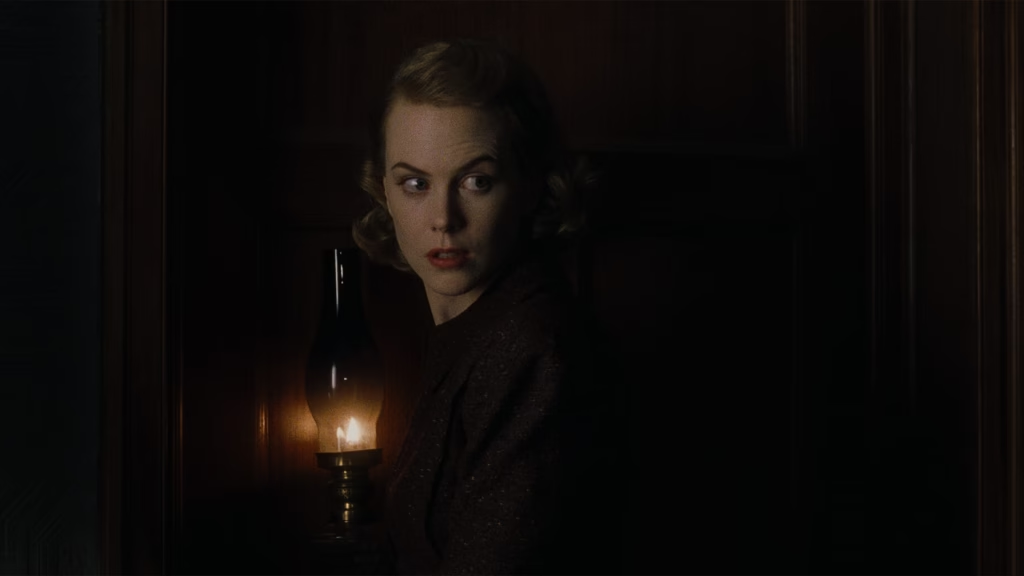
The Others follows Grace Stewart, a devoutly religious woman raising her two children, Anne and Nicholas, in a remote mansion. The children suffer from an extreme sensitivity to light, forcing Grace to keep the house in perpetual darkness. This single condition already sets a claustrophobic tone, as heavy curtains, locked doors, and shadow-filled rooms become constant sources of tension.
When a trio of servants arrives seeking employment, Grace welcomes their help but begins noticing strange occurrences: voices in empty rooms, footsteps overhead, and the presence of an unseen boy named Victor, whom Anne insists is real. Grace initially attributes the disturbances to imagination or misbehavior, but the evidence grows harder to ignore. Her strict religious worldview clashes with the supernatural events, creating internal conflict that mirrors the rising fear inside the house.
As Grace becomes more desperate, the film explores themes of trauma, grief, and denial. The truth slowly unravels not through spectacle but through subtle clues woven into the story: unexplained noises, missing curtains, the servants’ secretive behavior, and increasing contradictions in Grace’s memories. This gradual discovery leads to the film’s iconic revelation about the true nature of Grace and her family, transforming the narrative from a classic ghost story into a tragedy of guilt and self-realization.
Cast and Characters
The performances in The Others are central to its impact. The cast brings emotional depth to a minimalist story, ensuring that the psychological tension feels grounded rather than exaggerated. Nicole Kidman, in particular, received widespread acclaim for portraying Grace’s fragility, fear, and emotional instability with remarkable nuance.
Main Characters
-
Grace Stewart (Nicole Kidman) – A strict, devout mother whose unraveling grasp on reality drives much of the film’s suspense. Her emotional intensity anchors the story.
-
Mrs. Bertha Mills (Fionnula Flanagan) – The seemingly kind housekeeper who knows more about the house than she initially reveals.
-
Charles Stewart (Christopher Eccleston) – Grace’s husband, whose sudden and eerie reappearance raises questions about his mental state and the world outside the mansion.
-
Anne Stewart (Alakina Mann) – The strong-willed daughter who claims she can see other people in the house, challenging Grace’s beliefs.
-
Nicholas Stewart (James Bentley) – Anne’s younger brother, frightened of the supernatural events and reliant on Grace for protection.
-
Edmund Tuttle (Eric Sykes) – The soft-spoken gardener who assists Mrs. Mills and quietly conceals crucial information.
-
Lydia (Elaine Cassidy) – A mute maid whose silence adds to the film’s eerie tone.
Every member of the cast delivers performances that emphasize emotional tension and atmosphere, making the haunting feel personal rather than abstract.
Production and Development
Alejandro Amenábar served as writer, director, and composer for The Others, giving the film a unified creative vision. His approach favored restraint, relying on suggestion rather than explicit horror. The film was shot primarily in northern Spain, with the Palacio de los Hornillos serving as the main location. Its Victorian architecture and isolated setting contribute significantly to the film’s unsettling tone.
Amenábar was influenced by gothic novels, classic ghost stories, and psychological horror, most notably Henry James’ The Turn of the Screw. His goal was to create an atmospheric film where silence and subtlety build dread, rather than visual terror. The limited lighting—due to the children’s condition—became a creative tool, shaping how scenes were staged, filmed, and emotionally interpreted.
Additional Production Notes
-
The heavy use of natural darkness required precise cinematography to maintain visibility without undermining atmosphere.
-
Kidman was cast early in the process and was central to the film’s marketing campaign.
-
Amenábar composed the score himself, using minimal orchestration to sustain tension.
-
Despite being a Spanish production, it was filmed entirely in English and became the first English-language film to win Best Film at the Goya Awards.
-
Filming intentionally avoided modern horror clichés, aiming for timelessness rather than trend-based scares.
This commitment to classical storytelling techniques helped The Others stand apart from early 2000s horror trends dominated by gore and shock value.
Themes
The Others works on multiple thematic levels, blending psychological horror with emotional introspection. At its heart lies the tension between belief and denial, particularly concerning trauma and responsibility. The film gradually reveals that Grace’s perception of reality is shaped as much by her emotional wounds as by the supernatural events she encounters.
Key Themes
-
Denial and Trauma – Grace’s strict adherence to religious doctrine and order masks deeper emotional fractures that slowly surface.
-
Isolation – Physically, emotionally, and socially, the characters exist in a world cut off from both past and present.
-
Fear of the Unknown – The film suggests that fear often originates from within, not from external forces.
-
Maternal Responsibility – Grace’s behavior reflects the burden of motherhood intensified by loss and psychological strain.
-
Life and Death – The film blurs the boundaries between the living and the dead, presenting ghosts as victims of their own unresolved realities.
-
Faith vs. Reality – Grace’s religious beliefs clash with evidence of haunting, creating internal conflict central to the narrative.
These themes deepen the emotional and symbolic layers of the film, making it more than a standard haunted house story.
Why You Should Watch The Others?
The Others is essential viewing for fans of atmospheric horror, psychological drama, and subtle tension. Instead of relying on modern visual effects, the film builds its terror through pacing, silence, and character development. Every scene feels purposeful, and every detail contributes to the overarching mystery leading toward the final revelation.
The twist ending remains one of the most memorable in modern horror, not because it shocks, but because it redefines the entire narrative. Upon rewatching, even early scenes take on new meaning, revealing how carefully layered the story truly is. Nicole Kidman’s performance alone makes the film worth watching, as she balances vulnerability, fear, and determination with extraordinary precision.
Fans of ghost stories, period dramas, psychological thrillers, and classic horror aesthetics will find The Others to be one of the most rewarding films of its kind. It offers intelligence, artistry, and emotional weight beyond typical genre expectations.
Is The Others Worth Watching?
Absolutely. The Others stands as one of the finest psychological horror films ever made and is frequently included in lists of the best films of the 21st century. Its slow-burn approach, combined with its haunting atmosphere and powerful performances, creates a deeply immersive experience. Even viewers who don’t typically enjoy horror often find themselves drawn into its emotional storytelling and gothic tension.
The film’s twist also redefines the entire narrative, turning what first appears to be a standard haunting into a poignant tragedy. Because of this, The Others remains highly rewatchable, with new details revealing themselves upon each viewing. It is a rare example of a horror film where the emotional journey is just as compelling as the scares.
Reception and Critical Response
Upon release, The Others became a commercial and critical triumph, earning over $210 million on a $17 million budget. Critics praised its atmosphere, pacing, and focus on psychological tension. Nicole Kidman’s performance was widely recognized as one of her best, earning nominations across major award shows.
The film holds strong scores on Rotten Tomatoes and Metacritic, with reviewers commending its elegant restraint and gothic tone. Many noted that its success proved audiences still appreciated sophisticated horror driven by storytelling rather than spectacle. It won eight Goya Awards—including Best Film and Best Director—and multiple international accolades, cementing its place in cinematic history.
Today, The Others is considered a modern classic, often studied for its narrative structure, visual composition, and psychological depth.
Watch Order
Fortunately, The Others is a standalone film with no sequels or required supplemental viewing.
Watch Order
-
The Others (2001) – Complete and independent story.
Optional Material
-
Interviews with Alejandro Amenábar
-
Behind-the-scenes documentaries
-
Planned remake (currently in development)
These additional materials are not required but may enrich your understanding of the film’s craftsmanship.
The Others FAQ
Is The Others a ghost story?
Yes, but it approaches ghost storytelling from an unconventional angle, focusing on emotional and psychological tension.
Is the film scary?
It is suspenseful and atmospheric rather than graphic, making it ideal for viewers who prefer psychological horror.
Is the twist predictable?
Most viewers find the twist surprising, but the film includes many subtle clues leading up to it.
Is The Others based on a book?
No direct novel adaptation, but it is heavily influenced by Henry James’ The Turn of the Screw and classic gothic literature.
Can children watch it?
The film contains mature themes and sustained tension, so it is best suited for older teens and adults.
Conclusion
The Others remains one of the most exceptional horror films ever created—a masterpiece of atmosphere, subtlety, and emotional intensity. Alejandro Amenábar’s careful direction, combined with Nicole Kidman’s unforgettable performance, elevates the film beyond its genre and transforms it into a haunting examination of guilt, grief, and unresolved trauma. Its twist recontextualizes every moment, turning what seems like a familiar ghost story into something far more intimate and heartbreaking.
More than two decades after its release, the film continues to captivate audiences and influence the genre with its mastery of mood and psychological depth. Whether you’re discovering it for the first time or revisiting it, The Others offers a powerful experience that rewards close attention and reflection. It stands as a shining example of how horror can be beautiful, intelligent, and emotionally profound without relying on excess.
If you don’t know where to watch this Movie for FREE make sure to contact me via E-mail, or in the comments below. Thank you for reading and make sure to bookmark the site.
How useful was this post?
Click on a star to rate it!
Average rating 0 / 5. Vote count: 0
No votes so far! Be the first to rate this post.