
 8.7/10
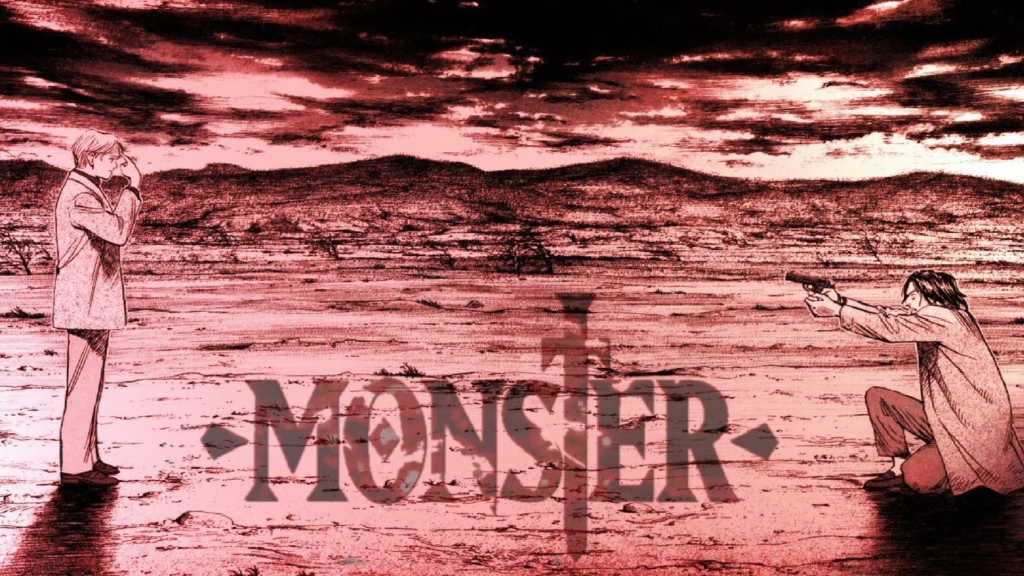
Monster stands as one of the most influential and respected psychological thrillers in anime and manga history. Known for its slow-burning tension, morally complex characters, and deeply philosophical narrative, the story has captivated audiences for decades. The anime adaptation, produced by Madhouse and airing from 2004 to 2005, brought Naoki Urasawa’s dark masterpiece to a global audience. Its grounded storytelling and realistic tone set it apart from typical action-heavy series, offering something far more introspective and unsettling.
While the anime made Monster a worldwide cult sensation, the story began years earlier in the pages of Big Comic Original. Naoki Urasawa wrote and illustrated the manga between 1994 and 2001, creating one of the most acclaimed seinen works of all time. The manga later inspired a companion novel, Another Monster, told from the perspective of an investigative reporter. Whether experienced through animation or through print, Monster delivers a gripping, morally challenging experience unlike anything else in the medium.
Monster – Anime Trailer
What Is Monster About?
Monster tells the story of Dr. Kenzo Tenma, a renowned Japanese neurosurgeon living in Düsseldorf, Germany. His life begins to unravel after he makes a moral choice that defines the entire narrative: he defies orders to save the life of a young boy named Johan Liebert, who has been shot in the head. This seemingly noble decision spirals into a tragedy when the boy grows up to become a remorseless serial killer with a chillingly calm demeanor and a nihilistic worldview. Johan’s journey through Europe leaves a trail of psychological destruction, murder, and manipulation, weaving a narrative that delves deeply into the darkest aspects of humanity.
The story evolves into a cat-and-mouse pursuit as Dr. Tenma takes responsibility for the life he saved and attempts to put an end to Johan’s reign of terror. Along the way, Tenma meets characters whose lives have been shaped or shattered by Johan’s influence. Many of them provide crucial pieces of a larger puzzle involving secret experiments, psychological conditioning, and unethical practices tied to the 511 Kinderheim orphanage. As layers unfold, Monster becomes both a thriller and a meditation on morality, identity, and the nature of evil.
Cast and Characters
Kenzo Tenma
A brilliant neurosurgeon whose commitment to saving lives forces him into a morally impossible situation. Tenma represents compassion, responsibility, and the struggle to remain ethical in a corrupt world.
Johan Liebert
One of the most terrifying and iconic antagonists in anime. Johan is calm, intelligent, manipulative, and hauntingly charismatic. His lack of identity and philosophy of emptiness drive the narrative into unsettling psychological terrain.
Nina Fortner (Anna Liebert)
Johan’s twin sister, survivor of childhood trauma, and one of the few who understands the depths of Johan’s darkness. Her journey parallels Tenma’s in confronting Johan’s legacy.
Inspector Lunge
A determined BKA detective whose obsession with solving the case blinds him to truths in front of him. His rigid personality creates one of the most intriguing non-villain characters in the series.
Supporting Cast
The anime features dozens of interconnected characters, each contributing to the greater narrative. Notable figures include Eva Heinemann, Dieter, Wolfgang Grimmer, and several Kinderheim survivors. Each character, no matter how minor, adds texture to the story’s world.
Production and Development
The roots of Monster can be traced to Naoki Urasawa’s fascination with morality tales and classic suspense storytelling. He has cited the American TV series The Fugitive as a major inspiration, particularly the idea of a doctor wrongfully implicated in crimes and searching for the real killer. Setting the series in Germany allowed Urasawa to explore post-war tension, political unease, and the lingering influence of extremist ideologies. The decision to incorporate psychological conditioning, European conspiracies, and Cold War remnants gave the narrative its signature depth.
The anime adaptation, produced by Madhouse, is considered one of the most faithful manga-to-anime adaptations ever created. Directed by Masayuki Kojima, the series maintains the manga’s tone, pacing, and realism, avoiding filler or unnecessary deviations. The soundtrack by Kuniaki Haishima enhances the tense, oppressive atmosphere, while David Sylvian’s ending theme adds a haunting emotional weight. Madhouse’s grounded animation style complements Urasawa’s artwork, bringing the suspense to life with careful attention to character expression and mood.
Themes
Monster is layered with profound and unsettling themes that probe deeply into human nature. One of its most dominant questions revolves around the origin of evil: is it created by environment, trauma, ideology, or something intrinsic within a person? Johan embodies the terrifying idea of a “blank” monster, someone shaped by manipulation yet also capable of influencing others to self-destruction.
Identity and the value of human life are central to the narrative. Tenma’s belief that all lives are equal clashes with a world that prioritizes power, wealth, and politics. The story also explores the fragility of the human psyche, showing how people can be broken, twisted, or manipulated into acting against their own morals. Many characters must confront childhood trauma, systemic cruelty, or the lingering effects of indoctrination.
Another major theme is personal responsibility. Tenma spends the series confronting the consequences of saving Johan, embracing a mission to correct his “mistake.” Meanwhile, secondary characters grapple with their own pasts, secrets, and moral failures. Ultimately, Monster challenges viewers to consider the weight of every choice, and the fine line between justice and revenge.
Why You Should Watch Monster
You should watch Monster because it offers a level of storytelling, character depth, and psychological intensity rare even among top-tier anime. It stands apart for its realism, mature themes, and commitment to exploring the darkest aspects of human behavior. The slow pacing builds tension meticulously, rewarding viewers with an intricate, multilayered plot that ties every character and event together by the end.
For fans of crime dramas, psychological thrillers, and morally complex narratives, this anime is essential viewing. It avoids typical tropes, focusing instead on atmosphere, character development, and philosophical questions about right and wrong. The writing is intelligent and tightly crafted, making Monster a series that stays with you long after it ends. Its impact is so strong that many fans consider it one of the greatest anime ever produced.
Is Monster Worth Watching?
Yes—Monster is absolutely worth watching, especially for viewers who appreciate grounded, mature storytelling. Its reputation as one of the best anime ever made is well-deserved. The narrative is gripping from start to finish, and the series never underestimates the intelligence of its audience. It is a thoughtful, unsettling, and emotionally rich exploration of the human condition, one that few works in the medium can match.
The series is not for casual background viewing. It requires attention and emotional investment, but the payoff is remarkable. Whether you’re drawn to psychological stories, crime investigations, or philosophical themes about morality and identity, Monster delivers a uniquely powerful experience.
Reception
Both the anime and the manga have received widespread critical acclaim. The manga has won multiple prestigious awards, including the Shogakukan Manga Award, the Tezuka Osamu Cultural Prize, and accolades at the Japan Media Arts Festival. Critics have praised Naoki Urasawa’s storytelling as masterful, highlighting his skill in building suspense and crafting deeply human characters.
The anime adaptation is often cited as one of the greatest anime series ever made. Reviewers praise its mature tone, faithful adaptation, and impressive pacing. Many critics regard its atmosphere, music, and character writing as exceptional. Publications like THEM Anime Reviews and Otaku USA have featured Monster on lists of the best anime of the decade. Its legacy continues to grow as new audiences discover it through modern streaming platforms.
Watch Order
Because Monster is a single continuous narrative, the watch order is simple:
Anime Watch Order
-
Monster (Episodes 1–74)
Reading Order for Deeper Understanding
-
Monster manga (Volumes 1–18)
-
Another Monster (companion novel)
This order provides the complete experience, with the novel offering additional context about events and characters.
Monster FAQ
Q: Is Monster based on true events?
No, but it is grounded in real historical tensions, psychological theories, and post-war European settings.
Q: Is the Monster anime complete?
Yes. The anime covers the entire manga storyline from beginning to end.
Q: Is Monster appropriate for younger viewers?
No. The themes, violence, and psychological content make it suitable for mature audiences.
Q: Is the manga different from the anime?
The anime is extremely faithful, but the manga offers additional detail and visual nuance.
Q: Will there be a live-action adaptation?
Attempts have been made, including a project by Guillermo del Toro, but none have reached production.
Conclusion
Monster is a towering achievement in both manga and anime, representing a rare fusion of psychological depth, moral complexity, and narrative brilliance. It takes viewers on a journey through the darkest corners of human nature while also offering moments of profound humanity, compassion, and introspection. Few works manage to balance suspense, philosophy, and character-driven storytelling with such precision.
Whether you watch the anime or read the manga, Monster delivers an unforgettable experience that lingers long after the final scene. It challenges assumptions, provokes deep reflection, and raises questions about responsibility, identity, and the nature of evil. For many fans, it is not just a favorite—it is a masterpiece that stands among the greatest works the medium has ever produced.
If you don’t know where to watch this Anime for FREE make sure to contact me via E-mail, or in the comments below. Thank you for reading and make sure to bookmark the site.
How useful was this post?
Click on a star to rate it!
Average rating 0 / 5. Vote count: 0
No votes so far! Be the first to rate this post.