
 7.5/10
 67% Critics / 85% Audience
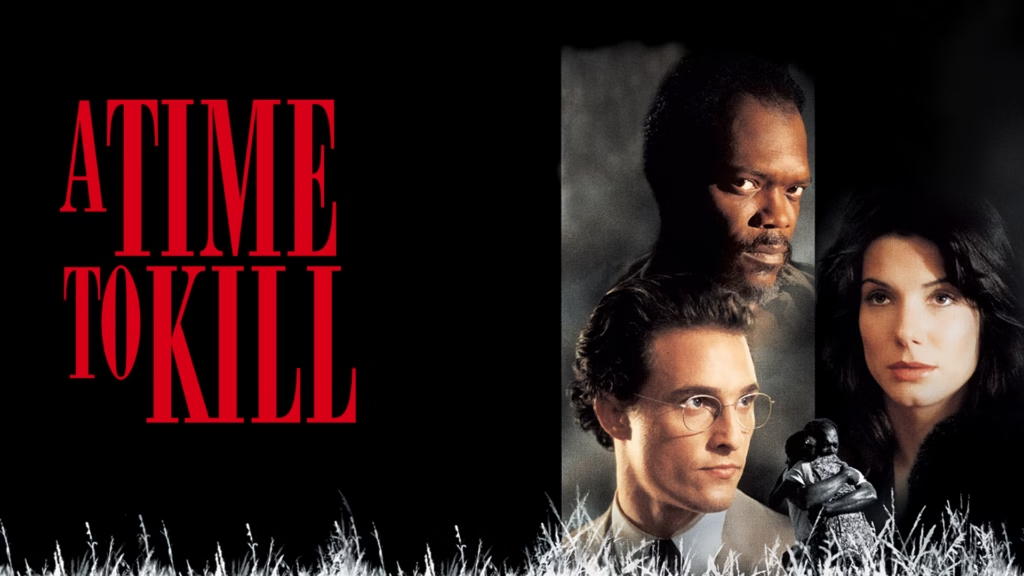
Released in 1996, A Time to Kill is an American legal drama film directed by Joel Schumacher, based on John Grisham’s 1989 novel of the same name. Featuring a star-studded cast including Matthew McConaughey, Sandra Bullock, Samuel L. Jackson, Kevin Spacey, and Donald and Kiefer Sutherland, the film explores the intersection of race, justice, and morality in the Deep South.
Set in Canton, Mississippi, the story follows a racially charged trial that forces both the characters and the audience to confront uncomfortable truths about prejudice, vengeance, and the American legal system. Despite mixed critical reception, the film became a box office success, grossing over $152 million worldwide, and remains one of the most emotionally charged courtroom dramas of the 1990s.
Adapted by screenwriter Akiva Goldsman, A Time to Kill combines John Grisham’s legal realism with powerful human emotion, tackling themes that remain as relevant today as they were nearly three decades ago.
A Time to Kill (1996) – Official Trailer
What Is A Time to Kill About?
In a small Mississippi town, a horrific crime shocks the community: Tonya Hailey, a 10-year-old African American girl, is brutally assaulted by two white men, Billy Ray Cobb and Pete Willard. When Tonya’s father, Carl Lee Hailey (Samuel L. Jackson), realizes that the justice system may fail his daughter, he takes the law into his own hands — ambushing and killing the rapists in the courthouse before they can stand trial.
Carl Lee’s act of vengeance becomes the centerpiece of a courtroom battle that ignites racial tensions across the town. Young defense attorney Jake Brigance (Matthew McConaughey) agrees to represent him, despite knowing that the odds — and the entire white community — are stacked against them.
Facing off against politically ambitious District Attorney Rufus Buckley (Kevin Spacey), Jake must convince an all-white jury to see beyond race and law — to understand Carl Lee’s pain as a father. The case spirals into chaos as the Ku Klux Klan resurfaces, threatening Jake’s family, his home, and his life. With the help of Ellen Roark (Sandra Bullock), an idealistic law student, and his mentor Lucien Wilbanks (Donald Sutherland), Jake builds a defense that culminates in one of the most powerful closing arguments in film history.
In the end, Carl Lee is acquitted after Jake delivers his unforgettable plea: “Now imagine she’s white.”
Is A Time to Kill Worth Watching?
Yes — A Time to Kill remains one of the most emotionally potent courtroom dramas ever made. It’s a film that grips you not just with its legal tension, but with its raw portrayal of justice, pain, and human empathy.
While its structure follows the conventions of a legal thriller, the story transcends genre by tackling deep racial divides and moral ambiguity. It doesn’t simply ask whether Carl Lee was right to take revenge — it forces the viewer to confront why he did it, and how race influences our perception of right and wrong.
The performances elevate the film beyond formula. Samuel L. Jackson delivers a powerful and heartbreaking portrayal of a father’s desperation, while Matthew McConaughey, in one of his breakout roles, embodies the courage of a man risking everything to defend what he believes is right. Sandra Bullock’s passionate performance as Ellen Roark adds both warmth and determination to a story rooted in conflict and fear.
If you appreciate intense dramas that challenge your sense of morality and justice, A Time to Kill is a must-watch.
Why Should You Watch A Time to Kill?
-
Powerful Performances: Samuel L. Jackson’s portrayal of Carl Lee Hailey remains one of his most memorable roles, supported by a commanding cast.
-
Emotional Courtroom Climax: The film’s final speech — McConaughey’s “Now imagine she’s white” — is one of the most iconic moments in legal cinema.
-
Moral Complexity: It doesn’t simplify justice or revenge but examines the emotions that drive both.
-
Realistic Southern Setting: The atmosphere of small-town Mississippi, with its tension and division, adds authenticity to the story.
-
Social Commentary: The movie tackles racism, vigilantism, and systemic bias with a level of intensity few Hollywood films dared to approach in the 1990s.
-
Grisham’s Legal World: As an adaptation, it captures the depth of John Grisham’s writing and his exploration of justice versus morality.
This is more than just a courtroom film — it’s a moral test that asks: What would you do if the system failed you?
Cast and Characters
-
Samuel L. Jackson as Carl Lee Hailey, the father who takes the law into his own hands.
-
Matthew McConaughey as Jake Brigance, the young defense attorney risking his life for justice.
-
Sandra Bullock as Ellen Roark, a determined law student assisting Jake.
-
Kevin Spacey as Rufus Buckley, the ambitious prosecutor.
-
Donald Sutherland as Lucien Wilbanks, Jake’s mentor and former civil rights lawyer.
-
Kiefer Sutherland as Freddie Lee Cobb, the racist brother of one of the victims who joins the KKK.
-
Ashley Judd, Charles S. Dutton, Oliver Platt, and Chris Cooper in key supporting roles.
The ensemble cast gives the film emotional and cultural texture, balancing anger, grief, and determination.
Production Background
The film was primarily shot in and around Canton, Mississippi, with its courthouse scenes filmed on location to maintain authenticity. Director Joel Schumacher and author John Grisham worked closely during the adaptation, with Grisham maintaining casting approval — reportedly vetoing several early choices before approving McConaughey.
Sandra Bullock received $6 million for five weeks of work, while Grisham sold the rights for a record $6 million. The movie also marked the film debut of Octavia Spencer, who appeared as Nurse Annette.
In later interviews, Samuel L. Jackson criticized the editing process, stating that emotional moments crucial to Carl Lee’s depth were cut, which he believed cost him an Oscar nomination. Nonetheless, his performance remains widely regarded as one of the best of his career.
Reception and Legacy
Upon release, A Time to Kill was both commercially successful and socially divisive.
-
Box Office: $108 million in the U.S., $152 million worldwide.
-
Rotten Tomatoes: 67% approval rating.
-
Metacritic: 54/100.
-
CinemaScore: “A” grade from audiences.
Roger Ebert gave the film three out of four stars, calling it “absorbing and convincingly performed,” while critics such as Peter Travers of Rolling Stone praised its emotional weight. Others, however, accused the film of moral oversimplification and excessive melodrama.
In France, the film caused major controversy, with critics denouncing it as “a justification for vigilantism” and even labeling it “fascist” in tone. French distributors added a question mark to the translated title — Le Droit de tuer? (“The Right to Kill?”) — to soften its moral implications.
Over time, however, A Time to Kill has gained recognition as one of the most provocative and emotional legal dramas of its era.
Soundtrack
Composed by Elliot Goldenthal, the film’s score combines modernist and classical elements to underscore the film’s tension and emotional gravity. The soundtrack includes gospel influences, particularly in “Take My Hand, Precious Lord” performed by Cissy Houston and The Jones Sisters, enhancing the story’s Southern atmosphere and spiritual undercurrent.
Accolades
-
Golden Globe Nomination: Best Supporting Actor – Samuel L. Jackson
-
NAACP Image Awards: Outstanding Motion Picture (Won)
-
NAACP Image Award: Best Supporting Actor – Samuel L. Jackson (Won)
-
MTV Movie Award: Best Breakthrough Performance – Matthew McConaughey (Won)
-
Blockbuster Entertainment Award: Favorite Actress in a Suspense Film – Sandra Bullock (Won)
Despite missing out on major Academy Awards, the film’s performances were celebrated, particularly for their emotional authenticity and intensity.
A Time to Kill (1996 Film) FAQ
Q: Is A Time to Kill based on a true story?
No, it’s a fictional story written by John Grisham, though it reflects real social and racial tensions in the American South.
Q: Where was the movie filmed?
Most scenes were shot in Canton, Mississippi, giving the film its authentic Southern atmosphere.
Q: Did Samuel L. Jackson win an Oscar for his role?
No, although his performance was widely praised, Jackson later stated that key scenes were cut, costing him stronger awards recognition.
Q: What makes this film different from other legal dramas?
Its blend of racial politics, emotional storytelling, and moral ambiguity sets it apart from more procedural courtroom films.
Q: What is the message of the movie?
The film explores whether justice can truly exist in a racially biased system — and how far one should go to protect family and morality.
Q: How did John Grisham feel about the adaptation?
He described it as a “good movie” and praised Matthew McConaughey’s performance as Jake Brigance.
Q: What was the controversy in France about?
French critics accused the film of glorifying revenge and personal justice, calling it “morally dangerous” in its portrayal of vigilantism.
Conclusion
A Time to Kill stands as one of the defining courtroom dramas of the 1990s — a film that dares to confront America’s deepest moral contradictions through the lens of law and race. It doesn’t offer easy answers, but it forces viewers to question their own values, prejudices, and sense of justice.
Joel Schumacher’s direction, coupled with an ensemble of powerhouse performances, creates a gripping exploration of vengeance, empathy, and redemption. Despite its controversies, the film endures as a morally complex and emotionally devastating story that still resonates in contemporary discussions about justice and race relations.
For those who appreciate emotionally charged, socially conscious dramas, A Time to Kill remains essential viewing — a film that proves justice is never as black and white as the courtroom walls that contain it.
If you don’t know where to watch this Movie for FREE make sure to contact me via E-mail, or in the comments below. Thank you for reading and make sure to bookmark the site.
How useful was this post?
Click on a star to rate it!
Average rating 0 / 5. Vote count: 0
No votes so far! Be the first to rate this post.