
 7.5/10
Blue Prince is an extraordinary puzzle adventure that merges the meticulous logic of tabletop design with the creative storytelling of interactive art. Developed by solo creator Tonda Ros under the studio name Dogubomb and published by Raw Fury, the game was released on April 10, 2025, for PlayStation 5, Windows, and Xbox Series X/S.
Blending elements of strategy, roguelike design, and environmental storytelling, Blue Prince challenges players to explore a mansion that reconstructs itself daily, hiding puzzles, secrets, and forgotten history behind every door. Its haunting worldbuilding and surreal narrative earned universal acclaim, positioning it among the best-reviewed puzzle games of the decade.
Developed over eight painstaking years, the game reflects Ros’s fascination with mystery books, intricate architecture, and cerebral problem-solving. Inspired by the legendary puzzle book Maze by Christopher Manson, Blue Prince is as much a meditative exploration of logic and curiosity as it is a work of narrative art.
Blue Prince – Official Release Trailer
Blue Prince – Official Gameplay Trailer
What Is Blue Prince About?
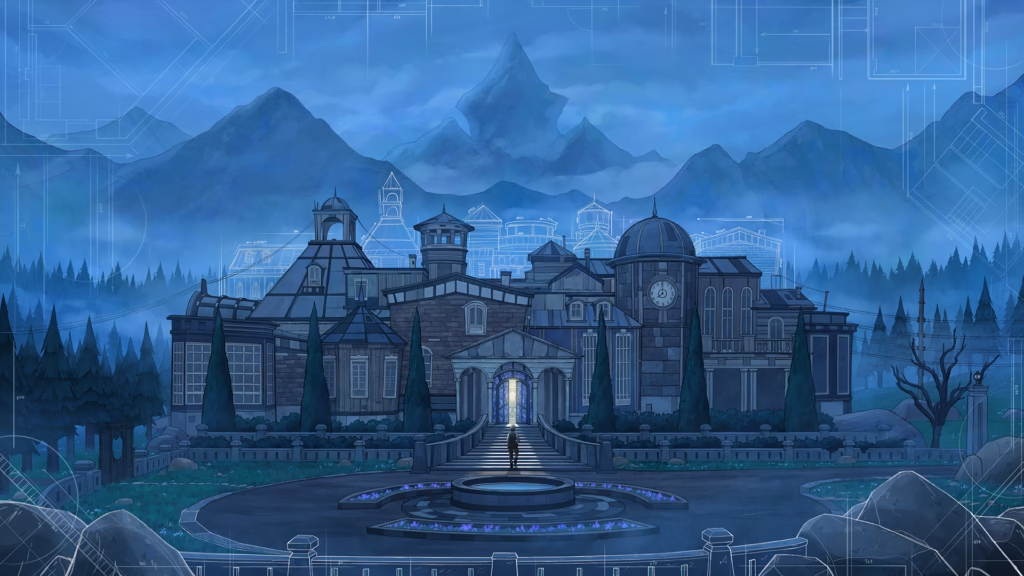
The story begins with Simon P. Jones, a mild-mannered man who inherits the mysterious Mt. Holly Estate, a sprawling mansion once owned by his eccentric great-uncle Herbert S. Sinclair. The will comes with a single condition: Simon must locate a hidden 46th room within the estate.
The catch? Each day the mansion resets — its rooms, doors, and passages rearranging themselves into a new configuration overnight. If Simon fails to reach the 46th room by nightfall, the process starts again.
While the search for the 46th room forms the game’s main objective, deeper mysteries lurk beneath the surface. Players uncover the estate’s layered history, the strange disappearance of children’s author Marion Marigold, and cryptic hints about the political and metaphysical nature of the world of Mora — a parallel planet with its own city-states, revolutions, and divine relics.
At its heart, Blue Prince is a story about inheritance, legacy, and the passage of knowledge, where every locked door conceals not just a puzzle but a fragment of the world’s forgotten truth.
Is Blue Prince Worth Playing?
Absolutely — Blue Prince is one of the most inventive and rewarding puzzle experiences in recent memory.
For players who appreciate games like The Witness, Return of the Obra Dinn, or Myst, this title offers an equally cerebral yet emotionally resonant experience. Each day in the mansion presents a new configuration, forcing players to adapt their strategies, track room patterns, and experiment with logic. The gameplay never feels repetitive thanks to its procedural design wrapped in deliberate structure.
Beyond puzzles, Blue Prince tells an intricate story filled with mystery, tragedy, and revelation. Its world evolves through subtle clues — letters, blueprints, and artifacts that paint a broader picture of rebellion, art, and legacy. It’s not just about solving the mansion — it’s about understanding why it exists.
Why Should You Play Blue Prince?
-
Ever-Changing Exploration: The mansion rebuilds itself daily, ensuring no two playthroughs are ever identical.
-
Innovative Drafting Mechanics: Players use randomized room “cards” to construct pathways toward the elusive 46th room.
-
Deceptively Deep Lore: Beneath its puzzles lies a richly developed world with political conspiracies, hidden revolutions, and lost royal bloodlines.
-
Elegant Puzzle Design: Every interaction feels handcrafted, from environmental riddles to meta-level mysteries that transcend the mansion’s boundaries.
-
Beautiful Art and Sound: Featuring atmospheric visuals by Davide Pellino and a haunting jazz-influenced score by Trigg & Gusset, the game evokes a mood of calm curiosity mixed with creeping unease.
-
Perfect for Analytical Minds: Fans of layered logic challenges, exploration-based storytelling, and world-building through clues will find it endlessly captivating.
Blue Prince combines the intellectual rigor of a puzzle book with the emotional weight of a narrative adventure — a game that respects both player intelligence and imagination.
Gameplay Overview
Players navigate the Mt. Holly Estate through a grid of 45 rooms — nine rows by five columns. Each new room is drafted using a selection of randomized “floor plan” cards, determining the layout, doors, and hidden contents within.
Two rooms — the Entrance Hall and the Antechamber leading to the 46th room — always remain fixed, serving as the only constants in an otherwise unpredictable labyrinth.
Every exploration costs one step, with Simon starting each day with 50 steps to spend. Running out of steps resets the day, forcing a fresh attempt through a newly rearranged house. Items such as food, gems, and tools can be acquired to extend runs or unlock shortcuts, while permanent upgrades ensure long-term progression.
Rooms may contain standalone puzzles, multi-room riddles, or story artifacts that deepen the overarching mystery. The mansion’s grid structure introduces a chess-like strategy, demanding careful planning — do you prioritize exploration, or efficiency?
The interplay between logic, memory, and procedural chance gives Blue Prince a deeply satisfying rhythm, where discovery and failure coexist as equally meaningful experiences.
Plot Summary
As Simon ventures deeper into Mt. Holly Estate, he begins to uncover the intertwined fates of his family, his missing mother Mary Jones (a.k.a. Marion Marigold), and the political history of his world, Mora.
Mora is divided into warring city-states, once ruled by the benevolent King Desilets III, whose generosity toward commoners led to a rebellion known as the Fennsurrection. His overthrow birthed the oppressive regime of Fenn Aries, which erased the peaceful past of Orinda Aries and even changed its royal sigil from black to red.
Simon’s mother, once a children’s writer, rebelled against the government’s censorship of her final book, The Red Prince. Deemed subversive for its symbolism of freedom, the book’s ending — a boy seeing the blue sky — became a banned allegory. She joined a resistance group known as the Children of Black Water, stealing the Ruby Crown of Orinda Aries before vanishing.
Herbert Sinclair, Simon’s great uncle, was secretly part of the same rebellion and hid clues within the mansion to protect the truth. As Simon discovers the final chamber, he realizes the 46th room contains the Crown of Blueprints — once ruby, now sapphire — symbolizing rebirth and restoration.
By reconstructing the Castle Orindia throne room, Simon claims the mantle of the Blue Prince, destined to restore the forgotten kingdom. In doing so, he fulfills the will of both his family and the world’s buried past.
Development
Blue Prince is the result of eight years of independent development by Tonda Ros, a self-taught designer inspired by puzzle literature and tabletop design. His goal was to merge the logic of games like The Witness with the tactile creativity of drafting board games such as Agricola and Magic: The Gathering.
A major influence was Christopher Manson’s book Maze: Solve the World’s Most Challenging Puzzle, whose illustrated rooms inspired Ros’s modular mansion concept. Ros even contacted Manson directly to design art and puzzles for the game — a rare collaboration between literary and digital mediums.
Ros worked primarily alone, funding the project through personal savings and ad revenue from a Magic: The Gathering website he managed. He later collaborated with art director Davide Pellino to craft the mansion’s unique visual identity and brought in the Dutch jazz duo Trigg & Gusset for its moody, minimalist score.
Originally titled Bequest, the game was renamed Blue Prince both for its pun on “blueprints” and its symbolic connection to the story’s themes of inheritance, architecture, and royal legacy.
Reception
Blue Prince was met with widespread critical acclaim, praised for its innovative mechanics, elegant presentation, and emotional depth. Critics celebrated it as a “masterclass in puzzle design” and “one of the smartest games of the decade.”
Aggregate Scores
-
Metacritic: 92/100 (PC), 90/100 (Xbox Series X/S), 85/100 (PS5)
-
OpenCritic: 96% recommendation rating
Highlighted Reviews
-
Eurogamer: ★★★★★ – “A masterpiece of environmental logic and interactive storytelling.”
-
IGN: 9/10 – “Ingenious, beautiful, and endlessly replayable.”
-
Game Informer: 9.5/10 – “A one-person triumph in game design.”
-
The Guardian: ★★★★★ – “An evocative journey through architecture and memory.”
-
Edge: 9/10 – “A design philosophy that treats players as co-authors of discovery.”
Critics praised its combination of mechanical complexity and emotional storytelling, while some noted minor accessibility challenges for casual players. Many publications named it one of 2025’s Game of the Year contenders.
Blue Prince (Video Game) FAQ
Q: How long does it take to finish Blue Prince?
A standard playthrough can last between 15 to 25 hours, though completionists can easily spend over 40 hours uncovering every mystery.
Q: Is Blue Prince replayable?
Yes — due to its procedural mansion resets and layered puzzle design, every run feels unique.
Q: Is this game similar to The Witness or Myst?
It shares their puzzle DNA but adds roguelike elements, procedural layout changes, and a deeper narrative structure.
Q: Does the mansion’s layout reset randomly?
Yes, but two key rooms always remain fixed, providing continuity and progression across runs.
Q: Who created the music for Blue Prince?
The soundtrack was composed by Trigg & Gusset, blending jazz, ambient, and melancholic tones.
Q: Is the 46th room the ending?
Reaching it concludes the main story, but post-game challenges and mysteries extend well beyond the initial goal.
Q: Will there be a sequel?
Tonda Ros has expressed interest in expanding the universe of Mora, though no official sequel has been announced.
Conclusion
Blue Prince stands as one of the most original and thought-provoking games of 2025 — a testament to what one visionary designer can accomplish with patience, imagination, and passion. Its ever-shifting mansion, intricate puzzles, and layered world lore create an experience that feels timeless yet innovative, cerebral yet emotional.
By merging the structure of logic puzzles, the curiosity of exploration, and the emotional resonance of storytelling, Tonda Ros has crafted a game that doesn’t just challenge your mind — it lingers in it long after you’ve found the final room.
For anyone who treasures creativity, discovery, and the art of problem-solving, Blue Prince isn’t just a game — it’s an invitation to think, to feel, and to explore the infinite rooms of human imagination.
Thank you for reading and make sure to bookmark the site, comment and follow up on the newest posts!
How useful was this post?
Click on a star to rate it!
Average rating 0 / 5. Vote count: 0
No votes so far! Be the first to rate this post.