
 8.5/10
When Command & Conquer: Red Alert launched in 1996, it wasn’t just another strategy game—it was a phenomenon that reshaped how players approached real-time strategy. Developed and published by Westwood Studios, the game served as a prequel to the original Command & Conquer: Tiberian Dawn, while spinning its own alternate-history storyline where Einstein eliminates Hitler, leaving Joseph Stalin’s Soviet Union unchecked. This daring twist set the stage for a world war like no other.
Praised for its addictive gameplay, memorable full-motion video cutscenes, and its unique balance between factions, Red Alert became one of the most successful and beloved strategy titles of its era. Its influence extended far beyond its initial release, spawning multiple expansions, console ports, remasters, and even shaping the future of RTS titles for decades to come.
Command & Conquer: Red Alert – Legions Reveal Trailer
What is Command & Conquer: Red Alert About?
At its core, Red Alert is a real-time strategy game where the player controls either the Allied forces or the Soviets in a fictional World War II. The game blends resource management, base-building, and large-scale military conflict, but what truly sets it apart is its alternate-history storyline:
-
The Premise: Einstein travels back in time and removes Hitler from history, creating a world where the Soviet Union rises unchecked.
-
The Conflict: The Allied Nations of Western Europe face off against Stalin’s aggressive USSR across the European continent.
-
The Choice: Players can experience both sides of the war through branching campaigns with unique endings.
This combination of history, science fiction, and military drama gave Red Alert its unforgettable identity.
Gameplay and Mechanics
Westwood Studios refined the formula they had pioneered with Tiberian Dawn to create a deeper, faster, and more strategically rewarding experience.
Players had to:
-
Gather Resources: Ore and gems were harvested to generate credits, which fueled every aspect of gameplay.
-
Build and Expand: Bases required careful planning—power plants to sustain operations, silos to store credits, and barracks/factories to create units.
-
Wage War: Players could build vast armies of tanks, infantry, aircraft, and naval units, deploying them across land, sea, and air.
Strategic highlights included:
-
Engineer Tactics: Capturing enemy buildings instead of destroying them.
-
Faction Strengths: The Soviets relied on brute force, Tesla coils, and the Iron Curtain, while the Allies excelled with speed, spies, and the Chronosphere.
-
Naval Power: Unlike many RTS titles of the era, water combat was a major component, with the Allies’ Cruisers and Destroyers giving them dominance at sea.
Multiplayer was another standout feature, allowing players to test strategies like the infamous Soviet tank rush against human opponents.
Plot and Storyline
Red Alert tells two very different stories depending on which side you play:
-
Allied Campaign: The Allies push back against Soviet aggression, ultimately storming Moscow. Stalin is found buried alive but is quietly silenced by his own general, hinting at internal power struggles.
-
Soviet Campaign: Stalin leads the USSR to victory, only to be betrayed by Nadia—a Brotherhood of Nod agent. In a twist, Kane himself appears, revealing that the entire conflict was orchestrated by Nod to shape the future.
This narrative link tied Red Alert to the larger Command & Conquer universe, making it not just a standalone title but a crucial piece of the franchise’s lore.
Expansions and Spin-Offs
Red Alert’s popularity quickly led to several expansions:
-
Counterstrike (1997) – Added new missions, maps, and the quirky giant ant bonus campaign.
-
The Aftermath (1997) – Introduced new units like Tesla Tanks, Chrono Tanks, and Shock Troopers.
-
Retaliation (1998, PlayStation) – Combined both expansions, added exclusive FMVs, and became a cult favorite on consoles.
These add-ons deepened the game’s strategies and gave fans countless hours of new content.
Sales and Reception
Command & Conquer: Red Alert was both a commercial and critical success.
-
Sales: Over 1.5 million copies sold in its first month, eventually surpassing 2 million worldwide.
-
Critical Praise: Reviewers lauded its balance, mission variety, and multiplayer. GameSpot awarded it a near-perfect 9.5/10, while PC Gamer later ranked it among the best PC games of all time.
-
Awards: Won “Best Strategy/War Game” at the 1996 Spotlight Awards and received numerous other nominations.
The game’s Frank Klepacki soundtrack, featuring the iconic Hell March, also became legendary, cementing Red Alert as not just a game but a cultural milestone in PC gaming.
Legacy, Remasters, and Modern Continuations
The Red Alert franchise became one of Westwood’s most important series, spawning direct sequels (Red Alert 2 and Red Alert 3) that expanded the alternate timeline with new factions, superweapons, and over-the-top FMVs.
In 2008, EA released Red Alert as freeware, ensuring new generations could experience it. Then, in 2020, the Command & Conquer Remastered Collection launched with updated graphics, restored FMVs, and modern multiplayer support—reviving the series for old fans and newcomers alike.
Today, community projects like OpenRA keep Red Alert alive, modernizing it with new features, rebalanced gameplay, and cross-platform support. Few RTS titles have enjoyed such longevity.
The Latest Season: Command & Conquer: Legions
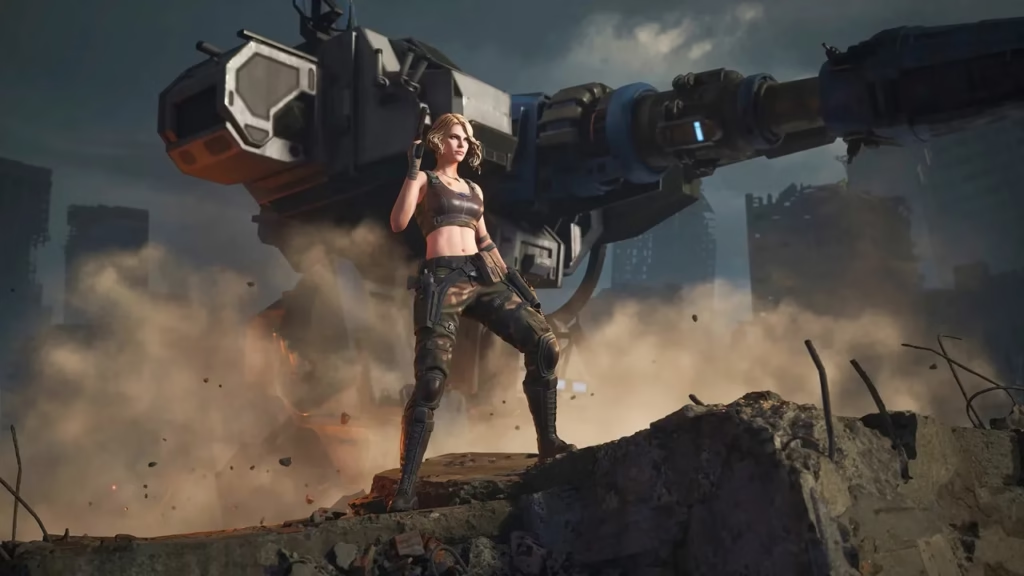
The world of Command & Conquer didn’t end with the classics—Tencent’s Level Infinite studio has taken the series into a new era with Command & Conquer: Legions, a mobile strategy game announced in August 2023.
-
Platforms: Android and iOS.
-
Plot: Set after the Third Tiberium War, the storyline reimagines the C&C universe as CABAL returns to threaten humanity. In this version, GDI and Nod must set aside their differences to survive. Surprisingly, characters from both the Tiberium and Red Alert universes appear, including Kane, Tanya, Yuri, and Albert Einstein.
-
Gameplay: Despite marketing itself as a “new approach,” Legions plays similarly to mobile titles like Clash of Clans. Players build bases, harvest Tiberium, join alliances, and engage in real-time PvE and PvP battles.
The game has sparked controversy over plagiarism claims (with assets reportedly copied from Halo and other sources), but it also demonstrates how enduring C&C remains. For many, Legions represents the latest “season” of Red Alert’s influence, carrying the alternate-history flavor into the mobile era.
Is Command & Conquer: Red Alert Worth Playing Today?
Absolutely. For fans of strategy, history, or classic PC gaming, Red Alert remains a timeless experience. Its mix of alternate history storytelling, addictive base-building, and competitive battles still feels satisfying nearly three decades after release.
Whether you’re exploring the original, diving into the remastered version, or experimenting with OpenRA mods, Red Alert delivers both nostalgia and enduring fun.
Why Should You Play Command & Conquer: Red Alert?
-
It’s one of the foundations of RTS gaming.
-
The storyline is uniquely bold, blending science fiction with alternate history.
-
Its faction design encourages varied strategies instead of mirror matchups.
-
The music and FMVs give it personality unmatched by modern games.
-
With remasters and modern reinterpretations like Legions, the series is still evolving.
Command & Conquer: Red Alert FAQ
Q: Is Command & Conquer: Red Alert connected to the main C&C storyline?
Yes. Red Alert was originally designed as a prequel to Tiberian Dawn, with Kane and the Brotherhood of Nod appearing in the Soviet campaign.
Q: Can you still play Red Alert on modern systems?
Yes. You can play the freeware release, the Remastered Collection on Steam/Origin, or through the OpenRA engine.
Q: What made Red Alert different from other RTS games of its time?
Its balance between factions, naval combat, and bold alternate-history storyline set it apart from competitors like Warcraft II.
Q: What is Command & Conquer: Legions?
Legions is a mobile reimagining of the C&C universe developed by Tencent’s Level Infinite studio. It mixes GDI, Nod, and even Red Alert characters in a mobile strategy format.
Q: Which faction is stronger: Allies or Soviets?
It depends on the map and playstyle. Soviets excel with brute force and Tesla weapons, while Allies rely on naval dominance, speed, and trickery.
Q: What is the most famous part of Red Alert’s soundtrack?
Frank Klepacki’s Hell March is considered one of the most iconic video game tracks ever composed.
Conclusion
Command & Conquer: Red Alert is more than just a video game—it’s a landmark in the history of real-time strategy. With its alternate-history premise, balanced gameplay, and groundbreaking multiplayer, it set the gold standard for RTS titles of the 1990s. Its expansions and sequels ensured its legacy, while remasters and community projects continue to bring it to new audiences today.
And now, with mobile projects like Command & Conquer: Legions, the franchise remains alive—if in a very different form. From PCs of the 1990s to smartphones in the 2020s, Red Alert’s spirit continues to evolve, proving its relevance across generations of players.
Thank you for reading and make sure to bookmark the site, comment and follow up on the newest posts!
How useful was this post?
Click on a star to rate it!
Average rating 0 / 5. Vote count: 0
No votes so far! Be the first to rate this post.