
 8.0/10
Fate/stay night is a multi-route Japanese visual novel created by Type-Moon and first released in 2004 for PC. What began as a branching narrative game soon evolved into one of the most celebrated anime franchises in Japanese media history. The story centers around Shirou Emiya, an ordinary high school student who is suddenly thrust into a deadly supernatural conflict called the Holy Grail War. Masters—talented mages—summon Servants, legendary heroes from across history and mythology, to wage a clandestine battle where only one pair can survive and claim the wish-granting Holy Grail.
This universe explores heavy themes such as trauma, idealism, morality, and the harsh limits of heroism. Through three distinct narrative routes—Fate, Unlimited Blade Works, and Heaven’s Feel—viewers and readers witness different sides of these characters, each revealing new truths about their pasts, their convictions, and the true cost of saving others.
The franchise has received multiple critically acclaimed anime adaptations, a massive multimedia expansion, and international recognition as the cornerstone of Type-Moon’s storytelling universe. Today, with official worldwide releases and high-definition remasters, Fate/stay night remains more accessible and relevant than ever for both new audiences and long-time fans.
Fate/Stay night – Unlimited Blade Works Official Trailer
What is Fate/stay night About?
The story takes place in Fuyuki City during the Fifth Holy Grail War, a ritual occurring in secret once every generation. Seven Masters summon seven Servants representing Heroic Spirits with iconic powers. Their objective is brutally simple: eliminate the opposition before the opposition eliminates them. The survivor is granted a miracle capable of altering fate itself.
Shirou Emiya never intends to join this conflict. A survivor of a massive fire years earlier, he was adopted and taught minimal magic by a mage named Kiritsugu. Inspired by Kiritsugu’s ideals, Shirou grows up wanting to save others from suffering. His wish is noble but dangerously naive, and when he is forced into the Grail War after unintentionally summoning Saber, he must confront the grim realities his idealism never accounted for.
Fate/stay night offers three unique yet interconnected routes that explore fundamentally different narrative directions. Each route presents separate answers to the same core questions: What does it mean to be a hero? Can ideals survive reality? What sacrifices are acceptable in the pursuit of saving others? This structure encourages a profound, layered understanding of its characters and the philosophical topics driving them.
Popularity and Cultural Impact
Fate/stay night quickly became a cultural phenomenon in Japan and beyond. During its original release, it was the best-selling visual novel of its year and helped transform Type-Moon from an indie doujin circle into a major influence in modern Japanese storytelling. Its expansions created the larger Fate franchise, now spanning anime, films, manga, light novels, stage productions, and video games.
The success of Fate/Zero and Ufotable’s adaptations elevated the franchise to mainstream popularity worldwide, especially due to its cinematic animation, meticulous fight choreography, and mature character writing. Massive conventions, dedicated merchandise lines, and record-breaking mobile game revenue through Fate/Grand Order reflect how deeply the world has embraced this universe.
Many creators cite Fate as a gateway into visual novels and Japanese heroic fantasy. It reshaped how branching narrative media can deliver emotional impact and continues to define the genre more than two decades later.
Why You Should Watch Fate/stay night
Fate/stay night stands out among dark fantasy anime and gaming storytelling due to its narrative complexity and emotional substance. Each Servant is based on a mythological or historical hero, giving their motivations weight, personality, and tragic irony. Combat is not only physical but philosophical—battles are driven by personal values, traumas, and clashing interpretations of justice.
What makes the franchise remarkable is how each route challenges viewers differently. One route celebrates idealism, another confronts it, and the last deconstructs it entirely. The deeper you go, the more the story tests your views about morality, love, sacrifice, and the burden of being “good.” Fans often return to the series to reflect on these questions at different stages of life. Ultimately, Fate/stay night is a rare narrative that rewards both emotional investment and critical thought.
Is Fate/stay night Worth Watching Today?
More than ever. Recent releases—including Fate/stay night Réalta Nua Remastered in 2024—have introduced the full story to a global audience. The Heaven’s Feel film trilogy offers extraordinary production quality and some of the franchise’s most emotionally powerful moments. In addition, Fate/Zero and the wider Type-Moon universe remain in active development.
Whether you are a first-time viewer or returning to evaluate different thematic interpretations, Fate/stay night remains one of the most essential works in modern Japanese media. It is a core foundation for the Fate franchise, and understanding its characters deeply enriches every related story.
Cast and Characters
Fate/stay night includes several layered protagonists and antagonists whose philosophies reflect conflicting definitions of heroism.
Key figures include:
• Shirou Emiya – A young man determined to save others at all costs, even at the expense of himself
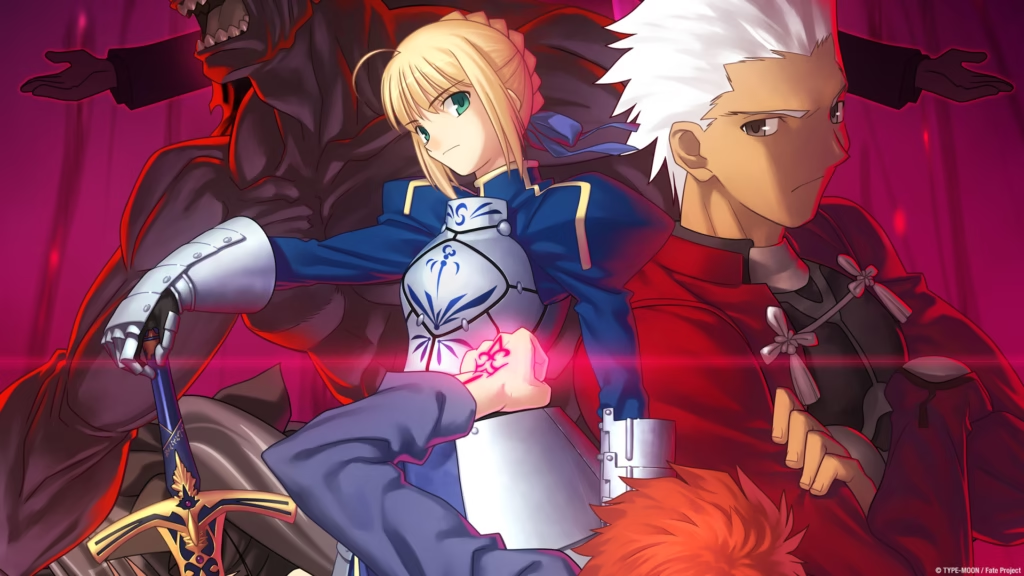
• Saber (Artoria Pendragon) – The once-and-future King of Britain, hiding her identity while carrying a heavy burden of regret
• Rin Tohsaka – A prodigious mage balancing ambition, responsibility, and personal vulnerability
• Sakura Matou – A soft-spoken girl whose past conceals unbearable darkness
• Archer – A cynical Servant whose origins challenge Shirou’s idealism directly
• Kirei Kotomine – A priest who searches for meaning in suffering and moral corruption
• Gilgamesh – A golden tyrant who considers humanity inferior and unworthy of salvation
The diversity of character philosophies is what drives Fate/stay night beyond simple good versus evil conflict.
Production and Release History
Fate/stay night began development in the late 1990s as a dark fantasy narrative by Kinoko Nasu, initially planned with reversed character roles before reworking into its visual novel form. It was released in 2004 for PC, followed by the all-ages version Réalta Nua on PlayStation 2 and later platforms.
Major anime adaptations include:
• Fate/stay night (2006, Studio Deen)
Primarily adapts the Fate route, but with major cuts and narrative compromises
• Fate/stay night: Unlimited Blade Works (2014–2015, Ufotable)
A faithful and visually acclaimed adaptation of the UBW route
• Fate/stay night: Heaven’s Feel film trilogy (2017–2020, Ufotable)
Adapts the darkest route with high fidelity and emotional weight
Ongoing worldwide demand has led to remasters, rereleases, and expanded production across multiple formats, solidifying its long-term growth as a multimedia franchise.
Critical Reception
Critics consistently praise Fate/stay night for its ambitious structure, philosophical complexity, and emotionally compelling protagonists. Reviewers frequently cite the strong themes of trauma recovery, moral growth, and internal conflict as major strengths. Shirou is regarded as one of the visual novel medium’s most nuanced protagonists, and his evolving beliefs across routes have inspired academic analysis.
Some criticism exists toward early adaptations, particularly the 2006 anime, which condenses or alters key narrative elements. However, the success of Ufotable’s projects and global acceptance of Fate/Grand Order helped modern audiences reconnect with the story in its intended thematic form.
Watch Order Guide (Best Approach for New Viewers)
Fate can be confusing for newcomers due to alternate timelines. This watch order ensures emotional impact and narrative clarity.
Recommended Story Order
-
Fate/stay night: Unlimited Blade Works (2014–2015)
This introduces the Grail War, core characters, and fundamental concepts.
Go through Season 1, Season 2, then the extra episode Sunny Day. -
Fate/stay night: Heaven’s Feel (Trilogy Films)
These films reveal the hidden truths behind the war and characters’ darkest realities.
They rely heavily on familiarity with UBW. -
Fate/Zero (2011–2012)
This is a prequel that explores the origins of the event and characters from 10 years earlier.
Watching it earlier spoils major plot revelations — so it belongs after SN routes.
Optional (Afterward / If You Want More)
• Today’s Menu for the Emiya Family – Slice-of-life epilogue with cooking and happiness
• Lord El-Melloi II Case Files – Magical politics and character follow-ups
• Studio Deen Fate/stay night 2006 – Only if curious about historical adaptation differences
This order keeps emotional surprises intact and respects the narrative structure intended by Type-Moon.
Fate/Stay night FAQ
Is it necessary to experience all three routes?
Yes, if you want to understand the full thematic arc of Shirou and Saber, Rin, and Sakura’s stories.
Do the routes contradict each other?
No. Each explores alternate outcomes and emotional truths rather than a single canonical timeline.
Can I start with Fate/Zero?
It is strongly discouraged for first-time viewers because it reveals major secrets that weaken Fate/stay night’s storytelling.
How mature is the content?
The story includes violence, psychological trauma, and heavy moral themes. The VN’s original release included adult content, later replaced in all-ages versions with additional narrative scenes.
If I prefer reading over watching, where should I start?
Begin with the visual novel Fate/stay night Réalta Nua Remastered for the fullest character development available.
Conclusion
Fate/stay night is a defining work of dark fantasy that continues to inspire audiences with its layered storytelling and timeless ethical questions. It tackles the fragile relationship between justice and sacrifice, and forces viewers to reconsider what makes a person a hero: ideals, actions, or the willingness to endure personal suffering to protect others.
Its legacy has expanded into one of the most ambitious multimedia franchises in Japan, yet the emotional core remains tied to this original story of a boy who wants to save everyone, no matter the personal cost. Experiencing Fate/stay night in its proper form grants a full appreciation for these characters and why their journeys resonate so strongly years after their creation.
Whether approached through its acclaimed anime adaptations or through the visual novel itself, Fate/stay night remains one of the most important narrative experiences available to fans of anime, gaming, or complex character-driven fiction.
If you don’t know where to watch this Anime for FREE make sure to contact me via E-mail, or in the comments below. Thank you for reading and make sure to bookmark the site.
How useful was this post?
Click on a star to rate it!
Average rating 5 / 5. Vote count: 1
No votes so far! Be the first to rate this post.