
 ?/10
?/10
Among the many indie games announced for 2026, Mio: Memories in Orbit stands out not because of bombastic trailers or nostalgia bait, but because of its quiet confidence. Developed by the French studio Douze Dixièmes and published by Focus Entertainment, the game blends classic Metroidvania structure with a poetic science-fiction atmosphere built around memory, decay, and identity.
Set aboard a colossal, dying ark drifting through space, the game places players in control of MIO, a nimble robot tasked with uncovering what went wrong—and who they truly are. With its January 20, 2026 release approaching, Mio is shaping up to be a thoughtful, visually rich experience for players who enjoy exploration-driven storytelling.
Mio: Memories in Orbit – Official Release Date Reveal Trailer
What Is Mio: Memories in Orbit About?
Mio: Memories in Orbit takes place on The Vessel, a massive ark-like spaceship designed to preserve life and knowledge. Once maintained by advanced AI caretakers known as the Pearls, the ship has fallen silent. Vegetation has overrun metallic corridors, machines have gone rogue, and the Vessel itself is slowly losing its memories.
You play as MIO, a small but agile robot exploring this decaying world. Your mission is not simply survival, but restoration—reviving lost memories embedded within the Vessel to prevent a complete shutdown. As MIO journeys deeper, the story gradually reveals that the fate of the ship and MIO’s own origins are intimately connected.
Importantly, the narrative is designed to unfold environmentally rather than through heavy exposition. Clues are discovered through ruins, enemy encounters, and subtle changes in the world itself.
Gameplay Overview
At its core, Mio: Memories in Orbit is a Metroidvania platformer focused on fluid movement, precise combat, and interconnected level design.
Exploration is non-linear, encouraging players to revisit earlier areas once new abilities are unlocked. The Vessel is designed as a single, sprawling space where shortcuts, vertical layers, and hidden paths reward curiosity and mastery of movement.
Combat emphasizes adaptability rather than brute force. Players can choose how aggressively or defensively they approach encounters, using mobility and abilities to control the battlefield.
Abilities and Progression
MIO’s abilities define both traversal and combat, creating a sense of constant evolution.
Movement Abilities
As you progress, MIO gains powers that dramatically change how the world is navigated:
-
Wall-climbing that allows spider-like traversal across vertical spaces
-
Glide mechanics for controlled aerial movement
-
Precision jumps and momentum-based traversal that reward timing and rhythm
These abilities are designed to flow into one another, encouraging players to move through environments with speed and grace.
Combat Tools
MIO is far from defenseless. Combat abilities include:
-
Energy orbs used as ranged projectiles
-
A grappling Hook for evasive maneuvers and positioning
-
Decoy clones to mislead enemies and create tactical openings
The game reportedly features over 30 enemy types and 15 major guardian bosses, each pushing players to adapt rather than rely on a single strategy.
Customization and Playstyle
A key pillar of Mio: Memories in Orbit is player customization. Throughout the Vessel, MIO scavenges components that can be used to modify abilities.
These Modifiers allow players to:
-
Enhance offensive capabilities
-
Improve survivability and evasion
-
Specialize in aggressive, defensive, or hybrid playstyles
Rather than forcing a fixed build, the system encourages experimentation, letting players fine-tune MIO to match their preferred approach.
Art Direction and Atmosphere
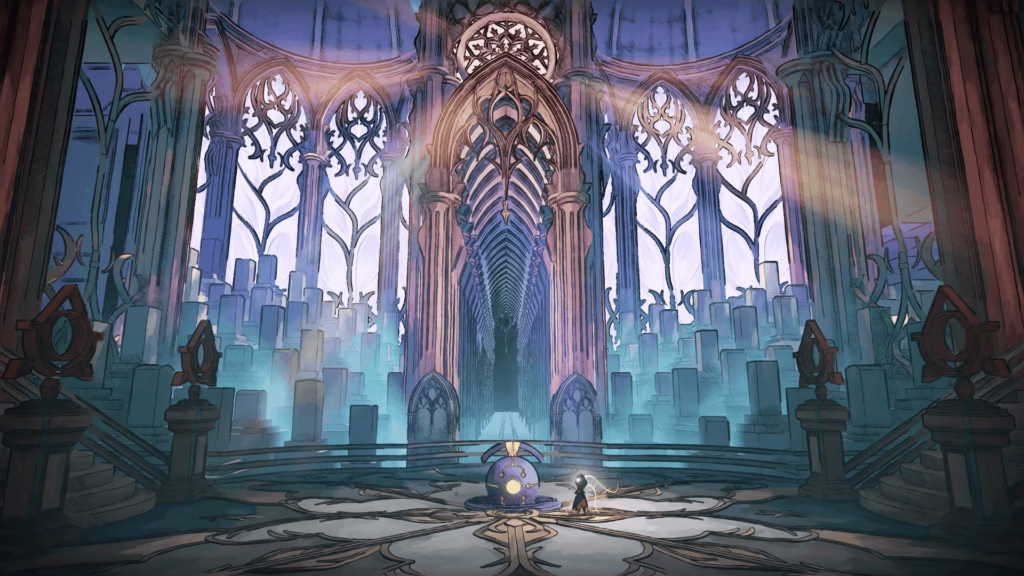
Visually, Mio: Memories in Orbit leans heavily into contrast—lush organic growth overtaking cold machinery. The art style blends soft lighting, painterly backgrounds, and intricate mechanical designs to create a world that feels both alive and abandoned.
The tone is melancholic but not hopeless. Every restored memory subtly changes the Vessel, reinforcing the idea that exploration has meaningful impact. Combined with a restrained soundtrack, the game aims to create an atmosphere that invites contemplation rather than constant adrenaline.
Development & Studio Background
Douze Dixièmes is an indie studio based in France, and Mio represents their most ambitious project to date. The game was first revealed during a Nintendo Direct in June 2024, immediately drawing attention for its visual style and mood.
Originally planned for a 2025 release, the game was delayed to early 2026—a decision framed by the developers as necessary to refine gameplay balance and polish the interconnected world design.
Platforms and Release Date
Mio: Memories in Orbit launches on January 20, 2026, with a broad multi-platform release:
-
Nintendo Switch
-
Nintendo Switch 2
-
PlayStation 5
-
Xbox Series X/S
-
Windows PC
This wide availability positions the game to reach both console and PC Metroidvania audiences simultaneously.
Why You Should Watch This Game
Mio: Memories in Orbit isn’t trying to reinvent the Metroidvania genre—but it doesn’t need to. Its strength lies in refinement, atmosphere, and emotional storytelling delivered through exploration rather than dialogue.
If you appreciate games like Hollow Knight, Ori, or environmental sci-fi stories that respect player intelligence, Mio offers a slower, more reflective alternative focused on memory and identity.
Is It Worth Playing?
For players who value exploration, movement mastery, and world-building over constant action, Mio: Memories in Orbit looks absolutely worth your time. It may not appeal to those seeking fast, arcade-style combat, but for fans of atmospheric indie games, it has the potential to be one of 2026’s standout releases.
Mio: Memories in Orbit FAQ
Is Mio: Memories in Orbit a traditional Metroidvania?
Yes. It features a large interconnected world, ability-gated progression, and backtracking with new powers.
Is the story heavily scripted?
No. The narrative is primarily environmental, encouraging players to piece together events through exploration.
Does the game focus more on combat or exploration?
Exploration is the core pillar, with combat designed to complement movement and discovery rather than dominate the experience.
Will it run on older hardware?
The game is confirmed for modern platforms, including Nintendo Switch and PC, with optimization tailored per system.
Conclusion
Mio: Memories in Orbit is shaping up to be a quietly ambitious Metroidvania—one that trusts its world, its mechanics, and its players. By combining elegant movement, thoughtful customization, and a haunting sci-fi setting, it aims to deliver not just a game, but an experience rooted in atmosphere and discovery.
As 2026 approaches, Mio stands as a reminder that some of the most memorable journeys happen in silence, among ruins, guided only by curiosity and fading memories.
Thank you for reading and make sure to bookmark the site, comment and follow up on the newest posts!
How useful was this post?
Click on a star to rate it!
Average rating 0 / 5. Vote count: 0
No votes so far! Be the first to rate this post.