
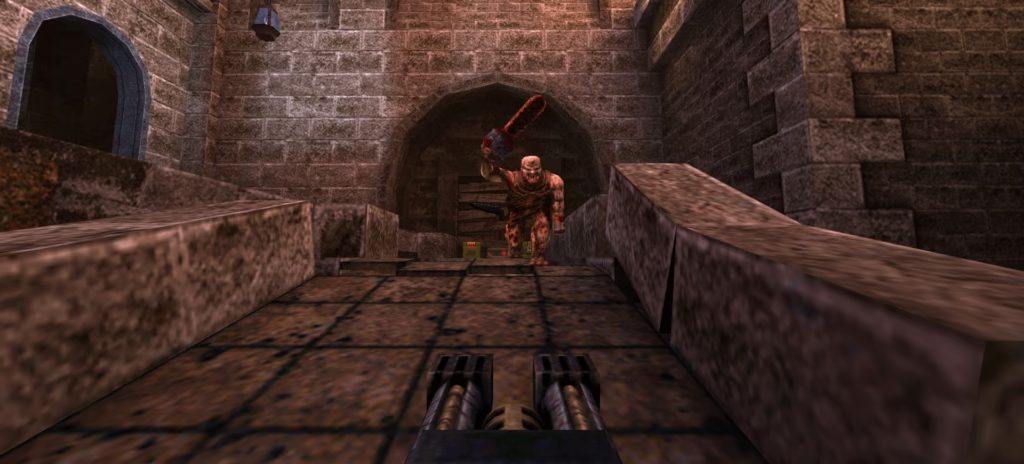
Released in 1996 by id Software, Quake was a technological leap that transformed first-person shooters forever. It was the studio’s follow-up to Doom, but instead of reusing 2.5D tricks, it pioneered true real-time 3D rendering with polygonal models, dynamic lightmaps, and fast-paced online play. Published by GT Interactive, it merged sci-fi and gothic horror with H.P. Lovecraft’s mythos, wrapped in a brooding soundtrack by Trent Reznor and Nine Inch Nails.
Quake wasn’t just another shooter — it was a cultural reset, blending cutting-edge graphics, unnerving atmosphere, and groundbreaking multiplayer innovations. Despite a troubled development cycle, it cemented id Software as industry pioneers and sparked a competitive gaming scene that still echoes today.
Quake – Official Trailer (2021) Remaster
What is Quake About?
Quake drops players into a dark sci-fi fantasy where teleportation experiments unleash an interdimensional invasion:
-
Premise: Secret U.S. government experiments with Slipgates accidentally open portals to dimensions controlled by a hostile force codenamed Quake.
-
Protagonist: You play as a nameless marine, later dubbed Ranger, the sole survivor of “Operation Counterstrike.”
-
Mission: Travel through Slipgates, fight hordes of monsters, and collect four Runes of Power across different realms to confront the Old One, Shub-Niggurath.
-
Tone: A surreal blend of military bases, medieval castles, and hellish dungeons, with enemies and names pulled directly from Lovecraftian lore (Shamblers, Vores, and Shub-Niggurath).
The story is intentionally minimalistic, relying on level titles, cryptic text, and environmental design to convey its otherworldly dread.
Gameplay
Quake expanded on Doom’s formula but introduced mechanics that reshaped FPS design:
-
Episodes & Levels:
-
Four episodes, each with 7–8 levels and one secret level.
-
Players return to a hub map after each episode to choose the next.
-
Each episode starts you with no weapons, ensuring balance and progression.
-
-
Difficulty:
-
Easy, Normal, Hard chosen via portal gateways.
-
Nightmare difficulty is hidden, accessed only through a secret passage.
-
-
Combat Flow:
-
Weapons include the Shotgun, Super Shotgun, Nailgun, Super Nailgun, Rocket Launcher, Grenade Launcher, and Lightning Gun.
-
Movement mastery—strafe-jumping, bunnyhopping, and rocket-jumping—made combat fast and skill-driven.
-
-
Atmosphere:
-
Lighting, texture work, and Nine Inch Nails’ ambient soundtrack gave Quake an industrial-gothic tone unlike anything before it.
-
Ammo crates even featured the NIN logo as an Easter egg.
-
Quake’s level design emphasized exploration, secrets, and verticality, pushing FPS gameplay into new dimensions.
Monsters & Enemies
Quake’s bestiary became legendary for its design and menace:
-
Grunts & Enforcers – possessed soldiers using guns and energy weapons.
-
Ogres – chainsaw-wielding brutes that lob grenades.
-
Knights & Death Knights – melee foes with swords and flame attacks.
-
Fiends – terrifying quadrupeds that leap across rooms.
-
Scrags – floating, snake-like monsters spitting acid.
-
Shamblers – iconic white-furred beasts that unleash devastating lightning.
-
Vores – spider-like demons firing tracking pods.
-
Bosses – Chthon (lava-dwelling god) and Shub-Niggurath (a Lovecraftian Old One).
The enemy roster was deliberately gothic, grotesque, and unpredictable, blending sci-fi militarism with cosmic horror.
Multiplayer
Perhaps Quake’s greatest legacy lies in its multiplayer revolution:
-
LAN & Online Play:
-
Allowed co-op campaign runs or deathmatch battles.
-
QuakeWorld (1996) added client-side prediction, fixing Internet lag and making online FPS viable.
-
-
Modes:
-
Free-for-all deathmatch.
-
1v1 duels (popular in competitive play).
-
Team-based clan battles.
-
-
Movement Meta: Advanced techniques like rocket-jumping and bunnyhopping made movement skill essential.
-
Esports Birth:
-
In 1997, Dennis “Thresh” Fong won John Carmack’s Ferrari 328 at the Red Annihilation tournament.
-
Established FPS dueling as a legitimate esport format.
-
Quake’s online culture, clans, ladders, and competitive scenes inspired everything from Counter-Strike to Overwatch.
Development History
The road to Quake was turbulent and fascinating:
-
Origins: Inspired by id’s private Dungeons & Dragons campaign, where a hero named Quake wielded a hammer.
-
Early Concepts: Planned as an RPG-style melee game with dragons, magic hammers, and destructible terrain.
-
Pivot: Technical challenges with the new 3D engine forced a shift back toward a shooter in late 1995.
-
Engine Innovations:
-
True 3D polygonal rendering (no sprites).
-
Lightmaps for atmospheric lighting.
-
QuakeC scripting language enabled fan mods.
-
TCP/IP networking for Internet play.
-
-
Internal Conflicts: Creative differences led to burnout; co-founder John Romero left shortly after release.
Despite the chaos, Quake shipped as a groundbreaking title that pushed both technology and design forward.
Ports & Expansions
Quake spread across multiple systems and received official expansions:
-
Ports:
-
PC (MS-DOS, Windows, Linux, Mac).
-
Sega Saturn (1997) – redesigned levels, exclusive maps, no multiplayer.
-
Nintendo 64 (1998) – streamlined campaign, added 2-player deathmatch.
-
-
Expansions:
-
Scourge of Armagon (1997) – new weapons, enemies, and machinery-based level design.
-
Dissolution of Eternity (1997) – alternate ammo types, Egyptian-themed enemies, grappling hook.
-
MachineGames’ Episodes:
-
Dimension of the Past (2016).
-
Dimension of the Machine (2021).
-
-
-
Enhanced Edition (2021):
-
Nightdive/Bethesda re-release for modern platforms.
-
Restored NIN soundtrack, widescreen support, online cross-play, and add-ons.
-
Reception
Quake was critically acclaimed and became a landmark in gaming:
-
Critical Praise:
-
PC version averaged 93–94% on GameRankings/Metacritic.
-
Praised for its 3D engine, atmosphere, and multiplayer depth.
-
-
Console Ports: Mixed reception due to compromises (Saturn, N64).
-
Sales: Over 1 million units sold in its first year, though shareware piracy hurt early revenues.
-
Enhanced Edition Reviews: Praised for preserving Quake’s magic while modernizing performance (Switch version often cited as “definitive”).
Legacy & Impact
-
Cemented id Software as FPS pioneers after Doom.
-
Popularized 3D acceleration and modding culture via QuakeC.
-
Laid the foundation for competitive online shooters and esports.
-
Inspired countless modders—Team Fortress and Counter-Strike trace lineage back to Quake modding.
-
Established movement-based combat as a subgenre (arena shooters).
-
Still regarded as one of the greatest video games ever made.
Quake FAQ
Q: What made Quake different from Doom?
A: While Doom used a 2.5D engine with sprite-based enemies, Quake introduced true 3D polygonal graphics, dynamic lightmaps, and full real-time rendering. It also had a darker Lovecraft-inspired tone and more advanced multiplayer.
Q: Who composed the Quake soundtrack?
A: The soundtrack was composed by Trent Reznor and Nine Inch Nails, who created unsettling ambient soundscapes instead of traditional music, giving the game a haunting industrial-gothic atmosphere.
Q: Can you still play Quake today?
A: Yes. The 2021 Enhanced Edition by Nightdive and Bethesda is available on PC, PlayStation, Xbox, and Nintendo Switch. It includes the original game, expansions, cross-play multiplayer, and restored soundtrack.
Q: What are the expansions for Quake?
A: Official expansions include Scourge of Armagon and Dissolution of Eternity. Later, MachineGames developed Dimension of the Past (2016) and Dimension of the Machine (2021).
Q: How important was Quake for online gaming?
A: Hugely important. With the release of QuakeWorld, it popularized online multiplayer FPS and laid the foundation for esports, introducing competitive dueling and clan battles.
Q: What is Quake’s connection to H.P. Lovecraft?
A: Many of the monsters and names come from Lovecraft’s Cthulhu Mythos, including Shub-Niggurath, the final boss, and creatures like Shamblers and Vores. This gave the game its unique gothic-horror identity.
Conclusion
Quake was more than just Doom’s successor; it was a watershed moment for PC gaming. With its haunting Lovecraftian mood, fluid 3D engine, competitive multiplayer, and Trent Reznor’s unsettling soundtrack, it reshaped how shooters were built, played, and shared. Nearly 30 years later, Quake remains not just a nostalgic classic, but a living blueprint for the genre.
Thank you for reading and make sure to bookmark the site, comment and follow up on the newest posts!
How useful was this post?
Click on a star to rate it!
Average rating 0 / 5. Vote count: 0
No votes so far! Be the first to rate this post.