
 8.5/10
 93% Critics / 94% Audience
In 2001, visionary animator Genndy Tartakovsky, already celebrated for Dexter’s Laboratory, created one of the most striking and cinematic animated series ever made — Samurai Jack. Blending ancient myth, futuristic sci-fi, and silent storytelling, the show redefined what television animation could achieve.
Airing first on Cartoon Network and later revived on Adult Swim, Samurai Jack follows a nameless samurai prince flung into a dystopian future ruled by the evil shapeshifting demon Aku. The prince, nicknamed Jack by the people of the future, embarks on a lonely quest to return to his own time and undo Aku’s reign of terror.
With its minimalist dialogue, visual storytelling, and stunning art direction, Samurai Jack became a landmark in Western animation — fusing Japanese folklore, futuristic cyberpunk, and philosophical reflection into a single, unforgettable narrative.
Samurai Jack – Official Season 1 Trailer Remastered
What Is Samurai Jack About?
Samurai Jack tells the tale of a young Japanese prince whose kingdom falls under the shadow of Aku, the shapeshifting master of darkness. Gifted a mystic katana forged by the gods Ra, Rama, and Odin, the prince trains across the world to prepare for the day he can destroy the demon once and for all.
But just as victory is within reach, Aku tears open a portal through time, casting the samurai into a bleak future where Aku’s evil rules unchallenged. Stranded in a world of machines, aliens, and chaos, the warrior must navigate this strange new era to find a way back to the past — and fulfill his destiny.
The premise blends feudal Japanese honor and futuristic despair, contrasting Jack’s serene discipline with the grotesque corruption of Aku’s rule. Each episode functions as a standalone adventure, yet all contribute to the overarching story of perseverance, morality, and fate.
Is Samurai Jack Worth Watching?
Absolutely — Samurai Jack is more than an animated series; it’s visual poetry in motion.
Here’s why it stands among the greatest animated shows of all time:
-
Masterful Visual Storytelling: Many episodes are nearly silent, relying on imagery, pacing, and music instead of dialogue.
-
Unique Art Direction: Inspired by Japanese ink paintings, Frank Miller’s Ronin, and Kurosawa’s films, every frame feels cinematic.
-
Emotional Depth: Beneath the stoic heroism lies a story of loneliness, loss, and hope that matures as the series progresses.
-
Genre Fusion: It flawlessly combines samurai cinema, science fiction, mythology, and Western animation.
-
Universal Themes: Honor, patience, perseverance, and the search for meaning are central to Jack’s journey.
Even decades later, its animation and emotional impact remain timeless — appealing to both adults and younger audiences alike.
Why Should I Watch Samurai Jack?
Because Samurai Jack is not just a story about a warrior; it’s a reflection of human endurance and spiritual purpose.
-
The series pushes the boundaries of animation, showing that silence and simplicity can express more than dialogue ever could.
-
It celebrates artistry and discipline, echoing samurai philosophy through minimalist design and movement.
-
It’s a meditative experience, balancing thrilling action with philosophical quiet.
-
Its final season offers one of the most emotionally resonant conclusions in animation history.
If you appreciate animation that respects your intelligence, Samurai Jack stands as a perfect embodiment of creative integrity.
Cast and Characters
-
Samurai Jack (Phil LaMarr): The stoic, unnamed samurai prince who takes on the nickname “Jack.” His moral clarity and unwavering honor define the show’s emotional center.
-
Aku (Mako / Greg Baldwin): The shapeshifting demon lord of chaos, both terrifying and comically self-absorbed. Mako’s original performance became legendary.
-
Ashi (Tara Strong): Introduced in Season 5, she begins as one of the Daughters of Aku but becomes Jack’s ally and love interest.
-
The Scotsman (John DiMaggio): A loud, fearless warrior with an enchanted claymore and a machine-gun prosthetic leg — one of Jack’s closest allies.
Each character embodies archetypal storytelling — good and evil, wisdom and folly — told through Tartakovsky’s distinct visual rhythm.
Production and Development
After the success of Dexter’s Laboratory, Genndy Tartakovsky sought to craft something cinematic and wordless — inspired by Kung Fu (1972), Lone Wolf and Cub, and Kurosawa’s samurai epics. Samurai Jack premiered on August 10, 2001, with an ambitious three-part movie titled The Beginning.
The show’s minimalist style was revolutionary for its time: wide cinematic aspect ratios, long pauses, bold colors, and highly choreographed battles gave it a distinct tone. Each episode functioned like a self-contained short film, showcasing animation as visual storytelling rather than dialogue-driven narrative.
Tartakovsky’s creative philosophy drew from:
-
Frank Miller’s Ronin for aesthetic and dystopian elements.
-
Akira Kurosawa for storytelling structure and pacing.
-
Spartacus, Lawrence of Arabia, and Ben-Hur for cinematic grandeur.
The original run lasted four seasons (2001–2004), after which the story remained unfinished for over a decade — until its triumphant conclusion in 2017.
Setting and Themes
The world of Samurai Jack fuses ancient tradition with futuristic decay — a post-apocalyptic Earth ruled by Aku, populated by robots, aliens, mutants, and spirits. Despite technological advancement, wild natural lands still exist, untouched by corruption.
Themes explored throughout the series include:
-
Time and Fate: Jack’s struggle against destiny and isolation.
-
Honor vs. Corruption: The persistence of moral code amid chaos.
-
Silence and Stillness: Meditation as narrative; the quiet between sword strikes.
-
Transformation: Both Jack’s inner evolution and Aku’s endless shapeshifting.
This fusion of myth and modernity creates a narrative that feels both timeless and futuristic.
Season 5 Revival (2017)
After more than twelve years, Samurai Jack returned with a darker and more mature fifth season on Adult Swim’s Toonami block. The revival, produced by Cartoon Network Studios and Williams Street, gave closure to Jack’s decades-long journey.
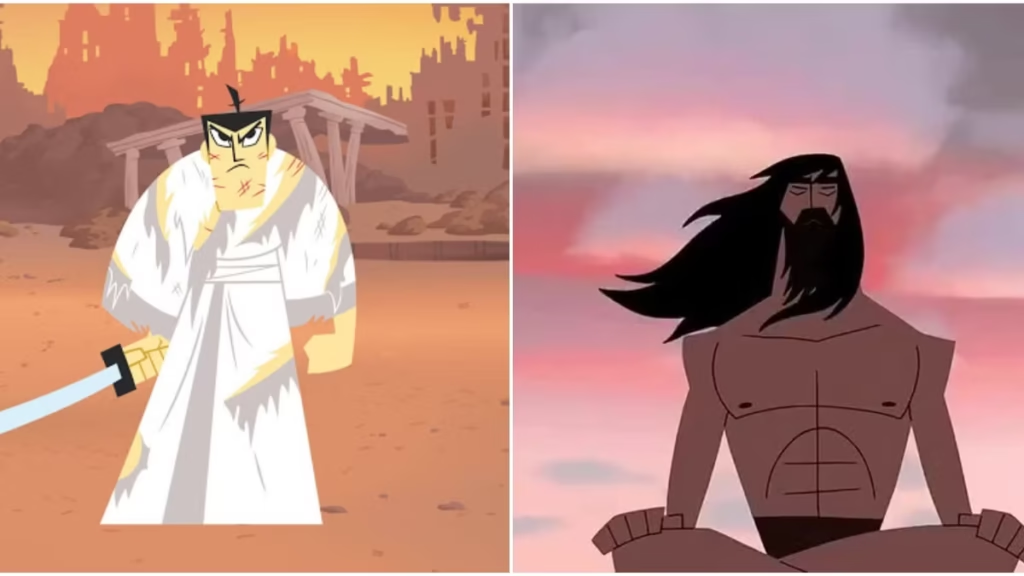
Set fifty years after the original seasons, Jack has lost his sword and his hope, haunted by guilt and visions of failure. When he meets Ashi, one of the Daughters of Aku trained to kill him, she becomes the catalyst for his spiritual redemption. Together they confront fate, identity, and love in a world still ruled by Aku.
The final season received universal acclaim, praised for its maturity, fluid animation, emotional storytelling, and satisfying conclusion.
Accolades and Critical Reception
Samurai Jack is widely regarded as one of the greatest animated shows ever created. It won eight Primetime Emmy Awards, six Annie Awards, and an OIAF Award, while critics consistently celebrate its artistic innovation.
Highlights include:
-
Rotten Tomatoes rating: 93% overall (100% for the final season).
-
IGN ranked it among the Top 25 Animated Series of All Time.
-
Entertainment Weekly placed it 3rd in “Best Cartoon Network Shows.”
-
RogerEbert.com critic Matt Zoller Seitz hailed it as “a masterwork of visual storytelling.”
Even two decades later, its influence echoes in modern animation and filmmaking, from Avatar: The Last Airbender to Primal (also by Tartakovsky).
Other Media and Adaptations
-
Video Games: The Amulet of Time (2003), The Shadow of Aku (2004), and Battle Through Time (2020) expanded the lore through interactive storytelling.
-
Comics: IDW Publishing released Samurai Jack: Tales of a Wandering Warrior (2013–2015), continuing Jack’s adventures.
-
Board Game: Samurai Jack: Back to the Past (2018) lets players relive Jack’s quest in cooperative gameplay.
-
Home Media: The Complete Series Blu-ray Collection (2017) features remastered visuals across all 62 episodes.
These extensions preserve the show’s legacy and reintroduce Jack to new generations.
Samurai Jack FAQ
Q: How many seasons of Samurai Jack are there?
A: There are five seasons with a total of 62 episodes, concluding the story in 2017.
Q: Is Samurai Jack suitable for adults?
A: Yes — while the early seasons were all-ages, the fifth season explores darker themes and mature storytelling.
Q: Was a Samurai Jack movie ever made?
A: Multiple film projects were planned but never completed; the fifth season served as the definitive conclusion.
Q: What makes Samurai Jack unique?
A: Its combination of silence, stylized visuals, and emotional minimalism — a rare blend of Eastern philosophy and Western animation.
Q: Where can I watch Samurai Jack today?
A: The complete series is available on HBO Max, Adult Swim, and Blu-ray.
Conclusion
Samurai Jack stands as a testament to artistic ambition and narrative restraint. Genndy Tartakovsky crafted a world where every frame feels deliberate, every silence speaks volumes, and every battle is a meditation on destiny.
Through its mix of mythology, futurism, and spiritual reflection, it transcends the boundaries of animation — reminding viewers that the hero’s path is not defined by victory, but by the persistence to fight on.
Whether revisited or discovered anew, Samurai Jack remains an unmatched journey through time, identity, and the human spirit.
If you don’t know where to watch this Anime for FREE make sure to contact me via E-mail, or in the comments below. Thank you for reading and make sure to bookmark the site.
How useful was this post?
Click on a star to rate it!
Average rating 0 / 5. Vote count: 0
No votes so far! Be the first to rate this post.