
 6.5/10
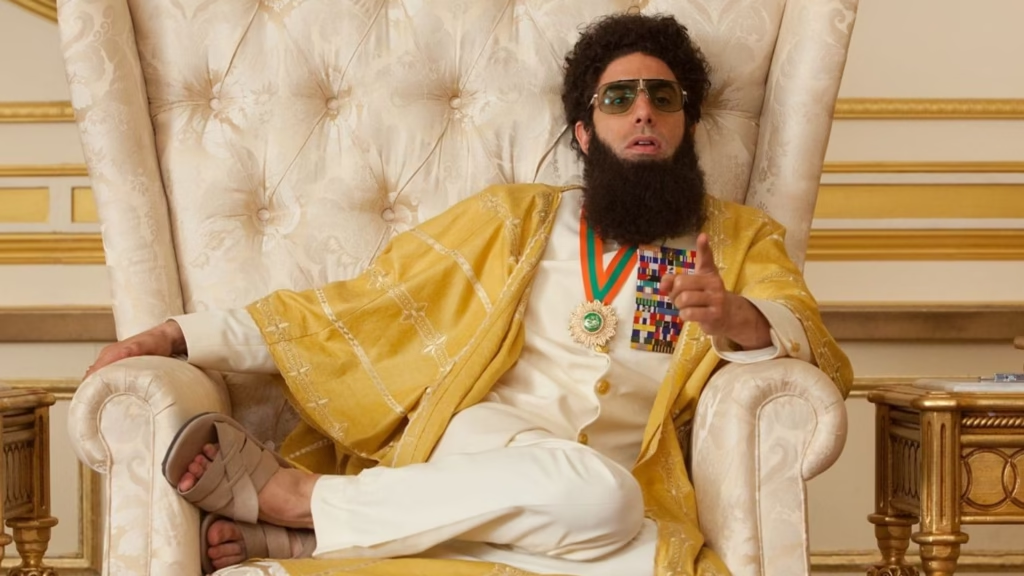
The Dictator (2012) is a political satire comedy directed by Larry Charles and starring Sacha Baron Cohen in his fourth leading role, following the success of Borat and Brüno. The film features Baron Cohen as Admiral General Haffaz Aladeen, an eccentric and ruthless ruler of the fictional North African nation of Wadiya. The star-studded cast includes Anna Faris, Ben Kingsley, Jason Mantzoukas, and cameo appearances by John C. Reilly, Garry Shandling, Megan Fox, and Edward Norton.
Marketed as a satirical take on modern-day authoritarian regimes, The Dictator blends slapstick, shock humor, and political commentary. While the movie divided critics, it became a commercial success, grossing over $190 million worldwide.
The Dictator – Official Movie Trailer
Plot Overview
The story follows Admiral General Aladeen, a narcissistic dictator who rules Wadiya with absolute control. He surrounds himself with female bodyguards, sponsors terrorism, rewrites the dictionary with his own name, and works on building nuclear weapons. When the United Nations threatens to intervene, Aladeen travels to New York to defend his nation.
Betrayed by his uncle Tamir (Ben Kingsley), Aladeen is kidnapped, stripped of his iconic beard, and replaced with a dim-witted double who is meant to sign away Wadiya’s resources. Lost and unrecognizable, he finds himself working alongside Zoey (Anna Faris), a liberal activist, and reconnecting with his disgraced nuclear scientist Nadal (Jason Mantzoukas).
What follows is a mix of satire and absurdity: Aladeen attempts to reclaim power while discovering an unexpected affection for Zoey. The film culminates in a UN conference where Aladeen delivers a speech ironically praising dictatorship, before reluctantly agreeing to a rigged “democracy” in Wadiya.
Is The Dictator worth watching?
Yes—if you’re up for sharp, offensive-on-purpose satire delivered at a brisk 80-something minutes. Sacha Baron Cohen commits fully, Jason Mantzoukas steals scenes, and Larry Charles keeps the gags coming fast. It’s uneven and frequently crude; if taboo humor or broad Middle Eastern caricatures are a deal-breaker, skip it. If you liked Borat, Team America, or The Interview, this scratches the same itch.
Why should I watch The Dictator?
-
Baron Cohen in full send mode: A gleefully unhinged lead turn with quotable lines and audacious set pieces.
-
Big laugh-per-minute payoff: Rapid-fire bits, sight gags, and outrageous cameos (played straight for maximum shock value).
-
Political bite under the silliness: A finale speech that lands a pointed jab at “benevolent” autocracy and Western hypocrisies.
-
Short and punchy: Easy weeknight watch that doesn’t overstay its welcome.
-
Cultural artifact of 2010s comedy: Love it or hate it, it’s a memorable snapshot of boundary-pushing studio satire.
Cast and Characters
-
Sacha Baron Cohen – Admiral General Haffaz Aladeen / Allison Burgers / Efawadh
-
Anna Faris – Zoey, activist and love interest
-
Ben Kingsley – Tamir Mafraad, Aladeen’s scheming uncle
-
Jason Mantzoukas – Nadal, Aladeen’s nuclear scientist
-
John C. Reilly – Clayton, the mercenary kidnapper (uncredited)
-
Megan Fox & Edward Norton – Cameo appearances as themselves
Supporting roles include Garry Shandling, Chris Parnell, Adeel Akhtar, Fred Armisen, Nasim Pedrad, and Bobby Lee.
Production
Paramount Pictures described the movie as “the heroic story of a dictator who risked his life to ensure democracy would never come to the country he so lovingly oppressed.”
-
Director: Larry Charles
-
Writers: Sacha Baron Cohen, Alec Berg, David Mandel, Jeff Schaffer
-
Inspiration: Real-world authoritarian figures, such as Gaddafi, Kim Jong Il, and Idi Amin, shaped Baron Cohen’s portrayal.
-
Filming Locations: Spain (Seville’s Plaza de España doubled as Aladeen’s palace), the Canary Islands, and New York City. The United Nations refused filming permission at its headquarters, so scenes were recreated on a New York soundstage.
Interestingly, although Aladeen is portrayed as anti-Israel, Baron Cohen (himself Jewish) speaks Hebrew for Wadiya’s fictional language—a subtle inside joke.
Marketing and Publicity
The film’s promotional campaign was as outrageous as its content:
-
Baron Cohen appeared at the 2012 Oscars in character, spilling “Kim Jong Il’s ashes” (actually pancake mix) on host Ryan Seacrest.
-
Aladeen appeared on Saturday Night Live and The Daily Show, “torturing” critics and congratulating political leaders in satirical videos.
-
Fake invitations claiming Zimbabwean dictator Robert Mugabe was hosting a premiere circulated in Washington, D.C.
Reception
The Dictator sparked debate among critics and audiences alike:
-
Rotten Tomatoes: 57% approval based on 222 reviews, average rating 5.9/10.
-
Metacritic: Score of 58/100, indicating “mixed or average reviews.”
-
CinemaScore: Audiences gave it a “C” grade, showing divided reactions.
While some praised Baron Cohen’s fearless satire and outrageous set pieces, others criticized the film’s uneven tone and reliance on crude humor.
Financially, the film grossed $190.2 million worldwide, proving commercially successful despite the controversies.
Controversies and Censorship
The film faced bans and edits in several countries:
-
Banned or censored in parts of the Middle East, Central Asia, and South Asia (Kazakhstan, Uzbekistan, Tajikistan, Turkmenistan, Malaysia, and Pakistan).
-
Edited versions were released in Italy (removing references to Silvio Berlusconi) and Uzbekistan (cut down to 71 minutes).
-
Criticized for Islamophobia and reinforcing Arab stereotypes, particularly through depictions of hypersexuality, terrorism links, and caricatured cultural imagery.
Despite these controversies, the film succeeded in drawing attention through satire and shock value, embodying Baron Cohen’s trademark brand of comedy.
FAQ — The Dictator (2012)
Is The Dictator based on a true story or book?
No. It’s a scripted satire loosely inspired by traits of real-world strongmen. Paramount once cited Saddam Hussein’s Zabibah and the King as an “inspiration,” but the movie isn’t an adaptation.
Is it a mockumentary like Borat and Brüno?
No. This one’s a fully scripted narrative feature (with improv), not a hidden-camera mockumentary.
What’s the runtime and rating?
The theatrical cut runs ~83 minutes and is rated R for strong crude/sexual content, language, brief male nudity, and some violence. An Unrated cut adds ~15 minutes.
What’s different in the Unrated version?
Mostly extra raunchy gags and dialogue, plus a couple of extended scenes (e.g., a bodyguard assassination attempt bit and more material around the hotel catering subplot).
Where can I watch it?
Availability shifts by region, but it’s widely rentable/purchasable digitally (e.g., Prime Video, Apple TV, Google Play) and on Blu-ray. Check your local streamer/storefront.
Is Wadiya a real country?
No—Wadiya is fictional, portrayed as being in the Horn of Africa. The palace exteriors were shot at Plaza de España in Seville; other locations include Fuerteventura (Spain) and New York City (UN interiors were recreated on a Long Island soundstage).
What language is Aladeen speaking in some scenes?
Despite the character’s anti-Semitic bluster, the “Wadiyan” he speaks is actually Hebrew—one of the film’s meta-jokes (Sacha Baron Cohen is Jewish).
Who directed it?
Larry Charles, who also directed Baron Cohen’s Borat and Brüno.
Who shows up in cameos?
Keep an eye out for Megan Fox and Edward Norton as themselves, plus uncredited bits from John C. Reilly and Garry Shandling.
How did it do at the box office?
It grossed about $190 million worldwide on a mid-budget studio spend.
Why was it controversial or banned in places?
Its portrayal of a cartoonishly stereotyped Middle Eastern dictator sparked accusations of Islamophobia/anti-Arab caricature. Several countries censored or restricted releases.
Is there a post-credits scene?
No Marvel-style stinger. Home releases include extra/deleted bits; the credits roll straightforwardly in the theatrical cut.
Is it worth watching if I’m easily offended?
Probably not. The comedy is intentionally provocative and vulgar. If you dig boundary-pushing political satire and Baron Cohen’s style, you’ll likely have a good time.
Conclusion
The Dictator is a bold, outrageous, and divisive political satire that pushed boundaries in typical Sacha Baron Cohen fashion. While not as universally acclaimed as Borat, it remains a memorable entry in the comedy genre for its fearless skewering of dictatorships and global politics. Its combination of slapstick, shock humor, and uncomfortable truths ensures that, love it or hate it, The Dictator remains one of the most provocative comedies of the 2010s.
If you don’t know where to watch this Movie for FREE make sure to contact me via E-mail, or in the comments below. Thank you for reading and make sure to bookmark the site.
How useful was this post?
Click on a star to rate it!
Average rating 0 / 5. Vote count: 0
No votes so far! Be the first to rate this post.