
 ?/10
?/10
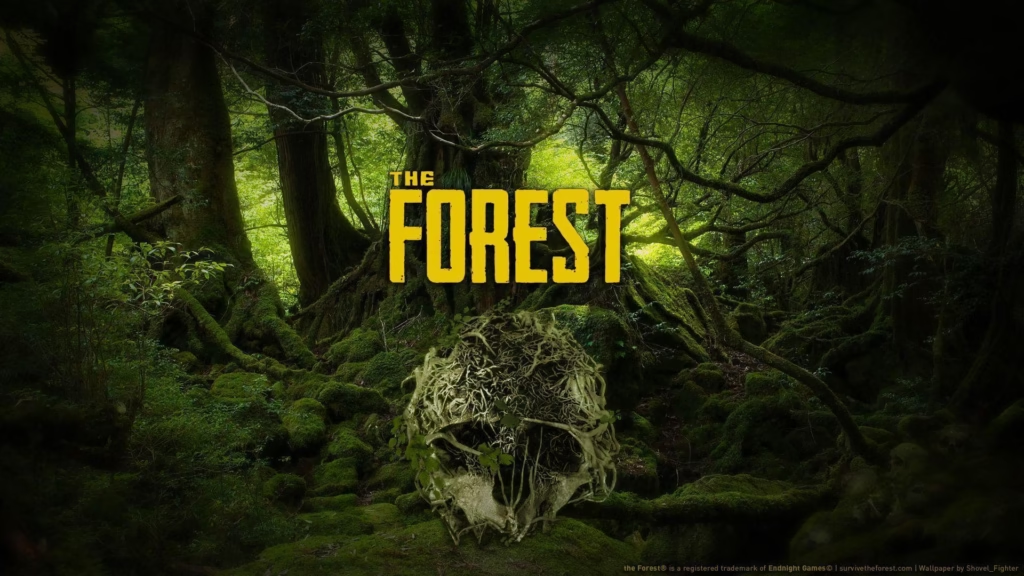
The Forest is one of those rare survival horror games that quietly embeds itself into players’ memories long after the credits roll. Released by Endnight Games, it does not rely on scripted jump scares or rigid objectives. Instead, it creates fear through uncertainty, isolation, and the constant feeling that something is watching you just beyond the treeline. From its first moments, the game places you in an unforgiving wilderness and gives you no clear instructions—only survival.
What elevates The Forest beyond a typical crafting survival game is how it blends player freedom with environmental storytelling. You are not just building shelters and weapons; you are slowly uncovering a deeply unsettling mystery involving human experimentation, moral compromise, and the cost of survival. Even years after its release, the game continues to attract new players, especially with Sons of the Forest released and Forest 3 now officially in development.
The Forest 3 – Official Trailer Game Awards 2025
What Is The Forest About?
At its core, The Forest follows Eric LeBlanc, a survival TV personality whose plane crashes on a remote, heavily forested peninsula. In the chaos, his young son Timmy is abducted by a mysterious man painted in red. What begins as a desperate rescue mission quickly turns into a nightmare as Eric discovers the island is inhabited by cannibalistic mutants and grotesque creatures lurking both above ground and deep underground.
As Eric explores the island’s cave systems, abandoned camps, and secret facilities, the story slowly reveals the truth behind the mutants. Sahara Therapeutics, a research corporation, conducted illegal experiments using ancient alien artifacts capable of resurrecting the dead—but only through child sacrifice. The island itself becomes a moral battleground where survival forces players to question who the real monsters are.
Gameplay
The Forest is played from a first-person perspective in a fully open world with no traditional quests or mission markers. The player is free to approach survival however they choose, whether aggressively hunting mutants or avoiding confrontation entirely.
Survival mechanics include hunger, thirst, stamina, health, and sanity. Players must gather resources, hunt animals, purify water, and craft weapons, traps, and shelters. Unlike many survival games, there is no autosave; saving requires building shelters, adding tension to every decision.
Combat is dynamic and unpredictable. Enemy AI is one of the game’s most praised features, as cannibals behave like intelligent predators—observing, flanking, retreating, dragging injured allies away, and responding directly to player aggression. The more violent the player becomes, the more hostile the island grows in response.
Story and Endings
The narrative culminates deep within an underground research facility, where Eric discovers the Resurrection Obelisk and the truth behind Timmy’s kidnapping. The game offers two endings, both morally devastating.
One ending allows Eric to activate the artifact, causing another plane crash to obtain a sacrifice and resurrect Timmy. This choice saves his son but condemns innocent lives, and the final scenes imply Timmy may not truly be human anymore.
The alternative ending shuts down the artifact, sparing future victims but permanently losing Timmy. This ending allows the player to continue surviving on the island, emphasizing acceptance and grief rather than false hope.
Both endings reinforce the game’s central theme: survival often demands a terrible price.
Development & Inspiration
Endnight Games drew inspiration from cult horror films like The Descent and Cannibal Holocaust, as well as survival games such as Don’t Starve. Interestingly, the developers cited Disney as an influence—not in tone, but in environmental design and visual contrast, avoiding a world that is constantly dark and oppressive.
Built using the Unity engine, The Forest began as a Steam Greenlight project and spent four years in Early Access before its full release in 2018. Despite a modest budget of roughly $125,000, the game achieved massive commercial success, selling over five million copies within its first year.
Themes
One of the strongest elements of The Forest is its ambiguity. The game deliberately blurs the line between victim and aggressor. Cannibals are not always hostile, often observing the player before attacking, reacting defensively to threats, and even showing fear.
Sanity mechanics further reinforce psychological horror. As Eric commits increasingly violent acts, his sanity drops, unlocking the ability to build effigies—primitive symbols that reflect his mental deterioration.
Ultimately, The Forest explores grief, obsession, ethical compromise, and the terrifying idea that love can justify almost anything.
Why You Should Play The Forest
If you enjoy survival games that trust the player to discover systems organically, The Forest is essential. Its lack of hand-holding creates genuine tension, while its enemy AI ensures no two playthroughs feel the same.
The story rewards curiosity without forcing it. Players can survive indefinitely without finishing the narrative, or they can pursue answers and face the consequences of doing so. Few games balance freedom and storytelling this effectively.
Is It Worth Playing Today?
Absolutely. Despite its age, The Forest remains one of the most atmospheric survival horror games available. Its mechanics hold up well, especially on PC and PlayStation 4, and its themes feel timeless.
For players who enjoyed Sons of the Forest, revisiting the original provides crucial narrative context—particularly regarding Timmy and the island’s larger mysteries.
Reception
The Forest received strong critical reception, earning an 83/100 on Metacritic for PC and praise from outlets like IGN, which highlighted its intelligent enemy behavior and layered storytelling. Some criticism was directed at lighting issues and darkness, but many players felt this enhanced immersion rather than detracted from it.
Its continued presence on “best survival games” lists years after release speaks to its lasting impact.
Play Order (Forest Series Timeline)
For players interested in the full narrative arc, the recommended play order is:
-
The Forest (2018)
-
Sons of the Forest (2023)
-
Forest 3 (In Development)
Sons of the Forest follows an older Timmy and expands on the consequences of the first game’s endings. Forest 3 is expected to further explore the mythology of the islands, the artifacts, and humanity’s continued interference with forces it does not understand.
Forest 3 – What We Know So Far
While details remain limited, Endnight Games has confirmed that Forest 3 is in development. Early statements suggest the third entry will build upon the expanded mechanics introduced in Sons of the Forest while pushing the narrative forward rather than rebooting it.
Given the escalating scope of the story—from a single desperate father to a broader, world-threatening mystery—Forest 3 is widely expected to serve as either a narrative culmination or a major turning point for the franchise.
The Forest FAQ
Is The Forest a horror game or a survival game?
It is both. Survival mechanics drive gameplay, while horror emerges organically through atmosphere, enemy behavior, and story revelations.
Can you beat The Forest without killing cannibals?
Yes. Passive playstyles can keep cannibals neutral for extended periods, though some encounters are unavoidable.
Is Sons of the Forest a direct sequel?
Yes. It continues the story, particularly focusing on Timmy and the long-term effects of the island’s artifacts.
Will Forest 3 continue the same story?
While unconfirmed, all signs point to Forest 3 expanding the existing narrative rather than starting over.
Conclusion
The Forest stands as one of the most effective examples of how survival gameplay and horror storytelling can coexist without one overpowering the other. Its refusal to label the player as a hero, its morally complex endings, and its unnerving enemy design create an experience that feels personal and unsettling in ways few games attempt.
With Sons of the Forest already expanding the universe and Forest 3 on the horizon, now is the perfect time to experience—or revisit—the game that started it all. Few survival horror titles ask such difficult questions about love, loss, and survival, and even fewer leave the answers entirely in the player’s hands.
Thank you for reading and make sure to bookmark the site, comment and follow up on the newest posts!
How useful was this post?
Click on a star to rate it!
Average rating 0 / 5. Vote count: 0
No votes so far! Be the first to rate this post.