
 7.8/10
 74% Critics / 77% Audience
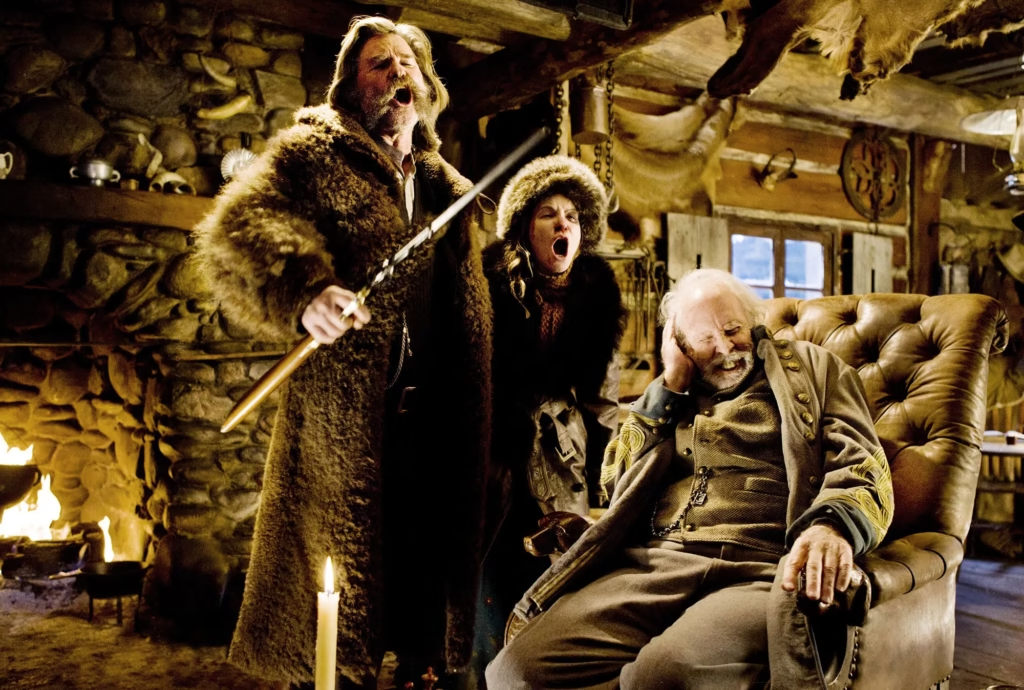
The Hateful Eight is a 2015 American Western mystery thriller written and directed by Quentin Tarantino, marking his eighth feature film. Set in the snow-covered wilderness of Wyoming a decade after the American Civil War, it tells the claustrophobic story of eight morally ambiguous strangers trapped together in a stagecoach lodge during a violent blizzard.
The ensemble cast includes Samuel L. Jackson, Kurt Russell, Jennifer Jason Leigh, Walton Goggins, Tim Roth, Michael Madsen, Demián Bichir, and Bruce Dern, each playing a character as mysterious and treacherous as the storm outside. The film blends Tarantino’s trademark sharp dialogue, nonlinear storytelling, and graphic violence with the slow-burn tension of a classic chamber drama.
Released in 70 mm Ultra Panavision film, The Hateful Eight was both a cinematic throwback and a technical triumph. It featured an original score by the legendary Ennio Morricone, his first complete Western score in over three decades — and one that earned him his long-awaited Academy Award for Best Original Score.
With its combination of dark humor, moral ambiguity, and philosophical tension, The Hateful Eight stands as one of Tarantino’s most deliberate and theatrical films — a snowbound mystery where truth and justice are buried under layers of deceit.
The Hateful Eight – Official Trailer
What Is The Hateful Eight About?
Set in the year 1877, the story begins as a deadly winter storm sweeps through the rugged wilderness of Wyoming Territory. Two bounty hunters — Major Marquis Warren (Samuel L. Jackson) and John “The Hangman” Ruth (Kurt Russell) — find themselves trapped in a stagecoach with Daisy Domergue (Jennifer Jason Leigh), a notorious outlaw wanted for murder, and Chris Mannix (Walton Goggins), a talkative Southerner who claims to be Red Rock’s new sheriff.
When they seek shelter at Minnie’s Haberdashery, a remote cabin serving as a stopover for travelers, they discover four more strangers: Oswaldo Mobray, the local hangman; Joe Gage, a quiet cowboy; General Sanford Smithers, a Confederate officer; and Bob, a Mexican caretaker supposedly minding the place for Minnie.
As the blizzard closes in, paranoia and mistrust take over. Ruth suspects that not everyone in the cabin is who they claim to be, and tensions quickly escalate into violence, manipulation, and revenge.
The film gradually unravels its mystery through Tarantino’s signature dialogue-driven scenes, violent confrontations, and moral stand-offs. Themes of race, justice, deception, and survival dominate the narrative, transforming the cabin into a powder keg of American hatred and hypocrisy.
By the time dawn breaks, nearly all of the “hateful eight” are dead — leaving behind a grim parable about justice, racism, and the fragility of human trust.
Is The Hateful Eight Worth Watching?
Absolutely — but it’s not for the faint of heart. The Hateful Eight is a slow, talkative, and relentlessly tense piece of cinema that rewards patience with explosive payoffs and thematic depth.
Unlike Tarantino’s earlier works like Pulp Fiction or Django Unchained, this film trades fast-paced action for a claustrophobic, theatrical intensity. Every line of dialogue is laced with menace, every gesture carries suspicion, and every silence deepens the mystery.
Those who appreciate character-driven storytelling and moral ambiguity will find it mesmerizing. The film’s deliberate pacing builds tension with each exchange, culminating in moments of shocking brutality that feel both earned and inevitable.
Samuel L. Jackson and Jennifer Jason Leigh deliver standout performances — Jackson’s cunning monologues balance dark humor with biting social commentary, while Leigh’s portrayal of Daisy is both disturbing and magnetic.
In short, The Hateful Eight is Tarantino’s most confined yet most explosive film — a violent, snowbound whodunit that doubles as a critique of American history, racism, and the myth of frontier justice.
Why Should You Watch The Hateful Eight?
-
A Classic Western with Tarantino’s Signature Edge: A modern reinvention of the chamber Western, filled with moral tension and sharp dialogue.
-
A Brilliant Cast: Every performance — from Jackson’s commanding presence to Leigh’s unpredictable menace — is layered and memorable.
-
Unparalleled Cinematography: Shot in 70 mm Ultra Panavision, the visuals are breathtaking, making the confined setting feel both intimate and grand.
-
Masterful Direction: Tarantino combines the suspense of a murder mystery with the blood-soaked poetry of his Western sensibilities.
-
An Oscar-Winning Score: Ennio Morricone’s haunting composition elevates the atmosphere, adding emotional weight and dread to every scene.
-
Rich Thematic Depth: The film explores race, justice, revenge, and moral hypocrisy in post-Civil War America with raw honesty.
If you enjoy films that challenge your comfort zone and spark conversation, The Hateful Eight stands as one of Tarantino’s boldest and most mature works.
Production and Development
Quentin Tarantino conceived The Hateful Eight in 2013, initially as a novel and spiritual successor to Django Unchained, before deciding to make it a standalone story. In January 2014, the screenplay was infamously leaked online, prompting Tarantino to shelve the project. After staging a live script reading in April 2014 at the Ace Hotel in Los Angeles, he rewrote the ending and resumed production.
Principal photography began in January 2015 near Telluride, Colorado, where a massive set was built to simulate the snowed-in cabin and surrounding wilderness. The harsh conditions and authentic 65 mm film setup made it one of Tarantino’s most ambitious productions.
The director drew inspiration from classic 1960s Western TV shows such as Bonanza and The Virginian, which featured hostage scenarios that revealed the moral complexities of every character. Tarantino described the concept as a “Western without heroes,” focusing solely on flawed, deceitful people trapped together under mounting tension.
Filming and Cinematography
Veteran cinematographer Robert Richardson, who had collaborated with Tarantino on Kill Bill, Inglourious Basterds, and Django Unchained, shot The Hateful Eight on 65 mm film using Ultra Panavision 70 lenses — a widescreen format not used in decades.
The visuals are spectacular: sweeping mountain vistas contrast with the claustrophobic interiors of Minnie’s Haberdashery, where every flicker of lamplight and flake of falling snow feels tangible.
The 2.76:1 aspect ratio gives even the smallest interactions a sense of epic scale. Tarantino intentionally limited the use of digital effects, opting for practical lighting, authentic set construction, and chemical color timing to preserve the texture of film.
The result was a cinematic rarity: a “roadshow release” featuring an overture, intermission, and collectible 70 mm film programs — a nostalgic homage to classic Hollywood epics.
Music by Ennio Morricone
One of the most celebrated aspects of The Hateful Eight is its score by Ennio Morricone, marking his first original Western soundtrack in 34 years. Known for his legendary compositions for The Good, the Bad and the Ugly and Once Upon a Time in the West, Morricone crafted a chilling, orchestral soundscape that perfectly captures the film’s slow-building dread.
His work blends eerie strings, ominous brass, and rhythmic tension, enhancing the film’s sense of impending violence. Notably, Morricone repurposed unused compositions from John Carpenter’s The Thing (1982), adding an extra layer of menace to the snowbound isolation.
For his efforts, Morricone received widespread acclaim and won his first-ever Academy Award for Best Original Score — a long-overdue recognition of his monumental influence on cinema.
Cast and Characters
-
Samuel L. Jackson as Major Marquis Warren – A cunning former Union officer turned bounty hunter.
-
Kurt Russell as John “The Hangman” Ruth – A relentless bounty hunter who never lets his captives die before their hanging.
-
Jennifer Jason Leigh as Daisy Domergue – A vicious outlaw whose intelligence and malice drive much of the film’s tension.
-
Walton Goggins as Chris Mannix – A self-proclaimed sheriff whose loyalties and morals are constantly in question.
-
Tim Roth as Oswaldo Mobray / “English Pete” Hicox – A polite hangman with a secret.
-
Michael Madsen as Joe Gage / “Grouch” Douglass – A quiet cowboy hiding more than he lets on.
-
Demián Bichir as Bob / Marco the Mexican – The mysterious caretaker of Minnie’s Haberdashery.
-
Bruce Dern as General Sanford Smithers – A bitter Confederate veteran clinging to the ghosts of the past.
The supporting cast also includes Channing Tatum, Dana Gourrier, Zoë Bell, and James Parks, each adding depth and tension to the confined ensemble.
Critical Reception
Upon release, The Hateful Eight received generally positive reviews, holding a 74% rating on Rotten Tomatoes and a Metacritic score of 68/100. Critics praised the performances, screenplay, cinematography, and score, though some were divided over the film’s length, pacing, and violent imagery.
Supporters hailed it as a masterclass in tension and dialogue, comparing it to Agatha Christie’s And Then There Were None set in a Tarantino Western. Others criticized its uncompromising brutality and portrayal of race and gender.
Notable praise came from The Telegraph, The Guardian, and ReelViews, with many critics ranking it among the year’s best films. Jennifer Jason Leigh received an Oscar nomination for Best Supporting Actress, while Robert Richardson was nominated for Best Cinematography.
In 2019, Netflix released an Extended Version of the film, re-edited into a four-part miniseries, offering fans an alternative viewing experience with additional footage and slower pacing.
Themes and Analysis
The Hateful Eight is much more than a Western — it’s a moral study of violence, trust, and justice. Beneath its bloody surface lies a meditation on America’s post-war identity, exploring how hatred, racism, and vengeance shaped the nation’s psyche.
The film also plays like a stage play, adhering closely to Aristotle’s unities of time, place, and action — everything unfolds within 24 hours, in one location, following a single tragic thread of deceit and death.
Tarantino blurs the line between heroes and villains, forcing audiences to question who, if anyone, deserves to survive. By the end, the act of hanging Daisy Domergue becomes both a grim homage to law and a metaphor for the violent cycle of justice itself.
The Hateful Eight FAQ
Q: Is The Hateful Eight connected to Django Unchained?
A: It was originally conceived as a sequel titled Django in White Hell, but Tarantino decided to make it a standalone story.
Q: Why was it filmed in 70 mm?
A: Tarantino wanted to revive the grandeur of classic Westerns, making the confined setting visually epic.
Q: Who composed the music for the film?
A: Ennio Morricone, whose work on The Hateful Eight earned him an Oscar for Best Original Score.
Q: Is the violence symbolic?
A: Yes. The brutality reflects themes of vengeance, distrust, and America’s moral decay after the Civil War.
Q: What’s the Netflix Extended Version?
A: A re-edited four-part cut with extra scenes and extended dialogue, released in 2019 as a limited miniseries.
Conclusion
The Hateful Eight stands as one of Quentin Tarantino’s most divisive yet deeply crafted films — a snowbound chamber piece drenched in paranoia, violence, and dark humor. Its confined setting, grand cinematography, and biting social undertones make it a rare Western that feels both classical and modern.
By stripping the Western of its mythic heroes, Tarantino reveals the ugliness of human nature, exposing hatred as the true frontier killer. Supported by Morricone’s haunting score, an exceptional cast, and razor-sharp dialogue, The Hateful Eight endures as a powerful exploration of morality and vengeance — a cinematic storm that leaves no one unscarred.
For those drawn to intelligent tension, masterful writing, and the moral gray zones of Tarantino’s universe, this film remains one of his boldest artistic statements — a Western frozen in time and drenched in blood.
If you don’t know where to watch this Movie for FREE make sure to contact me via E-mail, or in the comments below. Thank you for reading and make sure to bookmark the site.
How useful was this post?
Click on a star to rate it!
Average rating 0 / 5. Vote count: 0
No votes so far! Be the first to rate this post.