
 8.6/10
 ? Critics / 91% Audience
The Newsroom is an American political drama television series created and written by Aaron Sorkin, the Emmy-winning mind behind The West Wing and The Social Network. The show premiered on HBO on June 24, 2012, and ran for three seasons, concluding on December 14, 2014, with a total of 25 episodes.
Set inside the fictional Atlantis Cable News (ACN) network, The Newsroom offers a behind-the-scenes look at the struggles of journalists trying to produce honest, ethical news in an era dominated by sensationalism, corporate interests, and partisan bias.
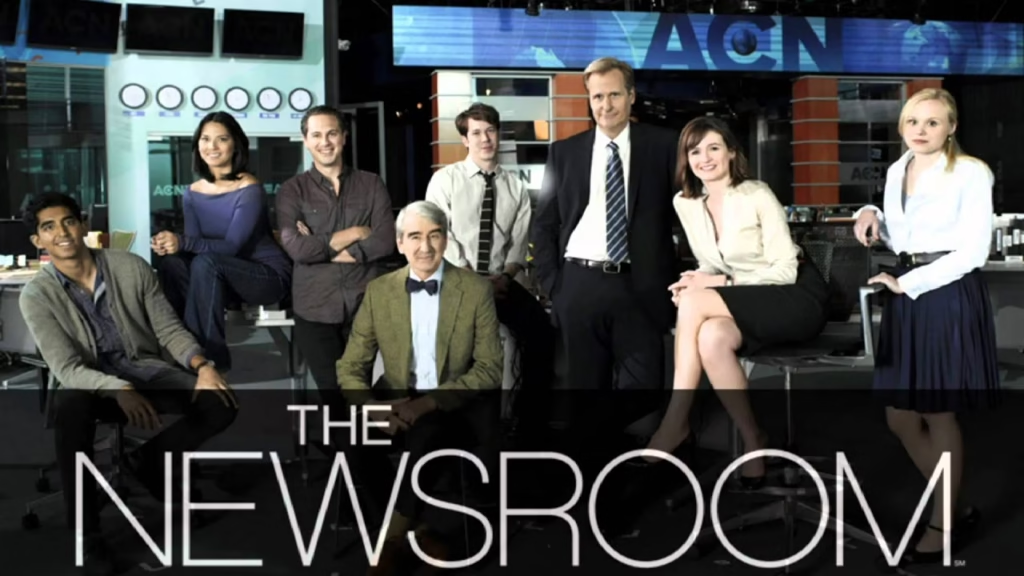
The series stars Jeff Daniels as Will McAvoy, a respected but complacent news anchor who rediscovers his passion for real journalism when his former producer and ex-girlfriend MacKenzie McHale (played by Emily Mortimer) returns with a vision to rebuild his show. The ensemble cast includes John Gallagher Jr., Alison Pill, Thomas Sadoski, Dev Patel, Olivia Munn, and Sam Waterston, with Jane Fonda in a recurring role as the network’s formidable CEO.
With its sharp dialogue, moral urgency, and unapologetically idealistic tone, The Newsroom captures the clash between truth and ratings, professionalism and politics — all delivered through Sorkin’s signature fast-paced, intellectually charged style of storytelling.
The Newsroom – Official Trailer
What Is The Newsroom About?
At its core, The Newsroom is about integrity in journalism. It follows Will McAvoy, the face of ACN’s prime-time news show News Night, as he attempts to move beyond superficial reporting and bring back real news that informs rather than entertains.
When MacKenzie McHale, a passionate and principled producer, returns to the network, she convinces Will to rebuild the program — to hold power accountable, to reject partisanship, and to value facts over opinion.
The newsroom team — including Jim Harper (John Gallagher Jr.), Maggie Jordan (Alison Pill), Don Keefer (Thomas Sadoski), Sloan Sabbith (Olivia Munn), and Neal Sampat (Dev Patel) — quickly learns that telling the truth often comes at a cost. The show intertwines professional ethics with personal relationships, as the team navigates love, loyalty, and pressure from corporate and political forces.
Each episode draws from real-world news events, including election coverage, environmental disasters, and international crises, grounding the show in a recognizable reality. This approach allows The Newsroom to explore not only what journalism is — but what it should be.
Is The Newsroom Worth Watching?
Absolutely. The Newsroom is a must-watch for anyone interested in politics, media, or the human side of news production. It is not merely a drama about current events — it’s a moral exploration of truth and responsibility.
Aaron Sorkin’s writing delivers fast, rhythmic exchanges and impassioned monologues that challenge both his characters and viewers to think critically about journalism’s purpose in society. The show invites audiences to reflect on what it means to tell the truth in a world obsessed with profit and outrage.
Jeff Daniels gives one of the best performances of his career, earning an Emmy Award for Outstanding Lead Actor in a Drama Series for his portrayal of Will McAvoy. His transformation from a disillusioned anchor into an outspoken defender of truth defines the series’ emotional arc.
While The Newsroom has been both celebrated and criticized for its idealism, it’s precisely that unwavering belief in better journalism that makes it inspiring. It offers a hopeful, if sometimes flawed, vision of integrity in modern media — and that idealism is what gives it lasting power.
Why Should You Watch The Newsroom?
-
A Powerful Cast: Jeff Daniels, Emily Mortimer, Olivia Munn, and Sam Waterston deliver emotionally rich performances that balance professionalism and vulnerability.
-
Intelligent Writing: Aaron Sorkin’s dialogue is sharp, witty, and emotionally charged, blending humor with political insight.
-
Relevance to Modern Media: The show examines fake news, corporate influence, and journalistic responsibility long before these became mainstream concerns.
-
Moral Idealism: It’s a rare series that argues for integrity and truth in an era of cynicism and spectacle.
-
Real-World Anchoring: By tying episodes to recent historical events, it bridges fiction with reality in a compelling way.
-
Cinematic Production: The direction, lighting, and newsroom sets give the series a sense of immediacy and authenticity.
Watching The Newsroom feels like peeking into the moral conscience of modern journalism — where every broadcast becomes a test of courage.
Seasons Overview and Watch Order
Season 1 (2012)
-
10 Episodes
-
Focuses on the rebirth of News Night under Will and MacKenzie’s leadership as they redefine the network’s identity.
-
Introduces the newsroom staff and their attempts to tackle real events with honesty and professionalism.
-
Establishes the personal and ideological conflicts that drive the series.
Season 2 (2013)
-
9 Episodes
-
Explores the consequences of the newsroom’s bold approach to truth, including legal risks and public backlash.
-
Delves into the moral cost of getting the story wrong and the challenge of regaining credibility.
-
Character development deepens as professional ambition clashes with personal sacrifice.
Season 3 (2014)
-
6 Episodes
-
A shorter but tightly written final season that focuses on journalistic freedom in the face of government scrutiny.
-
Themes of loyalty, privacy, and press responsibility take center stage.
-
Concludes with emotional closure and reaffirmation of the show’s belief in integrity and truth.
Recommended Watch Order:
The show should be watched chronologically by season, as each installment builds on the newsroom’s evolving ethics and character arcs.
-
The Newsroom – Season 1 (2012)
-
The Newsroom – Season 2 (2013)
-
The Newsroom – Season 3 (2014)
Production and Development
Aaron Sorkin began conceptualizing The Newsroom in 2009, while researching the world of cable news. He observed real broadcasts like Countdown with Keith Olbermann, Hardball with Chris Matthews, and Parker Spitzer to understand the pressures and personalities behind live news.
HBO ordered the pilot in 2011, originally titled More as This Story Develops. It was directed by Greg Mottola, with Scott Rudin and Alan Poul joining as executive producers. The cast came together quickly, led by Jeff Daniels and Emily Mortimer, with supporting roles filled by a dynamic ensemble.
Filming took place primarily at Sunset Gower Studios in Hollywood, while exterior shots of the fictional ACN building used the Bank of America Tower in Manhattan. The show was shot on both 16mm film (for the pilot) and later with Arri Alexa digital cameras, creating a cinematic yet intimate feel.
Sorkin’s writing process was famously intensive — he wrote or rewrote nearly every line himself, supported by a small team of researchers and consultants to ensure political and factual accuracy. The show’s scripts were dialogue-heavy, averaging 80–90 pages per episode, giving the actors ample space for the signature “Sorkin walk-and-talk” scenes that define the series’ energy.
Reception and Legacy
When The Newsroom premiered, it sparked intense debate. Critics were divided — some praised its intelligence and idealism, while others found it overly moralistic or self-righteous.
-
Season 1: Received mixed reviews, with a 56/100 on Metacritic and 48% on Rotten Tomatoes. Many praised its cast and writing but noted its preachy tone.
-
Season 2: Saw improvement, with a more balanced tone and cohesive storytelling. Critics highlighted the stronger narrative and focus on character growth.
-
Season 3: Concluded the show on a positive note, earning favorable reviews for tighter writing and a renewed sense of purpose.
Over time, The Newsroom gained recognition for its ambition and moral clarity. Jeff Daniels’ portrayal of Will McAvoy earned him an Emmy Award for Outstanding Lead Actor in a Drama Series, while Jane Fonda’s performance as CEO Leona Lansing was repeatedly nominated for guest acting awards.
Though it ended after just three seasons, The Newsroom remains one of the most thoughtful portrayals of broadcast journalism on television — a reflection of what news could be if guided by principle rather than profit.
The Newsroom (American TV Series) FAQ
Q: Is The Newsroom based on real news events?
Yes, many episodes are inspired by real news stories, such as major political and social events from the early 2010s.
Q: Is The Newsroom a true story?
No. While inspired by real journalism, the characters and network (ACN) are entirely fictional.
Q: How many seasons are there of The Newsroom?
There are three seasons, totaling 25 episodes from 2012 to 2014.
Q: Why did The Newsroom end after three seasons?
Aaron Sorkin stated he felt the story had reached a natural conclusion and that the short final season allowed for a proper thematic closure.
Q: Who won awards for The Newsroom?
Jeff Daniels won the Primetime Emmy Award for Best Actor, and the series received multiple nominations at the Golden Globes and Screen Actors Guild Awards.
Q: What makes The Newsroom different from other political dramas?
Unlike darker political series, it presents an idealistic and optimistic view of the media’s role — portraying journalists as flawed yet noble professionals trying to do the right thing.
Q: Where can I watch The Newsroom?
The series is available for streaming on Max (HBO) and select international services such as Sky Atlantic, SoHo, and Hotstar.
Conclusion
The Newsroom stands as one of Aaron Sorkin’s most ambitious and idealistic works — a passionate defense of truth, accuracy, and courage in journalism. Through its unforgettable characters, eloquent dialogue, and moral dilemmas, it explores the tension between what the news is and what it should be.
Jeff Daniels’ Will McAvoy, backed by an ensemble of dynamic characters, embodies the eternal conflict between speaking truth to power and navigating the consequences. While critics debated its tone, few denied its conviction and craftsmanship.
Ultimately, The Newsroom remains a powerful testament to the belief that facts still matter, integrity is worth fighting for, and even in a cynical world, there are still those willing to chase the truth — no matter the cost.
If you don’t know where to watch this Series for FREE make sure to contact me via E-mail, or in the comments below. Thank you for reading and make sure to bookmark the site.
How useful was this post?
Click on a star to rate it!
Average rating 0 / 5. Vote count: 0
No votes so far! Be the first to rate this post.