
 7.7/10
 82% Critics / 72% Audience
When Tokyo Ghoul first appeared in Weekly Young Jump in 2011, it redefined the dark fantasy genre. Written and illustrated by Sui Ishida, the series paints a chilling portrait of Tokyo plagued by creatures called ghouls—beings who look human but must feed on flesh to survive.
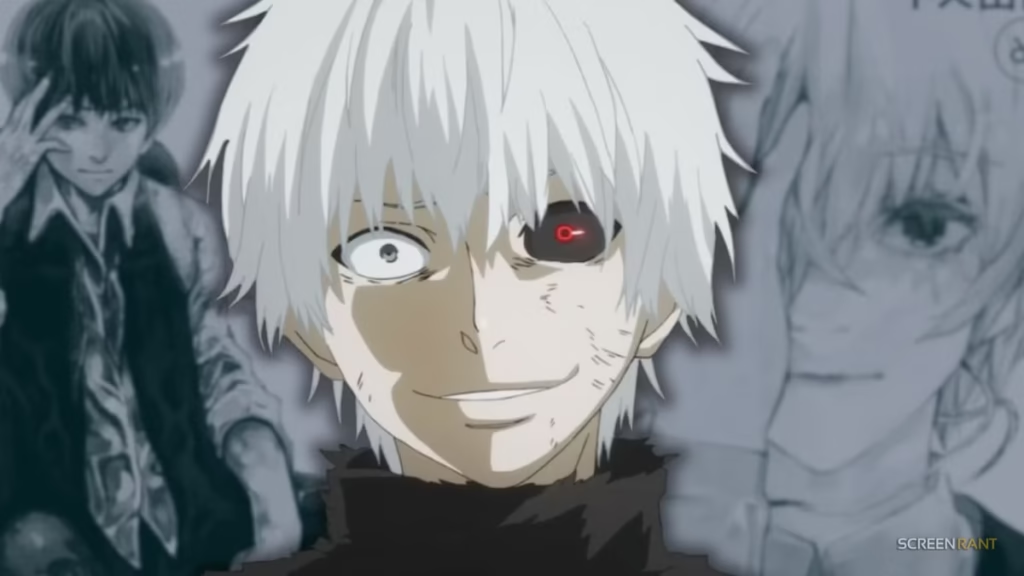
At the heart of the story is Ken Kaneki, an ordinary college student whose life changes forever after a fatal encounter with a ghoul. Following a desperate organ transplant, Kaneki becomes something in-between—a half-ghoul, trapped between two worlds that hate and fear each other.
Serialized until 2014 and later expanded with a prequel (Tokyo Ghoul [Jack]) and a sequel (Tokyo Ghoul:re), the franchise has grown into one of Japan’s most influential works. With anime adaptations, live-action films, light novels, and video games, Tokyo Ghoul has become a cultural phenomenon—selling over 47 million copies worldwide by 2021.
Dark, tragic, and philosophical, Tokyo Ghoul explores what it means to be human in a world where monsters wear familiar faces.
Tokyo Ghoul – Official Trailer
What Is Tokyo Ghoul About?
Set in an alternate version of Tokyo, the series follows a society secretly shared by humans and ghouls. To survive, ghouls must consume human flesh—but they blend into the population, hiding behind human identities.
The story begins when Ken Kaneki, a shy student and book lover, goes on a date with Rize Kamishiro, who turns out to be a ghoul planning to devour him. A tragic accident leaves Rize dead, and Kaneki’s life is saved only through the transplantation of her organs, turning him into a half-ghoul.
Unable to eat normal food and struggling to control his hunger, Kaneki seeks refuge in Anteiku, a café run by kind-hearted ghouls who teach him to live without losing his humanity.
But the world outside is far from peaceful. The Commission of Counter Ghoul (CCG) hunts ghouls relentlessly, while rival factions and secret experiments push Kaneki to confront his identity, morality, and destiny.
Ultimately, Tokyo Ghoul isn’t just about monsters—it’s about people. It’s about the fear of becoming what we hate, and the painful journey of finding acceptance in a world that refuses to understand you.
Is Tokyo Ghoul Worth Watching (or Reading)?
Without question. Tokyo Ghoul is one of the most emotionally gripping and thematically rich dark fantasy series ever made. It combines brutal horror with deep philosophical storytelling, appealing to fans who enjoy psychological complexity alongside intense action.
Here’s why it’s worth your time:
-
Unforgettable Protagonist: Ken Kaneki’s transformation from timid student to tortured survivor is one of anime’s most iconic journeys.
-
Moral Ambiguity: No one is purely good or evil—both humans and ghouls are victims of their own world.
-
Powerful Symbolism: The series explores identity, hunger, and prejudice, often mirroring real-world social issues.
-
Haunting Aesthetics: From the eerie streets of Tokyo to the haunting red eyes of ghouls, its visuals are striking.
-
Emotional Depth: Beneath the violence lies a story about loneliness, friendship, and the desperate need to belong.
While the anime adaptation received mixed feedback for pacing and story changes, the manga remains the definitive version, offering richer detail and emotional nuance.
Why Should I Watch or Read Tokyo Ghoul?
Because Tokyo Ghoul dives deep into the human condition, asking questions most series dare not touch.
It’s not just a battle between humans and monsters—it’s a psychological exploration of identity and morality. The story challenges you to sympathize with both sides and to see how easily a person can lose their humanity—or find it in the most unlikely places.
Reasons to experience Tokyo Ghoul:
-
It’s a dark, tragic masterpiece with meaning far beyond its violence.
-
It offers deep psychological development, especially in Kaneki’s descent into trauma and recovery.
-
It’s visually and emotionally stunning, especially with Max Richter’s haunting equivalent in music from TK’s “Unravel.”
-
It’s a philosophical allegory for discrimination, survival, and acceptance.
-
It’s one of the few anime that balances despair with fleeting beauty, making it unforgettable.
For anyone drawn to stories like Death Note, Parasyte, or Attack on Titan, Tokyo Ghoul is essential viewing and reading.
Plot Overview
Part 1 – The Birth of the Half-Ghoul
Ken Kaneki’s transformation throws him into chaos. Torn between his human morals and ghoul instincts, he joins Anteiku Café, where he learns about ghoul society from Touka Kirishima, Yoshimura, and others. Meanwhile, the CCG hunts down ghouls across Tokyo, setting up a war that Kaneki cannot escape.
Part 2 – The Rise of the One-Eyed Ghoul
After enduring torture at the hands of Yamori (Jason), Kaneki embraces his ghoul side, forming his own group to protect those he loves. The boundaries between right and wrong blur as Kaneki begins to question whether true peace between humans and ghouls is possible.
Tokyo Ghoul [Jack] (Prequel)
Set before the main story, this prequel follows Kishō Arima and Taishi Fura, two young men investigating ghoul activity in Tokyo. It provides insight into the CCG’s origins and Arima’s rise as the legendary ghoul investigator.
Tokyo Ghoul:re (Sequel)
Years later, Kaneki—now known as Haise Sasaki—has lost his memories and works for the CCG. Assigned to lead the Quinx Squad, half-ghoul humans engineered to fight ghouls, he faces the painful return of his memories and a new moral crisis that could determine the fate of both species.
The World of Tokyo Ghoul
Tokyo is divided into wards, each home to different ghoul factions and CCG branches. The central tension lies in the uneasy coexistence between two worlds—one hiding in shadows, the other pretending to be pure.
Key Concepts:
-
Kagune: A ghoul’s biological weapon, manifesting as deadly tentacles or blades.
-
Kakugan: The red-eye mutation triggered by hunger or combat.
-
RC Cells: Special cells that enhance ghoul physiology, providing their strength and regeneration.
-
Anteiku: A peaceful café serving as refuge for ghouls seeking coexistence.
-
CCG: The government organization dedicated to exterminating ghouls.
The world-building is layered with tragic irony—humans fight for safety, ghouls fight for survival, and both destroy themselves in the process.
Media and Adaptations
Manga
-
Tokyo Ghoul (2011–2014): 14 volumes chronicling Kaneki’s transformation and the battle between humans and ghouls.
-
Tokyo Ghoul:re (2014–2018): 16 volumes continuing Kaneki’s story under a new identity.
-
Tokyo Ghoul [Jack] (2013): Prequel exploring the early CCG days.
-
Tokyo Ghoul: Zakki (2014): Illustration artbook featuring Ishida’s commentary and concept designs.
Light Novels
Four side novels written by Shin Towada expand the universe, focusing on the daily lives, pasts, and struggles of beloved characters.
Anime
-
Tokyo Ghoul (2014): 12 episodes introducing Kaneki’s transformation.
-
Tokyo Ghoul √A (2015): 12-episode sequel following an alternate storyline.
-
Tokyo Ghoul:re (2018): Two-part anime adaptation of the manga sequel.
-
Opening Theme “Unravel” by TK: Became one of anime’s most iconic songs.
Live-Action Films
-
Tokyo Ghoul (2017): Directed by Kentarō Hagiwara, starring Masataka Kubota as Kaneki.
-
Tokyo Ghoul S (2019): Sequel expanding on Kaneki and Touka’s relationship.
Video Games
-
Tokyo Ghoul: Jail (PS Vita) and Tokyo Ghoul:re Call to Exist (PS4, PC) allow players to experience the world’s conflicts firsthand.
-
In 2025, Dead by Daylight announced a crossover event featuring Ken Kaneki as a playable killer, proving the series’ ongoing cultural impact.
Reception and Legacy
Since its debut, Tokyo Ghoul has received widespread acclaim for its storytelling, artwork, and psychological complexity.
Achievements:
-
Over 47 million copies sold worldwide.
-
Ranked among the Top 50 manga of all time in Japan’s 2021 Manga Sōsenkyo poll.
-
Named one of the Best Manga for Teens by the American Library Association.
-
Nominated for the Kodansha Manga Award (2014) and Harvey Award (2018).
-
Inspired art exhibitions, soundtracks, and academic discussions for its social and moral themes.
Despite censorship in some countries due to its dark content, Tokyo Ghoul continues to captivate fans for its raw depiction of violence, emotion, and identity.
Tokyo Ghoul FAQ
1. Is Tokyo Ghoul based on a true story?
No—it’s a work of fiction blending horror, action, and philosophy, written by Sui Ishida.
2. Is Tokyo Ghoul anime faithful to the manga?
The first season follows the manga closely, but Tokyo Ghoul √A diverges significantly. The manga offers a more complete and coherent story.
3. What is the correct watch order?
-
Tokyo Ghoul (2014)
-
Tokyo Ghoul √A (2015)
-
Tokyo Ghoul:re (2018) – Season 1 and Season 2
4. Why is Tokyo Ghoul so popular?
Because it combines horror and humanity, offering a tragic yet relatable narrative about identity, loss, and moral struggle.
5. Is there a deeper meaning behind the story?
Yes. It symbolizes how society treats the “other,” exploring discrimination, trauma, and the duality of human nature.
Conclusion
Tokyo Ghoul is a masterpiece of modern dark fantasy—a story that terrifies, inspires, and breaks hearts all at once.
It’s a series about becoming the monster you fear, about losing everything and finding yourself again in the ruins. Through Ken Kaneki’s journey, Tokyo Ghoul forces us to confront the blurred line between good and evil and to ask the hardest question of all:
When survival demands sacrifice, how much of your humanity will you keep?
With unforgettable art, tragic beauty, and profound storytelling, Tokyo Ghoul stands as one of the most important anime and manga of its generation.
If you don’t know where to watch this Anime for FREE make sure to contact me via E-mail, or in the comments below. Thank you for reading and make sure to bookmark the site.
How useful was this post?
Click on a star to rate it!
Average rating 5 / 5. Vote count: 1
No votes so far! Be the first to rate this post.