
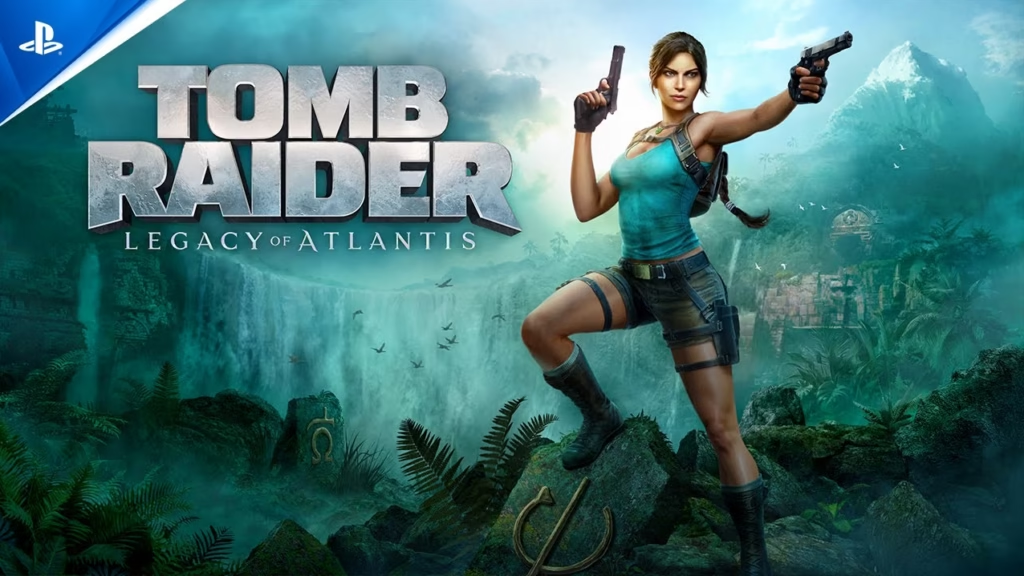
Tomb Raider: Legacy of Atlantis is an upcoming action-adventure remake of the original Tomb Raider, developed by Crystal Dynamics in collaboration with Flying Wild Hog, and published by Amazon Game Studios.
Revealed during The Game Awards in 2025, the game is set for release in 2026 on PlayStation 5, Xbox Series X/S, and Windows.
More than just a graphical update, Legacy of Atlantis promises a full reimagining of Lara Croft’s original adventure — combining classic tomb exploration with modern design philosophy powered by Unreal Engine 5.
For longtime fans, this isn’t just nostalgia. It’s a reconstruction of where it all began.
Tom Raider – Legacy of Atlantis – Official Trailer
A Return to Atlantis
The narrative follows Lara Croft as she searches for the scattered fragments of the Scion — a powerful artifact tied to the lost civilization of Atlantis. The core storyline remains faithful to the 1996 classic: globe-trotting exploration, ancient temples, mercenaries, and the manipulative antagonist Jacqueline Natla.
However, Crystal Dynamics has confirmed expanded storytelling elements. The remake aims to deepen character motivations and flesh out narrative threads that were limited by the technological constraints of the original PlayStation era.
In this version, Lara is portrayed by Alix Wilton Regan, taking over the role from Camilla Luddington, who voiced Lara in the Survivor Trilogy. Regan’s performance signals a tonal shift — potentially bridging classic Lara’s confidence with the emotional depth introduced in modern entries.
Unreal Engine 5 and Modern Design
Legacy of Atlantis is built in Unreal Engine 5, marking a major technical step forward for the franchise. This opens the door to:
-
Lumen-based dynamic lighting in tomb environments
-
High-detail character models
-
Real-time environmental destruction
-
More immersive traversal mechanics
The original Tomb Raider was known for grid-based movement and deliberate platforming. The remake will modernize controls while preserving the sense of isolation and puzzle-driven progression.
Game director Will Kersake emphasized adapting the difficulty curve for modern audiences. The instant-death traps and punishing jumps of the 1996 release may return in spirit, but likely with updated checkpoint systems and player-friendly refinements.
The goal appears to be balance — honoring Core Design’s original DNA while eliminating outdated frustration.
A Long-Planned Revival
Hints of a return to the original timeline appeared as early as the unpatched ending of Shadow of the Tomb Raider, where a removed scene featured Lara’s dual pistols and a letter from Jacqueline Natla. That moment sparked speculation about reconnecting the Survivor Trilogy with the classic era.
Crystal Dynamics officially confirmed development of a new Tomb Raider project in 2022 after partnering with Amazon and transitioning to Unreal Engine 5. The reveal of Legacy of Atlantis in 2025 confirmed that the studio was not just creating a sequel — but revisiting the foundation of the franchise.
The announcement came alongside Tomb Raider: Catalyst, positioning Legacy of Atlantis as both a celebration and a stepping stone toward the next era.
Celebrating 30 Years of Tomb Raider
Studio head Scot Amos described the project as a “love letter by fans to fans.” The timing aligns with the 30th anniversary of Tomb Raider’s debut, making this remake both commemorative and strategic.
Reimagining the original game allows Crystal Dynamics to:
-
Reintroduce classic Lara to new players
-
Solidify a unified timeline
-
Build narrative continuity leading into future titles
This move also re-centers Atlantis — one of the franchise’s most iconic mythological elements — as a cornerstone of Lara’s mythology.
What Could Change From the Original?
While the core narrative remains intact, several modern design expectations may shape the remake:
Expanded character arcs for Lara and Natla.
More cinematic storytelling between tomb sequences.
Improved AI and combat flow.
Deeper environmental interaction within ruins and lost cities.
The biggest unknown is tone. Will this lean toward the grounded realism of the Survivor Trilogy, or fully embrace the larger-than-life pulp adventure energy of the 90s original?
Early comments suggest a hybrid approach.
Is Legacy of Atlantis Necessary?
Some fans question whether remaking the 1996 game is needed when remastered collections already exist. But Legacy of Atlantis is positioned differently.
It is not simply a remaster. It is a reinterpretation — rebuilding the game with modern storytelling tools and technological power while preserving the spirit of exploration and solitude that defined the original.
If done correctly, it could unify classic and modern Lara into one cohesive identity.
FAQ
When does Tomb Raider: Legacy of Atlantis release?
It is expected to launch worldwide in 2026.
What platforms will it be on?
PlayStation 5, Xbox Series X/S, and Windows.
Who is voicing Lara Croft?
Alix Wilton Regan will voice and perform Lara Croft.
Is this connected to Tomb Raider: Catalyst?
Legacy of Atlantis was announced alongside Catalyst (2027), but Catalyst appears to be a separate next major chapter.
Is this a remaster or full remake?
It is a full remake built in Unreal Engine 5, featuring expanded storytelling and modernized gameplay.
Conclusion
Tomb Raider: Legacy of Atlantis is more than a remake. It represents a turning point.
By returning to the Scion, Atlantis, and Lara’s original globe-trotting adventure, Crystal Dynamics is revisiting the series’ roots while building a bridge toward its future.
If the studio succeeds in balancing nostalgia with innovation, Legacy of Atlantis could redefine what Tomb Raider means in the modern era.
Thirty years after Lara first stepped into a tomb, she is preparing to do it again — this time with the full power of modern technology behind her.
Thank you for reading and make sure to bookmark the site, comment and follow up on the newest posts!
How useful was this post?
Click on a star to rate it!
Average rating 0 / 5. Vote count: 0
No votes so far! Be the first to rate this post.