
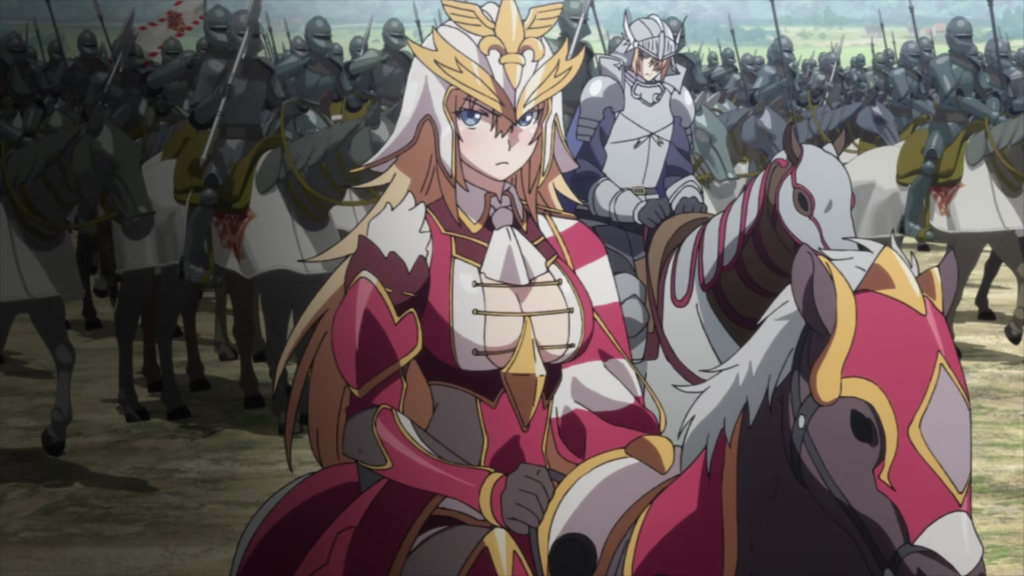
Ulysses: Jeanne d’Arc and the Alchemist Knight is not your traditional historical retelling. Instead of presenting the legend of Joan of Arc as a grounded medieval drama, it blends the Hundred Years’ War with alchemy, fairy queens, cursed relics, and apocalyptic forces.
Originally a light novel written by Mikage Kasuga and illustrated by Tomari Meron, the series was published under Shueisha’s Dash X Bunko imprint beginning in 2015. It later received a manga adaptation and, most notably, a 12-episode anime adaptation produced by AXsiZ, which aired from October to December 2018.
While the series is rooted in real historical events like the Battle of Agincourt and the Siege of Orléans, it takes dramatic creative liberties, turning Joan of Arc into a supernaturally empowered warrior known as a “Ulysses.”
The result is dark fantasy wrapped in historical tragedy.
Ulysses: Jeanne d’Arc and the Alchemist Knight – Official Trailer
What Is Ulysses About?
The story begins in 1415 during the Hundred Years’ War. Montmorency, a young noble studying at a Knights School in Paris, dreams not of glory in battle but of mastering alchemy and uncovering the secret of the Philosopher’s Stone.
When France suffers catastrophic defeat at the Battle of Agincourt, Montmorency’s world collapses. His friends are scattered, political alliances fracture, and betrayal becomes commonplace. In desperation to stop endless war, he performs a forbidden ritual that summons Astaroth, the Queen of the Fairies and guardian of the Philosopher’s Stone.
Through alchemy, Montmorency seeks to become a “Ulysses” — an immortal being capable of reshaping the world.
But fate intervenes.
Instead of becoming the Ulysses himself, he transfers half of the Philosopher’s Stone into a dying village girl named Jeanne. She survives — but transforms into something far more dangerous and powerful than anyone anticipated.
Montmorency – The Alchemist Knight
Montmorency serves as the emotional and philosophical center of the story. Unlike many fantasy protagonists, he is not driven by power or conquest, but by an obsession with ending war and creating utopia.
His journey is tragic from the beginning. He loses friends, witnesses betrayal, and gradually becomes entangled in forces beyond human comprehension. When he gives half of the Philosopher’s Stone to Jeanne to save her life, he unknowingly sets the stage for catastrophe.
Later in the series, he is forced to swallow the remaining half of the stone, becoming a Ulysses himself. This transformation grants him immense defensive abilities, such as manipulating air into impenetrable shields, but it also places him at the center of apocalyptic prophecy.
Montmorency is not a typical hero. He constantly struggles between idealism and the horrific consequences of the power he unleashed.
Jeanne d’Arc – Saint or Destroyer?
Jeanne begins as a kind and gentle twelve-year-old girl from Domrémy. After being mortally wounded during an English attack, Montmorency implants half of the Philosopher’s Stone into her body to save her life.
This act makes her a Ulysses.
However, because she only carries half the stone, she can only access her full power for three minutes at a time. During those moments, she becomes nearly invincible — but also brutally sadistic. The stone amplifies her arrogance and warlike instincts, creating a terrifying duality between innocence and destruction.
The anime portrays her not just as a holy savior, but as a tragic weapon forged by desperation. Her victories at Orléans and Patay are framed not only as heroic moments, but as steps toward an inevitable, darker destiny.
Her character constantly wrestles with identity: is she a saint chosen by God, or a pawn of alchemical forces beyond comprehension?
Astaroth and the Supernatural Mythology
Astaroth, the Queen of the Fairies, introduces the deeper mythology of the series. She is immortal, sarcastic, and often playful, but carries the burden of guarding the Philosopher’s Stone.
Through her, the story expands beyond medieval politics into cosmic horror. The Philosopher’s Stone is not merely a magical artifact — it is tied to ancient “gods” implied to be alien beings who once shaped humanity.
The anime’s later episodes introduce Enlil, an ancient entity who seeks to reclaim dominion over Earth. This revelation reframes the Hundred Years’ War as merely a small chapter in a much larger, interdimensional conflict.
The blend of Arthurian legend, fairy lore, Templar conspiracies, and apocalyptic theology makes Ulysses far more ambitious than its historical setting initially suggests.
Political Intrigue and Betrayal
Beyond supernatural battles, the series thrives on political maneuvering.
Characters like La Trémoille conspire with England and Burgundy, attempting to split France for personal gain. Philippe, initially a childhood friend, becomes the Dark Ulysses after donning the cursed Saint Grail helmet. Her descent into bloodlust contrasts sharply with Jeanne’s internal struggle.
Princess Charlotte’s rise to the throne after her brothers’ deaths adds another layer of tension, as France teeters between collapse and rebirth.
The anime repeatedly emphasizes that war is not only fought on battlefields, but in courts, alliances, and whispered betrayals.
The Anime Adaptation (2018)
The anime adaptation aired from October 7 to December 30, 2018, on Tokyo MX and other networks. It ran for 12 episodes and was directed by Shin Itagaki, with music composed by Taku Iwasaki.
The opening theme, “Libération” by Mai Fuchigami, sets an intense tone, while the ending theme by rionos emphasizes the melancholic and tragic undercurrents of the story.
The adaptation covers major arcs including:
-
The fall at Agincourt
-
Jeanne’s transformation
-
The Siege of Orléans
-
The confrontation with Dark Ulysses
-
The apocalyptic emergence of Enlil
While the anime condenses material from the light novels, it retains the darker philosophical themes and explosive battle sequences.
Themes – Fate, Free Will, and Utopia
At its core, Ulysses questions whether destiny can be changed.
Montmorency foresees Jeanne’s tragic historical fate and attempts to alter it. The series repeatedly asks whether history is fixed or if belief and willpower can rewrite the future.
The Philosopher’s Stone symbolizes ultimate power, but also corruption and loss of humanity. Characters who wield it must sacrifice something — innocence, morality, or even their lives.
Unlike traditional heroic fantasy, Ulysses leans into moral ambiguity. Victory often comes at immense cost.
Is Ulysses Worth Watching?
Ulysses is not a light historical drama. It is violent, tragic, and heavily stylized. The blend of real history with dark fantasy may feel jarring for viewers expecting a faithful retelling of Joan of Arc’s life.
However, if you appreciate:
-
Dark fantasy with historical backdrops
-
Tragic heroines
-
Alchemy and mythological conspiracies
-
Politically driven character drama
Then Ulysses offers a unique experience.
It is bold, sometimes chaotic, but undeniably ambitious.
FAQ
Is Ulysses based on real history?
It is inspired by the Hundred Years’ War and Joan of Arc, but heavily fictionalized with fantasy and alchemy elements.
How many episodes does the anime have?
The anime adaptation consists of 12 episodes.
Is there a second season?
As of now, no second season has been announced.
Is Ulysses faithful to Joan of Arc’s real story?
No. It reimagines her legend within a dark fantasy framework involving the Philosopher’s Stone and supernatural beings.
Where can you watch Ulysses?
The anime was simulcast internationally and is available through major streaming platforms depending on region.
Conclusion
Ulysses: Jeanne d’Arc and the Alchemist Knight transforms one of history’s most iconic figures into a tragic fantasy warrior caught between sainthood and destruction.
It merges alchemy, politics, fairy mythology, and apocalyptic horror into a single narrative set against the backdrop of medieval France.
Whether you see it as a daring reinterpretation or a controversial twist on history, one thing is certain:
This is not the Joan of Arc you learned about in school.
If you don’t know where to watch this Anime for FREE make sure to contact me via E-mail, or in the comments below. Thank you for reading and make sure to bookmark the site.
How useful was this post?
Click on a star to rate it!
Average rating 0 / 5. Vote count: 0
No votes so far! Be the first to rate this post.