
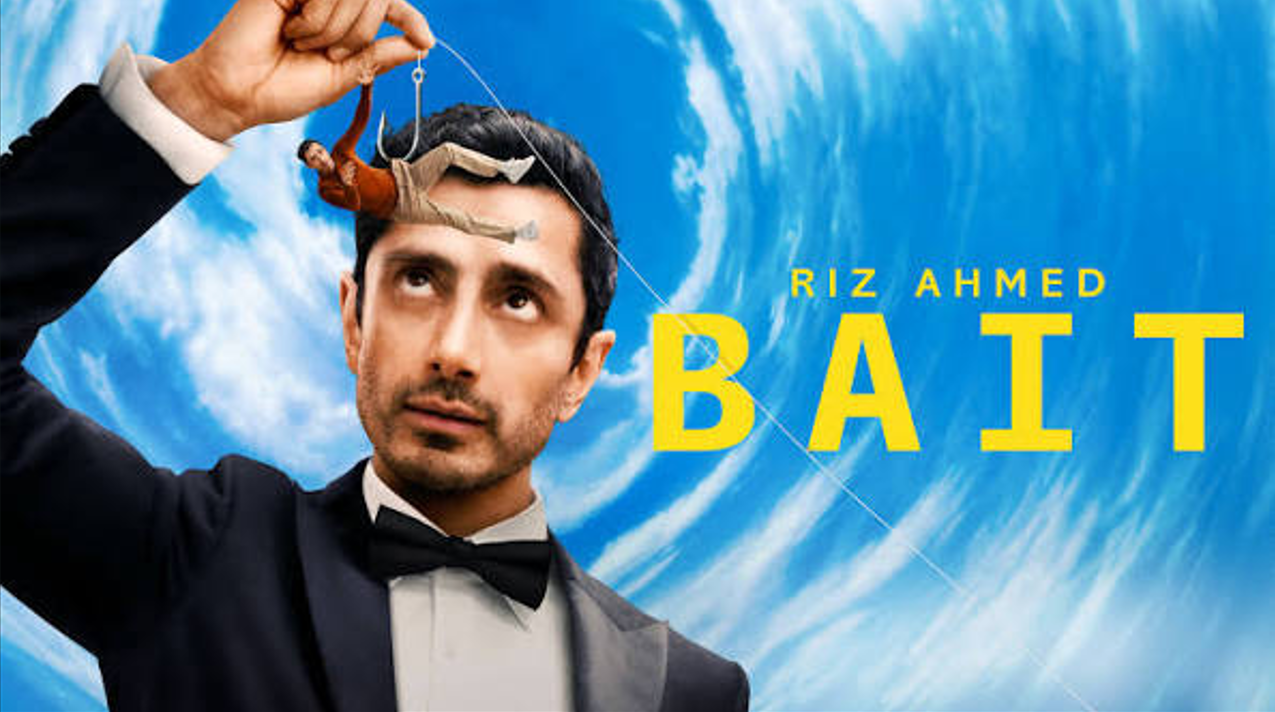
 6.8/10
Bait begins with a deliberately provocative idea: what happens when a British Pakistani actor is considered for the role of James Bond?
Created by and starring Riz Ahmed, the 2026 British television series initially appears to be an entertainment-industry satire about race, representation, celebrity, and one of cinema’s most famous characters. However, it quickly develops into something stranger and more personal.
The six-episode series follows Shah Latif, a struggling actor whose Bond audition pushes him into a rapidly escalating public and private crisis. Over four chaotic days, Shah must navigate social media outrage, professional opportunism, family conflict, unresolved trauma, cultural expectations, and his increasingly unstable sense of identity.
The series blends black comedy, psychological drama, industry satire, family conflict, and surreal spy-thriller imagery. It also features a severed pig’s head voiced by Patrick Stewart, which appears as a physical manifestation of Shah’s fear, shame, and self-doubt.
Released on Amazon Prime Video on March 25, 2026, Bait received strong critical acclaim for its writing, performances, visual experimentation, humor, and willingness to examine the contradictions surrounding representation.
Highlights
- Created by Riz Ahmed
- Released on Prime Video in March 2026
- Six half-hour episodes
- Combines satire, comedy, drama, and surrealism
- Centers on a British Pakistani actor auditioning for James Bond
- Features Patrick Stewart as the voice of a severed pig’s head
Bait TV Series – Official Trailer
What Is Bait About?
Bait follows Shah Latif, a British Pakistani actor from a Muslim family in west London.
Shah has spent years struggling to build a successful acting career when he receives the opportunity to audition for James Bond. To him, the role represents much more than another job.
Bond symbolizes acceptance, status, masculinity, cinematic legitimacy, and entry into an institution that historically excluded performers who look like him.
Unfortunately, Shah performs poorly during his initial screen test.
Rather than disappearing quietly, he deliberately exits through the front of the studio so photographers can capture him, ensuring that rumors about his possible casting spread online.
The publicity immediately transforms his life.
Supporters celebrate the possibility of a British Asian Bond, critics accuse him of destroying the character, and people from within his own community question whether pursuing the role makes him a sellout.
Shah’s growing obsession with winning approval gradually damages his relationships, destabilizes his mental health, and forces him to confront how little he understands himself.
Story Highlights
- Struggling actor auditions for James Bond
- News of his audition leaks online
- Public backlash rapidly escalates
- Family conflicts intensify
- Fame creates an identity crisis
- Psychological pressure becomes increasingly surreal
Is Bait Worth Watching?
Yes, particularly for viewers interested in unconventional comedies, industry satire, identity-driven dramas, and shows that refuse to remain within one genre.
Bait is fast, energetic, and packed with ideas.
It can move from an awkward family comedy to a paranoid spy thriller, surreal hallucination, romantic drama, or painful examination of childhood trauma within a single episode.
Riz Ahmed gives an emotionally exposed and frequently unflattering performance.
Shah is not written as an uncomplicated victim of racism or a symbolic hero carrying the burden of representation. He is vain, insecure, selfish, frightened, ambitious, and deeply confused about what he actually wants.
That complexity makes him frustrating, but it also gives the series its most interesting material.
The show’s biggest limitation is its length. Six approximately 30-minute episodes provide less than three hours to explore fame, mental illness, masculinity, family history, assimilation, race, class, celebrity, and the entertainment industry.
Some ideas therefore receive less development than they deserve.
Reasons to Watch
- Excellent performance by Riz Ahmed
- Bold combination of genres
- Sharp entertainment-industry satire
- Strong family dynamics
- Distinctive visual style
- Compact and easy to complete
Why You Should Watch Bait
The best reason to watch Bait is that it refuses to reduce representation to a simple question of progress.
Shah becoming James Bond could be viewed as a cultural victory.
A British Pakistani actor playing such an iconic role would challenge traditional expectations and create a major opportunity for visibility.
However, the series asks what happens when that visibility comes with conditions.
Does Shah need to change himself to be accepted?
Will the establishment celebrate him only if he becomes useful to its image?
Is he pursuing Bond because he genuinely wants the role, or because he believes success requires becoming someone entirely different?
The show treats representation as both meaningful and potentially destructive.
Being seen can create opportunity, but it can also transform one person into a symbol expected to satisfy audiences, institutions, critics, and entire communities simultaneously.
Biggest Strengths
- Complicates conversations about representation
- Examines ambition without romanticizing it
- Uses satire to expose institutional hypocrisy
- Explores the emotional cost of public visibility
- Combines personal and political storytelling
- Refuses to make Shah completely sympathetic
Riz Ahmed as Shah Latif
Riz Ahmed plays Shah Latif, an actor whose professional ambition becomes inseparable from his emotional instability.
Shah is talented, but he is also desperate for validation.
He wants the Bond role because it represents career success, masculine authority, national acceptance, and the possibility of escaping the version of himself he dislikes.
Ahmed plays him without attempting to hide his worst qualities.
Shah is frequently narcissistic, dishonest, jealous, self-pitying, and willing to abandon other people when their needs become inconvenient.
At the same time, he is carrying unresolved trauma.
Flashbacks reveal childhood racist violence, while his present-day panic attacks and hallucinations suggest that he has spent years avoiding serious psychological problems.
Ahmed’s performance becomes most effective when Shah’s confidence collapses and the distance between his public image and private fear becomes impossible to maintain.
Shah Highlights
- Struggling British Pakistani actor
- Auditions for James Bond
- Desperate for professional approval
- Experiences panic attacks and hallucinations
- Burdened by childhood trauma
- Played by creator Riz Ahmed
Guz Khan as Zulfi
Guz Khan plays Zulfikar “Zulfi,” Shah’s cousin and closest friend.
Zulfi works as an Uber driver while trying to promote his own rideshare business.
He initially appears to support Shah’s Bond opportunity, celebrating the possibility that someone from their family could achieve such enormous success.
However, their friendship becomes increasingly strained.
Shah treats Zulfi as both a relative and an accessory.
He brings him to public events as informal security, benefits from his loyalty, and then fails to defend him when others treat him unfairly.
Their conflict exposes the class tension beneath Shah’s ambition.
Shah wants to move deeper into elite cultural spaces, while Zulfi remains connected to the family and community Shah increasingly treats as embarrassing.
Their eventual confrontation becomes one of the series’ most painful examples of how ambition can damage relationships built over an entire lifetime.
Zulfi Highlights
- Shah’s cousin and childhood friend
- Entrepreneurial Uber driver
- Deeply loyal to the Latif family
- Used by Shah as informal security
- Represents family and community ties
- Played by Guz Khan
Sheeba Chaddha as Tahira Latif
Sheeba Chaddha plays Tahira Latif, Shah’s mother.
Tahira is proud of her son but also worried about the emotional and cultural distance growing between him and the family.
She participates in the excitement surrounding his Bond audition, yet she is far more interested in his stability and behavior than in celebrity.
Her relationship with family friend Naila adds another layer of tension.
Tahira resents Naila’s apparent success and reacts defensively when concerns are raised about Shah’s mental health.
The series implies that the Latif family has a history of psychological illness, but Tahira prefers silence to open discussion.
Her refusal to address those problems reflects a generational pattern of shame and avoidance.
When Shah lashes out during the Eid celebration, Tahira becomes the target of years of accumulated resentment, fear, and misunderstanding.
Tahira Highlights
- Shah’s mother
- Protective but emotionally guarded
- Struggles to discuss mental health
- Carries unresolved family resentment
- Central to the Eid conflict
- Played by Sheeba Chaddha
Sajid Hasan as Parvez Latif
Sajid Hasan portrays Parvez Latif, Shah’s father.
Parvez is quieter than Tahira but remains an important presence within the household.
He suffers from diabetes, and his health becomes a source of conflict when Shah gives him sweets despite knowing the risks.
After Parvez collapses during Eid prayers, the incident exposes the resentment between Shah and Zulfi.
Parvez also represents the emotional passivity within the family.
He loves Shah, but like Tahira, he has avoided directly confronting his son’s psychological problems.
His physical collapses mirror the wider instability of the Latif household.
The family wants to maintain the appearance that everything is manageable, even as Shah’s behavior becomes increasingly alarming.
Parvez Highlights
- Shah’s father
- Quiet presence within the family
- Lives with diabetes
- His collapse intensifies family conflict
- Avoids confronting Shah’s mental health
- Played by Sajid Hasan
Aasiya Shah as Q
Aasiya Shah plays Q, Shah’s cousin.
Her name provides an obvious reference to the gadget expert from the James Bond franchise, but she is much more than a simple joke.
Q is observant, direct, and increasingly frustrated by the family’s unwillingness to acknowledge Shah’s mental health.
She also has a secret romantic relationship with Salim, the son of family friend Naila.
Shah promises to protect that secret but later reveals it during an angry family confrontation.
The betrayal demonstrates how quickly he uses other people’s vulnerabilities when he feels judged.
Q eventually becomes one of the few characters willing to confront the family directly about their treatment of Shah.
Her role is essential because she can recognize both his destructive behavior and the environment that helped create it.
Q Highlights
- Shah’s cousin
- Secretly involved with Salim
- Recognizes Shah’s declining mental health
- Challenges the family’s silence
- Betrayed by Shah during an argument
- Played by Aasiya Shah
Ritu Arya as Yasmin Khan
Ritu Arya portrays Yasmin Khan, Shah’s former girlfriend.
Yasmin knows Shah well enough to recognize the insecurity beneath his ambition.
She publicly criticizes his pursuit of Bond, arguing that he is abandoning politically engaged art in exchange for approval from the white establishment.
Their reunion during the fourth episode combines romantic comedy, argument, regret, and emotional dishonesty.
After her bag is taken, they travel through London attempting to recover it, briefly reconnecting during the journey.
Shah hopes the night might revive their relationship, but Yasmin reveals that she is planning to leave for Argentina with another partner.
Their scenes demonstrate that Shah often uses performance in place of honesty.
Even when trying to express genuine emotion, he relies on lines from his Bond audition instead of speaking as himself.
Yasmin Highlights
- Shah’s former girlfriend
- Criticizes his Bond ambition
- Understands his insecurities
- Plans to leave for Argentina
- Central to the fourth episode
- Played by Ritu Arya
Weruche Opia as Felicia
Weruche Opia plays Felicia, Shah’s agent and friend.
Felicia understands the entertainment industry as a system built around image management.
After Shah injures an activist at a museum gala, she focuses on controlling the publicity damage through an apology video.
Her advice is practical but often emotionally detached.
She views scandals, trauma, and identity primarily through their effect on Shah’s career.
Later, she becomes part of one of the series’ most surreal hallucinations.
Shah imagines Felicia holding his family hostage and demanding that he eliminate them to free himself creatively.
The scene transforms her into a symbol of the industry’s pressure to abandon personal attachments in pursuit of success.
Felicia Highlights
- Shah’s agent and friend
- Focused on publicity management
- Helps protect his Bond opportunity
- Represents entertainment-industry pressure
- Appears prominently in Shah’s hallucinations
- Played by Weruche Opia
Himesh Patel as Raj Thakkar
Himesh Patel plays Raj Thakkar, another actor competing for the Bond role.
Raj represents the professional rivalry created when institutions appear willing to consider only one performer from a minority background at a time.
Rather than allowing both actors to exist independently, the audition process encourages them to view one another as obstacles.
At the museum gala, Shah manipulates Raj by describing the racist attack against his family.
Raj later recounts the pig’s-head incident as though it happened to him, using the story to gain sympathy from the audience.
The moment is absurd but revealing.
Both men understand that personal pain can be converted into cultural value, professional attention, and public legitimacy.
Their rivalry satirizes an industry that rewards performers for packaging trauma into an acceptable narrative.
Raj Highlights
- Rival actor auditioning for Bond
- Competes directly with Shah
- Uses Shah’s trauma for public sympathy
- Represents tokenized competition
- Played by Himesh Patel
Maxine Peake as Helen
Maxine Peake portrays Helen, the director of the new Bond film.
Helen gives Shah his initial opportunity but becomes frustrated when he forgets his lines during the screen test.
She represents the power of major cultural institutions to decide who is allowed inside.
For Shah, her approval means far more than ordinary professional success.
He views it as confirmation that he can become part of the British identity represented by Bond.
Helen is not presented as a simple villain.
She appears genuinely willing to consider Shah, but her expectations place enormous pressure on him to perform a version of confidence and masculinity he does not naturally possess.
Her final response to his audition becomes central to the show’s conclusion.
Helen Highlights
- Director of the new Bond film
- Gives Shah his major opportunity
- Demands confidence and precision
- Represents institutional approval
- Played by Maxine Peake
Patrick Stewart as Pigtrick
Patrick Stewart provides the voice of Pigtrick, a severed pig’s head that begins speaking to Shah.
The head is thrown through his parents’ window during a racist attack.
Instead of discarding it, Shah stores it in a basement freezer and begins imagining conversations with it.
Pigtrick mocks his ambition, questions his masculinity, and tells him that he will never convincingly become Bond.
The character is bizarre, comic, disgusting, and psychologically revealing.
Pigtrick represents Shah’s internalized hatred.
It speaks with the authoritative voice of the culture he is attempting to impress, constantly reminding him that acceptance may remain impossible.
Ahmed wrote the role with Stewart in mind, and Stewart reportedly accepted after receiving a personal letter about the project.
Pigtrick Highlights
- Severed pig’s head
- Voiced by Patrick Stewart
- Created from a racist attack
- Embodies Shah’s self-doubt
- Appears in hallucinations
- One of the series’ boldest creative choices
Family, Identity, and the British Asian Experience
The Latif family gives Bait much of its emotional depth.
Shah’s Bond audition creates pride, fear, excitement, jealousy, and suspicion among his relatives.
To some, his success represents an achievement for the entire community.
To others, it suggests that he is becoming increasingly disconnected from the people who supported him.
The series is especially interested in second-generation immigrant identity.
Shah moves between languages, social classes, cultural expectations, professional spaces, and different performances of masculinity.
He wants to be accepted as British without constantly being defined by his heritage.
At the same time, he worries that entering institutions such as the Bond franchise requires rejecting the family and community that shaped him.
Identity Highlights
- British Pakistani family
- Second-generation immigrant experience
- Pressure to represent an entire community
- Conflict between ambition and belonging
- Code-switching across different spaces
- Anxiety about cultural authenticity
James Bond as a Symbol
Despite its premise, Bait is not primarily about whether Riz Ahmed or another non-white actor should play James Bond.
Bond functions as a symbol.
For Shah, the character represents:
- Success
- British acceptance
- Masculine confidence
- International fame
- Cultural legitimacy
- Escape from insecurity
The problem is that Shah does not merely want the role.
He wants to become the kind of man he imagines Bond represents.
His pursuit is therefore an attempt to replace himself.
Ahmed described the character’s ambition as a desire to become someone else rather than simple enthusiasm for the franchise.
The Bond framing also allows the series to borrow visual and narrative elements from spy thrillers, including chases, rival agents, security consultants, secret motives, and imagined threats.
Bond Highlights
- Symbol of British cultural acceptance
- Represents idealized masculinity
- Provides the show’s spy-thriller language
- Creates debate about race and casting
- Reflects Shah’s desire to escape himself
Fame and Public Image
The series repeatedly contrasts Shah’s public persona with his private instability.
Once rumors of the Bond audition become public, Shah stops being treated as an individual.
Online supporters view him as progress.
Opponents view him as an attack on tradition.
Activists treat him as someone with a duty to speak politically.
Agents and producers treat him as a marketable image.
His family treats his opportunity as a reflection of their collective success.
Shah attempts to control these interpretations but becomes increasingly trapped by them.
The greater his visibility becomes, the less control he has over what his image means.
Fame Highlights
- Social media backlash
- Celebrity publicity
- Pressure to speak for a community
- Public apologies
- Manufactured identity
- Loss of control over personal image
Mental Health and Hallucination
Shah’s psychological decline is one of the series’ central storylines.
He experiences panic attacks, intrusive memories, paranoia, hallucinations, and conversations with Pigtrick.
The series also suggests a family history of mental illness through references to his aunt Ruqaya.
However, the Latif family avoids discussing these concerns directly.
Shah interprets his suffering through ambition, racial pressure, professional stress, and shame rather than seeking meaningful treatment.
His hallucinations become more elaborate as the story progresses.
He imagines critics confronting him, sees a Bond-like version of himself commit violence, and experiences a fantasy in which his agent demands that he murder his family.
These scenes visualize his belief that success requires destroying every relationship connecting him to his real identity.
Mental Health Highlights
- Panic attacks
- Childhood trauma
- Hallucinations
- Family history of mental illness
- Refusal to seek help
- Psychological collapse under pressure
Masculinity and Self-Worth
Bond represents an idealized form of masculinity that Shah believes he lacks.
The character is confident, physically capable, sexually desirable, controlled, admired, and supposedly fearless.
Shah feels almost the opposite.
He forgets lines, panics in public, struggles with family conflict, fails to defend Zulfi, injures someone accidentally, and becomes overwhelmed by criticism.
Pigtrick repeatedly attacks him for these perceived failures.
The show suggests that Shah’s pursuit of Bond is partly an attempt to prove that he is strong enough, British enough, masculine enough, and successful enough to deserve respect.
However, performing that image only deepens his insecurity.
His eventual breakthrough occurs when he stops trying to imitate the fictional ideal and acknowledges his own name.
Masculinity Highlights
- Bond as an alpha-male fantasy
- Shame about fear and vulnerability
- Pressure to appear controlled
- Childhood experiences of racial violence
- Career success tied to self-worth
- Identity reclaimed through his real name
The Meaning of the Title Bait
The title has several meanings.
In British slang, “bait” can mean obvious, blatant, attention-seeking, or excessively visible.
This reflects Shah’s fear of becoming a performer who is too eager for establishment approval.
The term can also describe online provocation or trolling, connecting it to the public controversy surrounding his Bond audition.
“Bait” is additionally something used as part of a trap.
The Bond opportunity attracts Shah, but it may also pull him deeper into an industry that wants to use his identity.
The similar-sounding words bayt, bayit, or beit can mean “home” in Arabic and Hebrew, while related wording can suggest loyalty or allegiance in Urdu.
The episode titles build on these overlapping meanings, connecting visibility, home, loyalty, provocation, and entrapment.
Title Highlights
- British slang for something obvious
- Can describe online provocation
- Literal bait used in a trap
- Connected linguistically to “home”
- Suggests loyalty and allegiance
- Reflects several of the show’s central themes
Episodes and Structure
Bait contains six episodes, all released on Prime Video on March 25, 2026.
The episodes are:
- Blatant, Not Subtle
- To Troll, to Provoke
- House or Home
- Loyalty, Allegiance
- Lure, Part of a Trap
- The Subtle One
The entire story unfolds over approximately four days.
Each episode focuses on a different stage of Shah’s collapse while expanding one meaning of the title.
The short runtime creates speed and momentum.
However, it also limits the amount of attention given to certain supporting characters, family history, and psychological themes.
The structure feels somewhere between an extended film and a conventional television season.
Episode Highlights
- Six episodes
- Approximately 30 minutes each
- Released simultaneously
- Story unfolds over four days
- Episode titles explore the meaning of “bait”
- Fast but occasionally underdeveloped
Episode 1 – Blatant, Not Subtle (Spoiler)
Shah auditions for James Bond but forgets his lines during the screen test.
After being dismissed, he leaves through the front entrance so paparazzi will photograph him.
The decision works.
Rumors about his possible casting immediately spread online, creating excitement and hostility.
Shah attends a music event where he encounters his former girlfriend Yasmin.
After reading the growing backlash, he experiences a panic attack outside the venue.
The episode ends with a racist attack on his parents’ home, where a severed pig’s head is thrown through the window.
Despite the chaos, Shah receives another opportunity to audition.
Episode 1 Highlights
- Failed Bond audition
- Deliberate paparazzi exposure
- Social media controversy
- Reunion with Yasmin
- Panic attack
- Pig’s-head hate crime
Episode 2 – To Troll, to Provoke (Spoiler)
Shah begins speaking to the severed pig’s head, which he stores in a freezer and names Pigtrick.
He hires security consultant Nigel to protect the family during Eid.
At a museum gala, Shah tries to increase his visibility among influential guests.
His rival Raj uses the pig’s-head incident as though it happened to him, gaining sympathy from the audience.
Zulfi is removed by security after being accused of profiling guests, but Shah fails to defend him.
When activist Sid enters the event, Shah instinctively attacks him and breaks his arm.
The episode combines cultural satire, institutional hypocrisy, physical comedy, childhood trauma, and growing psychological instability.
Episode 2 Highlights
- Introduction of Pigtrick
- Museum gala
- Rivalry with Raj
- Zulfi humiliated by security
- Shah injures Sid
- Flashbacks to childhood violence
Episode 3 – House or Home (Spoiler)
Shah’s agent attempts to manage the museum incident through an apology video.
During Eid celebrations, tensions within the Latif family become increasingly difficult to control.
Shah learns that Q and Salim are secretly involved and promises to protect them.
He struggles to create a sincere apology before eventually contacting Sid directly.
When Parvez collapses during prayer, Zulfi blames Shah for ignoring his father’s diabetes.
Shah responds by attacking nearly everyone around him.
He reveals Q’s secret relationship, insults Zulfi with a racial slur, and accuses Tahira of blaming him for the fate of Ruqaya.
Tahira slaps him, and Shah leaves the gathering in anger and shame.
Episode 3 Highlights
- Eid family celebration
- Failed apology videos
- Q and Salim’s secret relationship
- Parvez collapses
- Shah betrays the family
- Major confrontation with Tahira and Zulfi
Episode 4 – Loyalty, Allegiance (Spoiler)
Shah finds Yasmin at a Brick Lane restaurant and confronts her over her criticism.
Their argument changes direction when her bag disappears.
They travel through London attempting to recover it, gradually reconnecting during the journey.
Shah continues hallucinating Pigtrick.
After finding Yasmin’s bag, he hides it and lies to her.
She immediately recognizes the deception.
Yasmin reveals that she intends to leave for Argentina with another partner.
Shah attempts to express himself using lines from his Bond script, demonstrating that he remains unable to speak honestly without performing.
Episode 4 Highlights
- Reunion with Yasmin
- Search through London
- Romantic-comedy influence
- Continued hallucinations
- Yasmin plans to leave
- Shah uses Bond dialogue instead of honesty
Episode 5 – Lure, Part of a Trap (Spoiler)
Shah returns home and believes his family has disappeared.
Blood on the carpet and Pigtrick on the sofa convince him that something terrible has happened.
The police show little interest, while Nigel attempts to turn the crisis into a promotional opportunity.
Shah carries Pigtrick through London while his hallucinations become increasingly severe.
He seeks help at a mosque but causes panic when worshippers discover the severed head.
Imagined critics confront him before being killed by a fantasy version of Shah as Bond.
That idealized figure then begins pursuing the real Shah.
The episode ends after Shah is struck by a car and speaks to Pigtrick’s damaged remains.
Episode 5 Highlights
- Family appears to be missing
- Police and security consultant fail Shah
- Pigtrick carried across London
- Mosque misunderstanding
- Violent Bond hallucination
- Shah is hit by a car
Episode 6 – The Subtle One (Spoiler)
The finale reveals that Shah’s belief that his family disappeared was part of his psychological collapse.
He experiences another hallucination in which Felicia holds his relatives hostage and claims that he must kill them to free himself creatively.
Shah imagines shooting his family before waking in a hospital.
After learning that Zulfi intends to leave for Dubai, Shah rushes to the airport with Q.
He reconciles with Zulfi, while Q reconnects with Salim.
Shah then travels to his final Bond audition.
He performs successfully and is told that he has won the role.
However, when asked to deliver the iconic introduction, he does not say “Bond.”
He thinks about his family and introduces himself as Shahjehan, reclaiming the identity he had spent the entire series attempting to escape.
Episode 6 Highlights
- Hallucination involving Shah’s family
- Hospital awakening
- Airport reconciliation
- Successful Bond audition
- Shah receives the role
- Final declaration of his own name
The Ending Explained (Spoiler)
The ending appears to give Shah everything he wanted.
He completes the Bond audition successfully, receives approval from the director, and is positioned to take on the role.
However, his final line changes the meaning of that success.
When prompted to introduce himself in Bond’s famous style, Shah remembers his family and says, “The name’s … Shahjehan.”
He does not reject the opportunity outright.
Instead, he rejects the idea that success requires erasing himself.
Throughout the series, Shah has viewed Bond as an identity he can enter to escape insecurity, ethnicity, vulnerability, and family history.
The final line suggests that he may be able to occupy the role without allowing it to replace him.
It is a hopeful conclusion, although intentionally neater than much of the psychological conflict preceding it.
Ending Highlights
- Shah performs well at the final audition
- The director approves his performance
- He appears to receive the Bond role
- He refuses the expected introduction
- Uses his full name instead
- Reclaims identity rather than imitating Bond
Production and Development
Riz Ahmed developed the idea over several years.
The concept was partly inspired by a friend telling him that the distance between a person’s public and private self reflects the amount of shame they carry.
Ahmed later joked that the observation made him realize he either needed therapy or needed to create a television series.
Several scenes drew inspiration from incidents in his own life, including a panic attack at a music venue, a childhood racist assault, and an attempted approach by MI5.
However, Ahmed has emphasized that Bait is not straightforward autofiction.
The show was developed by Jax Media in association with Ahmed’s Left Handed Films for Amazon MGM Studios.
Ben Karlin served as co-showrunner, writer, and executive producer alongside Ahmed, with additional writers contributing across the six episodes.
Production Highlights
- Created by Riz Ahmed
- Developed over several years
- Inspired partly by real experiences
- Produced by Jax Media and Left Handed Films
- Made for Amazon MGM Studios
- Co-showrun by Ahmed and Ben Karlin
Permission to Use James Bond
Because the series directly references James Bond, Ahmed approached Barbara Broccoli while developing the project.
At the time, Broccoli retained creative control over the film franchise.
Ahmed explained the premise and requested permission to use the Bond name.
She agreed under the condition that she herself would not be referenced in the series.
Ahmed emphasized that the story was not intended as an attack on Bond or a simple debate about changing the character’s ethnicity.
Instead, Bond provides the framing for a story about self-love, ambition, identity, and the feeling that life is one continuous audition.
Bond Permission Highlights
- Ahmed approached Barbara Broccoli
- Requested consent to reference Bond
- Permission was granted
- Broccoli asked not to appear in the story
- Bond functions as a narrative framework
- The show focuses more broadly on identity
Filming Locations
Principal photography took place in London during September 2024.
The production used the working title Quarter Life.
Filming locations included:
- Wembley
- Central Mosque of Brent
- O2 Forum Kentish Town
- Brick Lane
- Other areas across west and central London
London is not merely a background.
The series identifies neighborhoods with large location titles inspired by international spy thrillers.
Areas such as Wembley, Kentish Town, Brick Lane, and Ladbroke Grove are presented with the dramatic importance usually given to global destinations in espionage films.
This visual joke reinforces the idea that Shah’s personal crisis feels as large and dramatic to him as an international mission.
Filming Highlights
- Filmed primarily in London
- Production began in September 2024
- Working title: Quarter Life
- Used Wembley and Kentish Town
- Featured the Central Mosque of Brent
- London neighborhoods presented like spy-film locations
Music and Soundtrack
Shruti Kumar composed the score for Bait.
The soundtrack combines several musical traditions and styles, including:
- Orchestral film music
- 1970s Pakistani psychedelic cinema
- Qawwali
- 1980s synth-pop
- British drum and bass
- Bhangra
- Contemporary British and South Asian music
The soundtrack reflects Shah’s divided cultural and emotional identity.
Traditional and modern influences overlap in the same way the series moves between British institutions, Pakistani family life, popular culture, and personal memory.
Featured artists include Jorja Smith, Arooj Aftab, Anish Kumar, Jay Sean, Véyah, and Casisdead.
The original soundtrack was released on March 25, 2026, alongside the series.
Music Highlights
- Score by Shruti Kumar
- Pakistani film influences
- Qawwali and Bhangra
- British electronic music
- Songs from major contemporary artists
- Soundtrack released with the series
Release and Sundance Premiere
Bait had its world premiere at the 2026 Sundance Film Festival.
It was subsequently released exclusively through Amazon Prime Video on March 25, 2026.
All six episodes became available simultaneously.
The Sundance premiere helped position the project as more than a conventional streaming comedy.
Its unusual combination of satire, surrealism, psychological drama, and cultural commentary made it well suited to a festival audience.
The Prime Video release then allowed viewers to experience the entire four-day story as one compact narrative.
Release Highlights
- Premiered at Sundance 2026
- Released March 25, 2026
- Available on Amazon Prime Video
- Six episodes released together
- Presented as a limited streaming series
Reception and Critical Response
Bait received strong critical acclaim.
The series earned a 93% approval rating on Rotten Tomatoes based on the reviews cited in the supplied source.
It also received a Metacritic score of 85, indicating universal acclaim.
Critics praised:
- Riz Ahmed’s performance
- The writing
- The visual style
- The dialogue
- The family cast
- The combination of satire and psychological drama
- The specificity of its British Asian perspective
Some reviewers compared its anxious momentum to Uncut Gems and its confessional humor to Fleabag.
Others praised the way the series moves between Multicultural London English, Urdu, Arabic, and more formal British speech.
The reception was not entirely positive.
Several critics argued that six half-hour episodes did not provide enough room to explore the show’s many themes or supporting characters.
Critical Highlights
- 93% Rotten Tomatoes score
- 85 Metacritic score
- Widely praised performance by Ahmed
- Strong reception for writing and visual style
- Recognized for cultural specificity
- Criticized for its limited runtime
Criticism of the Short Runtime
The most common criticism concerned the series’ length.
With less than three hours of total screen time, Bait attempts to address:
- Race
- Representation
- Masculinity
- Fame
- Class
- Mental health
- Family trauma
- Assimilation
- Celebrity culture
- Entertainment-industry politics
Some reviewers believed the series introduced these topics without exploring them deeply enough.
The family history involving Ruqaya is particularly underdeveloped.
Her apparent mental health struggles influence Tahira, Zulfi, Q, and Shah, but the story provides only limited explanation.
The finale also resolves several relationships and thematic conflicts very quickly.
The short structure creates energy, but a longer season might have given the supporting cast and psychological material more space.
Runtime Criticism
- Less than three hours total
- Many themes compete for attention
- Family history remains underexplored
- Supporting characters receive limited development
- Finale resolves conflicts rapidly
- Could have benefited from additional episodes
Awards and Recognition
Riz Ahmed received substantial recognition for his performance.
He earned a nomination for Outstanding Lead Actor in a Limited or Anthology Series or Movie at the Primetime Emmy Awards, according to the supplied source.
The series and Ahmed also received attention from the Gotham TV Awards and Astra TV Awards.
The recognition reflects the difficulty of Ahmed’s role.
He must balance physical comedy, panic, arrogance, shame, emotional breakdown, family conflict, and surreal fantasy while keeping Shah recognizable as the same unstable person.
Even critics who questioned the show’s structure often praised his commitment.
Award Highlights
- Emmy recognition for Riz Ahmed
- Gotham TV Award nomination
- Astra TV Award attention
- Praise for lead performance
- Recognition for writing
Legacy and Impact
Bait may ultimately be remembered as one of the more daring television explorations of representation in the entertainment industry.
It does not argue that diversity is meaningless.
Instead, it asks what happens after a symbolic breakthrough becomes possible.
The person receiving the opportunity may be expected to carry the hopes, anger, fears, and political arguments of millions of people.
Shah is not emotionally prepared for that burden.
The series also expands the kinds of stories available to British Asian performers.
It allows its characters to be funny, selfish, culturally specific, politically contradictory, psychologically unstable, and visually surreal without reducing them to educational symbols.
Its compact length limits the depth of some ideas, but its style and ambition make it difficult to confuse with any other series.
Legacy Highlights
- Distinctive treatment of representation
- Strong British Asian cultural specificity
- Mixes surrealism with industry satire
- Challenges symbolic casting narratives
- Expands the range of minority-led television stories
- One of Riz Ahmed’s most personal creative projects
FAQ
What is Bait about?
The series follows Shah Latif, a British Pakistani actor whose audition for James Bond causes public backlash, family conflict, and a severe identity crisis.
Is Bait based on Riz Ahmed’s life?
Some scenes were inspired by Ahmed’s personal experiences, but he has stated that the series is not straightforward autofiction.
How many episodes does Bait have?
The series contains six episodes, each lasting approximately 30 minutes.
Where can I watch Bait?
Bait was released exclusively on Amazon Prime Video.
When was Bait released?
All six episodes were released on March 25, 2026.
Who plays Shah Latif?
Riz Ahmed plays Shah and also created the series.
Who voices the pig’s head?
Patrick Stewart voices Pigtrick, the severed pig’s head that represents Shah’s internal fear and self-doubt.
Is Bait really about James Bond?
Bond is an important framing device, but the series is primarily about identity, acceptance, shame, family, masculinity, and the pressure to become someone else.
What does the ending mean?
Shah appears to win the Bond role but introduces himself using his real name, suggesting that he no longer believes success requires erasing his identity.
Is Bait a comedy?
Yes, but it also includes psychological drama, family conflict, surrealism, satire, and spy-thriller elements.
Is Bait worth watching?
Yes. Its short length, strong performances, original style, and sharp cultural satire make it worthwhile, although some themes feel underdeveloped.
Conclusion
Bait uses one of British cinema’s most famous roles to tell a much more intimate story about shame, ambition, family, and the desire to escape oneself.
Shah Latif believes becoming James Bond will prove that he belongs. He imagines the role will make him confident, respected, masculine, culturally accepted, and professionally secure.
Instead, the audition exposes every part of his identity that he has tried to hide.
His family sees the person behind the publicity.
His community questions what he represents.
The entertainment industry turns his pain into a marketable story.
Pigtrick gives a voice to the hatred he has internalized.
Riz Ahmed delivers a fearless performance that allows Shah to be sympathetic without making him admirable. The series is funniest and most effective when it exposes his vanity, dishonesty, fear, and need for approval.
Its six-episode structure occasionally prevents its ideas from developing fully, particularly those involving family mental health and supporting relationships.
Even so, Bait remains a bold, intelligent, and visually distinctive series.
Its final message is simple but meaningful: Shah does not need to stop pursuing success, but he must stop believing that success requires becoming someone else.
If you don’t know where to watch this Series for FREE make sure to contact me via E-mail, or in the comments below. Thank you for reading and make sure to bookmark the site.
How useful was this post?
Click on a star to rate it!
Average rating 0 / 5. Vote count: 0
No votes so far! Be the first to rate this post.