
 8.8/10
Few television comedies have turned minor social irritation into an art form as successfully as Curb Your Enthusiasm. Created by Larry David, the HBO series takes everyday annoyances—bad dinner etiquette, awkward greetings, inconsiderate strangers, misunderstood comments, strange social rules—and stretches them until they become elaborate disasters. What makes the show special is that Larry is often technically correct about the original problem, yet his determination to prove that point usually creates something far worse.
The series began with the hour-long special Larry David: Curb Your Enthusiasm in 1999 before expanding into a full television show in 2000. Across 12 seasons, it followed a fictionalized version of David as a wealthy, semi-retired television writer living primarily in Los Angeles. Rather than presenting a conventional sitcom structure, the series uses story outlines and largely improvised dialogue, giving conversations an unusually spontaneous and uncomfortable rhythm.
By the time its final season concluded in April 2024, Curb Your Enthusiasm had developed from a cult comedy into one of the most respected sitcoms of the modern era. It received 55 Primetime Emmy nominations, including Outstanding Comedy Series nominations for 11 of its 12 seasons, and earned widespread recognition for its improvisation, writing, performances, and distinctive approach to social comedy.
Highlights
- Created by Larry David
- Originally began as a 1999 HBO special
- 12 seasons
- Aired from 2000 to 2024
- Known for improvisational dialogue
- Features dozens of celebrity guest stars
- Widely regarded as one of television’s greatest comedies
Curb Your Enthusiasm – Official Main Trailer
What Is Curb Your Enthusiasm About?
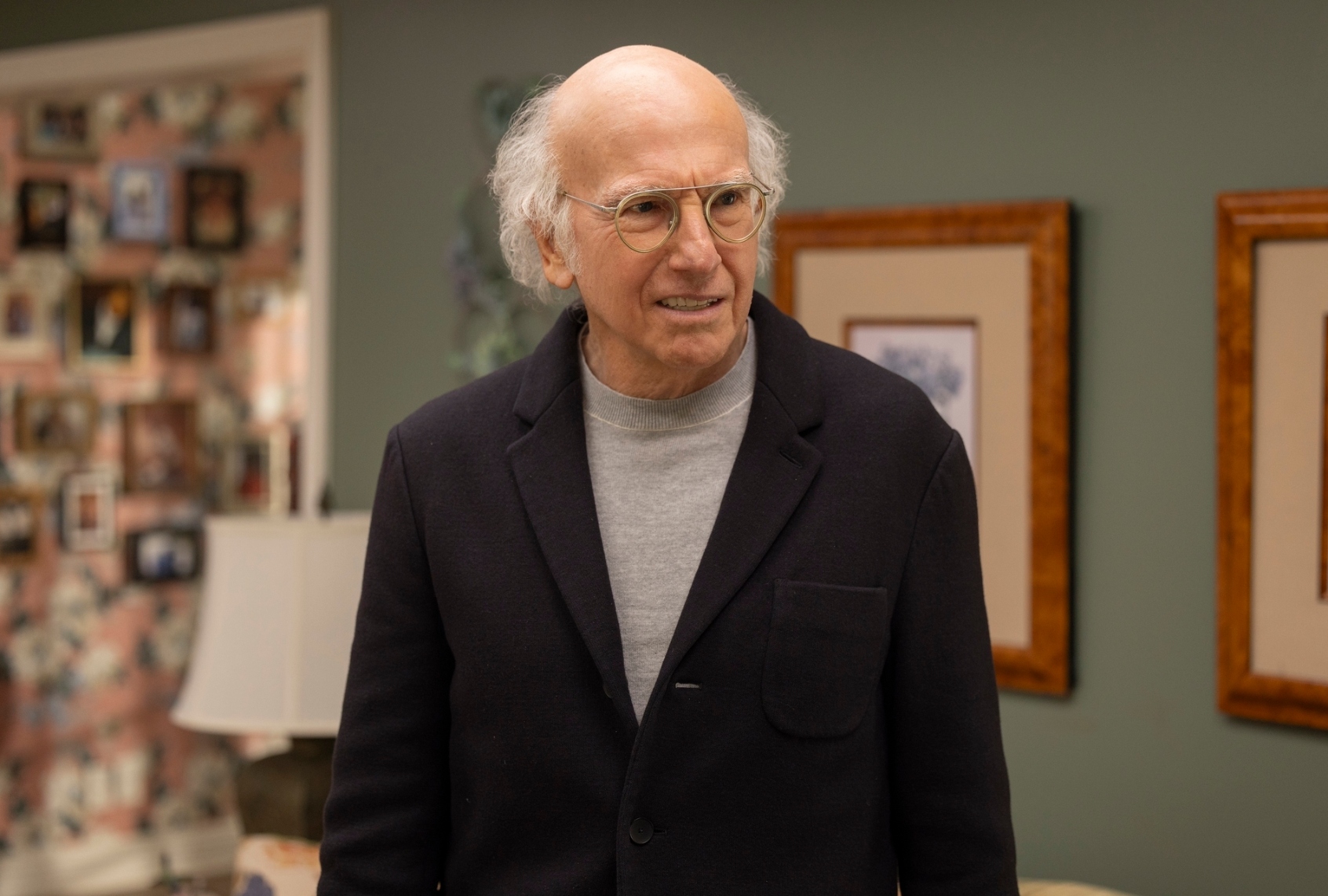
The series follows Larry David playing an exaggerated fictional version of himself. Like the real David, the character is wealthy because of his involvement in Seinfeld, but he spends relatively little time actually working. Instead, most episodes revolve around ordinary social situations that Larry believes other people are handling incorrectly.
He questions etiquette that everyone else accepts, becomes annoyed by minor inconveniences, refuses to ignore behavior he considers hypocritical, and frequently invents his own rules about how society should function. Sometimes his observations are completely reasonable. The problem is that Larry rarely knows when to stop arguing.
A disagreement about who should pay for lunch can become a friendship-ending conflict. A badly chosen word can create a misunderstanding lasting an entire episode. A simple attempt to avoid inconvenience can eventually involve several unrelated people who somehow all become angry with him.
The humor comes from watching these separate storylines collide. What initially appears to be a collection of small incidents gradually becomes one elaborate social catastrophe.
Story Highlights
- Larry David plays a fictionalized version of himself
- Everyday situations become escalating conflicts
- Minor grievances drive entire episodes
- Misunderstandings frequently connect together
- Larry challenges unwritten social rules
- Stories often end with several plotlines colliding
Is Curb Your Enthusiasm Worth Watching?
Absolutely, especially if you enjoy uncomfortable comedy, improvisation, and characters who are allowed to behave badly without the show constantly explaining the joke.
Curb Your Enthusiasm is very different from sitcoms built around warm relationships and comforting resolutions. Larry does not consistently learn lessons, become more considerate, or grow into a fundamentally better person. Much of the comedy depends on the fact that he remains stubbornly himself.
That lack of conventional character growth may sound limiting, but it actually gives the writers enormous freedom. The series can repeatedly place Larry in new social environments and ask the same basic question: what happens when one person refuses to participate politely in a rule everyone else accepts?
Its long run also gives the show an enormous variety of situations. Marriage, dating, friendship, religion, celebrity culture, restaurants, doctors, funerals, entertainment-industry politics, neighbor disputes, social media, and countless other subjects become targets.
Reasons to Watch
- Unique improvisational humor
- Exceptional recurring characters
- Relentlessly creative social situations
- Huge library of episodes
- Strong celebrity guest appearances
- Comedy that remains unusually unpredictable
Why You Should Watch Curb Your Enthusiasm
The greatest strength of Curb Your Enthusiasm is that it understands how ridiculous ordinary social life can be.
Most people encounter irritating situations and move on because maintaining social harmony is easier than starting an argument. Larry almost never does that. He wants explanations, accountability, consistency, and acknowledgment that his interpretation is correct.
This transforms him into both the hero and villain of his own life.
Viewers frequently recognize the original frustration. Someone cuts a line. A friend violates an unspoken rule. A stranger behaves selfishly. Larry says what many people might privately think—but then continues far beyond the point where any reasonable person would have stopped.
That structure gives the comedy a remarkable sense of identification. Audiences can simultaneously agree with Larry, feel embarrassed by him, and understand why everyone else wants him to leave.
Biggest Strengths
- Observational comedy based on recognizable behavior
- Constant tension between being right and behaving badly
- Exceptional escalation
- Strong improvisational performances
- Social commentary without becoming preachy
- Almost no traditional sitcom sentimentality
Larry David as Larry David
Larry David is the center of every disaster.
The fictional Larry is wealthy, semi-retired, blunt, self-centered, argumentative, and almost incapable of letting a perceived injustice go unchallenged. He frequently rejects social conventions he considers pointless while demanding that everyone else follow an equally complicated collection of rules he has created himself.
Yet the character works because he is not simply cruel.
Larry is often genuinely confused when other people become offended. He believes his behavior is logical, and there are numerous occasions when the audience can see that his original complaint was completely legitimate.
The comedy comes from the disproportion between problem and response. Larry may have a reasonable point, but he will sacrifice friendships, relationships, business opportunities, and entire evenings to prove it.
His willingness to expose hypocrisy also makes him oddly satisfying to watch. He says things that polite people normally avoid saying and challenges rules that exist largely because nobody wants to question them.
Larry Highlights
- Fictionalized version of Larry David
- Co-creator of Seinfeld
- Wealthy and mostly semi-retired
- Obsessed with social rules
- Frequently correct for the wrong reasons
- Incapable of letting small problems go
Cheryl David
Cheryl Hines plays Cheryl David, Larry’s wife during much of the earlier series and later his ex-wife.
Cheryl is far more socially competent than Larry and often functions as the person preventing him from completely destroying every relationship they have. She enjoys social gatherings, maintains friendships, participates in charitable causes, and frequently pushes Larry to apologize after he has offended someone.
Her patience creates an important contrast with Larry’s personality. She can often see that his original observation has some merit while simultaneously recognizing that his response has become completely unreasonable.
The relationship also prevents Larry from existing in a comedy vacuum. His behavior has consequences for someone who actually cares about him, making their marriage an important part of the show’s emotional structure without turning Curb into a conventional relationship sitcom.
Cheryl Highlights
- Played by Cheryl Hines
- Larry’s wife during the earlier seasons
- Much more socially capable than Larry
- Frequently serves as the voice of reason
- Maintains many of their friendships
- Balances Larry’s confrontational personality
Jeff Greene
Jeff Garlin plays Jeff Greene, Larry’s manager and closest friend.
Jeff is one of the few people willing to participate in Larry’s schemes even when he understands that they are probably going to fail.
Their friendship works because Jeff is hardly a moral counterweight. He has his own questionable behavior, including repeated infidelity and elaborate attempts to hide it from his wife Susie. Larry often becomes involved in those cover-ups, creating some of the show’s most complicated misunderstandings.
Jeff also understands Larry better than almost anyone else. He rarely seems shocked by his behavior and often acts as a sounding board while Larry explains whatever microscopic social violation has ruined his day.
Their conversations feel especially natural because of the show’s improvisational format.
Jeff Highlights
- Played by Jeff Garlin
- Larry’s manager
- Larry’s closest friend
- Frequently assists with questionable schemes
- Has a chaotic marriage with Susie
- Major part of the show from the beginning
Susie Greene
Susie Essman plays Susie Greene, Jeff’s wife and one of Larry’s most formidable opponents.
Susie is famous for her explosive temper, brutal insults, and almost supernatural ability to discover when Larry and Jeff are hiding something.
Interactions between Larry and Susie often begin politely before collapsing into shouting within minutes.
What makes the character especially effective is that she is frequently correct. Larry and Jeff often are lying, manipulating situations, or protecting themselves, and Susie understands them well enough to know when something feels suspicious.
Her willingness to match Larry’s aggression makes their arguments some of the funniest confrontations in the series. Larry can dominate many social situations simply by refusing to back down, but Susie is one of the few characters who can consistently overwhelm him.
Susie Highlights
- Played by Susie Essman
- Jeff’s wife
- Famous for profanity-filled confrontations
- Frequently catches Larry and Jeff lying
- Strong moral certainty
- One of the show’s most memorable characters
Leon Black
J. B. Smoove joined the series as Leon Black during Season 6 and quickly became one of its most popular characters.
Leon initially enters Larry’s life when members of his family stay at Larry and Cheryl’s home. Even after his relatives leave, Leon simply remains.
That decision creates one of the show’s best character pairings.
Leon is every bit as blunt as Larry, but he approaches social conflict very differently. Larry overthinks rules, consequences, and etiquette. Leon usually encourages confidence, confrontation, and complete disregard for embarrassment.
His advice is often ridiculous, yet he delivers it with such certainty that Larry occasionally treats it as genuine wisdom.
The later seasons benefit enormously from their friendship because Leon gives Larry someone who not only tolerates his personality but sometimes encourages the worst parts of it.
Leon Highlights
- Played by J. B. Smoove
- Introduced in Season 6
- Eventually becomes Larry’s housemate
- Gives questionable but confident advice
- More socially fearless than Larry
- Became a major fan favorite
Recurring Characters
Curb Your Enthusiasm has one of television’s deepest recurring comedy ensembles.
Richard Lewis appears as a fictionalized version of himself and regularly argues with Larry over friendships, relationships, manners, health, and insignificant personal grievances.
Ted Danson also plays a fictionalized version of himself, maintaining a friendship with Larry that frequently contains enough resentment to barely qualify as friendship.
Bob Einstein’s Marty Funkhouser became another essential recurring figure, while Richard Kind appears as Larry’s cousin Andy. Wanda Sykes, Shelley Berman, Kaitlin Olson, Saverio Guerra, and many others contribute characters who can return years after their first appearance and immediately become part of a new storyline.
This recurring structure makes the fictional world feel unusually interconnected. Larry’s past behavior is rarely forgotten because there is always a chance someone will reappear later.
Recurring Favorites
- Richard Lewis
- Ted Danson
- Marty Funkhouser
- Wanda Sykes
- Andy David
- Mocha Joe
- Becky
- Loretta Black
Celebrity Guest Stars
Celebrity appearances became one of the defining pleasures of the series.
Unlike traditional sitcom cameos where famous performers simply appear for recognition, Curb Your Enthusiasm often turns celebrities into exaggerated versions of themselves and places them directly into Larry’s social conflicts.
The enormous list includes Mel Brooks, Martin Scorsese, Ben Stiller, David Schwimmer, Rosie O’Donnell, Michael J. Fox, Jon Hamm, Seth Rogen, Bruce Springsteen, Shaquille O’Neal, Lin-Manuel Miranda, Lucy Liu, Martin Short, and many others.
Some celebrities become surprisingly important to entire season-long storylines.
Others appear briefly but create memorable conflicts because audiences already understand their public personas.
The show is especially good at making celebrities appear ridiculous without requiring viewers to believe the portrayals represent their real personalities.
Guest Star Highlights
- Many guests play fictionalized versions of themselves
- Major actors, musicians, athletes, and directors appear
- Celebrity personas are frequently exaggerated
- Some guest roles continue across multiple episodes
- Cameos often become central to the plot
- The show rarely treats celebrity status with reverence
The Seinfeld Connection
Larry David co-created Seinfeld, making comparisons between the two series unavoidable.
Both shows are fascinated by social rules, selfish behavior, misunderstandings, and the idea that seemingly insignificant problems can become enormous.
However, Curb Your Enthusiasm feels less structured and more uncomfortable.
The dialogue is improvised, Larry plays a version of himself, and the HBO format allows considerably more profanity and adult material.
Season 7 directly embraced the connection by bringing Jerry Seinfeld, Julia Louis-Dreyfus, Jason Alexander, and Michael Richards together through a fictional Seinfeld reunion project. The actors play versions of themselves rather than simply returning as their sitcom characters.
For fans of Seinfeld, Curb often feels like watching Larry David’s comedic worldview without the filtering mechanism of traditional network television.
Seinfeld Connections
- Larry David co-created both series
- Similar obsession with social minutiae
- Both feature interconnected episode plots
- Curb uses more improvisation
- The HBO format allows darker and more adult humor
- The Seinfeld cast appears prominently in Season 7
How the Improvisation Works
One of the most important aspects of Curb Your Enthusiasm is that the dialogue is largely improvised.
Larry David creates detailed story outlines explaining what needs to happen during each scene, but actors are generally not given fully scripted conversations. Instead, they know the situation, character motivation, and major plot beats before improvising the actual dialogue.
This technique is often called retroscripting.
The result is conversation that contains interruptions, hesitation, repetition, awkward pauses, and unpredictable responses that would often be removed from conventional scripted television.
It also allows talented improvisers such as Susie Essman, J. B. Smoove, Richard Lewis, and Jeff Garlin to develop distinctive rhythms around Larry.
Scenes can therefore feel less like actors delivering jokes and more like people genuinely becoming irritated with one another.
Improvisation Highlights
- Episodes begin with detailed story outlines
- Dialogue is largely improvised
- Actors know objectives rather than exact lines
- Natural interruptions remain in scenes
- Creates spontaneous comedic timing
- Makes arguments feel unusually authentic
Why the Comedy Feels So Uncomfortable
The show deliberately pushes viewers into situations where nobody knows the socially correct response.
Larry frequently violates etiquette, but the people around him can be equally unreasonable.
That moral uncertainty matters.
If Larry were always wrong, the series would become predictable. If he were always right, it would become a fantasy about someone bravely correcting society.
Instead, most conflicts exist somewhere between those extremes.
A viewer may agree with Larry’s principle while being horrified by his behavior. Another character may follow conventional etiquette while clearly acting selfishly.
That ambiguity is what keeps the comedy alive.
Comedy Style
- Social embarrassment
- Moral ambiguity
- Escalating misunderstandings
- Improvised arguments
- Petty grievances
- Unwritten rules
- Deliberate discomfort
Seasons and Episodes
Curb Your Enthusiasm aired across 12 seasons, with ten episodes in each full season. The original pilot special aired on October 17, 1999, while the regular series began in October 2000.
The first eight seasons aired between 2000 and 2011.
The show then entered a long hiatus before returning with Season 9 in 2017. Season 10 followed in 2020, Season 11 in 2021, and the twelfth and final season premiered on February 4, 2024.
The final episode aired on April 7, 2024.
Unlike heavily serialized dramas, viewers can enjoy many episodes independently. However, most seasons contain an overarching storyline that gradually builds toward the finale.
Series Overview
- 1999 pilot special
- 12 full seasons
- 120 regular episodes
- Regular series began in 2000
- Long hiatus between Seasons 8 and 9
- Final season aired in 2024
Best Seasons to Start With
The ideal approach is beginning with Season 1 because many recurring relationships and running jokes become more rewarding with context.
However, viewers unsure about committing to 12 seasons can also sample some of the strongest middle-period seasons first.
Seasons 3 through 7 represent an especially strong stretch. By that point, the improvisational rhythm is fully established, the supporting cast is deeply integrated, and larger seasonal storylines become increasingly ambitious.
Season 6 is particularly important because it introduces Leon Black, changing the dynamic of the series permanently.
Season 7 is also popular among Seinfeld fans because of its reunion storyline.
The later seasons remain highly enjoyable, although they occasionally feel broader and more exaggerated than the earlier years.
Suggested Starting Points
- Season 1 for the complete experience
- Season 3 for a polished early version
- Season 6 for Leon’s introduction
- Season 7 for the Seinfeld reunion
- Later seasons for more celebrity-heavy storylines
Production and Development
The series grew out of the 1999 HBO special Larry David: Curb Your Enthusiasm.
Larry David and HBO originally intended the project as a one-time production. The special was shot as a mockumentary, with characters acknowledging the presence of cameras and a production crew.
When the concept became a full series, the direct mockumentary element disappeared, but the loose cinéma vérité visual style remained.
The handheld cameras and naturalistic staging help reinforce the feeling that viewers are observing real conversations rather than carefully arranged sitcom scenes.
This deliberately unpolished appearance became part of the show’s identity.
The approach also allowed episodes to be produced around improvisation without requiring every camera movement to be precisely planned in advance.
Production Highlights
- Began with a 1999 HBO special
- Originally conceived as a one-time project
- Early special used mockumentary elements
- Series adopted a cinéma vérité-like style
- Handheld visual presentation
- Designed around improvisational performances
Setting and Los Angeles
Most of Curb Your Enthusiasm takes place in affluent areas of Los Angeles and its surrounding communities.
Locations include Beverly Hills, Santa Monica, Culver City, and various parts of the Westside.
The setting contributes significantly to the comedy.
Larry exists among wealthy entertainment-industry professionals who have extremely comfortable lives but become furious over tiny inconveniences.
Restaurants, golf clubs, coffee shops, private homes, doctors’ offices, and entertainment-industry events become battlegrounds for petty disputes.
The contrast between enormous privilege and microscopic grievances is frequently part of the joke.
Season 8 also spends significant time in New York City, allowing Larry’s personality to clash with a different social environment.
Setting Highlights
- Primarily based in Los Angeles
- Frequent Beverly Hills and Santa Monica locations
- Entertainment-industry social circles
- Restaurants and golf clubs appear regularly
- Wealth contrasts with trivial conflicts
- New York becomes prominent during Season 8
Music and the Famous Curb Theme
The theme music has become almost as recognizable as the show itself.
The opening and closing music is “Frolic” by Italian composer Luciano Michelini. Larry David originally heard the piece in a bank commercial and remembered its lighthearted quality before eventually using it for the series.
Its cheerful, slightly ridiculous sound perfectly complements the show’s endings.
A typical episode concludes immediately after Larry experiences humiliation, disaster, or some ironic consequence. “Frolic” then begins, turning the failure into a musical punchline.
Over time, the association became so strong that the music developed a second life online.
Music Highlights
- Theme: “Frolic”
- Composed by Luciano Michelini
- Discovered by Larry David through a bank commercial
- Used during opening and closing credits
- Contrasts cheerful music with social disaster
- Became closely connected to meme culture
The Directed by Robert B. Weide Meme
Even people who have never watched Curb Your Enthusiasm may recognize its closing-credit format.
Online videos frequently cut from an awkward, ironic, or disastrous real-life moment to the Curb theme accompanied by the “Directed by Robert B. Weide” credit.
The format became one of the internet’s most recognizable reaction memes because it perfectly captures situations where a person unknowingly creates their own downfall.
Interestingly, Robert B. Weide did not create the meme.
His name simply became associated with the joke because of his directing credit on the series.
The meme demonstrates how thoroughly Curb’s comedic grammar entered popular culture. Viewers understand the joke even without seeing an episode because the music itself now communicates impending embarrassment.
Meme Highlights
- Uses the show’s closing-credit style
- Usually follows an ironic disaster
- Frequently features Robert B. Weide’s credit
- Became popular across social media
- Extended the show’s cultural reach
- Recognizable even outside the fanbase
Reception and Critical Response
Curb Your Enthusiasm received remarkable critical consistency across more than two decades.
Rotten Tomatoes scores remained extremely strong across most seasons, with several receiving 100% approval among the reviews collected in the supplied source. Season 12 finished with a 94% score, while Metacritic gave the final season 82 out of 100.
Critics frequently praised the improvisation, uncomfortable social observations, ensemble performances, and Larry David’s willingness to create a protagonist audiences can simultaneously understand and dislike.
The show also grew beyond its original cult audience.
By the end of its run, major publications regularly included it among the greatest comedies of the 21st century and among the greatest television shows ever produced.
Critical Highlights
- Strong reviews across nearly every season
- Multiple 100% Rotten Tomatoes seasons
- Praised improvisational performances
- Recognized for writing and social observation
- Expanded beyond cult status
- Frequently ranked among television’s greatest comedies
Awards and Recognition
The series received 55 Primetime Emmy Award nominations across its run.
It earned 11 nominations for Outstanding Comedy Series, while Larry David received seven nominations for Outstanding Lead Actor in a Comedy Series. Cheryl Hines also received two supporting-actress nominations.
The show won Primetime Emmys for directing and picture editing and also received major recognition from the Golden Globes, Producers Guild, Directors Guild, Writers Guild, and other industry organizations.
It won the Golden Globe for Best Television Series – Musical or Comedy for its early run.
Perhaps more importantly, the consistency of the nominations demonstrates how unusual its longevity was. Comedy styles changed dramatically between 2000 and 2024, yet Curb remained critically relevant across nearly the entire period.
Awards Highlights
- 55 Primetime Emmy nominations
- 11 Outstanding Comedy Series nominations
- Seven acting nominations for Larry David
- Golden Globe winner
- Multiple guild awards
- Recognition spanning more than two decades
Cultural and Jewish Identity
One aspect that separates Curb from many mainstream American sitcoms is how openly it engages with Jewish identity.
Larry’s relationship with religion is inconsistent, skeptical, and often self-serving, but Jewish traditions, family expectations, holidays, stereotypes, assimilation, and cultural contradictions repeatedly become part of the comedy.
Academic commentary has connected Larry’s character to the traditional Yiddish schlemiel, a comic figure whose behavior repeatedly creates his own downfall while also challenging social norms.
This interpretation helps explain why Larry remains appealing despite his failures.
His refusal to behave properly exposes the absurdity of conventions that everyone else follows automatically.
The character therefore functions not only as an embarrassment but as a form of comic resistance.
Cultural Themes
- Jewish identity
- Secularism
- Assimilation
- Family expectations
- Religious traditions
- Social rules and hypocrisy
- The schlemiel tradition
Legacy and Impact
Few comedy series have maintained the same creative identity for more than twenty years.
Curb Your Enthusiasm influenced improvisational television, uncomfortable comedy, celebrity self-parody, and the growing popularity of protagonists who are allowed to remain deeply flawed.
Its structure also demonstrated that sitcom episodes could feel loose and spontaneous while still possessing extraordinarily precise narrative construction.
Every forgotten detail has the possibility of returning later.
A throwaway argument in the opening minutes may become essential to the final scene.
That combination of improvisational dialogue and tightly engineered plotting remains one of the show’s greatest technical achievements.
The Writers Guild of America ranked the series among the best-written television shows, while The Guardian and Rolling Stone later included it prominently among major all-time television rankings.
Legacy Highlights
- Influenced cringe and observational comedy
- Popularized celebrity self-parody
- Combined improvisation with intricate plotting
- Ran successfully across 24 years
- Entered internet meme culture
- Widely recognized as a television classic
FAQ
What is Curb Your Enthusiasm about?
The series follows a fictionalized version of Larry David as everyday annoyances and social disagreements spiral into increasingly complicated disasters.
How many seasons does Curb Your Enthusiasm have?
The show has 12 seasons, plus the original 1999 HBO special.
When did Curb Your Enthusiasm end?
The final episode aired on April 7, 2024.
Is Curb Your Enthusiasm scripted?
The plots are carefully outlined, but much of the actual dialogue is improvised by the actors.
Is Larry David playing himself?
He plays an exaggerated fictional version of himself who shares several details with the real Larry David, including his success as co-creator of Seinfeld.
Is Curb connected to Seinfeld?
They do not share a fictional universe in the traditional sense, but Larry David co-created both shows, and the Seinfeld cast appears as fictionalized versions of themselves during Curb.
When does Leon join Curb Your Enthusiasm?
Leon Black first appears in Season 6 and becomes one of the show’s major characters.
What is the Curb Your Enthusiasm theme song?
The theme is “Frolic” by Luciano Michelini.
Why is Curb Your Enthusiasm considered so influential?
Its combination of improvised dialogue, precise plot construction, social discomfort, flawed characters, and celebrity self-parody helped shape modern television comedy.
Is Curb Your Enthusiasm worth watching?
Absolutely. Viewers who enjoy Seinfeld, observational humor, awkward social situations, and character-driven comedy will find one of the most consistent and inventive sitcoms of the modern era.
Conclusion
Curb Your Enthusiasm lasted for more than two decades because its basic idea never stopped working. Human beings continue creating unnecessary social rules, behaving hypocritically, misunderstanding one another, and becoming irrationally angry over trivial inconveniences. Larry David simply refuses to pretend any of that is normal.
The brilliance of the series lies in the contradiction at its center. Larry is frequently correct about what originally bothers him, yet almost always makes the situation worse by insisting on proving it. That tension allows viewers to identify with him without necessarily wanting to behave like him.
Its improvised dialogue gives conversations an authenticity few sitcoms can match, while the carefully constructed episode outlines ensure apparently unrelated jokes eventually connect in satisfying ways. Add memorable characters such as Susie, Jeff, Cheryl, Leon, Richard Lewis, Ted Danson, and Marty Funkhouser, and the series develops a comic world capable of generating new disasters indefinitely.
Across 12 seasons, 55 Emmy nominations, an enormous list of celebrity guests, and countless arguments over rules nobody else knew existed, Curb Your Enthusiasm established itself as far more than Larry David’s post-Seinfeld project. It became one of the defining comedies of the 21st century—and one of television’s funniest demonstrations that being right does not necessarily mean you should keep talking.
If you don’t know where to watch this Series for FREE make sure to contact me via E-mail, or in the comments below. Thank you for reading and make sure to bookmark the site.
How useful was this post?
Click on a star to rate it!
Average rating 0 / 5. Vote count: 0
No votes so far! Be the first to rate this post.