
 7.7/10
Most fantasy stories introduce their worlds through monsters, wars, magic systems, chosen heroes, or battles between kingdoms. Spice and Wolf can create just as much tension from a collapsing currency, an unfavorable exchange rate, a shipment of armor, or two merchants attempting to determine who understands the market better. That unusual approach has helped Isuna Hasekura’s series remain distinctive almost two decades after its debut.
The original light novels began publication in February 2006, written by Hasekura with illustrations by Jū Ayakura. Rather than following an adventurer attempting to defeat some enormous evil, the story centers on Kraft Lawrence, a traveling merchant whose greatest ambition is to earn enough money to open his own shop. His routine changes when he encounters Holo, an ancient wolf harvest deity who wants to return to her northern homeland of Yoitsu.
Their journey becomes the heart of Spice and Wolf. Lawrence understands commerce but frequently overestimates how safely he can navigate complicated deals. Holo understands people, manipulation, pride, and human behavior extraordinarily well, yet beneath her confidence is someone who has spent centuries confronting loneliness and change. The pleasure of the story comes from watching those two personalities travel together, negotiate, argue, tease one another, and gradually become increasingly important to each other.
The franchise has since expanded through manga, video games, VR projects, the spin-off Wolf and Parchment, the beloved 2008–2009 anime, and the new Spice and Wolf: MERCHANT MEETS THE WISE WOLF adaptation that aired for 25 episodes in 2024. A second season of the remake is officially in production, although its release date remains unannounced as of August 2026.
Highlights
- Written by Isuna Hasekura
- Illustrated by Jū Ayakura
- Light novels began in 2006
- More than 5 million novel copies sold by October 2020
- Focuses heavily on economics and medieval trade
- Stars traveling merchant Kraft Lawrence and Holo the Wise Wolf
- Original anime aired in 2008 and 2009
- New adaptation aired in 2024
- Season 2 of the remake is officially in production
- Known for exceptional character chemistry and slow-burn romance
Spice and Wolf – Official Trailer
What Is Spice and Wolf About?
Spice and Wolf takes place in a fictional world inspired heavily by medieval Europe.
Kraft Lawrence is a 25-year-old traveling merchant who has spent seven years moving between towns and cities, buying goods in one location and selling them elsewhere for a profit. His long-term dream is comparatively modest: he wants to stop traveling and finally own a permanent shop.
His plans change while passing through the agricultural village of Pasloe.
There he discovers Holo inside his wagon.
Holo is no ordinary young woman. She is a centuries-old wolf deity once worshipped by the village as a god responsible for protecting its wheat harvests. As agricultural practices become more reliable, however, the villagers increasingly stop depending upon her.
That change leaves Holo feeling unnecessary.
She therefore asks Lawrence to take her north toward Yoitsu, the homeland she left long ago. Lawrence agrees, and the two begin traveling together through merchant towns, religious territories, markets, villages, and increasingly dangerous commercial situations.
The premise is simple.
What makes it exceptional is everything that happens during the journey.
Story Highlights
- Lawrence is a traveling merchant
- His dream is owning a shop
- Holo is an ancient wolf harvest deity
- Holo wants to return to Yoitsu
- Their journey crosses a medieval-inspired trading world
- Commerce frequently drives the conflict
- Their relationship gradually becomes increasingly important
Is Spice and Wolf Worth Watching?
Absolutely.
But it helps to understand what kind of fantasy series it actually is.
If you want constant magical battles, tournament arcs, enormous monsters, or heroes gaining increasingly destructive abilities, Spice and Wolf is probably not what you are looking for.
The series is far quieter.
A tense episode may revolve around the price of silver.
Another may involve credit.
Another may depend on whether Lawrence can sell a particular product before the market changes.
And somehow, it works.
The reason is that the economics are never completely separated from the characters. Money creates opportunity, desperation, greed, trust, betrayal, and risk. A bad business decision can threaten Lawrence’s entire livelihood, while a successful deal may move him closer to the shop he has spent years dreaming about.
At the same time, Holo and Lawrence’s constant conversation makes even long wagon journeys entertaining.
Reasons to Watch
- One of anime’s most unusual fantasy premises
- Excellent chemistry between its two leads
- Smart use of economics
- Strong medieval atmosphere
- Slow-burn romance
- Thoughtful dialogue
- Meaningful character development
- Low reliance on conventional action-anime formulas
Why Spice and Wolf Feels So Different From Other Fantasy Anime
The answer is economics.
Trade is not decorative world-building here.
It is the plot.
Lawrence makes his living through price differences between regions. He evaluates supply and demand, transportation costs, currency values, debt, credit, reputation, seasonal markets, and risk.
A merchant cannot simply defeat a financial problem with a sword.
If Lawrence misreads the market, someone else profits.
If he accepts a dangerous contract, he may lose everything.
If another merchant has better information, Lawrence is already at a disadvantage.
The original series became famous precisely because it treated economics as something capable of generating genuine drama. Mainichi Shimbun described it as a “unique fantasy” because of its focus on trade rather than the swords-and-magic structure normally associated with the genre.
The cleverest part is that viewers do not need an economics degree.
The series explains concepts through situations Lawrence actually needs to survive.
What Makes It Different
- Trade drives many conflicts
- Currency values matter
- Debt creates real danger
- Merchant reputation has consequences
- Information can be more valuable than strength
- Fantasy elements remain important without dominating the story
- Economic concepts directly affect character decisions
Kraft Lawrence
Kraft Lawrence is an unusual fantasy protagonist because his greatest weapon is experience.
He is not a legendary warrior.
He is not royalty.
He is not a sorcerer.
He is a merchant.
At 25, Lawrence has already spent seven years traveling between settlements and building the relationships necessary to survive in commerce. His long-term goal is to save enough money to purchase his own shop and finally stop living permanently from a wagon.
That experience makes him intelligent but never infallible.
Lawrence understands contracts, markets, transportation, prices, and merchant behavior.
He can still become greedy.
He can become overconfident.
And when an opportunity appears too profitable to ignore, he sometimes convinces himself the risk is smaller than it really is.
Those flaws are essential.
If Lawrence always made the correct trade, the economics would have no tension.
Lawrence Highlights
- 25-year-old traveling merchant
- Has traded for approximately seven years
- Dreams of owning his own shop
- Highly knowledgeable about commerce
- Capable negotiator
- Sometimes becomes overconfident
- Develops a close bond with Holo
Holo the Wise Wolf
Holo is the character who transformed Spice and Wolf from an unusual merchant story into something unforgettable.
She is an ancient wolf deity associated with wheat harvests.
Although she usually travels in human form, her wolf ears and distinctive tail remain visible, while her true form is that of an enormous wolf. She refers to herself proudly as the Wise Wolf of Yoitsu.
And she certainly behaves like someone who expects everyone else to recognize how clever she is.
Holo is playful, sarcastic, proud, manipulative, observant, and exceptionally good at reading people.
She also loves food.
Apples become particularly associated with her.
But reducing Holo to an entertaining companion would ignore what makes her such a strong character.
She has lived far longer than the humans around her.
She has watched traditions disappear.
She understands that people she loves will age while she continues living.
Her confidence frequently hides the fear of being left alone again.
Holo Highlights
- Ancient wolf harvest deity
- Originally from Yoitsu
- Known as Holo the Wise Wolf
- Extremely perceptive
- Loves teasing Lawrence
- Frequently helps with negotiations
- Hides loneliness beneath confidence
- One of light novels’ most celebrated female characters
Why Holo Became Such an Iconic Anime Character
Holo does not succeed simply because she has wolf ears.
Her personality carries the character.
She can dominate a conversation without needing supernatural power.
One moment she is teasing Lawrence because she knows exactly how uncomfortable she can make him.
The next she is identifying something about another merchant that Lawrence completely missed.
Then an apparently harmless comment reveals insecurity she has been hiding.
This constant movement between confidence and vulnerability gives her unusual emotional range.
Holo also rarely feels written merely to make Lawrence look impressive.
She outsmarts him regularly.
She gets jealous.
She makes mistakes.
She becomes angry.
She can be selfish.
Their relationship works because neither character exists solely to support the other.
In the 2007 edition of Kono Light Novel ga Sugoi!, Holo was ranked Best Female Character, reflecting how quickly she became one of the franchise’s defining strengths.
Lawrence and Holo’s Chemistry
This is the real reason to watch Spice and Wolf.
Lawrence and Holo spend enormous amounts of time talking.
In another series, those wagon conversations might feel like downtime between important events.
Here, they are the important events.
Holo teases Lawrence.
Lawrence attempts to retaliate.
One deliberately ambiguous sentence becomes a game.
A business discussion gradually turns personal.
One of them reveals more emotion than intended and immediately tries to recover.
Their conversations constantly operate on several levels at once.
There is surface dialogue.
There is merchant negotiation.
There is flirtation.
And beneath all of it is the growing realization that neither wants their journey together to end.
Anime News Network’s retrospective on the original adaptation particularly praised the pair’s chemistry and the way their dialogue allows the romance to develop naturally.
Relationship Highlights
- Exceptional conversational chemistry
- Constant playful teasing
- Gradual emotional intimacy
- Mutual respect
- Occasional jealousy
- Neither character dominates the relationship
- Romance develops through shared experiences rather than shortcuts
Is Spice and Wolf a Romance?
Yes—but it is an exceptionally patient romance.
Lawrence and Holo do not meet and immediately behave like a conventional anime couple.
They are traveling companions first.
Business partners second.
Friends gradually.
And something more complicated develops underneath all of that.
Their affection becomes visible through tiny changes.
Lawrence worries more deeply when Holo is threatened.
Holo becomes sensitive to the possibility that their journey might eventually separate them.
Both sometimes disguise sincere feelings through jokes because admitting how much the other person matters is considerably more dangerous.
That restraint makes the romance rewarding.
Instead of constantly announcing the relationship, Spice and Wolf allows viewers to watch it grow.
Loneliness Is One of the Story’s Most Important Themes
Holo’s journey begins because she is lonely.
Pasloe once depended on her.
Generations later, the villagers increasingly rely on their own agricultural techniques.
Holo understands that change is natural.
That does not mean it does not hurt.
Her desire to return to Yoitsu is therefore about more than geography.
She wants to reconnect with something that belongs to her own past.
Lawrence’s loneliness is quieter.
A traveling merchant constantly meets people but rarely stays anywhere long enough to build permanent relationships.
Before Holo appears, his wagon is both his business and his home.
Putting those two lonely people together gives the story much of its emotional power.
Trade and Trust
Commerce in Spice and Wolf depends heavily on trust.
Contracts matter, but reputation can matter just as much.
Lawrence often trades with people because someone else has vouched for them.
A dishonest deal can damage more than one transaction.
It can make future business impossible.
That creates an important connection between commerce and romance.
Both require trust.
Lawrence must judge whether merchants are telling the truth.
Holo must decide whether Lawrence will keep his promise.
Lawrence must trust Holo when she sees something he does not.
Their journey repeatedly links financial risk with emotional risk.
The series therefore uses trade as more than world-building.
It becomes a metaphor for relationships themselves.
Medieval World-Building
The world of Spice and Wolf resembles medieval Europe without directly recreating one specific country or historical period.
Towns survive through specialized industries.
Merchants travel between markets.
The Church possesses enormous social influence.
Communities depend heavily on harvests.
Travel is slow.
Information moves through personal networks.
Money varies between regions.
This environment creates natural obstacles.
There is no instant communication when prices change.
A merchant can arrive somewhere only to discover the information used to plan the journey is already outdated.
Religious institutions can also become dangerous because Holo’s existence conflicts with the worldview promoted by increasingly dominant organized faith.
That makes the declining pagan traditions surrounding Holo an important part of the setting.
World-Building Highlights
- Medieval European inspiration
- Strong merchant culture
- Multiple currencies
- Regional economies
- Religious influence
- Pagan traditions
- Slow travel and communication
- Towns built around specialized industries
The Church and Changing Belief
Holo once represented something essential to Pasloe.
She guaranteed the harvest.
But societies change.
As people become more confident in their own agricultural methods, dependence on supernatural explanations declines.
At the same time, organized religion spreads.
That places beings such as Holo in a complicated position.
She can be worshipped in one era and considered dangerous heresy in another.
The story rarely reduces this conflict to simple religion-versus-magic storytelling.
Instead, it is part of a broader theme about changing societies.
Holo has lived long enough to see systems humans assume are permanent disappear.
That perspective gives her unusual wisdom—and explains some of her sadness.
Norah Arendt
Norah is a young shepherd Lawrence and Holo encounter during their travels.
She works near the church city of Ruvinheigen and travels with her skilled sheepdog Enek.
Her profession naturally creates tension with Holo.
Wolves and shepherds are not exactly traditional allies.
But Norah is much more than a joke built around that contrast.
Her situation illustrates how ordinary workers can become trapped between economic necessity and powerful institutions.
She is capable, kind, and quietly resilient.
Norah also introduces one of the recurring pleasures of Spice and Wolf: supporting characters often have completely understandable economic motivations even when those motivations create conflict.
Fermi Amati
Fermi Amati is a young fish merchant whom Lawrence encounters in Kumersun.
Like Lawrence, he thinks commercially.
Unlike Lawrence, he also becomes openly interested in Holo.
That combination gives his storyline two layers.
There is the personal rivalry.
And there is business.
In Spice and Wolf, those two things rarely remain separate.
Amati’s presence allows the story to turn a romantic complication into a financial contest without making either element feel artificially attached.
It is one of the clearest examples of how naturally the franchise blends economics with relationships.
Diana Rubens
Dian “Diana” Rubens is a chronicler living among people who exist somewhat outside conventional society.
She collects pagan stories and legends, making her particularly relevant to Holo’s search for information about Yoitsu and other old beliefs.
Diana is important because Holo’s history cannot simply be found through official records.
The world is changing.
Older traditions disappear.
Stories survive through people willing to preserve them.
This creates another thematic connection between Holo and the changing medieval world.
She is not merely looking for a place.
She is searching through history for evidence that the world she remembers still exists somewhere.
Mark Cole
Mark is a town merchant and wheat seller operating in Kumersun.
He becomes notable because Lawrence begins seeing him as more than a useful business contact.
He becomes a genuine friend.
That may sound like a small distinction.
For Lawrence, it matters enormously.
His profession requires relationships, but many of those connections remain transactional.
You know someone because they can buy something.
You maintain a relationship because it may create future business.
Mark’s friendship shows Lawrence gradually developing ties that cannot be reduced purely to profit.
Elsa Schtingheim and Evan
The 2024 adaptation introduced anime viewers to material that the older anime had never covered.
That includes the storyline surrounding Elsa Schtingheim, a young church figure in the village of Tereo, and Gyoam Evan, a miller.
This was one of the most important advantages of the remake.
The 2008–2009 adaptation stopped before reaching several light-novel storylines.
MERCHANT MEETS THE WISE WOLF instead had the opportunity to revisit familiar material before moving into territory that had never previously received an anime adaptation.
Crunchyroll specifically highlighted that the 2024 series entered previously unadapted material during its later arc.
The Original Light Novels
Spice and Wolf began as a light novel series written by Isuna Hasekura and illustrated by Jū Ayakura.
The first volume earned the Silver Prize at the 12th Dengeki Novel Prize before publication began in February 2006.
The original major storyline initially ran through 17 volumes between 2006 and 2011.
But that was not the end.
For the franchise’s tenth anniversary, Hasekura resumed the main series in 2016 with Volume 18.
By the source material supplied for this article, the main series had reached 24 published volumes, demonstrating that Lawrence and Holo’s world continued well beyond the point where many readers initially thought it had concluded.
Yen Press began releasing the novels in English in 2009.
Light Novel Highlights
- Written by Isuna Hasekura
- Illustrated by Jū Ayakura
- First published in 2006
- Won a Dengeki Novel Prize Silver Prize
- Original major run reached 17 volumes
- Main series resumed in 2016
- 24 volumes cited in the supplied source
- Licensed in English by Yen Press
Wolf and Parchment
The franchise expanded through the sequel spin-off Wolf and Parchment: New Theory Spice & Wolf.
It began publication in 2016 and focuses on Myuri, the daughter of Lawrence and Holo, alongside Cole.
That premise obviously reveals information about the broader franchise timeline, so anime-only viewers trying to remain completely unspoiled may prefer not to explore the spin-off immediately.
Its existence nevertheless demonstrates the scale of the world Hasekura created.
The original journey may revolve around Lawrence and Holo, but economic, political, cultural, and religious changes continue across generations.
The supplied source lists thirteen Wolf and Parchment light-novel volumes.
Manga Adaptation
Keito Koume illustrated the manga adaptation.
Serialization began in Dengeki Maoh in 2007 and eventually concluded with 16 collected volumes in 2018.
The manga offers another way to experience the story but should not automatically be treated as a replacement for the novels.
Like many adaptations, it condenses and reorganizes some material.
Yen Press licensed the manga in English, and its early volumes performed strongly in North America.
The first English volume debuted at No. 4 on The New York Times Manga Best Seller list, while Volume 3 reached No. 3.
The 2008 Spice and Wolf Anime
The first television adaptation premiered in Japan in January 2008.
Produced by Imagin and directed by Takeo Takahashi, the anime broadcast 12 episodes, with another episode released as a DVD-exclusive OVA.
Jun Fukuyama voiced Kraft Lawrence.
Ami Koshimizu voiced Holo.
Their performances became so closely associated with the characters that both eventually returned for the 2024 remake more than fifteen years later.
The original series helped establish the franchise internationally and remains beloved for its atmosphere, dialogue, music, and character interactions.
Its opening theme, “Tabi no Tochū” by Natsumi Kiyoura, remains especially nostalgic among longtime fans.
2008 Anime Highlights
- Premiered January 2008
- Produced by Imagin
- Directed by Takeo Takahashi
- Jun Fukuyama as Lawrence
- Ami Koshimizu as Holo
- 12 broadcast episodes plus an OVA
- Popular soundtrack and opening theme
Spice and Wolf II
The second original anime season aired between July and September 2009.
Spice and Wolf II contains 12 episodes, with Brain’s Base and Marvy Jack handling animation while much of the original staff and voice cast returned.
Another OVA accompanied the continuation.
Unfortunately for viewers who became invested in Lawrence and Holo’s journey, the anime stopped there.
For years, fans hoped for a third season that never arrived.
The light novels continued far beyond the material animated in 2009, leaving anime viewers without a continuation for more than a decade.
That history is a major reason the 2024 reboot became such an important announcement.
Why Didn’t the Original Anime Continue?
The supplied source confirms that the original adaptation ended after its second season in 2009, but it does not provide an official explanation proving one single reason for why a third season never happened.
It is therefore better to avoid repeating internet assumptions as fact.
What matters is the outcome:
The novels continued.
The anime did not.
For roughly fifteen years, fans who wanted the rest of Lawrence and Holo’s journey needed to continue through the novels or manga.
Then the franchise returned to television in 2024.
Spice and Wolf: MERCHANT MEETS THE WISE WOLF
The new anime was first announced in 2022 as part of the franchise’s anniversary celebrations.
It was eventually confirmed as a new adaptation titled Spice and Wolf: MERCHANT MEETS THE WISE WOLF.
Passione produced the series.
Hijiri Sanpei served as director.
Takeo Takahashi, director of the original adaptation, returned as chief director.
Kevin Penkin composed the music.
Most importantly, Jun Fukuyama and Ami Koshimizu returned as Lawrence and Holo.
The series aired from April through September 2024 and contained 25 episodes.
Crunchyroll streamed it internationally outside Asia.
2024 Anime Highlights
- Produced by Passione
- Directed by Hijiri Sanpei
- Takeo Takahashi returned as chief director
- Kevin Penkin composed the music
- Original Lawrence and Holo voice actors returned
- 25 episodes
- Aired April–September 2024
- Streamed internationally by Crunchyroll
Is the 2024 Spice and Wolf Anime a Remake?
Yes.
MERCHANT MEETS THE WISE WOLF begins the story again rather than functioning as Season 3 of the 2008 anime.
That means viewers do not need to watch the original adaptation first.
The remake introduces Lawrence, Holo, Pasloe, Yoitsu, and the economic world from the beginning.
However, calling it merely a repetition of the original anime is misleading.
The 2024 adaptation eventually reaches material that the older television version never animated.
One particularly important example is the Tereo storyline, which moves the remake into previously untouched territory.
That allows the new adaptation to serve both new viewers and returning fans.
Original Anime vs 2024 Remake
Both versions have genuine strengths.
The 2008 anime has an atmosphere that many longtime viewers remain deeply attached to. Its visual tone, music, pacing, and early presentation have become part of the franchise’s nostalgic identity.
The 2024 remake benefits from modern production, a longer 25-episode first season, Kevin Penkin’s soundtrack, closer access to material from the novels, and the opportunity to continue into arcs that never received animation before.
Fortunately, this does not need to become an argument about which version must replace the other.
The existence of the remake does not erase the original.
New viewers can start with 2024.
Longtime fans can revisit 2008.
Readers can use both as gateways to the considerably larger light-novel story.
Key Differences
- 2008 adaptation carries stronger nostalgia
- 2024 series restarts from the beginning
- Original voice leads return in Japanese
- 2024 adaptation runs for 25 episodes in Season 1
- New version reaches previously unanimated material
- Both offer different visual and musical interpretations
Spice and Wolf Season 2 – What Is the Current Status?
A second season of Spice and Wolf: MERCHANT MEETS THE WISE WOLF is officially happening.
The production announcement was made immediately following the 2024 finale.
Then, on November 8, 2025, the official anime site released a dedicated Season 2 teaser visual.
As of August 30, 2026, however, the official site has not announced a broadcast date.
That distinction is important.
Season 2 is confirmed.
A release year should not be invented.
A premiere month should not be guessed.
The official site remains active—most recently running its “Summer Journey With Holo” campaign throughout August 2026—but its current news page still lists the teaser visual as the latest substantial Season 2 announcement.
Season 2 Status
- Officially confirmed
- Currently in production
- Teaser visual released November 8, 2025
- No confirmed premiere date as of August 30, 2026
- No official episode count announced
- Official anime promotions remain active
What Could Season 2 Adapt?
This is where spoiler-free discussion requires caution.
Because the light novels already exist, readers can make informed predictions about which material logically follows the first season.
However, the official anime website has not provided a complete Season 2 adaptation breakdown.
That means there is a difference between probable source material and officially confirmed episode content.
For a viewer who wants to remain unspoiled, there is little benefit in listing every upcoming character, location, and conflict.
The most important fact is simpler:
Lawrence and Holo’s journey continues north, and the anime now has the opportunity to adapt material that remained untouched by the older television series.
Why Season 2 Matters So Much
This is where the remake can fully justify its existence.
Season 1 needed to retell a substantial amount of material longtime fans had already seen.
Season 2 has the opportunity to move much deeper into the novels.
That changes the experience.
Instead of constantly comparing familiar events between 2008 and 2024, audiences can increasingly focus on material that has never been animated before.
For light-novel readers, this means seeing long-awaited scenes adapted.
For anime-only viewers, it means the story finally has the opportunity to continue rather than stopping near the point where the older adaptation disappeared.
If Passione receives enough seasons to keep going, MERCHANT MEETS THE WISE WOLF could eventually become the definitive animated version simply through completeness.
Kevin Penkin’s Music
Kevin Penkin composed the score for the 2024 adaptation.
His involvement immediately attracted attention because of his previous work on series including Made in Abyss.
Spice and Wolf requires very different musical priorities.
The story needs music capable of supporting:
- countryside travel
- medieval towns
- market activity
- religious tension
- quiet romance
- financial danger
- melancholy
- Holo’s ancient history
Penkin’s score gives the remake its own identity without simply attempting to reproduce the musical atmosphere of 2008.
The soundtrack often understands when not to overpower a conversation.
That matters enormously in a series where dialogue is the main attraction.
Opening and Ending Themes
The 2024 adaptation used different themes across its two cours.
The first opening was “Tabi no Yukue” performed by Hana Hope, while ClariS performed the ending “Andante.”
The second cour introduced “Sign” by Aimer as the opening and “Ringo to Kimi” by NeRiAme as the ending.
The official anime site also confirms Aimer and NeRiAme as the second-cour artists.
The choice of “Ringo to Kimi”—“The Apple and You”—is especially fitting considering Holo’s famously enthusiastic relationship with apples.
Japanese Voice Cast
One of the most celebrated decisions surrounding the remake was keeping its original leads.
Jun Fukuyama voices Kraft Lawrence in both the 2008 and 2024 adaptations.
Ami Koshimizu voices Holo in both versions.
Other returning performers include:
- Mai Nakahara as Norah Arendt
- Saeko Chiba as Fermi Amati
- Akeno Watanabe as Diana
- Rikiya Koyama as Mark Cole
The 2024 version also introduced performers including Lynn as Elsa and Atsushi Abe as Evan.
Retaining Fukuyama and Koshimizu was particularly important because their conversational rhythm had already become inseparable from how many fans imagined Lawrence and Holo.
English Dub
The English adaptation also retained two especially important voices.
J. Michael Tatum returned as Kraft Lawrence.
Brina Palencia returned as Holo.
That made the 2024 remake unusually welcoming to viewers of the original English dub.
Instead of needing to adjust to completely new interpretations after fifteen years, longtime dub viewers could hear the same central voices inside a new production.
The English dub is available through Crunchyroll alongside the Japanese version.
Video Games
The franchise has also produced several games.
The first Nintendo DS title, Spice and Wolf: Holo’s and My One Year, released in Japan in 2008.
It combines dating-simulation and business-simulation elements, asking players to use merchant skills while building their relationship with Holo.
A second DS game followed in 2009.
Neither originally received an official Western release, although fan translations later made them more accessible to English-speaking audiences.
These games make perfect sense for the franchise.
A conventional action game would miss the point.
Business simulation and relationship management are much closer to what Spice and Wolf is actually about.
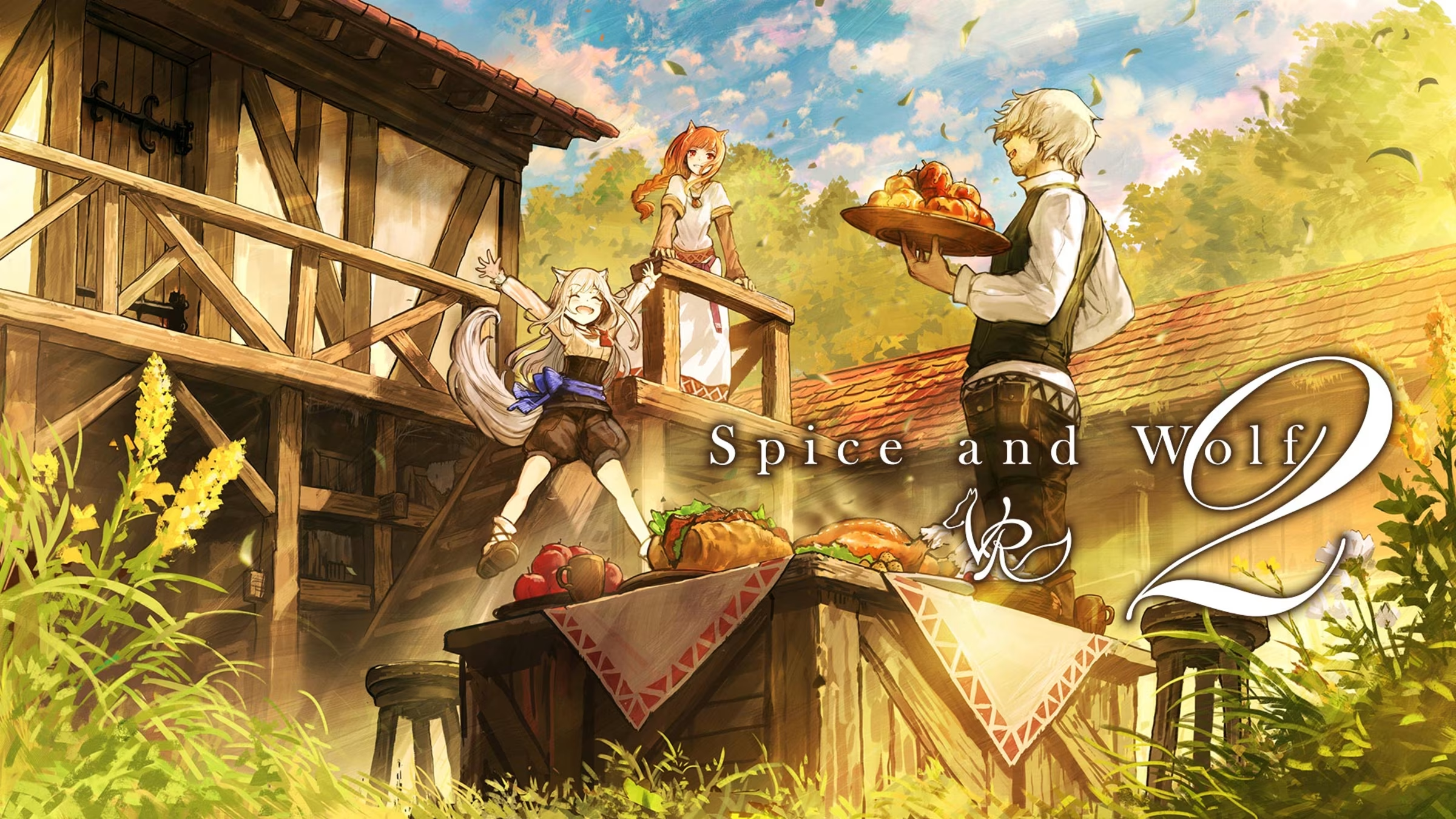
Spice and Wolf VR
The series later moved into virtual reality.
Spice and Wolf VR launched in 2019 through Spicy Tails, a group founded by Isuna Hasekura.
The game supported multiple VR platforms before expanding to systems including Nintendo Switch and PlayStation VR.
A sequel, Spice and Wolf VR2, followed in December 2020.
The concept allows fans to experience the quieter appeal of simply spending time around Holo and Lawrence rather than attempting to transform the franchise into something action-oriented.
That reflects how character-driven Spice and Wolf has always been.
Reception and Critical Response
Spice and Wolf developed a strong reputation across both its original novels and anime adaptations.
The novels exceeded 3.5 million copies sold by December 2009 and passed 5 million copies by October 2020.
Its critical reputation frequently centers on two things:
economics and chemistry.
Anime News Network’s Michael Basile praised the original anime for how seriously it handled economic concepts and for the realism those details added to the world. He was equally enthusiastic about Lawrence and Holo’s relationship, describing their chemistry and dialogue as particular strengths.
That combination explains the franchise’s longevity.
Plenty of anime have charming romances.
Plenty have elaborate fantasy settings.
Very few could make an argument over currency depreciation feel romantic.
Awards and Recognition
The light novels performed strongly in Kono Light Novel ga Sugoi!, one of Japan’s prominent annual light-novel rankings.
The franchise ranked:
- 1st in 2007
- 5th in 2008
- 5th in 2009
Holo was also named Best Female Character in the 2007 edition.
Those results demonstrate that the franchise’s reputation existed long before nostalgia became part of the conversation.
Spice and Wolf was not merely rediscovered years later.
It was recognized almost immediately as something unusual within the light-novel market.
Why the Economics Actually Make the Story Better
It would have been easy for the economics to become a gimmick.
“Look, our fantasy anime discusses currency.”
Instead, commerce becomes a tool for revealing character.
Lawrence sees opportunity and risk differently from Holo.
Holo understands emotional manipulation better than accounting.
A merchant may appear friendly while secretly calculating profit.
A religious organization may possess economic motives beneath its spiritual authority.
A town can become desperate when one commodity collapses.
This makes the world feel interconnected.
Money is not something characters earn between adventures.
Money creates the adventure.
Why Spice and Wolf Is Surprisingly Educational
Nobody should use an anime as a replacement for studying economics.
But Spice and Wolf can make economic ideas much easier to visualize.
Concepts such as currency debasement become understandable when Lawrence’s livelihood depends on recognizing what is happening.
Supply and demand become obvious when one product becomes scarce.
Credit becomes dangerous when borrowed money is tied to market fluctuations.
Information asymmetry becomes dramatic when one merchant knows something another does not.
The story gives abstract ideas human consequences.
You do not need to memorize definitions.
You watch someone potentially lose everything because the concept matters.
That is excellent teaching through storytelling.
Why the Series Rarely Needs Action
Holo is physically powerful.
The world contains genuine danger.
But Spice and Wolf wisely avoids transforming every conflict into combat.
The suspense often comes from not knowing whether Lawrence’s plan will work.
Can he sell before the price collapses?
Can he identify a deception?
Can he convince another merchant?
Can he repay what he owes?
This kind of tension works because failure matters.
Lawrence’s wealth is finite.
His reputation can be damaged.
His dream can disappear.
When physical danger does occur, it carries more impact precisely because it is not happening every episode.
Travel Is Part of the Appeal
There is something deeply comfortable about the basic structure of Spice and Wolf.
A wagon.
A road.
Two travelers.
Another town ahead.
That structure creates both continuity and variety.
Lawrence and Holo remain the emotional constants.
The markets, local customs, religious traditions, products, merchants, and economic problems change with each destination.
This gives the series an almost episodic travelogue quality without making the larger story feel disconnected.
Their destination matters.
But so does everything encountered along the way.
Apples, Wheat, and Food
Food plays a surprisingly memorable role in the series.
Holo’s enthusiasm for apples became one of her most recognizable traits.
She enjoys drinking.
She enjoys good meals.
She enjoys spending Lawrence’s money on both.
Those details are funny, but they also reinforce her relationship with human life.
Holo may be an ancient deity, but she takes enormous pleasure in ordinary experiences.
Food becomes another way she reconnects with a world that changed while she remained isolated in Pasloe.
Wheat carries deeper symbolic importance because it connects directly to her identity as a harvest deity.
The result is a fantasy series where something as simple as an apple can become instantly recognizable imagery.
Spice and Wolf Is Really About Change
Economics changes.
Religion changes.
Towns change.
People age.
Markets collapse.
Traditions disappear.
Holo understands this better than almost everyone because she has lived long enough to witness it repeatedly.
Lawrence experiences change differently.
For him, every journey is supposed to move him closer to a stable future.
He wants a shop because he wants something permanent.
That creates a beautiful contrast.
Lawrence is a mortal man searching for stability.
Holo is an immortal being who already knows how temporary everything can be.
Their relationship exists between those two perspectives.
That may be the deepest reason the story remains emotionally powerful.
Who Should Watch Spice and Wolf?
The series is an excellent recommendation for viewers who enjoy:
- character-driven fantasy
- mature romance
- clever dialogue
- medieval settings
- economics
- slow-burn relationships
- travel stories
- strong female characters
- intelligent world-building
- low-action fantasy
Fans of series such as Frieren: Beyond Journey’s End, The Apothecary Diaries, Ascendance of a Bookworm, and quieter sections of Maoyu may particularly appreciate its willingness to build drama through conversation and systems rather than combat.
However, Spice and Wolf really has its own identity.
There still are not many fantasy anime where understanding currency purity can be as important as understanding magic.
Should You Watch the 2008 Anime or the 2024 Remake First?
For completely new viewers, the 2024 remake is probably the easiest starting point.
It begins from the start, features modern production values, retains the famous Japanese and English lead actors, covers more material during its first season, and has an officially confirmed continuation.
That does not make the 2008 version obsolete.
Longtime fans still have good reasons to recommend it for its atmosphere, music, visual identity, and particular adaptation choices.
The best answer depends on commitment.
If you want one ongoing anime continuity, start with 2024.
If you fall in love with the franchise afterward, the older version becomes a fascinating alternate adaptation to experience.
Frequently Asked Questions
What Is Spice and Wolf About?
Spice and Wolf follows traveling merchant Kraft Lawrence and Holo, an ancient wolf harvest deity, as they travel north toward Holo’s homeland while becoming involved in commerce, financial schemes, religious conflicts, and an increasingly close personal relationship.
Is Spice and Wolf a Romance?
Yes. Romance is one of the central elements, but it develops gradually alongside the merchant story and travel narrative.
Why Is Spice and Wolf About Economics?
Commerce is Lawrence’s profession, so currency, supply, debt, contracts, speculation, and market behavior naturally determine many of the conflicts he encounters.
Who Is Holo?
Holo is a centuries-old wolf harvest deity from Yoitsu who calls herself the Wise Wolf.
Who Is Kraft Lawrence?
Lawrence is a 25-year-old traveling merchant who dreams of saving enough money to open his own shop.
How Many Seasons Did the Original Spice and Wolf Anime Have?
The original anime received two television seasons, airing in 2008 and 2009, along with OVA material.
Is Spice and Wolf: MERCHANT MEETS THE WISE WOLF a Remake?
Yes. The 2024 series starts the story again rather than continuing directly from Spice and Wolf II.
How Many Episodes Does the 2024 Spice and Wolf Have?
The first season contains 25 episodes. Crunchyroll currently carries the complete season in subtitled and dubbed formats.
Is Spice and Wolf Season 2 Confirmed?
Yes. A second season of MERCHANT MEETS THE WISE WOLF is officially in production.
When Does Spice and Wolf Season 2 Release?
As of August 30, 2026, no official premiere date has been announced. The official site released a Season 2 teaser visual in November 2025 but has not yet provided a broadcast schedule.
Where Can I Watch the 2024 Spice and Wolf?
Crunchyroll streams Spice and Wolf: MERCHANT MEETS THE WISE WOLF outside Asia in supported territories.
Who Voices Holo?
Ami Koshimizu voices Holo in Japanese in both the original and 2024 anime. Brina Palencia voices her in English.
Who Voices Lawrence?
Jun Fukuyama voices Lawrence in Japanese, while J. Michael Tatum voices him in English. Both returned for the 2024 adaptation.
How Many Spice and Wolf Light Novels Are There?
The supplied source lists 24 volumes in the main light-novel series.
Is the Spice and Wolf Manga Finished?
Yes. Keito Koume’s main manga adaptation concluded in 2018 with 16 volumes.
What Is Wolf and Parchment?
Wolf and Parchment is a sequel spin-off light-novel series set within the wider Spice and Wolf world. It began publication in 2016.
Is Spice and Wolf Worth Watching?
Absolutely. Its combination of believable economics, medieval fantasy, clever dialogue, memorable characters, and one of anime’s strongest slow-burn relationships gives it an identity that remains remarkably difficult to imitate.
Conclusion
Spice and Wolf has lasted because it understands that fantasy does not need the end of the world to create meaningful stakes.
Sometimes everything can depend on whether a merchant understands why one silver coin is losing value.
Sometimes danger comes from accepting the wrong loan.
Sometimes the most important moment in an episode is simply two people talking while a wagon moves slowly toward another town.
And sometimes an ancient wolf deity who has lived for centuries can still be frightened by the possibility of becoming lonely again.
That balance is what makes the series special.
The economics give Spice and Wolf intellectual identity, but Lawrence and Holo give it a heart. Their teasing conversations, disagreements, negotiations, moments of insecurity, and gradually deepening attachment turn what could have been an educational medieval trading story into one of the most beloved relationship-driven fantasies in anime and light novels.
The franchise’s longevity reflects that strength. The novels began in 2006, crossed five million copies in circulation, expanded through manga and Wolf and Parchment, inspired two anime seasons in the late 2000s, disappeared from television for fifteen years, and then successfully returned with a 25-episode remake in 2024.
And this time, the journey is not stopping at the same point.
Season 2 of Spice and Wolf: MERCHANT MEETS THE WISE WOLF is officially in production. The newest official teaser visual arrived in November 2025, and the franchise’s official site remains active with new promotional material in August 2026. What we still do not have is a release date—and until the production committee announces one, any supposed 2026 or 2027 premiere should be treated as speculation.
For newcomers, that makes now an excellent time to begin.
For longtime fans, it means something they waited more than a decade to see is finally happening:
Lawrence and Holo’s journey still has somewhere new to go.
If you don’t know where to watch this Anime for FREE make sure to contact me via E-mail, or in the comments below. Thank you for reading and make sure to bookmark the site.
How useful was this post?
Click on a star to rate it!
Average rating 0 / 5. Vote count: 0
No votes so far! Be the first to rate this post.