
 7.2/10
Some manga disappear quietly after a short serialization, while others gradually build a reputation strong enough to earn a second life years later. Black Torch belongs firmly in the second category. Written and illustrated by Tsuyoshi Takaki, the supernatural action manga originally ran between 2016 and 2018, finishing after only 19 chapters and five collected volumes. Despite that brief run, it developed a loyal following attracted to its sharp artwork, ninja influences, supernatural mythology, and immediately likable partnership between rebellious teenager Jiro Azuma and the powerful cat-like mononoke Rago.
That cult reputation eventually paid off. More than seven years after the manga ended, Black Torch received an anime adaptation produced by 100studio. The television series premiered in Japan on July 4, 2026, with Crunchyroll handling international streaming and Muse Communication licensing the series across South and Southeast Asia.
At first glance, the setup contains several familiar shonen ingredients: ninjas, supernatural creatures, government agents, unusual powers, rival fighters, and a protagonist unexpectedly sharing his body with an immensely powerful being. What makes Black Torch appealing is how efficiently those ingredients are combined. Jiro’s ability to communicate with animals immediately makes him different from the typical aggressive shonen lead, while his relationship with Rago gives the story both humor and emotional weight.
The original manga may have been short-lived, but the anime gives audiences another opportunity to discover a series that many readers felt ended before reaching its full potential.
Black Torch – Official Trailer
What Is Black Torch About?
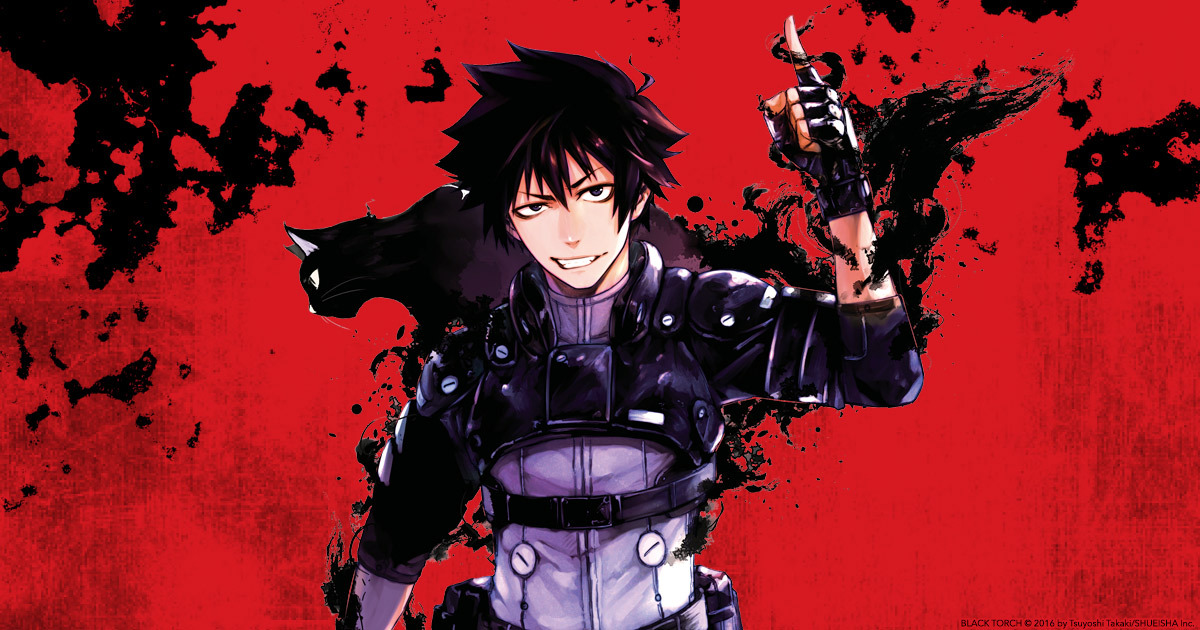
Black Torch follows Jiro Azuma, a teenage delinquent who has been trained in ninjutsu by his grandfather. Jiro possesses another unusual ability: he can communicate with animals.
That power made childhood difficult. Other children mocked him for speaking with animals, leaving Jiro more comfortable around creatures such as his dog Nachi than around many people. His unusual life changes dramatically when birds lead him toward an injured black cat.
Jiro rescues the animal and soon discovers that this is no ordinary stray.
The cat is Rago, an immortal supernatural being known as a mononoke. Rago has powerful enemies and has refused to cooperate with other mononoke who want to use his strength. Jiro’s decision to protect him consequently pulls the teenager directly into a hidden conflict between humans and supernatural creatures.
Without going heavily into later developments, their meeting permanently connects their lives and eventually brings Jiro into contact with the mysterious Bureau of Espionage, an organization responsible for dealing with dangerous mononoke.
From there, Black Torch becomes a fast-moving supernatural action story built around Jiro learning how to work with Rago while discovering that neither humans nor mononoke are quite as straightforward as he initially assumes.
Is Black Torch Worth Watching?
Yes, particularly if you enjoy supernatural battle shonen that move quickly and establish their central concept without spending a dozen episodes getting started.
Black Torch is not trying to completely reinvent the genre. Viewers familiar with series such as Bleach, Jujutsu Kaisen, Blue Exorcist, or Dandadan will recognize elements of its DNA: supernatural threats hidden within the ordinary world, organizations built around fighting those threats, unusual inherited abilities, specialized fighters, and a protagonist connected to a dangerous supernatural power.
Where it succeeds is personality.
Jiro has the confidence and recklessness expected from an action protagonist, but his empathy toward animals gives him an immediately softer side. Rago is powerful and intimidating, yet spending so much time in the appearance of a black cat creates a naturally entertaining contrast.
The Bureau characters also prevent the series from becoming purely a two-character adventure. Ichika, Reiji, Shiba, Hana, and the expanding cast bring different philosophies and fighting styles into the story.
The biggest limitation originates from the source material itself. With only five manga volumes, this is a compact story rather than a sprawling saga. That can make certain developments feel fast, but it also means the anime has very little opportunity for pointless filler.
Why You Should Watch Black Torch
The strongest reason to watch Black Torch is its combination of familiar shonen energy with an unusually compact structure.
Modern battle anime can require enormous commitments. Hundreds of chapters, multiple cours, large casts, complicated terminology, and years of unresolved plotlines are increasingly common.
Black Torch is much easier to approach.
Its mythology is understandable, the central partnership forms quickly, and the Bureau provides an immediate framework for future missions and character development. The story can introduce supernatural concepts without burying viewers beneath extensive lore.
There is also something appealing about watching an anime adaptation of a manga that has already developed a cult following. Instead of adapting a currently dominant franchise, 100studio is effectively giving an older series another chance.
For readers who thought the manga deserved more attention, that alone makes the adaptation interesting.
Jiro Azuma
Jiro Azuma is the protagonist of Black Torch and the character responsible for giving the series much of its personality.
He looks like the kind of teenager likely to start trouble—and he often does—but his aggressive appearance hides a strong instinct to protect vulnerable creatures.
His ability to communicate with animals has shaped him since childhood. Because other people treated that ability as strange, Jiro learned to trust animals more easily than humans.
This makes his decision to help Rago completely believable.
Jiro does not rescue the injured black cat because he understands the supernatural situation. He does it because helping an injured creature is simply what he would naturally do.
That compassion contrasts nicely with his impulsiveness.
He is confrontational, stubborn, and willing to throw himself into dangerous situations before fully considering the consequences. His ninja training gives him a strong physical foundation, but learning how to use his new circumstances effectively requires considerably more discipline.
Ryōta Suzuki voices Jiro in Japanese, while A.J. Beckles performs the character in the English dub.
Rago
Rago is one of the most immediately memorable elements of Black Torch.
He is introduced as an injured black cat, but he is actually an ancient and extremely powerful mononoke known as Rago of the Black Star of Doom.
Unlike many hostile mononoke, Rago does not automatically view humanity as something that must be destroyed. His refusal to cooperate with certain supernatural forces makes him a target, ultimately creating the circumstances that bring him and Jiro together.
The relationship works because Rago is not simply a magical power source.
He has his own history, personality, pride, motivations, and opinions about Jiro.
Their disagreements give the series humor, while the trust developing between them provides much of its emotional foundation.
The contrast between Rago’s reputation and his feline appearance also gives the anime plenty of visual personality.
Yōji Ueda voices Rago in Japanese, while Keith Silverstein provides his English voice.
Jiro and Rago’s Partnership
The heart of Black Torch is not the Bureau or even the larger conflict with hostile mononoke. It is the relationship between Jiro and Rago.
Both are independent and stubborn.
Neither enjoys being controlled.
Both are capable of violence but are not motivated primarily by cruelty.
That similarity allows them to understand one another even when their personalities clash.
Their connection also gives the series an interesting approach to power. Jiro’s supernatural strength is not something he simply unlocks through training. It exists because another conscious being is sharing that power with him.
Cooperation therefore matters.
Jiro cannot treat Rago as equipment, and Rago cannot completely ignore the consequences of sharing his existence with a human.
That dynamic gives their partnership more personality than a conventional protagonist-and-inner-demon arrangement.
Ichika Kishimojin
Ichika Kishimojin is one of the first Bureau agents Jiro encounters and quickly becomes an important member of the central cast.
She comes from a ninja family with its own history of fighting mononoke, giving her much more formal experience with the supernatural world than Jiro has.
Where Jiro tends to rely on instinct, Ichika begins from a position shaped by responsibility and inherited expectations.
Her attitude toward mononoke is also influenced by personal experience, making her much more suspicious than Jiro when Rago enters the picture.
That creates useful tension between them.
Their disagreements are not simply personality clashes. They represent different experiences with the supernatural world.
Sayaka Senbongi voices Ichika in Japanese, while Erin Yvette performs her in English.
Reiji Kirihara
Reiji Kirihara becomes another important member of the Black Torch team.
Unlike Jiro’s rough improvisational approach, Reiji carries himself with more discipline and initially has little reason to accept the inexperienced newcomer.
Their contrasting personalities naturally create rivalry.
Reiji’s background also introduces another side of the series’ supernatural mythology, particularly through his relationship with swordsmanship and his family.
Importantly, Black Torch does not make him a simple arrogant rival designed only to lose against the protagonist.
His personal history gives him reasons for pursuing strength that exist independently of Jiro.
Junya Enoki voices Reiji in Japanese, while Kyle McCarley voices him in English.
Ryosuke Shiba
Ryosuke Shiba is an experienced Bureau officer who becomes closely involved with Jiro’s situation.
He understands immediately that Jiro and Rago represent both enormous danger and unusual potential.
Rather than approaching every supernatural situation through simple extermination, Shiba is willing to evaluate circumstances individually.
That flexibility makes him important.
A character such as Jiro would never function comfortably inside an excessively rigid organization. Shiba provides the bridge that allows an unpredictable teenager and powerful mononoke to operate within the Bureau without completely destroying the story’s internal logic.
Junichi Suwabe voices Shiba in Japanese, with Ryan Colt Levy performing him in English.
Hana Usami
Hana Usami works alongside Shiba and becomes another member associated with the Black Torch unit.
She is voiced by Reina Ueda in the Japanese adaptation.
Hana helps provide a more grounded presence among characters who are frequently throwing themselves into supernatural battles.
That administrative and support-side perspective is useful because the Bureau needs to feel like an actual organization rather than merely a collection of powerful fighters waiting for the next enemy.
Her involvement also broadens the group’s personality beyond Jiro, Ichika, and Reiji’s more competitive dynamic.
The Bureau of Espionage
The Bureau of Espionage is one of the more unusual elements of the setting.
Despite its name, the organization is heavily involved with identifying, containing, and eliminating dangerous mononoke.
Its existence establishes that supernatural creatures are not completely unknown to the government.
Specialized agents are trained to investigate incidents, assess threats, and fight entities ordinary civilians would have little chance of surviving.
Once Jiro becomes connected with Rago, the Bureau understandably takes immediate interest in him.
That creates one of the central tensions of the story.
Jiro wants autonomy.
The Bureau wants control over something potentially catastrophic.
Rago wants even less to do with authority than Jiro does.
The compromise between those positions eventually creates the team from which the series takes its name.
What Are Mononoke in Black Torch?
Mononoke are supernatural spirits existing alongside humans.
They vary enormously in appearance, personality, intelligence, and strength.
Some behave violently and view humans as enemies.
Others have more complicated motivations.
Rago demonstrates immediately that treating every mononoke as identical would be a mistake.
That distinction matters because it prevents the story’s morality from becoming too simplistic.
The Bureau may be justified in fighting dangerous supernatural entities, but the existence of beings such as Rago raises uncomfortable questions about whether extermination should always be the default response.
Mononoke also allow Takaki to create wildly different enemy designs and supernatural abilities without limiting the story to one rigid power system.
Ninja Influences
Jiro is not simply an ordinary teenager who suddenly receives supernatural abilities.
He has been trained in ninjutsu by his grandfather Toshimasa Azuma, who possesses his own history with the Bureau.
That training gives Jiro a believable physical foundation before Rago’s power enters his life.
The ninja influence also gives Black Torch a different flavor from supernatural series centered entirely around sorcerers, exorcists, or demon hunters.
Stealth, physical combat, specialized equipment, infiltration, and family traditions can exist alongside supernatural powers.
Ichika’s background reinforces those elements from another direction.
The result feels like a hybrid between modern supernatural shonen and ninja action rather than a direct copy of either genre.
Toshimasa Azuma
Toshimasa is Jiro’s grandfather and the person responsible for his ninja training.
He initially comes across as the strict older guardian trying to keep an impulsive teenager under control.
However, his connection to the supernatural world runs deeper.
His experience gives him a much clearer understanding of the danger surrounding Jiro than the younger protagonist initially realizes.
That makes their relationship more interesting than a standard strict-grandfather dynamic.
Toshimasa values resolve.
He understands that physical ability means little when someone lacks the discipline required to decide what they actually stand for.
Shinpachi Tsuji voices him in Japanese, while Ben Balmaceda provides the English performance.
Koga
Koga is one of the notable mononoke introduced as the conflict begins expanding beyond isolated supernatural attacks.
Voiced by Nobuhiko Okamoto, Koga brings a much more aggressive philosophy toward power than Rago.
His presence is useful because it demonstrates that Rago’s strength has significance within the wider mononoke hierarchy.
Rago is not simply a powerful creature who happened to encounter Jiro.
Other supernatural beings understand what he represents, and some have their own reasons for wanting that power.
Without revealing later developments, Koga helps push the anime from introductory missions toward a larger conflict.
Amagi
Amagi, voiced by Toshiyuki Morikawa in Japanese and Ben Diskin in English, is another major supernatural figure connected to Rago’s past.
His existence reveals that events surrounding Rago did not begin when Jiro discovered an injured cat in the forest.
There is a much older history involving conflicts between mononoke and humans.
That history gradually becomes more important as the anime progresses.
Amagi consequently represents one of the story’s larger threats without requiring the series to immediately reveal everything about its mythology.
Black Torch Anime
The anime adaptation was officially announced in March 2025 during Emerald City Comic Con.
That announcement was notable because the manga had already been finished for several years.
Instead of adapting a currently serialized Jump title, the production revived a completed series whose popularity had survived largely through reader recommendations and word of mouth.
The anime is produced by 100studio and directed by Kei Umabiki. Gigaemon Ichikawa handles series composition and scripts, Gō Suzuki provides character designs, and Yutaka Yamada composes the music.
The series premiered on July 4, 2026 on Tokyo MX and other Japanese networks.
Where Can You Watch Black Torch?
Crunchyroll is streaming the anime internationally.
Viz Media, which previously published the English-language manga, also licensed the anime, while Muse Communication handles licensing across South and Southeast Asia.
That distribution gives the series much wider international visibility than the original manga enjoyed during its initial publication.
For readers who discovered the manga only after it ended, the anime is particularly significant because it creates an active weekly audience around Black Torch for the first time in years.
Black Torch Release Schedule
The anime began airing on July 4, 2026.
The episodes documented in the supplied material follow a weekly Saturday schedule:
- Episode 1 – July 4, 2026
- Episode 2 – July 11, 2026
- Episode 3 – July 18, 2026
- Episode 4 – July 25, 2026
- Episode 5 – August 1, 2026
- Episode 6 – August 8, 2026
- Episode 7 – August 15, 2026
Because the anime is still airing, later episode information should be treated as developing rather than assumed from the manga.
That also means viewers can currently experience the adaptation weekly instead of waiting until the entire season has finished.
Episode 1 – The Future Is in Our Hands
The premiere establishes Jiro’s personality, his ability to communicate with animals, and his first encounter with Rago.
Rather than spending several episodes teasing the supernatural premise, the anime moves rapidly into the event that connects them permanently.
The Bureau also appears early, ensuring viewers immediately understand that a larger organization exists behind the supernatural conflict.
It is an efficient premiere.
Some viewers may find the pacing aggressive, but it successfully communicates what kind of series Black Torch intends to be.
Episode 2 – The Choice Is Yours
The second episode focuses more heavily on consequences.
Jiro is now forced to deal with people who understand far more about mononoke than he does.
The episode also expands Toshimasa’s role and reveals that Jiro’s upbringing is more connected to the hidden supernatural world than he initially understood.
More importantly, Jiro has to decide whether he is willing to accept responsibility for the dangerous situation surrounding him.
That choice helps prevent him from being a protagonist who simply gets dragged unwillingly from one fight to another.
Episode 3 – WHAT’S MY NAME?
Episode 3 expands the central cast and pushes Jiro toward the group that will eventually define the series.
Ichika receives more attention, while Reiji enters as another fighter whose abilities and attitude immediately contrast with Jiro’s.
The episode is especially important because the story stops feeling like a supernatural incident involving one teenager and begins developing into a team-based shonen series.
The formation of the Black Torch unit gives the anime a much clearer long-term structure.
Episode 4 – Two Is Not Enough
By Episode 4, the team dynamic becomes more important.
Jiro and Reiji’s rivalry provides both comedy and a way for the anime to demonstrate their different approaches to combat.
The episode also expands Bureau technology and operations, including specialized uniforms and the group’s first official mission.
Rather than simply sending characters toward random monsters, Black Torch begins introducing investigations and historical questions surrounding Rago.
That helps broaden the story beyond straightforward battles.
Episode 5 – Young Gunz
Episode 5 pushes the wider mononoke conflict forward through Koga while also continuing the development of the newly formed team.
Training becomes more important, allowing the series to explore each character’s weaknesses instead of relying entirely on escalating enemy strength.
The hallucination-based training sequence is particularly useful because it provides character development through action.
Rather than pausing the plot for lengthy exposition, the anime allows personal memories and insecurities to become part of the challenge.
Episode 6 – Turn Up
Episode 6 continues exploring the personal histories of Jiro, Reiji, Ichika, and Rago.
Without revealing the most important details, it becomes increasingly clear that several members of Black Torch carry unresolved conflicts from before the team was formed.
Rago’s past also begins receiving more attention.
That shift is important because the central mononoke would become far less interesting if he existed only as Jiro’s source of supernatural power.
Understanding that Rago has his own history, enemies, and previous decisions gives the story greater depth.
Episode 7 – 3 on Three
The seventh episode aired on August 15, 2026, according to the supplied episode information.
At this stage, the anime has moved beyond the introductory phase and established the main team, several rival forces, and the larger mystery surrounding Rago.
Because the series is currently airing, this is also where spoiler-free discussion becomes more useful than detailed episode summaries.
New viewers can comfortably begin without needing later developments explained in advance.
Voice Cast
The Japanese voice cast includes several well-known performers:
- Ryōta Suzuki as Jiro Azuma
- Yōji Ueda as Rago
- Sayaka Senbongi as Ichika Kishimojin
- Junya Enoki as Reiji Kirihara
- Reina Ueda as Hana Usami
- Junichi Suwabe as Ryosuke Shiba
- Nobuhiko Okamoto as Koga
- Toshiyuki Morikawa as Amagi
- Shinpachi Tsuji as Toshimasa Azuma
- Yūko Kaida as Toko Kusumi
- Hōchū Ōtsuka as Banjuro Tokieda
The English dub also includes A.J. Beckles, Keith Silverstein, Erin Yvette, Kyle McCarley, Ryan Colt Levy, Ben Diskin, and Ben Balmaceda among its announced performers.
Opening and Ending Songs
The anime’s opening theme is “Freeze Me Up” performed by SiM.
Its ending theme is “Groooovy” by I Don’t Like Mondays.
SiM is a particularly fitting choice for a series such as Black Torch because the band’s heavier sound naturally matches the anime’s fast supernatural action and rebellious protagonist.
The contrast with the more relaxed ending track gives each episode a useful shift in atmosphere after the action concludes.
Music for the series itself is composed by Yutaka Yamada, whose involvement gives the production another experienced creative figure.
Animation by 100studio
100studio handles production of the anime.
Adapting Black Torch requires preserving two qualities from Tsuyoshi Takaki’s manga: its aggressive action and its stylish character artwork.
The manga frequently uses strong silhouettes, sharp motion, supernatural effects, and visually distinct creature designs.
Animation provides an opportunity to make those battles much more kinetic.
The adaptation also benefits from a source manga that is already complete.
The production team knows exactly where character arcs and storylines lead, making it theoretically easier to determine pacing than with an unfinished ongoing manga.
Manga History
Tsuyoshi Takaki began Black Torch in Shueisha’s Jump Square on December 31, 2016.
The manga remained there until March 2, 2018 before transferring to Shōnen Jump+, where four additional chapters were serialized between April and July 2018.
The complete manga contains only 19 chapters across five tankōbon volumes.
Japanese volumes were released between April 2017 and August 2018.
Viz Media licensed the series for North America and released all five English volumes between August 2018 and August 2019.
That compact length makes the manga extremely approachable today.
How Many Black Torch Manga Volumes Are There?
There are five volumes.
The Japanese release schedule was:
- Volume 1 – April 4, 2017
- Volume 2 – August 4, 2017
- Volume 3 – December 4, 2017
- Volume 4 – April 4, 2018
- Volume 5 – August 3, 2018
The English editions followed between August 2018 and August 2019.
For viewers who become impatient waiting for the anime, reading the complete manga does not require a huge commitment.
Why Was Black Torch So Short?
The supplied material confirms that Black Torch ended after 19 chapters and five volumes, but it does not provide an official explanation for why the series concluded when it did.
This distinction is important.
It is tempting to describe every short Shueisha manga as “canceled,” but without a confirmed statement from the author or publisher, that should not be presented as fact.
What can be said is that the manga moved from Jump Square to Shōnen Jump+ for its final four chapters before concluding in July 2018.
Its short run later became part of its cult reputation, with many readers recommending it as a series that contained enough strong ideas to feel as though it could have continued much longer.
Tsuyoshi Takaki
Black Torch was written and illustrated entirely by Tsuyoshi Takaki.
His artwork became one of the manga’s most praised qualities.
Characters have strong silhouettes, combat panels are easy to follow, and supernatural creatures often possess memorable designs.
Takaki later created Heart Gear, another manga series.
Readers familiar with Heart Gear may recognize similarities in his clean action composition and distinctive character art, although the settings and themes are very different.
Artwork and Bleach Comparisons
One recurring observation surrounding Black Torch is the resemblance of Takaki’s artwork to the visual confidence associated with Bleach creator Tite Kubo.
Anime News Network reviewer Rebecca Silverman specifically noted similarities to Kubo and other Weekly Shōnen Jump artists while emphasizing that the work did not feel like direct imitation.
The comparison is understandable.
Both series favor:
- Strong character silhouettes
- Stylish clothing
- Supernatural enemies
- Sharp black-and-white contrast
- Fast sword-oriented action
- Characters designed to look immediately recognizable
Yet Black Torch still develops its own identity through ninja traditions, animal communication, government espionage, and Jiro’s partnership with Rago.
Black Torch vs Jujutsu Kaisen
Modern viewers will inevitably notice similarities between Black Torch and Jujutsu Kaisen.
Both involve young protagonists suddenly becoming connected to extremely dangerous supernatural entities while entering organizations dedicated to fighting other supernatural threats.
However, Black Torch began serialization in December 2016, before Jujutsu Kaisen began its main serialization in 2018.
More importantly, the stories approach their central relationships differently.
Jiro and Rago communicate directly and develop something closer to reluctant companionship.
The ninja influence, Bureau setting, and animal communication also give Black Torch a noticeably different tone.
The comparison can help new viewers understand the broad genre, but treating one series as merely another version of the other undersells both.
Black Torch vs Bleach
Bleach is probably the more useful comparison aesthetically.
Both series combine ordinary modern life with a hidden supernatural world and fighters equipped with distinctive powers.
Takaki’s visual style can occasionally evoke the clean, fashion-conscious character designs associated with Tite Kubo.
However, Black Torch is much smaller in scope.
Its five-volume manga cannot develop the enormous cast, factions, mythology, and multi-arc structure that Bleach built over hundreds of chapters.
That compact scale is not necessarily negative.
For viewers intimidated by extremely long shonen franchises, Black Torch offers similar supernatural energy in a much easier package.
Themes of Trust
Trust sits beneath much of the supernatural action.
Jiro trusts animals partly because humans treated him poorly when he was younger.
Rago distrusts both human institutions and certain mononoke.
Ichika has reasons to distrust supernatural creatures.
The Bureau understandably distrusts Rago.
Reiji initially has little reason to trust Jiro.
The Black Torch team therefore does not begin as a perfectly compatible group.
They have to earn cooperation.
That theme works particularly well with the protagonist’s unusual power because communication is literally one of Jiro’s defining abilities.
He can understand creatures other humans cannot.
The question becomes whether understanding someone is enough to trust them.
Humanity and Mononoke
The manga’s supernatural conflict becomes more interesting when it stops treating species as morality.
Not every human is automatically good.
Not every mononoke is automatically evil.
Rago makes that obvious from the beginning.
This gives Jiro an unusual position.
Because he can communicate with animals and shares a bond with a mononoke, he naturally approaches supernatural creatures differently from people trained exclusively to eliminate them.
That perspective creates friction with the Bureau but also gives him potential value.
He can understand beings that other agents may see only as targets.
Found Family and Team Dynamics
The Black Torch squad gradually becomes one of the series’ strongest elements.
Jiro begins as someone more comfortable with animals than people.
Joining a team therefore forces him to develop in an area supernatural power cannot solve.
Ichika, Reiji, Shiba, Hana, and Rago each respond differently to him.
Friendship does not emerge instantly.
There are arguments, rivalries, tests of ability, and legitimate reasons for suspicion.
That makes the eventual sense of teamwork more satisfying than simply declaring everyone friends immediately after their introduction.
Reception
Despite its short publication run, Black Torch gained notable recognition.
In 2019, it was included among the Top 10 Graphic Novels for Teens selected by the Young Adult Library Services Association of the American Library Association.
Anime News Network’s Rebecca Silverman gave the first manga volume a B, praising its character dynamics and story concepts while criticizing its rushed opening and limited early character development. She nevertheless described it as a shonen action series worth checking out.
Those comments summarize the manga’s reputation remarkably well.
It has imperfections.
It moves quickly.
It clearly could have used more room.
But the central ideas and characters are strong enough that readers continued talking about it long after publication ended.
The existence of a 2026 anime adaptation is perhaps the clearest evidence of that staying power.
Why the Anime Matters
The anime is significant because adaptations arriving this long after a manga ends are relatively unusual.
Black Torch was not a current hit being adapted while sales were exploding.
Its manga ended in 2018.
The anime began in 2026.
That eight-year gap means the adaptation effectively functions as a rediscovery.
Existing fans can finally see Jiro and Rago animated, while a much larger streaming audience can encounter the series without knowing anything about its original publication history.
If successful, the anime could ultimately become more widely known than the manga ever was during serialization.
Who Should Watch Black Torch?
Black Torch is an easy recommendation for fans of supernatural action anime.
It should particularly appeal to viewers who enjoy:
- Bleach
- Jujutsu Kaisen
- Blue Exorcist
- Dandadan
- Noragami
- Ninja-themed action
- Supernatural government organizations
- Human-and-monster partnerships
It is also a strong choice for viewers who dislike extremely long commitments.
The source material is compact, the anime establishes its story quickly, and the central cast is small enough that remembering every faction and ability does not become homework.
Frequently Asked Questions
What Is Black Torch About?
Black Torch follows teenage ninja Jiro Azuma, who can communicate with animals. After encountering the powerful mononoke Rago in the form of an injured black cat, Jiro becomes involved with the Bureau of Espionage and its battle against dangerous supernatural beings.
Is Black Torch an Anime?
Yes. The television anime premiered on July 4, 2026 and is produced by 100studio.
Where Can I Watch Black Torch?
Crunchyroll is streaming the series internationally, while Muse Communication holds rights across South and Southeast Asia.
Who Created Black Torch?
Tsuyoshi Takaki wrote and illustrated the original manga.
How Many Black Torch Manga Volumes Are There?
There are five collected volumes containing 19 chapters.
Is the Black Torch Manga Finished?
Yes. The original manga concluded in July 2018.
Was Black Torch Canceled?
The manga’s short run and move to Shōnen Jump+ are confirmed, but the supplied source does not provide an official statement explaining why serialization ended. It is therefore safer not to state definitively that it was canceled.
Who Voices Jiro?
Ryōta Suzuki voices Jiro in Japanese, while A.J. Beckles performs him in the English dub.
Who Voices Rago?
Yōji Ueda voices Rago in Japanese and Keith Silverstein voices him in English.
What Studio Is Making Black Torch?
100studio produces the television anime.
Who Directs Black Torch?
Kei Umabiki directs the anime, with Gigaemon Ichikawa handling series composition and screenplays.
What Is the Black Torch Opening Song?
The opening theme is “Freeze Me Up” by SiM.
Is Black Torch Similar to Jujutsu Kaisen?
The two series share broad supernatural shonen elements, but Black Torch began serialization before the main Jujutsu Kaisen manga and has a different focus built around ninjas, animal communication, the Bureau, and Jiro’s partnership with Rago.
Is Black Torch Worth Watching?
Yes. Its strong protagonist-mononoke partnership, stylish artwork, fast pacing, supernatural action, and compact source material make it especially appealing to viewers looking for an accessible new shonen anime.
Conclusion
Black Torch is a fascinating example of a manga refusing to disappear simply because its original run was short.
Tsuyoshi Takaki created only 19 chapters across five volumes, yet Jiro, Rago, the Bureau, and the series’ supernatural ninja world left enough of an impression that readers continued recommending it years after publication ended. Its recognition from YALSA and positive critical response further demonstrated that its appeal extended beyond its initial Japanese serialization.
The 2026 anime now gives those ideas significantly more visibility.
At the center remains a very simple relationship: a teenager who understands animals meets a supernatural creature almost nobody else would trust. Everything larger—the Bureau, ninja families, rival mononoke, government operations, and supernatural conspiracies—grows from that encounter.
Jiro works because his aggression is balanced by compassion. Rago works because enormous supernatural power is paired with personality rather than treating him as a convenient ability. Characters such as Ichika and Reiji introduce competing perspectives without immediately becoming interchangeable teammates.
The manga’s biggest weakness is also part of what makes revisiting it interesting. It feels compact enough that viewers can see possibilities for a much larger world beyond what Takaki originally had room to explore.
Whether the anime can make the most of those possibilities remains one of the most interesting questions surrounding the adaptation.
For now, Black Torch offers something increasingly rare: a supernatural shonen with enough familiar ingredients to feel immediately comfortable, but a short enough history that new viewers can jump aboard without catching up on years of material.
If you don’t know where to watch this Anime for FREE make sure to contact me via E-mail, or in the comments below. Thank you for reading and make sure to bookmark the site.
How useful was this post?
Click on a star to rate it!
Average rating 0 / 5. Vote count: 0
No votes so far! Be the first to rate this post.