
 8.1/10
Sometimes, the most memorable video game experiences are not about defeating powerful enemies, conquering enormous kingdoms, or surviving impossible challenges. Sometimes, all it takes is a beautiful landscape, a group of friends, and the simple decision to explore somewhere unfamiliar together. That is the philosophy behind Big Walk, a cooperative adventure game that transforms an ordinary outdoor excursion into one of the most creative multiplayer experiences of 2026.
Developed by Australian independent studio House House, the creators of the enormously successful Untitled Goose Game, and published by Panic, Big Walk was officially released on August 4, 2026. The game invites groups of friends to explore an expansive natural environment filled with mysterious structures, unusual objects, environmental puzzles, and countless opportunities for spontaneous interactions.
Unlike traditional cooperative adventures that rely on combat, survival mechanics, or competitive objectives, Big Walk places communication at the center of its gameplay. Players must work together to overcome challenges, but the game frequently makes that cooperation deliberately difficult. Voices become quieter with distance, darkness can separate companions, and certain puzzles prevent players from communicating through conventional methods.
The result is an experience where waving your arms, shouting across a valley, flashing a torch, or desperately trying to explain a symbol through a window can become just as important as solving the puzzle itself.
The game’s natural environment is equally significant. Inspired directly by Wilsons Promontory National Park in Victoria, Australia, Big Walk recreates the atmosphere of Australian bushland through carefully researched vegetation, landscapes, wildlife sounds, and environmental details. Rather than functioning merely as scenery, the wilderness encourages players to slow down, appreciate their surroundings, and discover memorable moments through exploration.
After approximately six years of development, Big Walk arrived to widespread critical acclaim. Its Windows and PlayStation 5 versions received Metacritic scores of 91, while OpenCritic reported a 96% recommendation rate. The game also achieved remarkable commercial success, selling more than one million copies during its first week and surpassing two million sales by September 25, 2026.
But what makes Big Walk so special? How does its unusual multiplayer system work? Can you play with just one friend? How many puzzles are there, and what happens when you reach the end?
Here is everything you need to know about one of 2026’s most distinctive cooperative adventures.
Big Walk (2026) – Official Gameplay Trailer
What Is Big Walk About?
Big Walk is an open-world cooperative adventure in which players explore a large natural environment, discover mysterious locations, and solve puzzles through teamwork.
There is no conventional narrative centered on a heroic protagonist, an evil antagonist, or a world-threatening catastrophe. Instead, the game creates a shared environment where players generate their own stories through exploration and interaction.
You and your companions begin in a playground-like tutorial area containing various objects and signs explaining the basic controls. Players can experiment with jumping, crouching, picking up objects, and interacting with their surroundings before heading into the wider wilderness.
From there, the adventure becomes largely self-directed.
Groups can follow pathways, investigate unusual structures, explore forests, climb hills, discover hidden locations, and attempt puzzles scattered throughout the world.
Many challenges require several players to cooperate, sometimes while separated by obstacles that prevent normal communication.
Completing puzzles rewards the group with mysterious bulbous objects that contribute toward unlocking additional features and progression.
However, the puzzles are only part of the experience.
Much of Big Walk revolves around the moments between objectives: getting lost, searching for missing friends, discovering a beautiful viewpoint, or laughing at an unexpected interaction.
The game is ultimately about spending time together in a world designed to make companionship itself feel meaningful.
Is Big Walk Worth Playing?
Big Walk is absolutely worth considering for players who enjoy cooperative adventures, creative puzzles, exploration, and social experiences that encourage genuine interaction.
Its greatest strength is the way it turns communication into gameplay. Rather than treating voice chat as an external convenience, the game integrates communication directly into its world.
When players move too far apart, their voices become inaudible. When they enter certain puzzle rooms, they may need to communicate through gestures, symbols, or other unconventional methods.
These restrictions create memorable situations that would be difficult to reproduce in conventional multiplayer games.
The open-world environment is another major attraction. Instead of constantly directing players toward the next objective, Big Walk allows groups to wander and discover interesting locations at their own pace.
The puzzles also provide meaningful challenges without turning the experience into a relentless competition.
However, the game may not appeal equally to everyone.
Players seeking combat, character progression, extensive loot systems, or a traditional story campaign may find its structure unusually relaxed.
Its reliance on communication also means that the quality of the experience can depend heavily on the people playing together.
For groups willing to embrace experimentation, exploration, and occasional confusion, Big Walk offers something genuinely different.
Why Should You Play Big Walk?
One of the strongest reasons to play Big Walk is its ability to create memorable social experiences without relying on conventional multiplayer competition.
The game encourages players to cooperate naturally, but it also allows them to become distracted, explore independently, and invent their own activities.
Another attraction is its inventive communication system. Proximity-based voice chat, hand gestures, flashlights, megaphones, walkie-talkies, and other tools create a surprisingly extensive vocabulary for interacting with friends.
The environmental design also deserves attention. Wilsons Promontory provides the inspiration for a landscape that feels unusually grounded, with realistic vegetation, distinctive terrain, and carefully recorded natural sounds.
The puzzles are another major highlight. Rather than simply asking players to activate switches simultaneously, many challenges require genuine interpretation, coordination, and creative problem-solving.
The game’s flexible group size makes it accessible to different social circles. Whether playing with one close friend or a larger gathering, the experience adapts to the number of participants.
Finally, Big Walk demonstrates that multiplayer games do not need violence, competition, or constant rewards to remain engaging. Sometimes the most entertaining moments emerge from simply trying to find your friends after everyone has wandered in different directions.
Big Walk Gameplay Explained
Big Walk is a multiplayer exploration game built around movement, interaction, communication, and environmental puzzles.
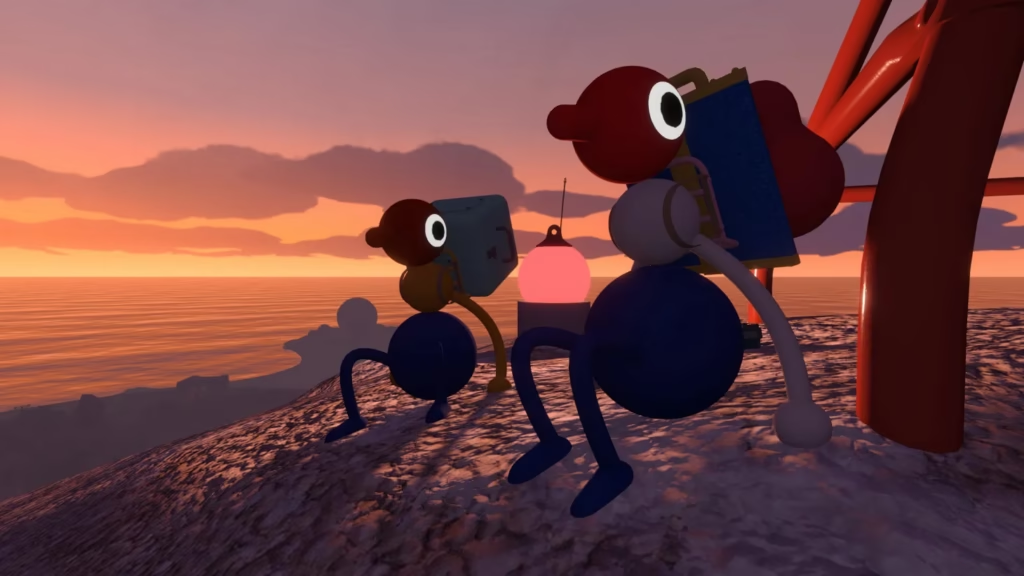
Players control colorful humanoid characters as they explore a large open-world environment inspired by Australian bushland.
The controls are intentionally straightforward. Characters can move, jump, crouch, pick up objects, and interact with items found throughout the environment.
Rather than introducing complicated combat systems or extensive inventories, the game focuses on making simple actions meaningful.
A seemingly ordinary object can become useful during a puzzle, while a communication device may help locate a friend who has disappeared beyond hearing distance.
The game also features a day-night cycle, creating different conditions for exploration.
During daylight, groups can navigate the landscape using natural landmarks and visual clues. At night, darkness makes it more difficult to identify companions, encouraging the use of torches and other light sources.
Puzzles provide the primary structured objectives, but players are free to explore the world between challenges.
This combination of environmental freedom and cooperative problem-solving creates a gameplay loop that feels less like completing a conventional campaign and more like participating in a shared outdoor adventure.
How Many Players Can Play Big Walk?
Big Walk supports groups of 2 to 12 players through online multiplayer.
This flexibility is one of the game’s most appealing features because it allows different group sizes to experience the adventure together.
A two-player session can feel intimate and focused, with both participants relying heavily on one another to navigate the environment and solve puzzles.
Larger groups introduce a different dynamic.
With several people exploring simultaneously, communication becomes more chaotic, groups may split apart, and puzzles can produce unexpected situations as players attempt to coordinate their actions.
The game’s content adjusts according to the number of participants, helping accommodate different group sizes.
Players gather through an online lobby, with the host maintaining the game’s save data.
Other participants can join or leave the session without requiring everyone to remain together for the entire adventure.
This makes Big Walk suitable for both smaller cooperative sessions and larger social gatherings.
Can You Play Big Walk Solo?
Big Walk is fundamentally designed as a cooperative multiplayer experience.
Its supported group size begins at two players, and many of its puzzles depend on communication and collaboration between participants.
Unlike conventional single-player exploration games, the central mechanics are built around the presence of other people.
The game’s unusual communication systems would also lose much of their purpose without companions to interact with.
For this reason, players looking for a dedicated solo adventure should understand that Big Walk is intended to be experienced with at least one friend.
However, those who prefer smaller groups do not need to organize a large gathering.
A two-player session is fully supported and can provide a more focused experience than playing with a large group.
The Proximity Chat System – Big Walk’s Most Important Feature
One of the defining mechanics of Big Walk is its proximity-based voice chat system.
Unlike conventional online multiplayer games where players can communicate regardless of their position, Big Walk connects voice communication directly to the physical distance between characters.
When two players stand close together, they can hear one another normally.
As they move farther apart, their voices become quieter until they eventually disappear entirely.
The communication range is deliberately shorter than in many other cooperative games.
This design encourages players to remain aware of their companions’ locations.
However, it also creates situations where someone may wander too far away while investigating an interesting object or following an unfamiliar path.
Suddenly, the group must find another way to communicate.
A friend who was speaking clearly moments earlier may become completely inaudible after walking beyond a hill or disappearing into the trees.
This transforms ordinary movement into a meaningful social decision.
Players must decide whether to remain together, divide responsibilities, or risk becoming separated while exploring.
The system also makes reunions more satisfying, especially when companions have spent several minutes trying to locate one another through indirect signals.
Communication Without Words – Gestures, Flashlights, and Signals
Big Walk provides numerous alternatives to ordinary voice communication.
These tools become especially important when players are separated by distance or placed in puzzle environments where speaking is restricted.
Communication methods include:
Hand gestures and visual signals.
Flashlights and torches.
Laser pointers.
Megaphones.
Walkie-talkies.
Flare guns.
Whiteboards for written messages.
Static broadcast stations.
Noise-making objects, including cowbells.
Each method creates different possibilities for interaction.
A flashlight can help identify someone’s position in darkness, while a megaphone allows a message to reach farther than an ordinary voice.
Walkie-talkies provide another way to maintain contact across distances.
Whiteboards allow players to communicate information that might be difficult to express through gestures alone.
The game also encourages improvised solutions.
Players may invent their own signals, develop informal communication rules, or discover unexpected uses for ordinary objects.
This freedom makes communication feel like an evolving part of the adventure rather than a fixed collection of commands.
Big Walk Puzzles – How Cooperative Challenges Work
Puzzles form the primary structured objectives in Big Walk.
However, their design differs considerably from traditional puzzle games.
Many challenges are built around limitations on communication, requiring players to exchange information through unusual methods.
For example, a puzzle may separate participants behind soundproof glass, preventing them from explaining what they see through ordinary speech.
Instead, they must use symbols, gestures, or visual demonstrations to communicate the necessary information.
Other challenges emphasize sound, requiring players to recognize patterns, transmit codes, or coordinate actions based on auditory clues.
The important distinction is that the difficulty frequently comes from communication rather than from the underlying logic alone.
A solution may be relatively straightforward once everyone understands the relevant information.
The challenge lies in finding a way to share that information effectively.
This design creates situations where players must think about how they communicate, not merely what they want to communicate.
It also allows different groups to develop entirely different approaches to the same challenge.
The Mystery of Big Walk’s Strange Puzzle Rewards
One of the game’s most unusual features is the mysterious object awarded after completing puzzles.
These bulbous objects have an appearance somewhat resembling butternut squash.
They can be red or purple, with the colors associated with different puzzle difficulties.
However, the developers deliberately avoided giving the objects a conventional official name within the game.
As a result, players have invented their own terminology.
Some call them gourds, while others refer to them as peanuts, beans, babies, heads, or Kongs.
This seemingly minor design decision contributes to the game’s playful atmosphere.
Instead of introducing a formal currency or elaborate progression terminology, Big Walk allows the community to develop its own language around the objects.
The rewards also serve an important mechanical purpose.
Collecting them contributes toward unlocking additional features and progression opportunities throughout the world.
Their unusual appearance and intentionally ambiguous identity make them memorable examples of House House’s distinctive approach to game design.
Exploration – Discovering Big Walk’s Open World
Exploration is one of the most rewarding aspects of Big Walk.
The game’s world is not designed merely as a sequence of corridors connecting puzzle rooms.
Instead, it presents a large natural environment filled with pathways, hills, beaches, forests, unusual structures, and hidden locations.
Players can choose their own routes and investigate areas that attract their attention.
This freedom encourages spontaneous discoveries.
A group may set out toward a particular objective but become distracted by an interesting landmark or unexpected sound.
Another player may discover a shortcut or hidden location while the rest of the group is occupied elsewhere.
The environment also provides opportunities for quiet moments.
Unlike games that constantly introduce enemies or timed objectives, Big Walk allows players to appreciate the landscape without immediate pressure.
The result is an open world that feels designed for companionship rather than conquest.
Wilsons Promontory – The Real Australian Location Behind Big Walk
One of the most fascinating aspects of Big Walk is its relationship with Wilsons Promontory National Park.
Located in southeastern Victoria, Australia, Wilsons Promontory is known for its coastal landscapes, mountains, beaches, forests, and distinctive native vegetation.
Rather than creating a purely fictional environment, House House used the national park as the principal inspiration for the game’s world.
The developers visited the area, stayed in a cabin at Tidal River, and spent time exploring the landscape.
During these visits, they gathered reference photographs, studied the terrain, and discussed ideas for the game’s environment.
The completed world is described as a loose model of Wilsons Promontory at approximately one-twentieth of its real-world scale.
This approach allowed the developers to preserve the atmosphere of the location while adapting its geography for gameplay.
The result is a world that feels grounded in a recognizable natural environment without attempting to reproduce every geographical detail exactly.
How House House Recreated Australian Nature
The developers took an unusually detailed approach to recreating the natural environment.
Rather than relying exclusively on generic vegetation assets, the team researched plants native to Wilsons Promontory.
Developer Kalonica Quigley created and placed approximately 80 to 100 different plant models based on the region’s vegetation.
The studio also used lidar scanning to help create a three-dimensional representation of the landscape.
This research contributed to the game’s distinctive visual identity.
The environment feels organic because its vegetation and terrain are inspired by real ecological relationships rather than randomly assembled decorative elements.
The developers also considered how the landscape should function as a playable space.
Paths, hills, open areas, and natural landmarks were arranged to encourage exploration and create opportunities for players to become separated.
This balance between environmental authenticity and gameplay design is one of the reasons the world feels unusually convincing.
Day and Night Cycle – Why Darkness Changes Everything
Big Walk features a day-night cycle that significantly affects exploration and communication.
During daylight, players can identify landmarks, follow pathways, and recognize companions from a distance.
However, the environment becomes considerably more difficult to navigate after dark.
Characters can disappear into the shadows, making it challenging to determine where friends have gone.
Fortunately, the game’s colorful humanoid avatars possess glowing eyes that remain visible in darkness.
Players can also use torches and other light sources to illuminate their surroundings.
These tools become particularly important when groups separate during nighttime exploration.
A flashlight beam can reveal someone’s position, while a distant light may help guide lost companions back toward the group.
The day-night cycle therefore does more than change the atmosphere.
It reinforces the game’s central emphasis on communication, cooperation, and spatial awareness.
The Big Walk Map Room – Planning Your Journey
As players complete puzzles and progress through the adventure, they can unlock additional features that make exploration easier.
One of these is a map room.
The map room provides a place where players can examine the environment and plan future journeys.
This is particularly useful because the game’s large world encourages groups to travel between different regions.
Without a conventional objective marker constantly directing players, navigation becomes an important part of the experience.
A shared map also creates opportunities for discussion.
Players can decide which locations to investigate, establish meeting points, and coordinate their next expedition.
The feature reinforces the idea that Big Walk is not simply about completing puzzles individually.
It is about planning and experiencing a journey together.
Trains and Ski Lifts – Traveling Across Big Walk’s World
Progression in Big Walk unlocks transportation options that help players navigate its expansive environment.
These include a train and a ski lift.
The train provides an alternative to traveling entirely on foot, allowing groups to move through parts of the world more conveniently.
The ski lift is particularly notable because it traverses a substantial portion of the map.
These transportation systems serve practical purposes, but they also contribute to the game’s social atmosphere.
Traveling together creates opportunities for conversation, observation, and spontaneous interactions.
Rather than treating transportation merely as a way to skip exploration, Big Walk integrates it into the broader experience of spending time with friends.
The ability to unlock these features also gives puzzle completion a meaningful sense of progression.
Big Walk Endings – How Many Are There?
Big Walk features two different endings.
The first is commonly referred to as the Big Goodbye.
Reaching this conclusion requires players to progress through the game’s puzzle objectives and obtain access to a restricted area beyond a large wall.
The second ending is associated with complete puzzle progression and requires obtaining a separate key that unlocks a hidden location.
These endings provide different goals for players depending on how thoroughly they wish to explore the game.
Groups interested primarily in experiencing the main adventure can pursue the standard conclusion.
Completionists, meanwhile, have an additional objective that rewards more extensive exploration and puzzle-solving.
Because discovery is central to the game’s appeal, players who want to preserve the mystery may prefer to avoid detailed ending guides until they have explored the world themselves.
How to Unlock the Big Goodbye Ending
The Big Goodbye is the game’s first ending.
Progression toward this conclusion involves completing puzzles and obtaining a black key located inside a black tower.
The key provides access beyond a large wall that initially restricts movement into a particular area.
After passing the wall, players encounter a giant black sphere and must complete additional puzzles.
These challenges lead toward the game’s first conclusion.
The large wall itself has an interesting development history.
It was originally introduced to block access to puzzles that had not yet been completed during production.
However, the developers liked the mysterious atmosphere it created and decided to retain it in the finished game.
This makes the wall an example of how a temporary development solution became an intentional part of the game’s identity.
How to Unlock Big Walk’s Secret Ending
The second ending requires players to complete all puzzles.
Achieving 100% puzzle completion provides access to a white key.
This key unlocks a hidden theatre where the alternative ending takes place.
The requirement makes the second conclusion particularly appealing to completionists.
Rather than simply reaching the main destination, players must explore the game thoroughly and overcome every available puzzle challenge.
The secret ending therefore functions as a reward for groups willing to dedicate additional time to the adventure.
It also gives players a reason to revisit areas they may have overlooked during their initial exploration.
Accessibility Features – Can You Skip Puzzles?
Big Walk includes accessibility options intended to make the experience more approachable.
One important feature is text chat, providing an alternative to voice communication.
This can be useful for players who cannot or prefer not to communicate through microphones.
The game also allows puzzles to be skipped when players are unable to complete them.
This is particularly significant because some challenges rely heavily on communication methods that may not be accessible to every participant.
By providing an alternative progression option, the developers reduce the possibility that a single puzzle will prevent an entire group from continuing.
These features reflect the game’s broader philosophy of encouraging shared experiences.
The objective is not to punish players for being unable to communicate in one particular way.
Instead, the game provides opportunities for different groups to enjoy its world together.
Big Walk Sound Design – Why Audio Matters So Much
Sound is one of the most important elements of Big Walk.
Because the gameplay revolves around communication, the developers needed audio systems capable of representing distance, direction, and environmental conditions convincingly.
The game’s proximity chat is only one part of this design.
Voices can behave differently depending on the surrounding environment.
For example, shouting from a cliff can produce an echo, while tunnels can alter how sound travels.
These details make communication feel physically connected to the landscape.
The natural environment also contains carefully recorded sounds inspired by Wilsons Promontory.
Bird calls, footsteps, environmental ambience, and interactions with objects contribute to the game’s atmosphere.
The result is an audio experience that supports both immersion and gameplay.
A Shell in the Pit – The Studio Behind Big Walk’s Audio
The game’s sound design was led by Vancouver-based audio studio A Shell in the Pit.
Em Halberstadt spent time recording environmental sounds at Wilsons Promontory.
These recordings included local wildlife and distinctive natural materials.
One particularly unusual example involved recording the sound of quartz sand at Squeaky Beach.
Halberstadt produced sounds by striking the sand with her fists, capturing audio that could be incorporated into the game’s environment.
The team also experimented with unconventional objects to create character and interaction sounds.
According to the developers, the characters’ sounds were created using a Kong dog toy, while the mysterious puzzle reward objects were recorded using a butternut squash.
Nicholas Zhang contributed to the technical implementation of the sound systems, including environmental echoes and spatial effects.
These creative methods reflect House House’s willingness to use unusual techniques in pursuit of a distinctive audiovisual identity.
Big Walk Soundtrack – Music Hidden Throughout the World
The soundtrack of Big Walk is integrated directly into the game environment.
Rather than relying exclusively on a conventional background score, much of the music can be discovered through radio stations scattered across the world.
These locations contain arrangements of speakers that create spatial audio experiences.
Players can also carry radios, allowing them to listen to music while traveling.
The soundtrack was created by Sam Gill and Luke Neher under the name AKSFX.
Their music contributes to the game’s atmosphere without constantly dominating the experience.
The soundtrack also changes in relation to the day-night cycle, creating different musical conditions as players explore.
This approach reinforces the game’s emphasis on discovery.
Finding music becomes another reason to investigate the environment rather than simply following a predetermined route.
Big Walk Development – How the Game Was Created
The development of Big Walk began during the COVID-19 pandemic.
Following the success of Untitled Goose Game in 2019, House House possessed enough financial stability to explore new creative ideas.
During pandemic lockdowns, the developers and their friends used online games as a way to remain socially connected.
They became particularly interested in the informal social interactions that occurred within multiplayer spaces.
Rather than focusing exclusively on the main objectives of these games, they appreciated the opportunities for conversation and spontaneous activity.
This inspired the idea of creating a virtual environment specifically designed for spending time together.
An early prototype was developed within approximately one week.
Initially, the team did not necessarily expect the project to become a commercial release.
However, the concept gradually expanded into a much larger adventure.
What the developers originally imagined might take a few years eventually required approximately six years to complete.
House House – From Untitled Goose Game to Big Walk
House House is an independent Australian game development studio based in Melbourne.
The studio achieved international recognition with Untitled Goose Game, a humorous puzzle adventure released in 2019.
That game placed players in control of a mischievous goose whose primary objective was to cause trouble in a peaceful English village.
Its success demonstrated House House’s talent for creating memorable experiences from simple, unconventional ideas.
Big Walk follows a similar creative philosophy but applies it to a very different genre.
Instead of controlling a goose in a single-player environment, players explore a large wilderness alongside friends.
Both games emphasize physical interaction, playful experimentation, and unexpected consequences.
However, Big Walk places much greater importance on social communication.
Its development also reflects the studio’s interest in creating experiences that encourage players to interact naturally rather than simply complete predefined objectives.
The COVID-19 Pandemic’s Influence on Big Walk
The COVID-19 pandemic played an important role in the creation of Big Walk.
During lockdowns, the developers found themselves relying on digital spaces to maintain social relationships.
Traditional video calls provided a way to communicate, but they often lacked the informal interactions associated with spending time together in person.
In a physical gathering, people can move between conversations, explore their surroundings, and participate in activities without requiring everyone to focus on the same discussion.
House House wanted to recreate some of that freedom.
The developers drew inspiration from multiplayer game lobbies and shared online environments where people could interact without constantly pursuing objectives.
This idea eventually evolved into the central premise of Big Walk.
The game would provide a virtual place where friends could explore, communicate, and simply enjoy one another’s company.
The resulting design makes social interaction a fundamental part of the experience rather than an optional feature.
Games That Inspired Big Walk
During development, House House experimented with several multiplayer games that influenced its approach.
The developers played Overwatch and became interested in the informal interactions that occurred in waiting areas before matches.
They also spent time with survival games such as Raft and Valheim, which offered opportunities for shared exploration and cooperation.
Later, they explored experiences created within Roblox.
Among the games they examined were Scuba Diving at Quill Lake, Somewhere, Wales, and Theme Park Tycoon 2.
These experiences demonstrated how digital environments could encourage players to explore and socialize without relying entirely on conventional progression systems.
However, Big Walk was not intended to reproduce any one of these games.
Instead, House House combined ideas from different genres to create a distinctive cooperative adventure centered on communication.
Why Big Walk Took Six Years to Develop
Although the initial prototype was created quickly, completing Big Walk required approximately six years.
The developers originally expected the project to take considerably less time.
However, the scope expanded as the team experimented with the world, communication systems, puzzles, and environmental design.
Creating a natural landscape that felt convincing while remaining enjoyable to explore required extensive iteration.
The puzzle systems also presented challenges because they needed to accommodate groups of different sizes.
Communication mechanics had to function reliably while preserving the deliberate limitations that made the game interesting.
The audio system required particularly careful implementation because distance and environmental acoustics were central to the experience.
As development continued, the team refined the game’s identity around exploration, cooperation, and spontaneous social interaction.
The lengthy process ultimately resulted in a much more ambitious project than the original prototype.
Big Walk Release Date and Platforms
Big Walk was released on August 4, 2026.
The game launched on four platforms:
| Platform | Availability |
|---|---|
| Windows PC | Released August 4, 2026 |
| macOS | Released August 4, 2026 |
| PlayStation 5 | Released August 4, 2026 |
| Nintendo Switch 2 | Released August 4, 2026 |
The game was published by Panic.
Its announcement originally took place during The Game Awards in December 2023.
An official gameplay trailer was subsequently released on June 7, 2025, during a Day of the Devs showcase.
The finished game arrived approximately three years after its initial public reveal.
Does Big Walk Support Crossplay?
Yes. Big Walk supports cross-platform multiplayer.
This allows players using supported platforms to participate in the same cooperative sessions.
Crossplay is particularly important for a game designed around groups of friends.
Without cross-platform compatibility, players might be unable to participate together simply because they own different gaming systems.
By supporting crossplay, House House makes it easier for groups to organize sessions without requiring everyone to purchase the game on the same platform.
The feature also complements the game’s flexible group-size system.
Whether playing with two people or a larger gathering, cross-platform support helps make the experience more accessible.
Is Big Walk Available on Xbox?
As of the supplied October 2026 information, Big Walk is not available on Xbox Series X or Xbox Series S.
House House chose not to release the game on those platforms in accordance with the Palestinian-led Boycott, Divestment, and Sanctions campaign, which identifies Microsoft gaming products among its boycott priorities.
This was a stated distribution decision rather than an indication that the game could not technically function on Xbox hardware.
The confirmed launch platforms were Windows PC, macOS, PlayStation 5, and Nintendo Switch 2.
No Xbox release date was provided in the supplied information.
Big Walk Reviews – What Are Critics Saying?
Big Walk received widespread critical acclaim following its August 2026 release.
Reviewers praised its cooperative gameplay, inventive communication systems, environmental design, and ability to create memorable social experiences.
Many critics highlighted the way the game transforms ordinary interactions into meaningful gameplay.
Rather than simply providing puzzles that multiple players can complete together, Big Walk makes the process of communicating and coordinating part of the challenge.
Its natural environment also received substantial praise.
Reviewers appreciated the realistic atmosphere of the Australian-inspired landscape and the freedom to explore without constant pressure.
However, the Nintendo Switch 2 version received more mixed technical assessments, with some criticism directed toward performance and reduced visual quality.
Despite these differences, the overall reception was strongly positive.
Big Walk Metacritic and OpenCritic Scores
The game’s review aggregates reflect its favorable reception.
| Platform | Metacritic Score |
|---|---|
| Windows PC | 91/100 |
| PlayStation 5 | 91/100 |
| Nintendo Switch 2 | 78/100 |
OpenCritic recommendation rate: 96%.
The PC and PlayStation 5 versions received particularly strong reviews.
The Nintendo Switch 2 version received a lower aggregate score, partly reflecting criticism of its technical presentation.
Aggregate ratings can change as additional reviews are published, but these figures illustrate the game’s reception in the supplied October 2026 data.
Individual Critic Review Scores
Several major gaming publications reviewed Big Walk following its release.
| Publication | Score |
|---|---|
| Eurogamer | 5/5 |
| PCGamesN | 10/10 |
| PC Gamer | 90% |
| Game Informer | 9/10 |
| GameSpot | 9/10 |
| Nintendo Life | 8/10 |
| The Guardian | 4/5 |
The strong scores demonstrate considerable enthusiasm for House House’s approach to cooperative gameplay.
Several publications praised the game’s willingness to experiment with communication and environmental interaction.
Others highlighted its atmosphere and the emotional value of exploring alongside friends.
Although individual reviewers differed in their assessments, the overall critical response established Big Walk as one of 2026’s most highly regarded cooperative releases.
Big Walk Sales – How Successful Was the Game?
Big Walk achieved impressive commercial success shortly after its release.
The game sold more than one million copies during its first week.
By September 25, 2026, total sales had surpassed two million copies.
These figures are particularly significant for an independent game built around an unconventional concept.
Rather than relying on an established franchise or traditional combat mechanics, Big Walk attracted players through its distinctive cooperative design.
Its success also demonstrates the growing audience for multiplayer games centered on shared experiences and spontaneous social interaction.
The combination of critical acclaim and strong sales suggests that House House’s creative approach resonated with a substantial audience.
Big Walk Awards and Nominations
Big Walk received multiple nominations at the 2026 Golden Joystick Awards.
The nominated categories included:
Best Audio Design.
Best Game Trailer.
Best Indie Game.
Best Multiplayer Game.
PC Game of the Year.
Ultimate Game of the Year.
The game was also nominated for Stream Game of the Year at The Streamer Awards.
As of October 30, 2026, these nominations were pending in the supplied information, so they should not be presented as confirmed victories.
The range of categories reflects the game’s achievements across several areas.
Its audio design, multiplayer systems, independent development, and overall creative execution all attracted recognition.
Big Walk vs. PEAK – Which Co-Op Game Is Better?
Comparisons between Big Walk and PEAK are understandable because both games emphasize multiplayer cooperation and shared exploration.
However, their underlying philosophies differ considerably.
PEAK focuses on climbing and overcoming environmental obstacles, creating tension through movement, survival, and the possibility of failure.
Big Walk places greater emphasis on communication, environmental discovery, and puzzles.
Although both games can produce humorous situations, Big Walk is generally more relaxed in its overall approach.
Its open world encourages players to wander, investigate locations, and spend time together without constantly facing immediate danger.
The better choice depends on what a group wants from its multiplayer experience.
Players seeking demanding physical challenges may prefer PEAK.
Those interested in creative communication puzzles and a more leisurely social adventure may find Big Walk more appealing.
Big Walk vs. Untitled Goose Game
Both Big Walk and Untitled Goose Game were developed by House House, but they offer very different experiences.
Untitled Goose Game focuses on humorous objectives in a compact environment where players manipulate objects and cause chaos.
Big Walk expands the studio’s interest in physical interaction into a much larger cooperative world.
Instead of completing mischievous tasks as a goose, players explore an Australian-inspired landscape while communicating with friends.
The games share a playful design philosophy.
Both encourage experimentation and allow unexpected interactions to become part of the entertainment.
However, Big Walk introduces a much stronger emphasis on social interaction, environmental exploration, and collaborative puzzle-solving.
It represents an evolution of House House’s creative approach rather than a direct sequel to its earlier success.
Is Big Walk a Friendslop Game?
The term “friendslop” has been used in online gaming discussions to describe certain multiplayer games that emphasize chaotic social interaction, simple mechanics, and entertaining moments with friends.
Big Walk has frequently been discussed in relation to this trend because it features cooperative gameplay and proximity voice chat.
However, many critics have distinguished it from other games associated with the label.
Its carefully researched environment, deliberate communication systems, and intricate puzzle design demonstrate a more structured creative philosophy.
Rather than relying exclusively on unpredictable chaos, Big Walk encourages players to appreciate their surroundings and develop meaningful forms of cooperation.
Some commentators have instead described it as a hangout game.
This classification emphasizes its function as a shared virtual environment where social interaction is as important as conventional objectives.
Ultimately, genre labels are less important than the experience itself.
Big Walk demonstrates how multiplayer games can encourage companionship through thoughtful design.
Big Walk Performance and Technical Issues
Although Big Walk received strong reviews, its launch was not entirely free from technical criticism.
Some players reported that the game’s voice-volume controls made other participants sound quieter than intended, even when standing nearby.
On August 8, 2026, House House stated that it had addressed the issue.
The studio attributed the problem to certain microphone configurations rather than the intended proximity-chat distance.
Importantly, the developers did not change the range at which voices became inaudible.
This distinction matters because the limited communication distance is an intentional part of the gameplay.
The Nintendo Switch 2 version also received criticism from some reviewers for lower frame rates and reduced visual quality.
These issues contributed to differences in critical reception between platforms.
Will Big Walk Get DLC or Expansions?
As of August 2026, House House had not announced plans for additional downloadable content or expansions.
Developer Stuart Gillespie-Cook indicated that the studio had no content plans at that time.
This means players should not assume that new regions, puzzles, or major expansions are currently in development.
However, the absence of announced plans does not establish that additional content will never be created.
For now, the game should be evaluated based on its existing features and completed experience.
The two endings, extensive puzzle content, and open-world exploration already provide substantial opportunities for cooperative play.
Does Big Walk Have VR Support?
Big Walk was not released as a native virtual reality game.
However, an independent developer known as CircuitLord created a mod designed to transform the experience into VR.
Development on the modification began shortly after the game’s August 2026 release.
The mod demonstrates community interest in experiencing the game’s environment through a more immersive perspective.
However, unofficial modifications are separate from the developer’s supported release.
Players interested in VR should verify the mod’s compatibility, requirements, and current development status before attempting to use it.
Big Walk’s Legacy – Why This Game Matters
Although Big Walk is still a relatively recent release, its early reception suggests that it could become an influential example of cooperative game design.
The game’s most important contribution is its treatment of communication as a central mechanic.
Many multiplayer games provide voice chat as a convenience, but Big Walk turns the limitations of communication into the foundation of its challenges.
This approach creates experiences that depend on the personalities, creativity, and relationships of the players involved.
Its environmental design also demonstrates the value of using real-world locations as inspiration.
The detailed recreation of Australian bushland gives the game a distinctive atmosphere that separates it from more generic open-world environments.
Commercially, the game has already demonstrated substantial appeal, surpassing two million sales within two months of release.
Its Golden Joystick nominations further reflect the recognition it received across the gaming industry.
Most importantly, Big Walk offers a reminder that games can create meaningful experiences without relying on violence, competition, or constant progression.
Sometimes, the journey itself is enough.
Frequently Asked Questions
What Is Big Walk?
Big Walk is a 2026 cooperative open-world adventure game developed by House House and published by Panic. Players explore a natural environment, solve puzzles, and communicate through proximity voice chat and various in-game tools.
When Was Big Walk Released?
The game was released on August 4, 2026.
Who Developed Big Walk?
House House, the Australian studio behind Untitled Goose Game, developed the game.
Who Published Big Walk?
Panic published Big Walk.
What Platforms Is Big Walk Available On?
The game is available on Windows PC, macOS, PlayStation 5, and Nintendo Switch 2.
Is Big Walk Available on Steam?
Yes. The Windows and macOS versions are available through Steam.
Is Big Walk Available on Xbox?
No Xbox Series X/S version was announced in the supplied October 2026 information.
How Many Players Can Play Big Walk?
The game supports online groups of two to twelve players.
Can You Play Big Walk With Two Players?
Yes. Two-player cooperative sessions are supported.
Can You Play Big Walk Solo?
The game is designed for multiplayer and supports a minimum of two players.
Does Big Walk Have Crossplay?
Yes. Cross-platform multiplayer is supported.
Does Big Walk Have Proximity Chat?
Yes. Players’ voices become quieter as they move farther apart and eventually become inaudible.
Can You Communicate Without Voice Chat?
Yes. Players can use gestures, text chat, flashlights, whiteboards, walkie-talkies, megaphones, and other communication tools.
Does Big Walk Have Combat?
The game’s primary focus is exploration and cooperative puzzles rather than traditional combat.
Is Big Walk an Open-World Game?
Yes. Players explore a large interconnected natural environment.
Where Is Big Walk Set?
The environment is inspired by Wilsons Promontory National Park in Victoria, Australia.
Does Big Walk Have a Day-Night Cycle?
Yes. Darkness affects visibility and makes communication and navigation more challenging.
What Are the Strange Objects in Big Walk?
They are deliberately unnamed puzzle rewards that players often refer to as gourds, beans, peanuts, or other informal names.
Does Big Walk Have Fast Travel?
Progression unlocks transportation features, including a train and a ski lift.
How Many Endings Does Big Walk Have?
The game has two endings.
How Do You Unlock the Secret Ending?
Players must complete all puzzles to obtain a white key that unlocks a hidden theatre.
Can You Skip Puzzles in Big Walk?
Yes. The game includes an accessibility option allowing puzzles to be skipped.
Who Composed Big Walk’s Music?
The soundtrack was created by Sam Gill and Luke Neher under the name AKSFX.
Who Created Big Walk’s Sound Design?
A Shell in the Pit led the game’s sound design.
How Long Was Big Walk in Development?
The game took approximately six years to develop.
How Many Copies Has Big Walk Sold?
It sold more than one million copies during its first week and surpassed two million copies by September 25, 2026.
What Is Big Walk’s Metacritic Score?
The supplied October 2026 scores were 91/100 on PC, 91/100 on PlayStation 5, and 78/100 on Nintendo Switch 2.
What Is Big Walk’s OpenCritic Recommendation Rate?
OpenCritic reported that 96% of critics recommended the game.
Will Big Walk Receive DLC?
House House had not announced plans for downloadable content or expansions as of August 2026.
Is Big Walk Worth Playing?
Yes, particularly for players who enjoy cooperative exploration, creative communication puzzles, and relaxed social experiences.
Conclusion
Big Walk is one of the most distinctive cooperative games of 2026, demonstrating how a simple concept can evolve into a memorable multiplayer adventure. Developed by House House and published by Panic, the game transforms an ordinary walk through the wilderness into an experience centered on exploration, communication, and companionship. Its success lies not in complicated combat systems or enormous collections of rewards, but in the way it encourages players to interact naturally with one another.
The proximity chat system is central to this achievement. By limiting communication according to physical distance, Big Walk creates situations where players must remain aware of their surroundings and develop alternative methods of staying connected. Flashlights, gestures, walkie-talkies, whiteboards, and other tools become essential parts of the adventure. These mechanics transform ordinary social interactions into meaningful gameplay, allowing different groups to create entirely different experiences.
The game’s puzzles reinforce this philosophy. Many challenges require players to communicate information through unconventional methods, making cooperation itself the primary obstacle. The satisfaction of completing a puzzle therefore comes not only from discovering the solution but also from successfully coordinating with friends. This approach gives Big Walk a distinctive identity among modern multiplayer games.
Its natural environment is equally important. Inspired by Wilsons Promontory National Park, the game’s landscape reflects years of environmental research, sound recording, and careful worldbuilding. The result is an open world that encourages players to slow down, appreciate their surroundings, and explore without constant pressure. The day-night cycle, hidden locations, transportation systems, and discoverable music contribute to the feeling of participating in a shared outdoor journey.
The development story also adds significance to the finished game. Originating during the COVID-19 pandemic, Big Walk emerged from House House’s desire to create a virtual space where friends could spend time together. What began as a small prototype eventually became a six-year project built around the idea that social interaction could be the foundation of an entire adventure.
Its reception demonstrates how strongly that concept resonated. With Metacritic scores of 91 on PC and PlayStation 5, a 96% OpenCritic recommendation rate, multiple Golden Joystick nominations, and more than two million copies sold by September 2026, Big Walk achieved both critical and commercial success. These accomplishments are particularly impressive for an independent game that deliberately avoids many conventional multiplayer design trends.
Ultimately, Big Walk is a celebration of friendship, curiosity, and shared discovery. It reminds players that the most memorable gaming moments do not always come from defeating powerful enemies or completing difficult objectives. Sometimes they come from getting lost in the woods, hearing a familiar voice in the distance, or finally understanding what a friend has been trying to communicate through a series of increasingly ridiculous gestures.
And that is what makes Big Walk special: it understands that the best part of an adventure is not always where you are going, but who you are walking with.
Thank you for reading and make sure to bookmark the site, comment and follow up on the newest posts!
How useful was this post?
Click on a star to rate it!
Average rating 0 / 5. Vote count: 0
No votes so far! Be the first to rate this post.