
 8.7/10
Every once in a while, an animated series completely reshapes expectations for what the medium can achieve. Blue Eye Samurai is one of those rare productions. Combining breathtaking animation, emotionally layered storytelling, brutal action sequences, and unforgettable characters, Netflix’s historical revenge epic quickly established itself as one of the finest animated series of the decade.
Created by husband-and-wife writing team Amber Noizumi and Michael Green, with supervising director Jane Wu, the series transports viewers to Japan’s Edo period through a fictional yet richly detailed world inspired by history. Rather than simply delivering stylish sword fights, Blue Eye Samurai explores themes of identity, discrimination, revenge, power, belonging, and personal transformation through an emotionally gripping narrative.
The series follows Mizu, a mixed-race swordswoman who disguises herself as a man while hunting four foreign men who remained in Japan despite the country’s isolationist policies. Her quest for vengeance gradually evolves into something much larger, drawing her into political conspiracies, personal revelations, and conflicts that challenge everything she believes about herself.
Following overwhelming critical acclaim and numerous awards, Netflix quickly renewed the series for a second season, cementing Blue Eye Samurai as one of its biggest original animation successes.
Key Highlights
- Netflix original animated series
- Premiered in November 2023
- Adult historical action drama
- Set during Japan’s Edo period
- Produced by French animation studio Blue Spirit
- Season 2 confirmed for 2026
- Multiple Emmy and Annie Award winner
Blue Eye Samurai – Official Trailer
What Is Blue Eye Samurai About?
At its core, Blue Eye Samurai is a revenge story—but it quickly becomes much more than that.
The protagonist, Mizu, is a mixed-race woman born during Japan’s Edo period, when foreigners were almost entirely forbidden from entering the country. Because of her blue eyes and mixed heritage, she experiences prejudice and isolation from an early age. Forced to disguise herself as a boy to survive, she grows into an extraordinarily skilled swordswoman determined to hunt down four white men who illegally remained in Japan, believing that one of them is her father.
Her journey takes her across feudal Japan, where she encounters criminals, nobles, samurai, spies, merchants, and political conspirators. As the story unfolds, Mizu discovers that her personal mission is deeply connected to larger conflicts threatening the future of the country itself.
Without relying on predictable twists, the series constantly expands its scope while maintaining its emotional focus on Mizu’s search for identity and purpose.
Story Highlights
- Revenge-driven narrative
- Edo-period Japan
- Political conspiracies
- Hidden identities
- Emotional character growth
- Stunning sword combat
Why Blue Eye Samurai Is So Different
Many revenge stories emphasize violence above all else.
Blue Eye Samurai certainly delivers spectacular action, but its greatest strength lies in its characters.
Every major figure in the story receives meaningful development, believable motivations, and emotional complexity. Even characters who initially appear to fit familiar archetypes gradually reveal unexpected depth.
The series also avoids portraying revenge as glamorous or simple. Instead, it explores how obsession, trauma, prejudice, and loneliness shape a person’s life.
This emotional maturity elevates the show far beyond a standard action series.
Why It Stands Out
- Deep character writing
- Mature themes
- Beautiful visual storytelling
- Exceptional pacing
- Complex moral conflicts
- Outstanding world-building
Is Blue Eye Samurai Worth Watching?
Absolutely.
Whether you’re a fan of historical dramas, samurai stories, action animation, or emotionally driven narratives, Blue Eye Samurai delivers an unforgettable experience.
The series consistently balances breathtaking action with meaningful character moments, ensuring that every fight serves the story rather than existing solely for spectacle.
Its concise eight-episode first season also makes it remarkably accessible, allowing viewers to experience a complete and satisfying story while leaving exciting possibilities for future seasons.
Reasons It’s Worth Watching
- Incredible animation
- Excellent storytelling
- Memorable characters
- Emotional depth
- Award-winning production
- Outstanding action choreography
Why You Should Watch Blue Eye Samurai
Few animated series manage to appeal equally to longtime animation fans and audiences who rarely watch animation at all.
Blue Eye Samurai succeeds because it tells a compelling human story first.
The animation is extraordinary, but it exists to support the narrative rather than replace it. Every sword duel, emotional confrontation, and quiet character interaction contributes to Mizu’s journey.
The result is a series that feels cinematic from beginning to end.
Biggest Strengths
- Rich historical atmosphere
- Exceptional emotional storytelling
- Incredible action sequences
- Strong supporting cast
- Beautiful artistic direction
- Thought-provoking themes
Mizu – One of Modern Animation’s Greatest Protagonists
Mizu
Mizu quickly established herself as one of the most compelling protagonists in modern animation.
Driven by revenge yet haunted by isolation, she is neither a traditional hero nor an antihero. Instead, she is a deeply human character struggling with identity, belonging, and self-worth.
Her mixed heritage makes her an outsider within the society she desperately wants to navigate, forcing her to hide both her gender and her identity while pursuing vengeance.
Throughout the series, viewers witness not only her extraordinary swordsmanship but also her emotional vulnerability and gradual personal growth.
Character Highlights
- Master swordswoman
- Emotionally complex
- Skilled strategist
- Driven by revenge
- One of Netflix’s strongest protagonists
Supporting Cast Brings the World to Life
One of Blue Eye Samurai’s greatest strengths is its supporting ensemble.
Maya Erskine as Mizu
Erskine delivers a remarkably nuanced vocal performance, capturing both Mizu’s quiet restraint and explosive determination.
George Takei as Seki
Princess Akemi’s wise tutor provides emotional warmth and guidance throughout much of the story.
Masi Oka as Ringo
Perhaps the series’ most optimistic character, Ringo offers humor, loyalty, and emotional balance to Mizu’s darker personality.
Brenda Song as Princess Akemi
Akemi’s storyline evolves into one of the show’s strongest political and personal narratives.
Darren Barnet as Taigen
Initially introduced as an arrogant rival, Taigen develops into one of the story’s most layered characters.
Kenneth Branagh as Abijah Fowler
Fowler serves as the season’s primary antagonist, combining political ambition with ruthless manipulation.
Cast Highlights
- Outstanding voice performances
- Strong character development
- Complex relationships
- Memorable antagonists
- Emotional chemistry
Edo-Period Japan Becomes a Character Itself
The historical setting plays a major role in the series’ success.
Set during Japan’s Edo period under the Tokugawa shogunate, the story draws inspiration from the country’s isolationist Sakoku policies, during which foreign influence was heavily restricted. While the series takes creative liberties with historical events, it uses the period effectively to explore prejudice, social hierarchy, gender expectations, and political power.
Rather than feeling like a backdrop, Edo Japan actively shapes every character’s decisions and opportunities.
Setting Highlights
- Rich historical inspiration
- Beautiful environmental design
- Strong cultural atmosphere
- Political intrigue
- Authentic-feeling world-building
Animation – One of Netflix’s Most Beautiful Series
Produced by French animation studio Blue Spirit, Blue Eye Samurai combines 2D and 3D animation techniques to create a distinctive visual identity.
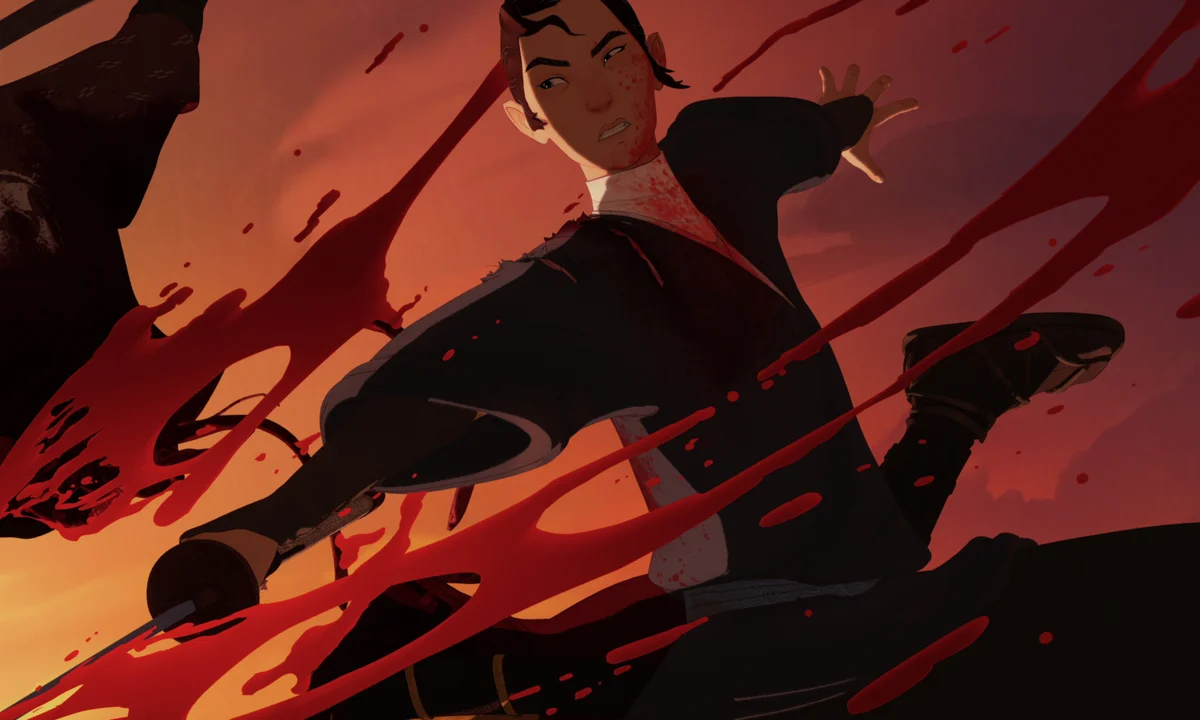
The creators described their goal as making the series resemble “a moving painting,” drawing inspiration from bunraku puppetry, classic samurai cinema, and filmmakers such as Akira Kurosawa. The result is a visual style that feels both painterly and cinematic, with fluid action sequences and striking compositions.
Fight choreography was carefully designed to feel grounded and believable rather than exaggerated, further enhancing the show’s dramatic impact.
Animation Highlights
- Hybrid 2D/3D animation
- Painterly visual style
- Cinematic direction
- Incredible sword fights
- Stunning lighting and environments
Themes That Elevate the Series
Beyond its action, Blue Eye Samurai explores remarkably mature ideas.
Throughout the season, the story examines:
- Identity
- Racism
- Revenge
- Gender expectations
- Power
- Family
- Self-acceptance
- Freedom
Rather than presenting simple answers, the series encourages viewers to consider the emotional cost of hatred and the possibility of personal transformation.
This thematic richness helps explain why the show resonated so strongly with critics.
Major Themes
- Belonging
- Revenge versus healing
- Social discrimination
- Family trauma
- Political corruption
- Personal identity
Season 2 – What We Know So Far
Netflix officially renewed Blue Eye Samurai in December 2023 following the tremendous success of its debut season.
Season 2 is scheduled to premiere in 2026 and will consist of six episodes. The creators have also outlined an overall three-season story, suggesting that Mizu’s journey has been carefully planned from the beginning.
Without revealing spoilers, the first season’s ending opens exciting new possibilities, expanding the scope of the story beyond Japan while introducing new challenges for Mizu.
Season 2 Highlights
- Confirmed by Netflix
- Six episodes
- Planned for 2026
- Continues Mizu’s journey
- Part of a larger multi-season plan
Reception and Critical Response
Few Netflix animated series have received such enthusiastic acclaim.
Critics praised nearly every aspect of the production, including its writing, animation, voice acting, action choreography, and emotional storytelling.
The series currently holds outstanding review scores, including a 97% critics’ rating on Rotten Tomatoes and a Metacritic score of 88, indicating universal acclaim. Legendary game creator Hideo Kojima even described it as the “best anime of the year,” despite it being an American-produced animated series.
Critical Highlights
- Universal acclaim
- 97% Rotten Tomatoes
- 88 Metacritic
- Praise for animation and storytelling
- Strong audience reception
Awards and Legacy
The series quickly became one of the most decorated animated productions of 2024.
Among its many honors were multiple Annie Awards, a Primetime Creative Arts Emmy Award for Outstanding Animated Program, and numerous wins for animation, production design, writing, and editing.
Its success has helped demonstrate that mature animated storytelling continues to gain broader mainstream recognition.
Award Highlights
- Primetime Emmy winner
- Multiple Annie Awards
- Creative Arts Emmy victories
- Peabody nomination
- Industry-wide recognition
Similar Series You May Enjoy
If you loved Blue Eye Samurai, consider watching:
- Arcane
- Castlevania
- Samurai Champloo
- Dororo
- Sword of the Stranger
- Vinland Saga
These series feature similarly mature storytelling, memorable action, and richly developed characters.
FAQ
Is Blue Eye Samurai based on a true story?
No. It is an original fictional story inspired by historical Japan during the Edo period.
Is Season 2 confirmed?
Yes. Netflix officially renewed the series, and Season 2 is scheduled for release in 2026.
How many episodes are in Season 1?
The first season consists of eight episodes.
Is Blue Eye Samurai anime?
While it draws heavy inspiration from anime and samurai cinema, Blue Eye Samurai is an American adult animated series produced for Netflix.
Is Blue Eye Samurai worth watching?
Absolutely. It is widely regarded as one of the finest animated series released in recent years thanks to its exceptional storytelling, stunning visuals, and unforgettable characters.
Conclusion
Blue Eye Samurai is far more than a revenge story. It is a beautifully crafted exploration of identity, belonging, prejudice, and resilience wrapped inside one of the most visually spectacular animated productions of the decade. Every element—from its breathtaking animation and carefully choreographed action to its emotionally rich characters and mature themes—works together to create an experience that lingers long after the final episode.
With a critically acclaimed first season, an exciting second season on the horizon, and a long-term story already mapped out by its creators, Blue Eye Samurai has firmly established itself as one of Netflix’s greatest original animated series and one of the defining adult animated dramas of modern television.
If you don’t know where to watch this Anime for FREE make sure to contact me via E-mail, or in the comments below. Thank you for reading and make sure to bookmark the site.
How useful was this post?
Click on a star to rate it!
Average rating 0 / 5. Vote count: 0
No votes so far! Be the first to rate this post.