
 7.1/10
Some films recreate the past as though memory were a perfectly preserved recording. Blue Heron understands something far more uncomfortable: memory is fragmented, selective, unreliable, and sometimes reconstructed only after we are old enough to understand what we witnessed. Written and directed by Sophy Romvari in her feature-film debut, Blue Heron uses that instability to tell an intimate story about childhood, immigration, family crisis, and the way traumatic experiences continue changing meaning long after they happen.
Set primarily on Vancouver Island in the late 1990s, the film follows eight-year-old Sasha, played by Eylul Guven, after her Hungarian immigrant family relocates to a new home. What initially appears to be a fresh beginning becomes increasingly unstable as Sasha’s eldest brother, Jeremy, begins displaying dangerous behavioral problems that his parents struggle to understand and control.
Yet describing Blue Heron merely as a family drama does not capture what Romvari is doing. The movie gradually becomes an examination of how childhood memory is formed—and how an adult can return mentally to events she experienced without fully understanding them at the time. Romvari has described the project as her most significant attempt to capture the fallibility of memory, and the film’s semi-autobiographical connection to her own childhood gives that exploration extraordinary emotional weight.
The response has been remarkable. After premiering at Locarno in August 2025, Blue Heron accumulated festival awards before receiving its North American theatrical release in April 2026. It currently holds 98% from critics on Rotten Tomatoes and a 92/100 Metacritic score, placing it among the most acclaimed films released theatrically in 2026.
Highlights
- Written and directed by Sophy Romvari
- Romvari’s feature-film directorial debut
- Semi-autobiographical family drama
- Set on Vancouver Island in the late 1990s
- Stars Eylul Guven and Edik Beddoes
- Explores memory, grief, immigration, and family trauma
- Premiered at Locarno in August 2025
- Won major awards at Locarno and TIFF
- 98% Rotten Tomatoes score
- 92/100 on Metacritic
Blue Heron – Official Trailer
What Is Blue Heron About?
Blue Heron follows a Hungarian immigrant family attempting to begin a new life on Vancouver Island.
Eight-year-old Sasha experiences the move largely through the perspective of childhood.
There is a new house.
There is unfamiliar scenery.
There are siblings to play with.
There are ordinary summer days whose significance she cannot yet understand.
But something inside the family is becoming increasingly difficult to ignore.
Her eldest brother Jeremy displays behavioral problems that become more dangerous as the story continues. Sasha’s parents attempt to respond, but there are no simple solutions available to them.
That distinction matters.
The film is not built around identifying an obvious villain.
It is about people facing a family situation for which love alone may not provide an answer.
Janus Films describes the parents as eventually confronting a devastating choice after Jeremy’s increasingly dangerous behavior overwhelms their attempt at a fresh start.
Blue Heron then complicates this childhood perspective through adult Sasha, allowing memory and interpretation to become central parts of the film rather than simply storytelling devices.
Story Highlights
- Hungarian immigrant family relocates to Vancouver Island
- Story is primarily experienced through young Sasha
- Jeremy’s behavior becomes increasingly dangerous
- Parents struggle to protect the entire family
- Adult memory eventually becomes important
- The film avoids simple explanations
- Family love is portrayed as powerful but not all-powerful
Is Blue Heron Worth Watching?
Yes—provided you know what kind of film you are choosing.
Blue Heron is slow, intimate, emotionally demanding, and deliberately uninterested in giving every experience a clean explanation.
There are no large plot twists designed simply to shock viewers.
There is very little conventional melodrama.
Instead, Romvari builds tension through observation.
A conversation.
A family meal.
The way someone reacts when Jeremy enters a room.
A childhood moment that initially seems ordinary but later becomes painful once additional context exists.
That approach will probably frustrate viewers who need every conflict explicitly explained.
For everyone else, the film is extraordinary.
Its critical reception reflects that strength. Metacritic currently reports universal acclaim with a score of 92, and all 28 critics counted there are categorized as positive.
Why It’s Worth Watching
- Exceptional debut filmmaking
- Emotionally complex family drama
- Strong child performances
- Unusual approach to memory
- Beautifully controlled pacing
- Avoids manipulative sentimentality
- Rewards attentive viewing
- Among the strongest-reviewed films of 2026
Why You Should Watch Blue Heron
The strongest reason to watch Blue Heron is not its awards or reviews.
It is the way the movie understands memory.
Most autobiographical films imply that looking backward eventually produces clarity.
Romvari is more skeptical.
We remember fragments.
We remember spaces.
We remember the emotional atmosphere surrounding something before we necessarily remember what happened.
Sometimes we remember what adults told us happened.
Sometimes photographs begin replacing the original memory.
Sometimes years of reflection change how we understand an event we genuinely witnessed.
Blue Heron turns those uncertainties into cinematic form.
That makes the movie more than a dramatization of childhood trauma.
It becomes a film about the very act of trying to dramatize childhood trauma.
Key Reasons to Watch
- Memory itself becomes part of the storytelling
- Childhood and adulthood interact meaningfully
- Personal experience becomes cinematic structure
- Difficult subject matter is handled carefully
- Emotion emerges through accumulation rather than manipulation
- The film invites viewers to question what remembering actually means
Who Is Sasha?
Sasha is the emotional center of Blue Heron.
Eylul Guven plays her as an eight-year-old girl whose understanding of her family is necessarily incomplete.
This is crucial.
Adults watching the film may recognize danger before Sasha does.
We understand tone.
We interpret tension.
We notice the fear hidden inside conversations she may hear without completely processing.
Sasha simply knows that something in her family feels wrong.
That makes her perspective both limited and incredibly powerful.
The movie does not force her to understand adult psychology.
It lets her remain a child.
Amy Zimmer later appears as adult Sasha, allowing the film to explore how an older version of the same person attempts to reconstruct experiences that shaped her long before she possessed the language necessary to understand them.
Sasha Highlights
- Played as a child by Eylul Guven
- Adult Sasha is played by Amy Zimmer
- Story is filtered through childhood understanding
- Does not fully comprehend the family crisis
- Memory changes the meaning of earlier events
- Serves as both participant and later interpreter
Jeremy
Edik Beddoes plays Jeremy, Sasha’s eldest brother.
He is the most difficult character in the film to discuss without destroying its emotional complexity.
Jeremy behaves in ways that frighten the family.
He creates instability.
His actions increasingly become impossible for his parents to manage safely.
Yet Romvari refuses to reduce him to a monster.
That is one of the film’s most important decisions.
Jeremy is still someone’s child.
Someone’s brother.
A person whose own suffering cannot be separated from the damage his behavior causes everyone else.
The film understands that compassion and fear can exist simultaneously.
You can love someone and still be unsafe around them.
You can recognize someone’s pain while acknowledging that other people need protection.
That tension is much harder than simply assigning blame.
Jeremy Highlights
- Played by Edik Beddoes
- Sasha’s eldest brother
- Displays increasingly dangerous behavior
- Remains humanized despite the danger he creates
- His situation places extraordinary pressure on the parents
- Represents one of the film’s most painful moral tensions
The Parents
Iringó Réti and Ádám Tompa play Sasha’s mother and father.
The parents are essential because Blue Heron refuses the comforting assumption that every family crisis has an obvious correct response.
They are dealing with multiple children.
One child needs extraordinary help.
The others need protection and stability.
Those obligations begin colliding.
From Sasha’s childhood perspective, parents may initially seem like people who should simply know what to do.
Adult viewers recognize the opposite.
They are improvising.
They are frightened.
They are exhausted.
They can make mistakes while genuinely trying to protect everyone.
That complexity prevents the parents from becoming simple symbols of failure.
Parent Highlights
- Iringó Réti plays Sasha’s mother
- Ádám Tompa plays Sasha’s father
- Both face impossible competing responsibilities
- Their choices are viewed partly through a child’s perspective
- Film avoids simplifying them into good or bad parents
- Family protection becomes increasingly complicated
The Other Siblings
Liam Serg plays Henry, while Preston Drabble plays Felix.
Their presence matters because Jeremy’s behavior does not affect only Sasha.
A family crisis changes the emotional atmosphere of an entire household.
Children learn when something is wrong even when nobody explains it clearly.
They notice doors closing.
They notice arguments stopping when they enter a room.
They recognize when parents are distracted.
They understand fear long before they understand its cause.
By surrounding Sasha with siblings, Blue Heron presents family trauma as something distributed across a household rather than experienced by one isolated protagonist.
Family Highlights
- Liam Serg plays Henry
- Preston Drabble plays Felix
- Multiple siblings experience the same crisis differently
- The household becomes its own emotional ecosystem
- Childhood understanding varies between family members
Blue Heron Is Semi-Autobiographical
Sophy Romvari has described Blue Heron as semi-autobiographical.
The film draws partly from her own childhood and builds upon ideas she previously explored in the short film Still Processing.
That personal foundation changes the way the movie feels.
Romvari is not presenting autobiography as objective truth.
She is examining the difficulty of turning memory into narrative at all.
In a CBC Arts essay, she called the film her most significant attempt to capture how fallible memory can be.
That statement provides a key to understanding the entire project.
The question is not simply:
“What happened?”
It is also:
“What do I remember happening?”
And even more importantly:
“What does that memory mean to me now?”
Background Highlights
- Semi-autobiographical
- Draws from Romvari’s childhood
- Connected to her earlier short Still Processing
- Memory is intentionally treated as unreliable
- Personal experience becomes part of the film’s form
Memory Is the Real Subject of Blue Heron
The family crisis creates the narrative.
Memory creates the film.
Those are not the same thing.
Young Sasha experiences events without understanding their full context.
Adult Sasha possesses context but no longer has perfect access to the experience.
That gap becomes fascinating.
An adult can explain something a child could not.
But adulthood can also contaminate memory.
Later knowledge changes earlier interpretation.
Stories told repeatedly by relatives may become indistinguishable from original recollection.
The movie therefore treats remembering as reconstruction.
You build the past from fragments.
Some pieces fit.
Some do not.
And occasionally you realize the story you have been telling yourself cannot fully explain what happened.
Memory Highlights
- Childhood recollection is incomplete
- Adult understanding changes earlier events
- Memory and reconstruction overlap
- The film questions objective autobiography
- Emotional truth can exist without perfect factual certainty
Grief Without Easy Catharsis
Grief films often move toward release.
Someone finally cries.
Someone gives a speech.
Someone accepts what happened.
The music rises.
The audience understands that healing has begun.
Blue Heron is much less comfortable than that.
Some experiences never become neat.
Understanding the past does not reverse it.
Reconstructing a memory does not guarantee peace.
Sometimes the best someone can accomplish is looking directly at something they spent years trying to understand.
That approach gives the film considerable emotional honesty.
It does not argue that remembering cures grief.
It suggests remembering can become part of learning how grief shaped you.
Grief Highlights
- Avoids easy emotional resolution
- Memory does not automatically produce healing
- Grief is portrayed as evolving rather than disappearing
- Adult understanding cannot change childhood experience
- Catharsis remains complicated
Childhood Perspective
One of Romvari’s strongest choices is refusing to make young Sasha behave like an adult screenwriter’s idea of a child.
She does not constantly explain what her family is experiencing.
She notices.
That is different.
Children often understand households through atmosphere before explanation.
They know when a parent is angry.
They know when someone is dangerous.
They know when adults are hiding something.
They may not know why.
That limited perspective creates enormous dramatic tension.
The audience has access to information Sasha cannot fully process.
Yet because the story remains emotionally connected to her, we also experience the confusion of seeing fragments without receiving immediate answers.
Childhood Highlights
- Sasha observes more than she understands
- Adult conflicts remain partially inaccessible to her
- Atmosphere communicates danger
- Limited perspective increases tension
- Childhood confusion becomes part of the storytelling
Immigration and Starting Over
The family’s Hungarian background matters.
They are not simply moving houses.
They are immigrant parents attempting to establish stability within a different cultural environment.
Vancouver Island is supposed to offer a fresh start.
Instead, the internal crisis follows them.
That contrast is painful.
Immigration narratives frequently emphasize reinvention.
Move somewhere new.
Create a new life.
Give the children something better.
But geography cannot automatically solve psychological or family problems.
The family’s relocation therefore becomes both hopeful and tragic.
They genuinely want the new environment to work.
It cannot fix everything they brought with them.
Immigration Highlights
- Family is Hungarian
- They relocate to Vancouver Island
- The move represents hope for a new beginning
- Cultural displacement adds additional pressure
- Geography cannot erase existing family problems
Why Vancouver Island Matters
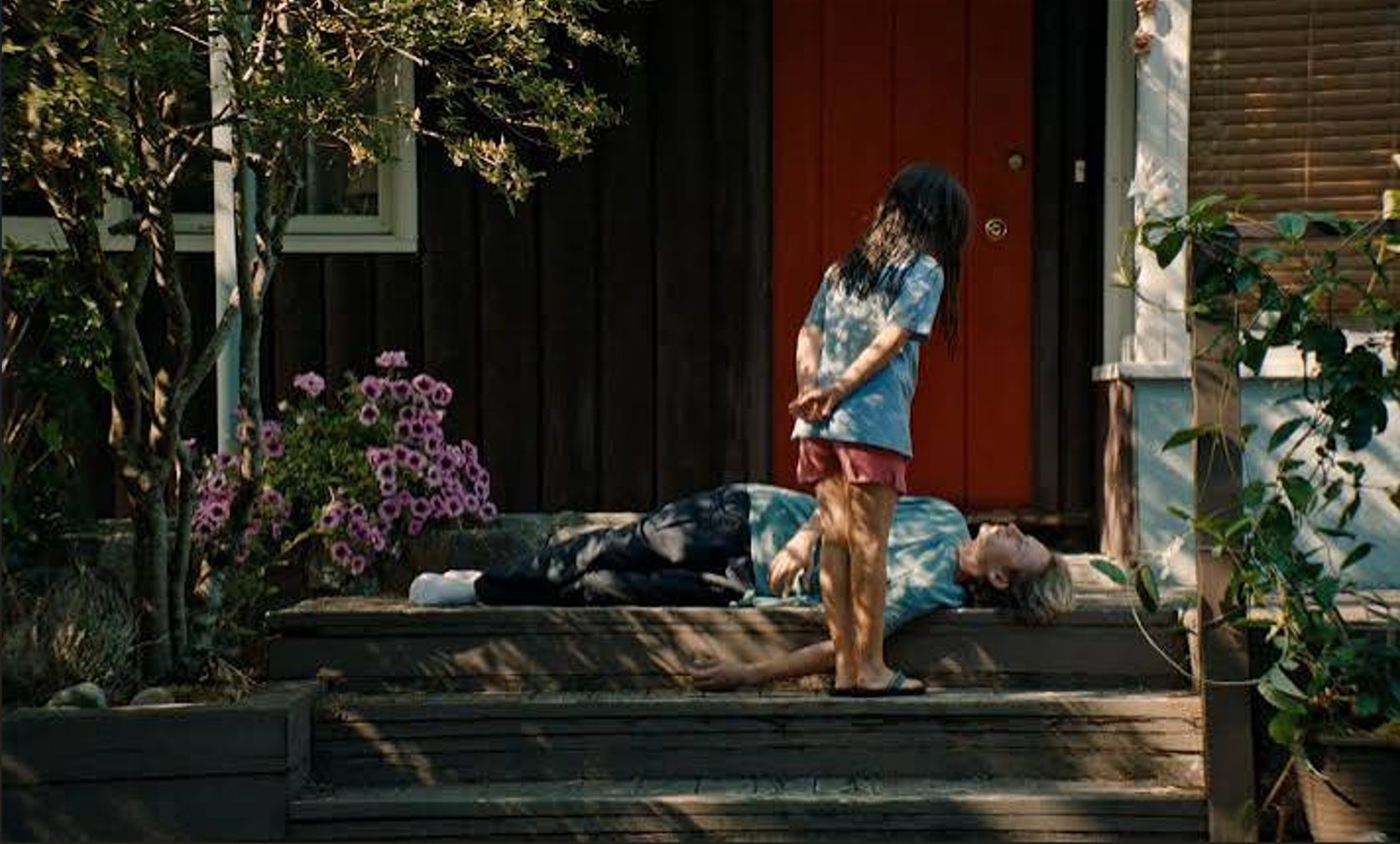
Vancouver Island gives Blue Heron an unusual visual identity.
The environment can be beautiful, open, peaceful, and almost idyllic.
That beauty clashes with what is happening inside the household.
Janus Films describes the movie as capturing both the haze of a languid summer and the sharp clarity of moments that define a life.
That contrast matters.
Trauma does not always occur inside visually miserable environments.
A terrible childhood memory may contain sunlight.
Trees.
Water.
A beautiful afternoon.
That can make the memory even stranger because visual beauty and emotional pain occupy the same mental image.
Setting Highlights
- Vancouver Island provides the central location
- Natural beauty contrasts with family instability
- Summer atmosphere becomes part of memory
- Landscape reinforces emotional contradictions
- Location feels remembered rather than merely photographed
Why Is the Film Called Blue Heron?
The title invites interpretation rather than giving audiences one simple symbolic definition.
The great blue heron is strongly associated with North American wetland landscapes and naturally fits the Vancouver Island setting.
But within the film’s larger concern with memory, the title also works evocatively.
A heron can become the kind of visual detail memory preserves.
Not necessarily because it was objectively the most important thing happening.
Because it happened to remain.
That is exactly how childhood memory often works.
We forget entire conversations.
Then remember an animal.
A color.
A room.
The way afternoon light looked on a particular day.
Blue Heron is full of that kind of emotional memory logic.
Title Highlights
- Connected naturally to the North American setting
- Functions more evocatively than literally
- Fits the film’s focus on remembered details
- Reinforces the connection between landscape and memory
Sophy Romvari
Blue Heron is Sophy Romvari’s feature-length directorial debut.
That fact makes the critical response even more impressive.
Romvari had already built a reputation through short films dealing with memory, family, images, grief, and the relationship between personal history and cinema.
Blue Heron brings those interests into a larger narrative.
Rather than abandoning the intimacy of her earlier work in order to make something more conventionally “cinematic,” she expands those same questions.
How does an image preserve someone?
Can filmmaking reconstruct a memory?
What is the difference between remembering and documenting?
Can cinema create access to a past that no longer exists?
Those questions give the film an unusually mature artistic identity for a first feature.
Romvari Highlights
- Writer and director
- Feature debut
- Previously directed Still Processing
- Frequently explores memory and personal history
- Uses autobiographical material experimentally
- Immediately received major international recognition
Production and Development
The film entered production in 2024 in British Columbia after receiving support from Telefilm Canada and Hungary’s National Film Institute.
That funding reflects the film’s identity as a Canadian-Hungarian co-production.
The international production background also mirrors the family depicted on screen.
This is not a story using Hungarian identity as decorative characterization.
Cultural memory and immigration are embedded in the project’s origin.
Janus Films lists the finished movie at approximately 91 minutes with a 1.66:1 aspect ratio.
That relatively compact runtime benefits the film enormously.
Romvari does not over-explain.
Scenes end when they have communicated enough.
The movie trusts viewers to carry emotional information forward.
Production Highlights
- Produced in 2024
- Filmed in British Columbia
- Canadian-Hungarian co-production
- Supported by Telefilm Canada
- Supported by Hungary’s National Film Institute
- Approximately 91 minutes
- 1.66:1 aspect ratio
The Visual Style
Blue Heron frequently feels caught between fiction and remembered documentary.
That is deliberate.
Critics have repeatedly noted the film’s shifting textures and perspectives.
Screen Daily described its approach as blurring fact and fiction through changing timelines, soft-focus imagery, and documentary-like elements.
This means the movie does not always behave like a conventional linear drama.
The form changes because memory changes.
Some moments feel immediate.
Others feel distant.
Certain images appear almost too clear.
Others possess the haziness associated with trying to recall something that happened decades ago.
The visual instability is not decoration.
It is the subject expressed through cinematography and editing.
Visual Highlights
- Documentary and fiction aesthetics overlap
- Soft-focus imagery appears alongside observational realism
- Perspective can shift
- Timelines interact
- Images often resemble fragments of memory
- Style serves the film’s central themes
The Performances
The performances are understated across the ensemble.
That is exactly what the material requires.
Eylul Guven does not perform Sasha as though she understands the importance of every scene.
Edik Beddoes does not reduce Jeremy to obvious villainy.
Iringó Réti and Ádám Tompa communicate parental exhaustion without transforming every scene into dramatic confrontation.
This restraint makes the film more painful.
Families experiencing severe difficulties do not spend every minute screaming.
There are ordinary breakfasts.
There are jokes.
There are quiet afternoons.
Then something happens that changes the emotional meaning of everything surrounding it.
The ensemble allows those shifts to happen naturally.
Performance Highlights
- Eylul Guven anchors the childhood perspective
- Edik Beddoes gives Jeremy complexity
- Iringó Réti and Ádám Tompa portray exhausted parents
- Performances avoid theatrical exaggeration
- Family dynamics feel lived-in
Edik Beddoes’ Performance
Jeremy could easily have become the movie’s weakest element.
Playing disturbing behavior too aggressively would turn him into a horror-film threat.
Playing it too softly would minimize what the family experiences.
Beddoes has to exist between those extremes.
His performance allows Jeremy to remain frightening without ceasing to be vulnerable.
That distinction was recognized during the film’s festival run.
Beddoes won Best Actor at the 2026 Hong Kong International Film Festival, according to the supplied awards information.
The recognition makes sense because so much of the film depends on audiences being able to hold contradictory feelings about Jeremy simultaneously.
Performance Highlights
- Jeremy remains frightening and sympathetic
- Beddoes avoids caricature
- Won Best Actor at Hong Kong International Film Festival
- Performance reinforces the film’s moral complexity
Locarno Film Festival Premiere
Blue Heron had its world premiere on August 8, 2025 at the 78th Locarno Film Festival.
It competed in the Concorso Cineasti del Presente section.
Romvari left the festival with the Swatch First Feature Award, which included a CHF 15,000 prize.
That immediately established the film as an important debut.
Locarno has a strong reputation for identifying ambitious international filmmakers, making the award particularly significant for Romvari’s first feature.
The film then continued gathering attention rather than becoming one of those festival titles that disappears after its premiere.
Locarno Highlights
- World premiere August 8, 2025
- Competed at the 78th Locarno Film Festival
- Entered Cineasti del Presente competition
- Won Swatch First Feature Award
- Established Romvari as a major emerging filmmaker
Toronto International Film Festival
The movie later received its Canadian premiere during TIFF 2025 in the Centrepiece program.
Romvari won the festival’s Best Canadian Discovery Award.
That continued an extraordinary first-feature festival run.
The film was subsequently selected for TIFF’s year-end Canada’s Top Ten list.
Those achievements positioned Blue Heron not merely as a promising debut but as one of the defining Canadian films of its year.
TIFF Highlights
- Canadian premiere at TIFF 2025
- Screened in Centrepiece
- Won Best Canadian Discovery
- Later selected for Canada’s Top Ten
- Strengthened its reputation within Canadian cinema
Other Festival Awards
The festival run became extensive.
At the Vancouver International Film Festival, Romvari won the Horizon Award for Emerging Canadian Director and the Arbutus Award for Best British Columbia Director.
At the Festival du nouveau cinéma, Blue Heron won the National Competition Grand Prix for Best Feature Film.
The film also received a Special Mention at San Sebastián and later screened internationally at festivals including Sarajevo.
The Toronto Film Critics Association later awarded the film both Rogers Best Canadian Film and Best First Feature.
This accumulation of recognition is unusual for a debut and helps explain why theatrical anticipation grew so significantly.
Award Highlights
- VIFF Horizon Award winner
- Arbutus Award winner
- Festival du nouveau cinéma Grand Prix winner
- San Sebastián Special Mention
- Toronto Film Critics Association Best Canadian Film
- Toronto Film Critics Association Best First Feature
- Multiple international festival appearances
Theatrical Release
Janus Films acquired U.S. distribution rights in January 2026.
Blue Fox Entertainment subsequently acquired Canadian rights.
The movie then entered commercial theatrical release across the United States and Canada during April 2026.
Rotten Tomatoes lists the U.S. limited theatrical release date as April 17, 2026, with digital availability following later in the year.
This was always going to be a specialized release rather than a blockbuster rollout.
For a quiet, formally unusual, semi-autobiographical debut drama, simply sustaining a significant theatrical run is meaningful.
Release Highlights
- U.S. distributor: Janus Films
- Canadian distributor: Blue Fox Entertainment
- U.S. limited opening April 17, 2026
- Expanded through specialized theatrical markets
- Digital availability followed theatrical release
Blue Heron Box Office
The supplied August 2026 figures list $831,379 across the United States and Canada.
Rotten Tomatoes separately lists approximately $602,700 in U.S. gross, which is consistent with the larger North American figure including Canada.
Those numbers need context.
This was never designed as a major commercial release.
It is an independent first feature centered on grief, family memory, and childhood trauma.
For films of this type, theatrical performance is less about competing with studio releases and more about demonstrating sustained interest across specialized cinemas.
The film’s festival reputation and extraordinary reviews likely helped considerably.
Box Office Highlights
- More than $800,000 reported across U.S. and Canada by August 2026
- Approximately $602,700 U.S. gross listed by Rotten Tomatoes
- Specialized theatrical release
- Strong performance must be viewed relative to independent-film scale
Critical Reception
This is where Blue Heron becomes extraordinary.
Rotten Tomatoes currently reports 98% positive reviews from 108 critics.
Metacritic reports 92/100 from 28 critics, classified as “Universal Acclaim.”
Those are exceptional numbers for any movie.
For a feature debut, they are remarkable.
The praise has focused heavily on Romvari’s handling of memory, the emotional precision of the performances, and the way the movie transforms personal grief into cinematic form.
The critical consensus has increasingly positioned the film among the defining independent releases of 2026.
Rotten Tomatoes currently also includes it among its highest-ranked new movies of the year.
Reception Highlights
- 98% Rotten Tomatoes
- 108 critic reviews
- 92/100 Metacritic
- 28 Metacritic reviews
- Universal acclaim
- Frequently cited among 2026’s best films
What Critics Loved
Critics repeatedly praised the movie’s formal control.
The New York Times called it an exquisite debut, while RogerEbert.com described the film as an act of remembrance and named Romvari a major emerging talent.
The Boston Globe compared the level of personal filmmaking favorably with Aftersun.
Variety praised the fragmented nature of the film’s memory structure, describing the importance Romvari places on incidental details alongside major life events.
That is perhaps the best summary of the movie’s strength.
Blue Heron understands that we do not remember life according to narrative importance.
We remember strangely.
And cinema may be uniquely suited to reproducing that strangeness.
Critical Praise
- Sophisticated memory structure
- Exceptional debut direction
- Strong ensemble acting
- Emotional restraint
- Personal filmmaking without self-indulgence
- Comparisons to Aftersun
- Frequently ranked among 2026’s strongest releases
What Critics Did Not Like
Near-universal acclaim does not mean every element worked for every reviewer.
Some criticism focused on the movie’s later self-reflexive choices.
The Wall Street Journal found aspects of those structural turns overly elaborate, suggesting that some of the emotional effect became more conceptual than immediate.
The Hollywood Reporter was generally positive but felt some of the emotional momentum dissipated around the abrupt conclusion.
Those criticisms identify the primary dividing line.
Viewers who embrace the film’s shifting relationship between memory, fiction, and filmmaking itself will probably find the structure deeply moving.
Those who prefer the intimate family story to remain completely naturalistic may find the later formal experimentation less satisfying.
Critical Reservations
- Some viewers may find the structure overly self-conscious
- Later formal choices may create emotional distance
- Ending can feel abrupt
- Not everyone will respond equally to its meta-cinematic approach
Blue Heron and Aftersun
The Aftersun comparison appeared repeatedly for obvious reasons.
Charlotte Wells’ 2022 film also explores an adult attempting to understand painful childhood experience through fragmented memory.
Both films recognize that childhood perception contains information without interpretation.
Both are interested in images.
Both understand that looking backward can reveal things the younger self could not possibly recognize.
But they are not the same movie.
Aftersun focuses heavily on the relationship between father and daughter.
Blue Heron examines an entire family system destabilized by one member’s increasingly serious problems.
Romvari is also more explicitly interested in the reliability of cinematic reconstruction itself.
The comparison is useful.
It should not become a substitute for understanding Blue Heron on its own terms.
Comparison Highlights
- Both explore adult interpretation of childhood memory
- Both rely on fragmented recollection
- Both avoid conventional melodrama
- Blue Heron emphasizes sibling and whole-family trauma
- Romvari pushes further into questions about reconstructing memory through film
Similar Movies to Blue Heron
Viewers who respond strongly to Blue Heron may want to explore other memory-driven family dramas.
Aftersun
The clearest contemporary companion piece, particularly in its relationship between childhood perception and adult understanding.
The Quiet Girl
Another understated film built around childhood, family instability, silence, and emotional information that children cannot fully articulate.
Petite Maman
Céline Sciamma’s delicate treatment of childhood, grief, time, and family memory offers a more fantastical but similarly intimate experience.
The Souvenir
Joanna Hogg’s autobiographically inspired film examines how personal history becomes reconstructed through art.
All of Us Strangers
A much more overtly supernatural drama, but one similarly concerned with memory, family, grief, and the impossible desire to return to emotionally unfinished moments.
Similar Film Highlights
- Aftersun
- The Quiet Girl
- Petite Maman
- The Souvenir
- All of Us Strangers
Is Blue Heron Depressing?
Yes, but describing it only as depressing undersells it.
The film deals with severe family instability, grief, and the long-term effects of childhood trauma.
There are emotionally difficult moments.
But Blue Heron is not interested in making audiences miserable.
There is tenderness throughout the film.
The family laughs.
The children play.
There are beautiful landscapes.
There are moments of ordinary affection.
That is exactly why the painful material works.
A traumatic childhood is rarely composed exclusively of traumatic moments.
Good memories and terrible ones can belong to the same summer.
The contradiction is part of what makes remembering complicated.
Is Blue Heron Based on a True Story?
Partly.
The movie is semi-autobiographical and draws from Sophy Romvari’s childhood experiences, as well as ideas previously explored in her short film Still Processing.
But “semi-autobiographical” should not be interpreted as a claim that every character, scene, or event is a literal recreation of reality.
In fact, that would contradict one of the film’s central ideas.
Romvari is specifically interested in the fallibility of memory.
The film exists somewhere between recollection and reconstruction.
Its relationship with truth is therefore emotional and autobiographical without presenting itself as a documentary record.
True Story Highlights
- Inspired partly by Romvari’s childhood
- Not presented as literal documentary reconstruction
- Memory intentionally complicates factual certainty
- Personal truth and cinematic invention overlap
Why the Movie’s Structure Matters
Explaining the structure in detail would spoil one of the film’s most important experiences.
What can be said safely is that Blue Heron gradually questions the stability of the narrative viewers initially think they are watching.
This is not a cheap twist.
It emerges directly from the film’s themes.
If memory is unreliable, then a film built from memory cannot pretend to be completely stable.
The cinematic form therefore begins reflecting the mental process behind it.
That can be disorienting.
It is supposed to be.
Romvari wants us to recognize that reconstructing the past involves imagination as well as recollection.
Structural Highlights
- Form changes alongside the exploration of memory
- Self-reflexive elements are thematically motivated
- Narrative certainty gradually becomes less stable
- Structural experimentation is not merely a twist
Why Blue Heron Is an Important Debut
Many first films announce technical ability.
Blue Heron announces a worldview.
Romvari already seems to know what kinds of questions interest her.
Memory.
Family.
Images.
Absence.
Loss.
The distance between lived experience and recorded experience.
The difficulty of representing people you love truthfully.
Those themes could sustain an entire filmmaking career.
The awards matter.
The reviews matter.
But the strongest indication of Romvari’s future potential is that Blue Heron already feels recognizably authored.
You can imagine seeing another Sophy Romvari film years from now and recognizing the same artistic concerns.
Debut Highlights
- Clear directorial identity
- Personal themes already strongly developed
- Formal experimentation feels purposeful
- Major festival recognition
- Extremely strong critical response
- Establishes Romvari as a filmmaker to follow
Who Should Watch Blue Heron?
Blue Heron is particularly well suited to viewers who appreciate:
- intimate family dramas
- autobiographical filmmaking
- slow cinema
- memory-driven narratives
- Canadian independent film
- coming-of-age stories
- complicated sibling relationships
- understated performances
- nonlinear storytelling
- films about grief
It is much less likely to satisfy viewers looking for conventional plot momentum.
The film asks for patience.
It wants you to notice small things.
It expects emotional information to accumulate rather than announce itself.
For the right audience, that patience pays off enormously.
Frequently Asked Questions
What Is Blue Heron About?
Blue Heron follows eight-year-old Sasha and her Hungarian immigrant family after they relocate to Vancouver Island in the late 1990s while struggling with increasingly dangerous behavioral problems involving Sasha’s eldest brother Jeremy.
Who Directed Blue Heron?
Sophy Romvari wrote and directed the film.
Is Blue Heron Sophy Romvari’s First Movie?
It is her feature-length directorial debut, although Romvari had previously directed several short films.
Is Blue Heron Based on a True Story?
The film is semi-autobiographical and inspired partly by Romvari’s own childhood.
Who Plays Sasha?
Eylul Guven plays young Sasha, while Amy Zimmer plays Sasha as an adult.
Who Plays Jeremy?
Edik Beddoes plays Jeremy.
Where Is Blue Heron Set?
The film is primarily set on Vancouver Island in British Columbia during the late 1990s.
When Did Blue Heron Premiere?
Its world premiere took place at the Locarno Film Festival on August 8, 2025.
When Was Blue Heron Released in Theaters?
Its U.S. limited theatrical release began on April 17, 2026.
How Long Is Blue Heron?
Janus Films lists the film at approximately 91 minutes.
What Is Blue Heron’s Rotten Tomatoes Score?
As of September 2026, it holds 98% from 108 critic reviews.
What Is Blue Heron’s Metacritic Score?
The film has a 92/100 Metascore, indicating universal acclaim.
Did Blue Heron Win Any Awards?
Yes. Its awards include the Swatch First Feature Award at Locarno, Best Canadian Discovery at TIFF, major prizes at VIFF and Festival du nouveau cinéma, and Toronto Film Critics Association awards for Best Canadian Film and Best First Feature.
How Much Did Blue Heron Make?
The supplied August 2026 data lists approximately $831,379 across the U.S. and Canada, while Rotten Tomatoes currently lists around $602,700 specifically for the United States.
Is Blue Heron Similar to Aftersun?
Yes, particularly in its use of adult memory to reinterpret childhood experience. However, Blue Heron focuses more heavily on siblings, family crisis, immigration, and the instability of autobiographical reconstruction.
Is Blue Heron Worth Watching?
Yes. For viewers comfortable with quiet, emotionally demanding films, Blue Heron is one of the strongest-reviewed dramas of 2026 and an exceptional feature debut.
Conclusion
Blue Heron begins with something deceptively familiar: a family moves somewhere new hoping life will become better.
But Sophy Romvari is not really making a movie about moving.
She is making a movie about what remains after childhood is over.
A house.
A landscape.
A sibling.
A frightening moment.
A beautiful afternoon.
Something your parents said that made no sense until twenty years later.
Something you thought you remembered correctly until another person remembered it differently.
Those fragments become the substance of Blue Heron.
What makes the film devastating is its refusal to pretend that adulthood automatically solves childhood confusion. Sasha can grow older. She can acquire language for things she could not understand. She can revisit memories. She can construct narratives around them.
But she cannot become the eight-year-old girl again with the knowledge she possesses now.
That impossibility sits beneath the entire movie.
The semi-autobiographical connection makes Romvari’s approach even more affecting. She is not simply dramatizing something painful from her past; she is interrogating whether cinema can ever reproduce that past honestly when memory itself is unstable.
The critical response suggests that experiment connected far beyond the filmmaker’s own experience.
With 98% on Rotten Tomatoes and a 92 Metacritic score, Blue Heron has emerged as one of the most acclaimed films in current release. Its Locarno and TIFF victories, Canadian critics’ awards, international festival recognition, and continued theatrical life have turned what began as an intensely personal first feature into one of the major independent-film stories of 2025–2026.
The film will not work for everyone.
It is quiet.
Its structure becomes increasingly self-aware.
It withholds explanations.
Its emotional climax may feel less like a conventional resolution than the realization that some experiences can never be made completely whole.
But that is precisely the point.
Memory does not give us the past back.
At best, it gives us fragments.
Blue Heron is about what we do with those fragments—and how filmmaking can briefly make them feel alive again.
If you don’t know where to watch this Movie for FREE make sure to contact me via E-mail, or in the comments below. Thank you for reading and make sure to bookmark the site.
How useful was this post?
Click on a star to rate it!
Average rating 0 / 5. Vote count: 0
No votes so far! Be the first to rate this post.