
 7.1/10
When fans hear the name Rumiko Takahashi, they immediately think of legendary series like Inuyasha, Ranma ½, Urusei Yatsura, and Maison Ikkoku. Few manga creators have shaped the industry as profoundly as Takahashi, whose works have entertained readers for decades through memorable characters, imaginative worlds, and stories that effortlessly blend action, romance, comedy, and fantasy.
With Mao, Takahashi takes a noticeably darker approach while still retaining the charm that has made her storytelling so recognizable. First serialized in 2019, the series combines supernatural mystery, historical fantasy, time travel, Japanese folklore, and detective-style investigations into a narrative that slowly reveals its secrets instead of rushing toward dramatic revelations. The manga has been serialized in Weekly Shōnen Sunday since May 2019, while Sunrise’s anime adaptation premiered in April 2026.
Unlike many modern supernatural series that prioritize constant action, Mao builds suspense through atmosphere, mysterious curses, ancient rivalries, and carefully layered storytelling. Every new case uncovers another piece of a much larger mystery, encouraging readers and viewers to gradually connect the clues alongside its protagonists.
Whether you’re already a longtime Rumiko Takahashi fan or simply looking for an engaging supernatural anime with excellent world-building, Mao offers a unique experience that deserves far more attention than it often receives.
Highlights
- Written and illustrated by Rumiko Takahashi
- Supernatural mystery with historical fantasy elements
- Time-travel between modern Japan and the Taisho era
- Anime produced by Sunrise
- Rich Japanese folklore and mythology
- Ongoing manga with an expanding mystery
Mao – Official Anime Trailer
What Is Mao About?
Mao follows Nanoka Kiba, an ordinary middle-school student whose life changed forever after surviving a devastating accident as a child. Eight years later, she discovers an abandoned shopping district that unexpectedly transports her to Japan’s Taisho era, where she encounters the mysterious onmyoji known as Mao.
Their meeting is anything but ordinary.
As strange supernatural incidents begin unfolding around them, Nanoka gradually realizes that the childhood accident she barely remembers may be connected to Mao himself, an ancient curse, and a terrifying supernatural entity known as Byoki. Rather than simply searching for answers independently, the two begin investigating mysterious disappearances, cursed objects, spirits, and dangerous rituals while slowly uncovering the truth behind their shared destiny.
Each investigation feels like another piece of a larger puzzle. While individual cases often conclude within a few chapters or episodes, they almost always reveal additional clues regarding the centuries-old conspiracy surrounding Mao, the Goko Clan, and the powerful curse that continues to shape both the past and present.
Unlike many action-focused supernatural series, Mao places equal emphasis on mystery, character relationships, and world-building.
Story Highlights
- Time travel between modern Japan and the Taisho era
- Supernatural investigations
- Ancient curses and Japanese folklore
- Gradually unfolding mystery
- Connected episodic adventures
- Strong emotional character development
Is Mao Worth Watching?
Absolutely—especially if you enjoy supernatural mysteries rather than nonstop action.
Mao rewards patience.
Instead of immediately revealing every major secret, Rumiko Takahashi carefully builds suspense across dozens of chapters. Every new character, supernatural creature, cursed artifact, and historical revelation expands the mythology while raising new questions.
The anime adaptation captures this gradual pacing surprisingly well. Sunrise focuses on preserving the atmosphere of the original manga rather than dramatically altering its structure, allowing viewers to appreciate the slow-burning mystery exactly as Takahashi intended. The television adaptation premiered in April 2026 and closely follows the manga’s early story arcs.
While viewers expecting constant battles similar to traditional battle shōnen series may initially find the pacing slower, those who appreciate investigative storytelling, folklore, and layered mysteries will likely find Mao highly rewarding.
Reasons to Watch
- Excellent supernatural mystery
- Beautiful historical atmosphere
- Interesting mythology
- Strong world-building
- Engaging investigations
- Faithful anime adaptation
Why You Should Watch Mao
The greatest strength of Mao is its ability to make every supernatural incident feel meaningful.
Rather than introducing monsters simply to create action scenes, almost every curse, spirit, or ayakashi reflects the emotional struggles of the people involved. Greed, jealousy, regret, revenge, grief, and obsession often manifest through supernatural events, giving each investigation genuine emotional weight.
Rumiko Takahashi also demonstrates remarkable confidence in her storytelling. She avoids rushing explanations or overwhelming audiences with exposition. Instead, information is revealed naturally through conversations, discoveries, and recurring mysteries that reward attentive viewers.
The historical Taisho-era setting also provides a refreshing contrast to many contemporary supernatural anime. Traditional Japanese architecture, spiritual practices, folklore, and early twentieth-century society create an atmosphere that feels distinct from modern fantasy settings.
Biggest Strengths
- Atmospheric storytelling
- Excellent pacing
- Rich folklore
- Emotional mysteries
- Memorable world-building
- Beautiful historical setting
Main Characters
One of Mao‘s biggest strengths is its gradually expanding cast. Rather than introducing dozens of characters immediately, the story allows each important figure to develop naturally over time.
Mao
Mao is an onmyoji who has spent centuries searching for the mysterious Byoki, a powerful supernatural entity responsible for countless tragedies. Armed with the cursed sword Hagunsei, he serves as both investigator and protector while carrying the burden of his own painful past. Although he often appears calm and composed, Mao’s history with the Goko Clan continues to influence many of his decisions.
Nanoka Kiba
Nanoka begins the series as an ordinary teenager but quickly proves herself far more resilient than expected. Her mysterious survival after the childhood accident connects her directly to the supernatural events surrounding Mao, and as the story progresses she gradually develops her own abilities while becoming an essential partner in each investigation.
Otoya
Otoya serves as Mao’s loyal shikigami assistant. Despite appearing young, he is intelligent, practical, and indispensable during investigations, helping Mao organize tools, maintain magical artifacts, and analyze unusual situations.
Byoki
Byoki stands among the series’ most mysterious figures. Rather than functioning as a conventional villain, the powerful demon pursues its own hidden objectives, creating uncertainty regarding its true motivations throughout the story.
Character Highlights
- Mao
- Nanoka Kiba
- Otoya
- Byoki
- Growing supporting cast
- Complex historical relationships
The World of Mao
One of the series’ greatest achievements is its fascinating world-building.
The story seamlessly moves between modern Japan and the Taisho era, allowing supernatural events from centuries earlier to influence the present day. Rather than simply using time travel as a convenient plot device, Takahashi creates meaningful connections between historical events and contemporary mysteries.
The Goko Clan serves as one of the story’s central institutions. Once an influential organization specializing in powerful spiritual techniques, its internal conflicts continue affecting the lives of nearly every major character. Former disciples, ancient rivalries, and unfinished betrayals create a rich historical foundation that slowly unfolds throughout the series.
Japanese mythology also plays a significant role. Ayakashi, shikigami, curses, spiritual rituals, and onmyoji traditions all contribute to a world that feels deeply rooted in folklore rather than generic fantasy.
World Highlights
- Taisho-era Japan
- Modern-day setting
- Japanese folklore
- Ancient clans
- Spiritual magic
- Rich supernatural mythology
Themes and Symbolism
Although Mao certainly contains action and mystery, its emotional themes are equally important.
Many stories revolve around memories, regret, forgiveness, identity, and the lasting consequences of decisions made long ago. Characters frequently struggle with burdens inherited from previous generations, questioning whether the past truly determines the future.
Time itself becomes a recurring theme.
Rather than treating history as something fixed, Mao explores how unresolved trauma continues affecting later generations, both emotionally and spiritually.
The series also examines:
- Revenge
- Family legacy
- Personal identity
- Fate versus choice
- Trust
- Redemption
These philosophical ideas give the story surprising emotional depth beneath its supernatural surface.
Anime Adaptation
Following years of speculation, Sunrise officially adapted Mao into a television anime that premiered in April 2026.
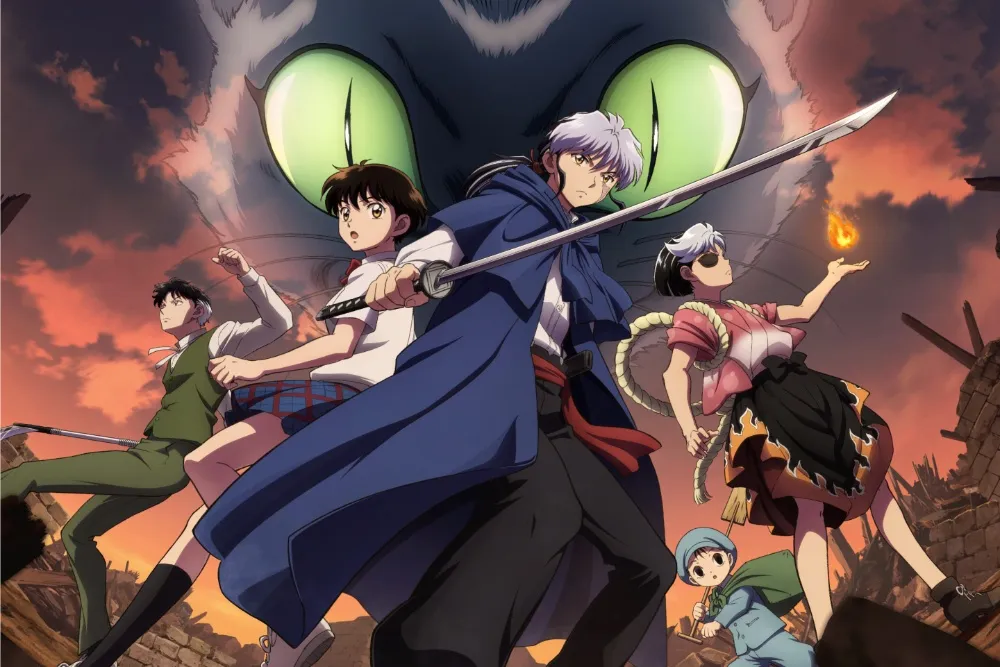
Directed by Teruo Satō with series composition by Yūko Kakihara, the adaptation remains remarkably faithful to Takahashi’s manga while preserving its slower investigative pacing and atmospheric storytelling. The anime also features music by Shū Kanematsu and opening and ending themes that complement the series’ mysterious tone.
Yuki Kaji voices Mao, while Natsumi Kawaida brings Nanoka to life. Their performances successfully capture both the serious and lighter moments that define the relationship between the two protagonists.
The adaptation has also expanded international accessibility through streaming platforms, allowing a wider audience to experience one of Takahashi’s newest works.
Anime Highlights
- Produced by Sunrise
- Premiered in April 2026
- Faithful manga adaptation
- Strong voice cast
- Beautiful animation
- Excellent soundtrack
Art Style and Atmosphere
Rumiko Takahashi’s artwork remains one of the series’ defining strengths.
Character expressions convey subtle emotional shifts, while supernatural creatures possess unsettling designs without becoming overly grotesque. Backgrounds beautifully recreate both modern Japan and Taisho-era streets, creating a consistent atmosphere throughout every investigation.
The anime successfully translates this visual style into motion. Careful lighting, traditional architecture, supernatural effects, and restrained color palettes reinforce the series’ mysterious tone without relying on excessive visual spectacle.
Rather than overwhelming viewers with constant action, the presentation emphasizes tension, curiosity, and quiet moments of discovery.
Visual Highlights
- Detailed historical environments
- Distinct supernatural creature designs
- Excellent atmosphere
- Beautiful traditional architecture
- Faithful character designs
- Strong visual storytelling
Reception and Critical Response
Mao has generally received positive reviews from both critics and longtime Rumiko Takahashi fans.
Readers have praised its world-building, historical atmosphere, supernatural mystery, and Takahashi’s consistently strong artwork. While some reviewers initially noted similarities to Inuyasha, many also recognized that Mao gradually establishes its own identity through a darker tone and more investigation-focused storytelling. The manga surpassed one million copies in circulation by 2021 and has received recognition for its thought-provoking themes.
The anime adaptation has likewise been well received for preserving the manga’s atmosphere while introducing the story to a broader audience.
Critical Highlights
- Praised storytelling
- Strong world-building
- Excellent artwork
- Rich mythology
- Positive manga reception
- Successful anime adaptation
Legacy and Impact
Although Mao is still ongoing, it has already become an important addition to Rumiko Takahashi’s remarkable body of work.
Rather than attempting to recreate the success of Inuyasha, Takahashi uses familiar supernatural elements to tell a more mature, mystery-driven story focused on curses, investigations, and historical secrets.
For longtime fans, Mao demonstrates that one of manga’s greatest creators continues evolving her storytelling while remaining true to the emotional character writing that has defined her career.
For newcomers, it offers an accessible entry point into Takahashi’s work without requiring familiarity with her previous series.
Legacy Highlights
- Expands Rumiko Takahashi’s legendary catalog
- Popular ongoing manga
- Successful anime adaptation
- Rich supernatural mythology
- Strong international appeal
FAQ
Is Mao connected to Inuyasha?
No. Although both series were created by Rumiko Takahashi and share supernatural themes, Mao tells an entirely original story with its own characters and world.
Is Mao finished?
No. The manga is still ongoing, while the anime adaptation premiered in 2026.
Is Mao an action anime?
It contains action, but its primary focus is supernatural mystery, investigation, folklore, and character development.
Who created Mao?
The series was written and illustrated by Rumiko Takahashi.
Where can you watch the Mao anime?
The anime is available through licensed streaming platforms in multiple regions, with Hulu carrying it in the United States and Disney+ in several international markets.
Is Mao worth reading if you like Inuyasha?
Yes. While both series share certain supernatural elements, Mao offers a darker mystery-driven narrative with its own identity and mythology.
Conclusion
Mao proves that Rumiko Takahashi remains one of manga’s greatest storytellers. Rather than relying on familiar formulas, she delivers a compelling supernatural mystery filled with fascinating folklore, memorable characters, and carefully layered world-building that rewards patient readers and viewers alike.
The relationship between Mao and Nanoka provides a strong emotional foundation, while the interconnected mysteries surrounding curses, ancient clans, and the mysterious Byoki keep the narrative consistently engaging. Combined with the atmospheric Taisho-era setting, thoughtful pacing, and Sunrise’s faithful anime adaptation, Mao stands out as one of the strongest modern supernatural series.
For anyone looking beyond conventional action anime toward something richer in mystery, mythology, and character-driven storytelling, Mao is an excellent choice that continues to grow stronger with every new chapter and episode.
If you don’t know where to watch this Anime for FREE make sure to contact me via E-mail, or in the comments below. Thank you for reading and make sure to bookmark the site.
How useful was this post?
Click on a star to rate it!
Average rating 0 / 5. Vote count: 0
No votes so far! Be the first to rate this post.