
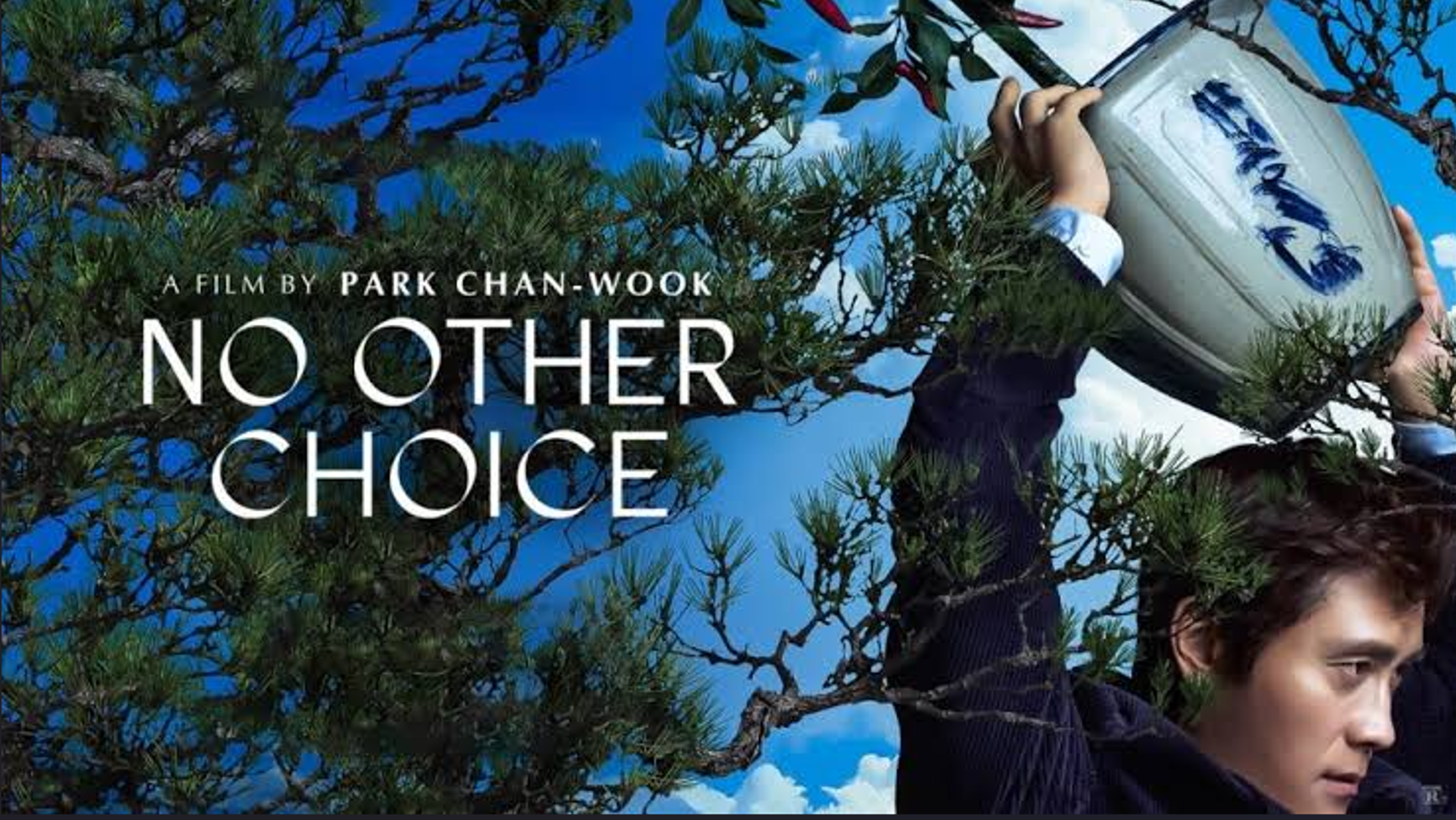
 7.5/10
Some thrillers are built around serial killers, conspiracies, or impossible heists. Others begin with something far more ordinary—and far more terrifying in its own way: losing your job and realizing the life you built can collapse faster than you ever imagined. That is the brilliantly uncomfortable starting point of No Other Choice, Park Chan-wook’s savage, darkly funny, and surprisingly human black comedy thriller.
Directed, co-written, and produced by Park Chan-wook, No Other Choice adapts Donald Westlake’s novel The Ax into a distinctly Korean story about work, status, family pressure, and moral collapse. The result is a film that feels both wildly entertaining and deeply unsettling. It asks a simple question—what happens when a man becomes so desperate to keep his family’s way of life intact that he begins to see other job applicants as obstacles to be removed?—and then follows that question to increasingly outrageous and disturbing places.
The film stars Lee Byung-hun as Yoo Man-su, a paper-industry specialist whose career collapse sends him into a spiral of humiliation, anxiety, and eventually violence. Around him is a superb supporting cast led by Son Ye-jin, Park Hee-soon, Lee Sung-min, Yeom Hye-ran, and Cha Seung-won. Together, they turn what could have been a simple satire into a layered film about capitalism, masculinity, family, and the absurd logic of competition.
By the time No Other Choice premiered at the 82nd Venice International Film Festival, it was already one of the most anticipated Korean films of the year. After release, it became one of the most acclaimed and commercially successful Korean movies of 2025, earning major festival attention, awards recognition, and praise as one of Park’s warmest and funniest films—without losing the razor-sharp cruelty audiences expect from him.
Key Highlights
- Directed by Park Chan-wook
- Released in 2025
- Stars Lee Byung-hun and Son Ye-jin
- Based on Donald Westlake’s novel The Ax
- Black comedy thriller with strong social satire
- Premiered in competition at Venice 2025
- One of South Korea’s biggest and most acclaimed films of 2025
No Other Choice – Official Trailer
What Is No Other Choice About?
At its core, No Other Choice is about unemployment, pride, and desperation.
The story follows Yoo Man-su, an experienced and highly respected paper-industry employee who appears to have built a stable and satisfying life. He lives with his wife Mi-ri and their children in the home he loves, and he believes that years of hard work have secured a comfortable future. Then his company is bought out, and Man-su is abruptly laid off. What initially seems like a temporary setback quickly becomes a full-blown personal and financial crisis.
Months pass. Man-su cannot find another position in his field. His family begins cutting costs, his self-respect erodes, and the pressure to preserve his household becomes overwhelming. When he identifies other unemployed paper-industry specialists as rivals for the same few jobs, he arrives at a monstrous solution: if the competition disappears, his chances improve. From there, the film turns a white-collar job search into a serial-killer thriller without ever losing sight of its absurdity.
What makes the premise so effective is that Park doesn’t treat it as pure horror or pure farce. Instead, No Other Choice constantly walks a tightrope between dark comedy, social critique, and moral tragedy. The more desperate Man-su becomes, the more the film asks viewers to examine how modern systems reduce people to competitors fighting over shrinking scraps of security.
Story Highlights
- A laid-off paper-industry veteran becomes desperate to find work
- A job hunt spirals into black comedy and murder
- Family pressure and financial anxiety drive the story
- Corporate life is treated as a brutal survival game
- The film mixes suspense, satire, and emotional drama
Why No Other Choice Feels So Different From Most Thrillers
One of the most fascinating things about No Other Choice is how ordinary its central fear is. Many thrillers begin with extraordinary circumstances, but Park starts with something mundane and recognizable: a middle-aged professional suddenly becoming economically expendable.
That choice gives the film an unusual kind of power. Even when the story becomes extreme, it still feels grounded in a real social anxiety. Man-su isn’t motivated by greed in the traditional sense. He isn’t chasing luxury for its own sake. He’s trying to hold together a home, a family identity, and a sense of dignity that have all been tied to his role as a provider. That doesn’t excuse what he does, but it makes the film’s satire sting harder because the desperation at its center feels plausible.
Park also refuses to present Man-su as a simple villain. He is pathetic, manipulative, frightened, and often horrifying—but he is also recognizable as a man trapped in a system that treats failure as a private moral flaw rather than a structural reality. The film’s black humor comes from the absurdity of watching job-market logic turn homicidal, yet underneath the comedy is a bleak portrait of atomized survival.
Why the Premise Works So Well
- It turns unemployment into the engine of a thriller
- The social satire feels immediate and contemporary
- The protagonist is flawed but psychologically understandable
- The comedy makes the violence even more uncomfortable
- The story critiques competition, status, and economic precarity
Is No Other Choice Worth Watching?
Absolutely—especially if you enjoy films that blend tension, character study, and social critique.
This is not a straightforward action thriller or a purely grim prestige drama. It is a film that asks you to laugh at terrible situations, then immediately question why you laughed. Park has always been skilled at creating tonal tension, and No Other Choice is one of his most controlled examples of that ability. Scenes can be ridiculous, suspenseful, awkward, and emotionally painful all at once.
It also helps that the film is impeccably made. The performances are excellent, the pacing is sharp, and the screenplay keeps escalating without losing its thematic focus. Even viewers who normally prefer more conventional thrillers may find themselves drawn in by the film’s confidence and its willingness to turn a workplace crisis into something operatic.
Reasons It’s Worth Watching
- One of Park Chan-wook’s most acclaimed recent films
- Clever mix of black comedy and thriller tension
- Excellent lead performance from Lee Byung-hun
- Sharp critique of work culture and capitalism
- Strong supporting cast and memorable character dynamics
- Stylish filmmaking without sacrificing emotional substance
Why You Should Watch No Other Choice
If you’re interested in films that use genre storytelling to say something meaningful about modern life, No Other Choice is an easy recommendation.
Underneath the thriller mechanics, the film is really about what happens when a person’s identity becomes inseparable from employment and financial usefulness. Man-su doesn’t simply want a job—he wants proof that he still matters, that he can still perform the role expected of him, and that his family’s future has not slipped beyond his control. Park uses that anxiety to expose how fragile middle-class security can be and how quickly ordinary decency can erode when people feel cornered.
The film also benefits from being deeply rooted in character rather than just concept. Man-su’s marriage, his relationship with his children, and the humiliations he suffers while unemployed all give the story emotional weight. Even when the plot becomes outrageous, the personal stakes remain clear.
Biggest Strengths
- A bold and memorable central concept
- Human drama underneath the satire
- Consistent tonal control from Park Chan-wook
- Strong emotional and thematic payoff
- A thriller that stays with you after it ends
Lee Byung-hun Delivers One of the Best Performances of 2025
Lee Byung-hun as Yoo Man-su
Lee Byung-hun’s performance is one of the film’s biggest achievements. Man-su could easily have become either too monstrous to engage with or too sympathetic to feel believable. Lee avoids both extremes. He plays the character as a man constantly performing normalcy while panic, humiliation, resentment, and exhaustion eat away at him from the inside.
What makes the performance so effective is its flexibility. Lee can make Man-su seem pitiful in one scene, darkly funny in the next, and genuinely frightening shortly after. The role demands a huge emotional range because the film is always shifting between satire and suspense, and Lee meets that challenge beautifully. His Golden Globe nomination and the wider awards attention he received make perfect sense once you see how much of the film’s tonal balance rests on his shoulders.
Why His Performance Stands Out
- He makes Man-su both tragic and terrifying
- His comic timing keeps the satire alive
- He captures the shame and panic of unemployment convincingly
- The performance anchors the film’s shifting tone
Son Ye-jin and the Importance of Mi-ri
Son Ye-jin as Lee Mi-ri
One of the most important creative decisions in No Other Choice is the expanded role of Mi-ri, Man-su’s wife. Park explicitly wanted to strengthen the wife’s role in this adaptation, and that choice gives the film much more emotional and moral complexity.
Mi-ri is not just the worried spouse waiting at home while the protagonist descends into chaos. She is an active presence in the family’s struggle, and the film uses her to complicate the audience’s understanding of Man-su’s behavior. Through her, we see the strain of financial collapse from another angle: the compromises, resentments, suspicions, and uneasy accommodations that appear when a household is pushed into survival mode.
Son Ye-jin plays Mi-ri with warmth, intelligence, and a quiet steeliness that prevents the character from ever feeling passive. Her presence helps keep the film grounded in domestic reality, which is essential because that domestic reality is exactly what Man-su believes he is “protecting.”
Why Mi-ri Matters So Much
- She gives the film emotional balance
- Her expanded role deepens the marriage storyline
- She reflects the family cost of Man-su’s desperation
- Son Ye-jin adds nuance and tension to every domestic scene
Cast and Characters
Beyond its two leads, No Other Choice benefits from a terrific supporting ensemble that gives Man-su’s world texture and pressure.
- Park Hee-soon plays Choi Seon-chul, one of Man-su’s major professional obstacles and one of the people who embodies the humiliation of the job market.
- Lee Sung-min plays Goo Beom-mo, one of the rivals Man-su targets as he becomes more desperate.
- Yeom Hye-ran plays Lee A-ra, whose role in the story adds instability, dark humor, and unexpected danger.
- Cha Seung-won plays Ko Si-jo, another of Man-su’s competitors, and one of the film’s most important moral mirrors.
- Yoo Yeon-seok appears as dentist Oh Jin-ho, who becomes part of the tension surrounding Mi-ri’s working life.
This supporting cast matters because the film is built on social friction. Every rival, family member, and suspicious observer adds pressure to Man-su’s increasingly impossible balancing act.
What No Other Choice Is Really About
Work, Status, and the Fear of Becoming Replaceable
The film’s surface plot is about murder, but its deeper concern is labor and value. Man-su is not simply unemployed; he is made to feel obsolete. That distinction matters. The story is about what happens when a person who has built his identity around competence and usefulness is told, explicitly or implicitly, that none of it guarantees security anymore.
Park turns that anxiety into a nightmare version of capitalist logic. If jobs are scarce and survival depends on outcompeting others, then the thriller takes that logic to its grotesque conclusion: what if competition became literal elimination?
Family as Motivation and Justification
Another major strength of the film is how it handles family. Man-su constantly frames his actions as being for the sake of his wife, children, and home. That framing is crucial because it reveals how easily love and duty can become excuses for terrible behavior. The film doesn’t deny that he cares about his family; instead, it shows how care can be distorted when filtered through fear, pride, and possessiveness.
Black Comedy as a Weapon
Park Chan-wook has always understood that humor can make violence more disturbing rather than less. In No Other Choice, black comedy is not just decorative. It’s the mechanism that exposes the absurdity of the systems trapping these characters. The laughter catches in your throat because the situations are ridiculous and painfully believable at the same time.
Core Themes
- The cruelty of economic competition
- Middle-class insecurity and masculine identity
- Family responsibility versus moral collapse
- Capitalism as a system of isolation and desperation
- The thin line between social performance and violence
Production and Development – A Long Road to the Screen
One of the most interesting things about No Other Choice is how long Park Chan-wook carried the project with him. The adaptation goes back to at least 2009, when it was first reported that Park would remake The Axe. Over the years, he repeatedly described it as a passion project and even a “lifetime project,” returning to it while making other films.
The film changed shape during that long development process. At one point it was expected to be an English-language project, but by 2024 Park had reconfigured it as a Korean film starring Lee Byung-hun and Son Ye-jin. That shift seems to have been the right one. The finished movie feels intensely local in its social observations while still preserving the broader universality of Westlake’s premise.
Filming began in August 2024 and wrapped in January 2025. Knowing Park’s precision as a filmmaker, it’s easy to see the years of thought that went into the final result. The film feels meticulously shaped rather than rushed to fit a trend.
Production Highlights
- Based on Donald Westlake’s The Ax
- A project Park Chan-wook pursued for well over a decade
- Reworked from an earlier English-language concept into a Korean film
- Filmed from August 2024 to January 2025
Release, Festival Run, and Box Office Success
No Other Choice had the kind of rollout reserved for prestige films with major awards ambitions. It premiered in competition at the 82nd Venice International Film Festival on August 29, 2025, before continuing through Toronto, Busan, New York, London, Sitges, Vancouver, and several other major festivals. That kind of festival path helped establish the film as one of the year’s essential international releases.
It then opened in South Korea on September 24, 2025, after serving as the opening film of the 30th Busan International Film Festival. Commercially, it was a major success, grossing nearly $20 million in South Korea and around $39 million worldwide. It also reportedly recouped its production budget before release through overseas presales, which meant it entered theaters already in a strong financial position.
That mix of critical acclaim, strong presales, and solid domestic box office made the film one of the biggest Korean cinematic success stories of 2025.
Release Highlights
- Venice premiere in August 2025
- Opened Busan 2025 and released in Korea on September 24
- Grossed about $19.9 million in South Korea
- Reached roughly $39 million worldwide
- Became one of South Korea’s top-grossing films of 2025
Reception and Critical Response
Critically, No Other Choice was one of the best-received films of 2025. It reportedly earned a lengthy standing ovation at Venice, and reviews praised its tonal confidence, sharp social critique, and Lee Byung-hun’s performance. Variety described it as one of Park’s most humane and mordantly funny works, which is a fitting summary of the film’s unusual balance between cruelty and compassion.
Review aggregators reflected that enthusiasm as well. The film held a 97% critics’ score on Rotten Tomatoes and a Metacritic score of 86, both strong indicators that it resonated widely with critics. What’s especially notable is that the praise didn’t come only from festival circles. The film also performed well with broader awards bodies and critics groups, suggesting that its themes and execution landed across very different audiences.
Critical Highlights
- Strong acclaim from Venice onward
- Praised as one of Park’s funniest and most humane films
- 97% on Rotten Tomatoes
- 86 on Metacritic
- Frequently cited as one of the best Korean films of 2025
Awards, Recognition, and Oscar Campaign
The film’s awards run was substantial. It was South Korea’s submission for Best International Feature at the 98th Academy Awards and made the December shortlist, though it ultimately did not secure a nomination. Even so, the film had an impressive overall campaign, including Golden Globe nominations for Best Motion Picture – Musical or Comedy, Best Foreign Language Film, and Best Actor for Lee Byung-hun.
It also collected a remarkable list of festival prizes and critics’ awards, including major wins at the Blue Dragon Film Awards and recognition across American and international critics groups. That breadth of recognition speaks to how effectively the film crossed boundaries between arthouse prestige, mainstream appeal, and biting social satire.
Does No Other Choice Hold Up as One of Park Chan-wook’s Best Films?
That’s a high bar, given Park’s filmography, but No Other Choice absolutely belongs in the conversation.
It may not have the immediate iconic shock of Oldboy or the lush romantic cruelty of The Handmaiden, but it offers something different: a film that feels more domestic, more contemporary, and in some ways more emotionally accessible without becoming any less sharp. It is one of Park’s clearest critiques of class anxiety and social atomization, and it proves that he can make a movie about layoffs, family budgets, and job interviews feel as tense as any revenge thriller.
That alone makes it stand out.
What Makes It Special in Park’s Filmography
- It channels his style into a very contemporary economic nightmare
- It is funny in a particularly bitter, uncomfortable way
- It feels more overtly humane than some of his colder thrillers
- It still delivers the precision, irony, and tension fans expect
Similar Films You May Enjoy
If No Other Choice works for you, these are good follow-ups:
- Parasite – for class satire and escalating domestic chaos
- The Axe – the earlier adaptation of the same source novel
- Decision to Leave – for another recent Park Chan-wook film with immaculate craft
- Burning – for slow-burn social tension and moral ambiguity
- I, Daniel Blake – for a very different but equally powerful look at economic precarity
- Sorry We Missed You – for another devastating story about work, family, and systemic pressure
FAQ
Is No Other Choice based on a book?
Yes. It is based on Donald Westlake’s novel The Ax, and it is the second film adaptation of that story after Costa-Gavras’s The Axe.
Who directed No Other Choice?
The film was directed, co-written, and produced by Park Chan-wook.
Who stars in No Other Choice?
The film stars Lee Byung-hun, Son Ye-jin, Park Hee-soon, Lee Sung-min, Yeom Hye-ran, and Cha Seung-won.
Was No Other Choice successful?
Yes. It was critically acclaimed, had a major festival run, grossed around $39 million worldwide, and became one of South Korea’s biggest films of 2025.
Did it get Oscar attention?
It was selected as South Korea’s submission for Best International Feature and made the Academy shortlist, though it was not ultimately nominated.
Conclusion
No Other Choice is a brilliant example of what happens when a master filmmaker takes a genre premise and uses it to dissect something painfully real. On one level, it’s a black comedy thriller about a desperate man trying to eliminate his competition. On another, it’s a devastating portrait of how capitalism turns insecurity into paranoia, family duty into pressure, and ordinary people into isolated competitors clawing for survival.
With a tremendous lead performance from Lee Byung-hun, a richly expanded role for Son Ye-jin, and Park Chan-wook working at an exceptionally high level, the film stands as one of the best Korean movies of 2025 and one of the most memorable thrillers of the year overall. If you want a film that is funny, vicious, sad, stylish, and thematically sharp all at once, No Other Choice absolutely lives up to its acclaim.
If you don’t know where to watch this Movie for FREE make sure to contact me via E-mail, or in the comments below. Thank you for reading and make sure to bookmark the site.
How useful was this post?
Click on a star to rate it!
Average rating 0 / 5. Vote count: 0
No votes so far! Be the first to rate this post.