
 7.0/10
Some movies immediately feel like they belong to another era of Hollywood, and The Weight wears that quality proudly. Padraic McKinley’s feature directorial debut is a Depression-era survival thriller built around prisoners, gold, wilderness, desperation, greed, and the promise of freedom, with Ethan Hawke carrying the story as Samuel Murphy. Set in Oregon in 1933, the film follows Murphy after he is separated from his daughter and sent to a brutal labor camp, where Warden Clancy offers him a dangerous opportunity to shorten his sentence. The assignment sounds simple enough on paper: transport gold through unforgiving wilderness. In practice, the combination of dangerous terrain, physical exhaustion, suspicion, and the increasingly corrosive influence of the cargo turns the journey into something much darker.
The film premiered at Sundance on January 26, 2026, later screened internationally at the Berlin International Film Festival, and received its U.S. theatrical release through Vertical on September 18. It arrives with an unusually strong cast for a relatively stripped-down adventure, including Ethan Hawke, Russell Crowe, Julia Jones, Austin Amelio, Avi Nash, and Lucas Lynggaard Tønnesen. Current critical reception is also strong: Rotten Tomatoes lists the movie at 93% from 114 critic reviews, while its verified audience Popcornmeter stands at 83%.
Yet The Weight is interesting for more than its scores. This is an intentionally rugged movie about ordinary people carrying an extraordinary physical and moral burden, and its greatest strengths come from how seriously it commits to that simplicity.
The Weight – Official Trailer
What Is The Weight About?
The Weight takes place in Oregon during 1933, when the United States is deep in the Great Depression. Samuel Murphy is struggling to survive while caring for his young daughter Penny, but circumstances tear the two apart and leave Murphy incarcerated in a remote labor camp. His overriding concern becomes getting back to his daughter before their separation becomes permanent.
Russell Crowe’s Warden Clancy recognizes that desperation and gives Murphy an opportunity. If he participates in a dangerous operation to move gold through the wilderness, he may be able to shorten his sentence. Murphy consequently joins a small group of prisoners tasked with carrying an enormously valuable load through mountains, forests, rivers, and other dangerous terrain.
The gold creates a wonderfully simple dramatic device.
Everyone understands its value.
Everyone understands its weight.
And everyone understands what possessing it could potentially change.
As the journey becomes increasingly dangerous, the prisoners have to contend not only with the wilderness but also with distrust, competing motivations, and the question of whether the people traveling beside them are becoming more dangerous than the environment itself.
That is essentially everything you need to know before watching.
Is The Weight Worth Watching?
For viewers who enjoy rugged survival thrillers, yes, The Weight is well worth considering.
Its greatest appeal is how uncomplicated its central idea is. There is no elaborate mythology to understand and no enormous franchise surrounding the characters. A desperate father wants his freedom, a corrupt opportunity presents itself, several men enter the wilderness carrying an absurd amount of gold, and almost everything that could make that journey dangerous gradually begins working against them.
The execution is deliberately old-fashioned. Sundance described the filmmakers’ intention as creating an “old school” adventure, with McKinley and Hawke discussing movies such as Jeremiah Johnson and Sorcerer as important reference points. Contemporary critics have noticed the same DNA, with comparisons also extending to The Wages of Fear, Deliverance, and the physical filmmaking of 1970s American cinema.
That does not mean the film has been universally praised. Several critics have argued that its middle section loses momentum, that some supporting characters needed greater development, or that the movie never pushes its tension as far as its strongest influences.
Those criticisms are worth knowing before watching.
But the central survival story, physical filmmaking, historical setting, and Hawke’s performance give The Weight a clear identity.
Why Should You Watch The Weight?
The strongest reason is Ethan Hawke.
Samuel Murphy needs to function simultaneously as an action protagonist and an exhausted father whose desperation gives the adventure emotional meaning. Hawke does not play him like an indestructible modern action hero. Murphy looks vulnerable to the landscape, the other men, the system imprisoning him, and his own increasingly difficult decisions.
That vulnerability is important because The Weight depends on physical danger feeling genuinely dangerous.
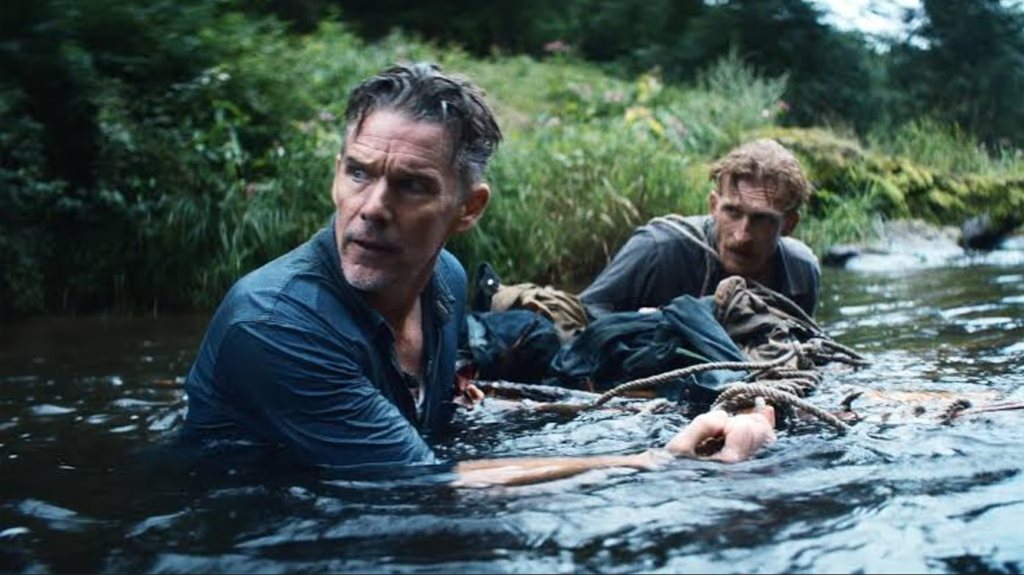
The second reason is the atmosphere. The movie embraces mud, water, forests, primitive equipment, unstable bridges, heavy cargo, rough clothing, and bodies being pushed beyond comfort. Even critics who were less enthusiastic about the screenplay frequently singled out its visual qualities or physical environment.
Finally, there is the simplicity.
Sometimes an adventure movie does not need to construct an entire universe.
Give compelling actors a dangerous objective.
Put something valuable between them.
Then make reaching the destination increasingly difficult.
The Weight understands the appeal of that formula.
Ethan Hawke as Samuel Murphy
Samuel Murphy is the emotional center of the film.
When audiences meet him, he is not chasing gold because he dreams of becoming wealthy. His fundamental objective is much more personal: he wants to reunite with his daughter Penny. The labor camp therefore does more than imprison him physically; every day inside threatens the relationship that matters most to him.
That motivation gives the wilderness journey its urgency.
Gold matters because it represents opportunity.
Freedom matters because Penny is waiting outside.
Hawke is particularly well suited to a character like Murphy because he can communicate exhaustion and vulnerability without making the character appear passive. Reviews from Sundance onward have repeatedly highlighted his performance, with TheWrap calling him “mesmerizing” and later theatrical reviews similarly emphasizing how effectively he grounds the movie’s action.
Murphy may be surrounded by larger-than-life circumstances.
Hawke keeps him recognizably human.
Russell Crowe as Warden Clancy
Russell Crowe plays Warden Clancy, the man who offers Murphy his dangerous path toward early release.
It is a role that immediately changes the energy of the film. Crowe has the presence necessary to make Clancy feel dangerous even when he is not physically dominating a scene, and the character’s authority gives him enormous leverage over men who have almost none.
Clancy’s proposition also establishes one of the movie’s central ideas.
What does freedom actually cost when the person offering it controls the terms?
Murphy can technically choose whether to participate, but calling that a completely free decision ignores his circumstances. He is incarcerated, separated from his daughter, and desperate for a way out.
Clancy knows that.
The arrangement consequently becomes less about generosity and more about power.
Crowe’s role is not as continuously prominent as the marketing might lead some viewers to expect, something multiple reviews have noted.
His presence nevertheless hangs over the mission long after the prisoners enter the wilderness.
Julia Jones as Anna
Julia Jones plays Anna, an Indigenous runaway who becomes connected with Murphy and the prisoners during their journey.
Anna gives the film another perspective on people trying to survive outside institutions that have done little to protect them. Jones brings toughness and alertness to the character, preventing her from feeling physically outmatched simply because she has entered a group dominated by desperate men.
Her role has also produced some of the more divided critical responses.
Some reviewers appreciated Jones’s performance and the additional tension Anna brings to the group, while others argued that the screenplay does not develop her character enough or relies too heavily on familiar narrative functions. The New York Times, for example, praised Jones’s nervy performance while criticizing the way Anna is introduced and used within the story.
That distinction is important.
Criticism of the writing surrounding Anna is not necessarily criticism of Jones’s performance.
If anything, the response suggests that some critics wanted the film to give her more.
The Prisoner Ensemble Makes the Journey More Dangerous
Murphy is joined by prisoners with different backgrounds and motivations, including Rankin, played by Austin Amelio; Singh, played by Avi Nash; and Olson, played by Lucas Lynggaard Tønnesen.
The ensemble matters because The Weight cannot create tension solely by throwing environmental hazards at its characters.
The gold needs to change the people carrying it.
Every mile becomes more psychologically complicated because the prisoners know precisely how valuable their cargo is. They also know they are being asked to risk their lives for people who already control their freedom.
That combination creates resentment, temptation, paranoia, and shifting loyalties.
Not every supporting character receives equal depth, and this has become one of the film’s most common criticisms. Some reviewers felt potentially interesting characters were pushed aside once the survival mechanics took over.
Even so, the group gives Hawke’s Murphy something essential: people whose interests may temporarily align with his without ever becoming completely predictable.
The Gold Is More Than a MacGuffin
The title The Weight works on several levels.
Most obviously, the prisoners are literally carrying gold.
Gold is valuable precisely because people have collectively decided that possessing it matters enormously, yet out in the wilderness its physical reality becomes almost absurd. It is heavy. It slows movement. It complicates dangerous crossings. It gives other people a reason to kill you.
The thing everyone wants can become the thing preventing them from surviving.
That contradiction allows the film to explore wealth without turning every scene into a speech about capitalism. RogerEbert.com’s Matt Zoller Seitz described the film partly as a political fable about capital and labor, while the Los Angeles Times similarly interpreted the story through the corrupting power of capitalism.
The title also applies emotionally.
Murphy carries the responsibility of getting back to his daughter.
The prisoners carry their histories.
And the journey gradually forces everyone to decide which burdens they are willing to keep carrying.
The Great Depression Is Essential to the Story
Setting the film in 1933 gives the premise much more weight than simply placing the same adventure in an unspecified historical period.
These are people living through an era of extreme economic insecurity. Work, shelter, food, family stability, and personal freedom cannot be taken for granted. The gold consequently represents an almost unimaginable concentration of wealth passing through the hands of people who possess very little themselves.
That imbalance is crucial.
The movie’s historical context also intersects with the federal government’s relationship with privately held gold during the period, something several reviews have highlighted when discussing the mechanics behind Clancy’s scheme.
Yet The Weight is not primarily constructed as a history lesson.
The Depression functions as pressure.
It explains why desperate people might accept dangerous opportunities and why the promise of money or freedom can become powerful enough to override obvious risk.
The wilderness is dangerous.
Poverty has already made the characters vulnerable before they enter it.
The Weight Feels Like a 1970s Survival Movie
One of the most consistent observations across the film’s reception is how deliberately it recalls older American adventure filmmaking.
William Friedkin’s Sorcerer is perhaps the most obvious comparison. That movie follows desperate men transporting an extremely dangerous load through hostile terrain, turning physical movement into almost unbearable suspense. The Los Angeles Times explicitly placed The Weight somewhere between Sorcerer and Kelly Reichardt’s First Cow, while Sundance’s own coverage noted Jeremiah Johnson and Sorcerer as inspirations discussed by the filmmakers.
The Wages of Fear is another natural comparison because of the basic idea of desperate men carrying dangerous or valuable cargo through unforgiving territory.
But The Weight is not simply attempting to reproduce one older movie.
It borrows a filmmaking attitude.
Characters are allowed to become dirty, exhausted, frightened, violent, and physically overwhelmed. The landscape is not a digital backdrop waiting for superheroes to cross it.
It feels capable of killing them.
The Wilderness Is Almost Another Character
The Oregon wilderness constantly changes the practical meaning of the mission.
A bag of gold may be manageable on stable ground.
It becomes something entirely different when you are crossing water, climbing, navigating unstable terrain, dealing with severe weather, or attempting to move quickly enough to survive.
That physicality gives cinematographer Matteo Cocco an enormous role in the film’s effectiveness. Critics have repeatedly praised the movie’s visual presentation, particularly the way the landscape creates both beauty and danger.
There is also something appropriately ironic about the scenery.
The wilderness can look magnificent while being completely indifferent to whether Murphy survives.
Human greed may generate much of the story’s conflict.
Nature does not care about the gold at all.
Production and Development
The Weight marks Padraic McKinley’s feature directorial debut, giving the film an interesting position as both an intentionally old-fashioned thriller and the beginning of a filmmaker’s feature career.
The screenplay credits involve Matthew Booi, Shelby Gaines, Matthew Chapman, and Leo Scherman across screenplay and story contributions, while the production brought together companies and financing from the United States and Germany. Current Metacritic credits list Booi, Gaines, Scherman, and Chapman among the writers associated with the film.
McKinley’s ambition was clear from the beginning.
Rather than treating the movie like a slick contemporary action thriller wearing historical costumes, the production pursued a rougher physical identity inspired by older adventure cinema. Sundance’s account of the film quotes McKinley describing the goal as an “old school, adrenalized” adventure, while Hawke emphasized the earthy, sweaty quality of the movies that influenced them.
That philosophy is visible throughout the finished film.
Its most memorable moments are built around bodies interacting with difficult environments.
Germany Became 1933 Oregon
Despite the story being set in Oregon, principal photography took place primarily in Germany, with Bavaria standing in for the Pacific Northwest.
Filming took place in and around Viechtach during July 2025, and the production received €2 million in support from FilmFernsehFonds Bayern according to the production information supplied for the film.
The substitution works because the movie needs forests, rivers, mountains, mud, and a landscape that can plausibly isolate its characters from civilization.
Several reviews specifically noted that Bavaria convincingly doubles for Depression-era Oregon.
That visual credibility is important.
If audiences stop believing in the environment, much of the danger disappears.
The production needed the wilderness to feel larger than the people crossing it.
For most of the film, it does.
Release Date and Runtime
The Weight had its world premiere at the 2026 Sundance Film Festival on January 26, where it screened in the Premieres section.
It subsequently received an international premiere at the Berlin International Film Festival in February before Vertical acquired North American distribution rights.
The film opened theatrically in the United States on September 18, 2026.
Its runtime is approximately 1 hour and 55 minutes, and it carries an R rating for language and some violence/bloody images.
That runtime is worth mentioning because pacing has been one of the areas where reviews disagree.
Viewers who become invested in the physical journey may find the deliberate pace immersive.
Those expecting a nonstop action movie may find parts of the middle section slower than anticipated.
Reception and Critical Response
The initial critical response has been strongly positive overall.
As of September 23, Rotten Tomatoes reports a 93% Tomatometer from 114 reviews, with an average critical consensus emphasizing Ethan Hawke’s performance and McKinley’s direction. The site’s verified audience score currently stands at 83% from more than 250 ratings.
Metacritic currently lists a 70/100 Metascore, categorized as “Generally Favorable.”
The praise has been relatively consistent.
Hawke’s performance is frequently identified as the movie’s greatest strength. Critics have also highlighted the cinematography, practical physicality, period atmosphere, survival sequences, and McKinley’s confidence as a first-time feature director.
The criticisms are also consistent enough to matter. Some reviewers argue that the middle portion becomes sluggish, that supporting characters are underdeveloped, and that the film never achieves the overwhelming suspense of the classics it evokes.
That makes the reception more interesting than a simple score suggests.
Most critics appear to agree on what the movie does well.
The disagreement is over whether those strengths compensate for what it leaves underdeveloped.
Ethan Hawke’s Performance Is the Critical Standout
If one element unifies much of the response, it is Hawke.
The role asks him to be physically credible without turning Murphy into an invincible action star. He has to carry heavy loads, survive environmental danger, navigate volatile relationships, and continually communicate that everything ultimately comes back to Penny.
TheWrap’s Sundance review called Hawke mesmerizing and emphasized the way he grounds the action, while the New York Times similarly argued that his performance does much of the work required to sustain the film’s adventure.
That grounding is crucial.
A weaker performance could make Murphy’s objective feel like a generic screenwriting device.
Hawke makes the separation from his daughter feel like the reason the entire journey exists.
Every mile has a destination beyond the literal destination.
He wants to go home.
What Are Critics Complaining About?
The most common criticism concerns pacing and character development.
The Houston Chronicle argued that the movie loses momentum through a sluggish middle section and does not develop its supporting characters sufficiently. The San Francisco Chronicle raised similar concerns about the middle of the movie sagging after a promising beginning.
The New York Times was more positive about the action but criticized parts of the screenplay as forced and suggested that characters such as Anna and Singh were not fully served by the writing.
Slant Magazine likewise praised the film’s grubby old-fashioned appeal while arguing that its strongest ideas are not always matched by their execution.
These criticisms help set appropriate expectations.
The Weight is not being praised because critics believe every subplot and supporting character is perfectly developed.
It is being praised primarily because the central journey, atmosphere, performances, physical danger, and filmmaking craft work strongly enough to carry the movie.
Is The Weight an Action Movie, Western, or Historical Drama?
It is easiest to describe The Weight as a historical survival thriller, but several genres overlap.
There is crime because the central mission involves smuggling gold.
There is adventure because the characters must transport that cargo across dangerous wilderness.
There are Western elements in the rugged landscapes, moral ambiguity, period setting, violence, and emphasis on people operating beyond comfortable civilization.
There is also a prison drama in the opening premise and a psychological thriller inside the traveling group.
Metacritic categorizes the movie across action, adventure, crime, drama, and thriller, which reflects how difficult it is to reduce the film to one label.
Calling it a survival thriller probably captures the experience best.
The movie continually asks the same basic question:
How much punishment can these people survive before the promise waiting at the end stops being worth it?
The Meaning Behind The Weight
Without spoiling where the story ultimately goes, the title is deliberately versatile.
There is the physical weight of gold.
There is the economic weight of poverty.
There is the institutional weight placed on prisoners whose choices are constrained by people with more power.
There is the emotional weight Murphy carries because his daughter is waiting for him.
There is also the moral weight created when survival, loyalty, money, and freedom begin pulling in different directions.
This is why gold works so effectively as the center of the story.
In civilization, gold represents wealth.
In the wilderness, gold can become a burden that happens to be valuable.
The characters have to decide whether those two ideas can remain separated.
Who Will Enjoy The Weight Most?
Viewers who love old-fashioned survival movies are the clearest audience.
If Sorcerer, The Wages of Fear, Deliverance, Jeremiah Johnson, or other physically grounded wilderness adventures appeal to you, the influences behind McKinley’s film will be immediately recognizable.
Ethan Hawke fans also have an obvious reason to watch because this is very much his movie.
Anyone expecting Russell Crowe to share equal screen time with Hawke should adjust those expectations. Clancy is important, but Crowe’s role is more concentrated than the prominence of his name on the poster might suggest.
Viewers who primarily want rapid modern action may be less enthusiastic.
The movie spends time on exhaustion, terrain, character interactions, and the mechanics of transporting the gold.
That slower physicality is part of its identity.
Why The Weight Feels Refreshingly Different in 2026
There is something increasingly unusual about watching a theatrical adventure whose primary selling point is simply people attempting an incredibly dangerous task.
No multiverse is required.
No pre-existing cinematic universe needs to be studied.
No post-credits scene has to establish the next installment.
No supernatural villain needs to threaten the planet.
A group of desperate people have to move gold through the wilderness.
That is enough.
Several reviews have explicitly framed the movie as the kind of adult-oriented survival adventure that appears less frequently in contemporary theaters.
Whether The Weight completely lives up to its classic influences is debatable.
The fact that it confidently attempts this kind of movie at all gives it personality.
Legacy and Potential Impact
It is obviously too early to discuss The Weight as though its long-term legacy has already been established. The movie only entered U.S. theaters on September 18, 2026.
What can already be said is that McKinley’s debut has attracted attention for successfully reviving a style of filmmaking that many critics consider increasingly uncommon. Its strong Rotten Tomatoes score, favorable Metacritic reception, Sundance pedigree, and Hawke’s widely praised performance give it a good foundation for continued discovery after its theatrical run.
Movies like this can also develop reputations gradually.
A relatively modest historical survival thriller does not need blockbuster numbers to remain culturally visible. Strong word of mouth, streaming availability, and continued interest in Hawke and Crowe can introduce it to audiences who never encountered the theatrical campaign.
The most interesting long-term question may concern McKinley himself.
A first-time feature director assembling Hawke, Crowe, Jones, and a substantial international production while earning this level of critical response is a notable beginning.
The Weight may eventually be remembered not only for its cast.
It could also become the movie that introduced a director worth following.
Frequently Asked Questions
What is The Weight about?
The Weight follows Samuel Murphy, a father imprisoned in a brutal labor camp in 1933 Oregon. Warden Clancy offers him the possibility of early release if he joins a dangerous mission transporting gold through the wilderness. The journey becomes increasingly dangerous as environmental threats, desperation, distrust, and greed begin affecting the group.
Is The Weight based on a true story?
The available production information describes The Weight as an original story, rather than a direct dramatization of a specific true event. Its setting and economic circumstances draw upon the real historical environment of Depression-era America.
When is The Weight set?
The movie takes place in 1933, during the Great Depression.
Who plays Samuel Murphy?
Ethan Hawke plays Samuel Murphy, the incarcerated father at the center of the story.
Who does Russell Crowe play?
Russell Crowe plays Warden Clancy, the labor-camp authority figure who offers Murphy the dangerous gold-smuggling assignment.
Who plays Anna?
Julia Jones plays Anna, an Indigenous runaway who becomes involved with Murphy and the traveling prisoners.
Who directed The Weight?
The Weight was directed by Padraic McKinley and marks his feature directorial debut.
How long is The Weight?
The movie runs approximately 1 hour and 55 minutes.
What is The Weight rated?
The film is rated R for language and some violence/bloody images.
When was The Weight released?
The movie premiered at Sundance on January 26, 2026, before receiving its U.S. theatrical release through Vertical on September 18, 2026.
Where was The Weight filmed?
Although the story takes place in Oregon, much of the movie was filmed in Bavaria, Germany, which stands in for the Pacific Northwest.
What is The Weight’s Rotten Tomatoes score?
As of September 23, 2026, Rotten Tomatoes lists The Weight at 93% from 114 critic reviews, alongside an 83% verified audience score from 250+ ratings. These figures can change as additional reviews and audience ratings are added.
What is The Weight’s Metacritic score?
Metacritic currently reports a 70/100 Metascore, indicating generally favorable reviews.
Is Russell Crowe in The Weight a lot?
Crowe plays an important role as Warden Clancy, but viewers should not expect him to have the same amount of screen time as Ethan Hawke. Several reviews specifically note that his character has a more limited presence once the wilderness journey takes over.
Is The Weight a Western?
It contains Western elements, but historical survival thriller is probably the more accurate description. The movie combines adventure, crime, drama, action, and wilderness-survival elements within its 1933 setting.
Is The Weight similar to Sorcerer?
There are clear similarities, particularly the idea of desperate men transporting a dangerous or extremely valuable load through hostile terrain. Sorcerer was also explicitly discussed as part of the older adventure tradition that influenced the filmmakers.
Is The Weight worth watching?
For viewers who enjoy Ethan Hawke, historical thrillers, wilderness survival stories, practical physical danger, and deliberately old-fashioned adventure filmmaking, The Weight has plenty to offer. Its critical reception has been strongly positive overall, although viewers should expect a deliberate pace and supporting characters that some critics felt deserved more development.
Conclusion
The Weight does not need a complicated premise to create tension.
A father wants to get back to his daughter.
A warden offers him freedom.
Several prisoners have to transport an enormous amount of gold through dangerous wilderness.
Everyone understands what the gold is worth.
And that is precisely why trusting anyone becomes increasingly difficult.
Padraic McKinley builds his feature debut around that simplicity rather than running from it. The result is a rugged historical survival thriller that deliberately recalls an era when adventure movies could be constructed around ordinary people being asked to accomplish something physically terrifying. The influences of Sorcerer, The Wages of Fear, and other survival classics are visible, but The Weight has enough Depression-era identity and emotional investment in Murphy’s relationship with his daughter to avoid feeling like a straightforward imitation.
Ethan Hawke is the biggest reason it works.
Murphy is not compelling because he appears unbeatable. He is compelling because he looks increasingly breakable and keeps moving anyway. The wilderness hurts him, the people around him are unpredictable, and the gold becomes heavier in every sense of the word.
Russell Crowe gives the movie an intimidating source of authority in Warden Clancy, while Julia Jones, Austin Amelio, Avi Nash, and Lucas Lynggaard Tønnesen help turn the central journey into something more unstable than a straightforward trek from one location to another.
The film is not without weaknesses.
Some critics have found its middle section sluggish, while others have argued that potentially interesting supporting characters never receive enough development. Those are legitimate reservations and help explain why its 93% Rotten Tomatoes score sits alongside a more moderate 70 Metacritic average.
But there is also something refreshing about what The Weight refuses to become.
It is not trying to launch a universe.
It does not need a hundred-million-dollar effects sequence.
It does not turn Samuel Murphy into a superhero.
It gives Ethan Hawke a desperate father, Russell Crowe a dangerous proposition, a group of prisoners an almost unbearable amount of gold, and Padraic McKinley a wilderness capable of destroying all of them.
Then it asks them to start walking.
For audiences missing the rough, physical, character-driven survival adventures that once appeared far more frequently in theaters, The Weight is an easy movie to put on the watchlist.
If you don’t know where to watch this Movie for FREE make sure to contact me via E-mail, or in the comments below. Thank you for reading and make sure to bookmark the site.
How useful was this post?
Click on a star to rate it!
Average rating 0 / 5. Vote count: 0
No votes so far! Be the first to rate this post.