
 7.6/10
Imagine civilization collapsing so completely that centuries later humanity no longer remembers what it means to see. Reading has largely disappeared, the visual world has become almost mythical, and people have rebuilt society around hearing, touch, smell, spatial awareness, and other ways of understanding their surroundings. Then children are born possessing the supposedly impossible ability of sight.
That is the unusually ambitious premise behind See, the Apple TV+ science-fiction drama created by Steven Knight and led by Jason Momoa. The series takes place centuries after a virus devastated humanity and left the descendants of its survivors without sight. By the time the story begins, blindness is not considered a disability within this society—it is simply the normal human condition. Sight, meanwhile, has become something closer to forbidden mythology.
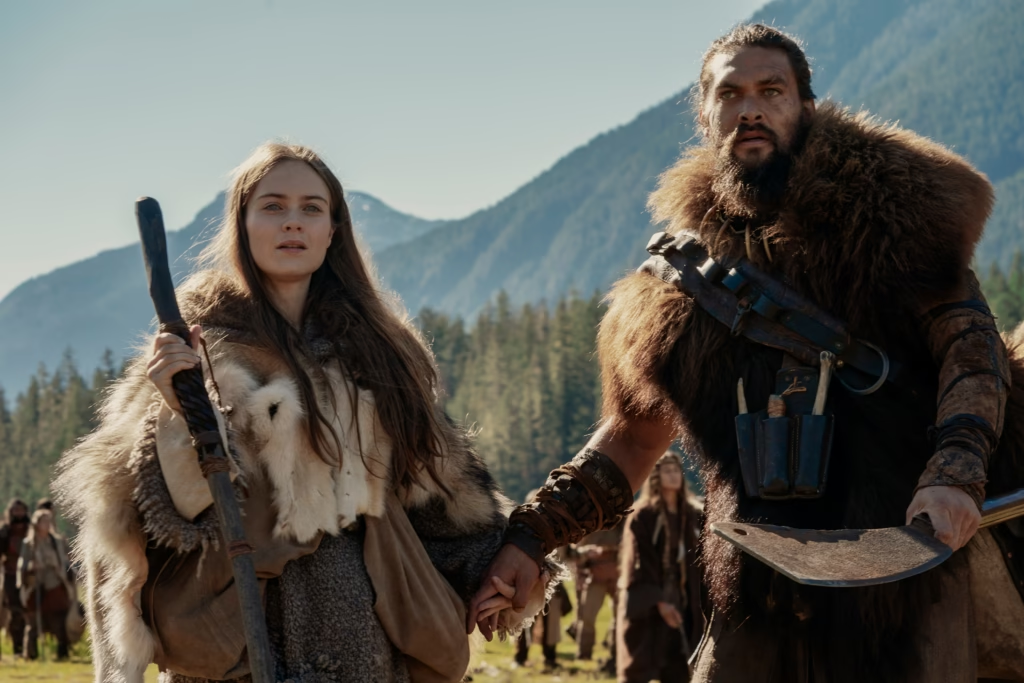
At the center of the story is Baba Voss, a formidable warrior and tribal leader played by Momoa. His adopted children, twins Kofun and Haniwa, are born with sight, making them extraordinary but also extremely dangerous in a civilization where even speaking about vision can be considered heresy. Their existence pulls Baba and his family into a much larger struggle involving religious fanaticism, political power, rival kingdoms, forgotten knowledge, and the question of whether humanity should reclaim abilities from its lost civilization.
See premiered on November 1, 2019 and ultimately ran for three seasons, with its final episode arriving on October 14, 2022. The entire story consists of 24 episodes—eight per season—making it a completed series rather than another science-fiction show viewers must begin without knowing whether it will ever receive a proper conclusion.
The interesting part is that See did not begin as a critical darling. Its first season received mixed-to-negative reviews, but the response improved dramatically as the series expanded its world and leaned harder into its strengths. Rotten Tomatoes currently records 44% for Season 1 and 83% for Season 2, while several critics reviewing the third season felt the series had continued improving.
So, was See an expensive Apple experiment that struggled to justify its unusual premise, or did audiences discover something critics initially underestimated?
The answer is considerably more interesting than its first-season review score suggests.
See – Official Trailer
What Is See About?
See takes place several centuries after a catastrophic virus killed most of humanity. Fewer than two million people initially survived, and subsequent generations lost the ability to see. Over hundreds of years, humanity adapted until civilization itself became fundamentally different from anything recognizable today.
People hunt, construct settlements, fight wars, travel, raise families, and govern kingdoms without relying upon vision. Society has also technologically regressed, with much of humanity’s previous knowledge disappearing or becoming distorted into mythology. Materials left behind by the old civilization can even be interpreted as objects created by gods rather than remnants of an advanced industrial society.
More importantly, sight itself has become a dangerous idea.
People who claim that humans could once see may be treated as heretics. The possibility that sight could return threatens religious beliefs, political systems, and social structures that have developed over centuries.
The story begins to change when Maghra, a pregnant woman seeking refuge with the Alkenny tribe, gives birth to twins. Baba Voss, leader of the Alkenny, becomes their adoptive father. The children’s biological father is Jerlamarel, a mysterious man possessing the supposedly impossible ability to see.
The twins, Kofun and Haniwa, inherit that ability.
Their existence eventually attracts the attention of Queen Sibeth Kane and her Witchfinders, placing Baba in the position that defines much of the series: a father willing to fight virtually anyone to protect his family.
From there, what initially resembles a survival story gradually develops into something much larger involving kingdoms, armies, religious authority, lost technology, political alliances, family rivalries, and the future of human civilization.
Is See Worth Watching?
Yes—especially if you enjoy ambitious science-fiction worlds, brutal action, political conflict, and larger-than-life characters.
The important qualification is that See requires viewers to accept its central concept. Trying to evaluate every aspect of its civilization exclusively through the logic of contemporary life can make certain elements difficult to accept. The series instead asks viewers to imagine what humanity might become after hundreds of years without sight.
Once that premise is accepted, the world becomes the show’s biggest attraction.
People communicate differently. Warriors fight differently. Settlements are designed differently. Navigation requires different methods. Social status and religious beliefs have developed around senses and abilities that contemporary civilization largely takes for granted.
The series also improves as it progresses. Season 1 spends considerable time explaining its world and establishing its mythology, which contributes to some pacing problems. Season 2 expands the political landscape, introduces new characters and factions, and gives Baba Voss a much more personal conflict. Season 3 can then build upon an already established world instead of constantly explaining how it functions.
Rotten Tomatoes currently gives the overall series a 63% average critics score but an 84% audience score, an unusually noticeable gap that helps illustrate the difference between its initial critical reception and its popularity among viewers who connected with the concept.
If you abandon See after only its earliest episodes, you may therefore never reach the version of the series that ultimately became its strongest.
Why Should You Watch See?
The biggest reason is that there really isn’t another major television series quite like it.
Post-apocalyptic fiction is hardly unusual. Television has given audiences countless stories about pandemics, zombies, nuclear destruction, ecological disasters, and civilization collapsing. See begins after the conventional apocalypse story would already be over.
Humanity has survived.
The fascinating question becomes what humans built afterward.
Centuries without sight have affected everything from combat and architecture to language, religion, education, relationships, and political authority. The return of sight therefore becomes more complicated than simply discovering a useful ability.
For Kofun and Haniwa, sight is extraordinary.
For religious authorities, it can be heresy.
For military leaders, it could become a weapon.
For people fascinated by the old world, it offers access to forgotten knowledge.
And for civilization itself, it could potentially overturn centuries of social development.
That tension gives See an identity considerably stronger than a conventional “Jason Momoa fights people in the wilderness” description would suggest.
Although, to be fair, Jason Momoa fighting people in the wilderness is another very good reason to watch it.
The World Without Sight Is See’s Greatest Idea
The central concept could easily have become a gimmick.
Instead, the production attempted to think seriously about how a society without sight might function.
Creator Steven Knight, director Francis Lawrence, the writers, and the production departments worked with blindness consultants, an evolutionary biologist, and a survivalist while developing the world. Their discussions explored how communities could adapt socially and physically after generations without vision.
That attention appears throughout the series.
Characters use knots and tactile systems to communicate information. Warriors exploit sound and environmental awareness during combat. People announce themselves differently when entering spaces. Settlements are constructed around movement patterns that do not depend upon visual orientation.
Even ordinary interactions had to be reconsidered.
The creators were aware that portraying blindness through familiar cinematic clichés would undermine the entire concept. This society has existed without sight for generations, meaning its inhabitants should not behave like recently blinded people attempting to imitate sighted civilization.
They are adapted to their environment.
That distinction is crucial.
Sight Is Both a Gift and a Threat
One of See‘s smartest decisions is refusing to treat sight as automatically beneficial.
From the perspective of a modern viewer, being able to see obviously seems advantageous. Kofun and Haniwa can read surviving books, recognize distant threats, understand maps and images, and interact with remnants of the old world in ways that others cannot.
But their ability also creates enormous danger.
Sight can provide military superiority. It can destabilize political systems. It challenges religious doctrine. It creates inequality between people possessing the ability and those without it.
The show gradually turns sight into a question about power.
What happens when one group possesses an ability unavailable to almost everyone else?
Should that ability be protected?
Should it be controlled?
Should humanity attempt to restore it?
Or could restoring the old world also restore the same destructive forces that helped create humanity’s problems in the first place?
Those questions give the show’s premise much more substance than its initial hook suggests.
Jason Momoa as Baba Voss
Jason Momoa is perfectly suited to Baba Voss.
Baba is introduced as the leader of the Alkenny tribe, husband of Maghra, and adoptive father of Kofun and Haniwa. He is an exceptionally capable warrior whose greatest motivation is protecting his family.
Momoa naturally brings physical presence to the role, and See takes full advantage of it. Baba’s combat style is aggressive, tactile, and brutally efficient. He does not fight as though he is a sighted warrior wearing a blindfold. He listens, feels movement, manipulates distance, uses contact, and turns the environment itself into part of his fighting technique.
But Baba works because he is more than a warrior.
His relationship with Kofun and Haniwa gives Momoa some of the show’s most emotional material. Baba understands that his children possess something extraordinary, but he never allows their sight to become more important than their identities as his children.
There is also a darker history behind him that gradually becomes important.
The contrast between Baba’s past and the man he has chosen to become gives Momoa considerably more dramatic material than the premise initially appears to promise.
Baba Voss Is the Heart of See
The worldbuilding may attract viewers, but Baba Voss is what holds the series together.
Almost every major political and ideological conflict eventually becomes personal for him because his priorities are remarkably straightforward.
Baba does not want to reshape civilization.
He does not want to become a king.
He does not want to control sight.
He wants his family safe.
The tragedy is that the importance of his children makes that increasingly impossible.
Kofun and Haniwa represent something every major faction eventually has a reason to care about. Protecting them consequently forces Baba into conflicts he would otherwise have little interest in fighting.
That makes him an effective protagonist because his motivations remain understandable even when the world around him becomes increasingly complicated.
Baba may be capable of extraordinary violence, but his defining characteristic is ultimately loyalty.
Queen Sibeth Kane
If Baba Voss provides the emotional center, Queen Sibeth Kane provides much of the chaos.
Played by Sylvia Hoeks, Sibeth rules the Payan Kingdom and is Maghra’s older sister. She exercises her authority ruthlessly and initially treats claims about sight as dangerous heresy.
Sibeth is deliberately theatrical.
Her unusual speech patterns, religious certainty, cruelty, sensuality, political instincts, and unpredictable behavior make her one of the show’s most divisive characters. Some viewers may find the performance excessive, while others will see her as exactly the kind of unstable ruler this heightened world needs.
What makes Sibeth effective is her understanding of belief.
She knows political authority does not depend entirely on military strength. People must believe that their ruler possesses legitimacy, divine approval, or some other justification for power.
Sight threatens that structure.
If something declared impossible by religious authority suddenly exists, then other supposedly unquestionable truths can also be challenged.
Sibeth therefore becomes more than a conventional villain. She represents a political system threatened by evidence that its worldview may no longer be sustainable.
Maghra Kane
Hera Hilmar’s Maghra begins the story as a woman who has sought refuge among the Alkenny, but her history is considerably more important than Baba initially understands.
She is Kofun and Haniwa’s mother, Baba’s wife, and the younger sister of Queen Sibeth Kane.
Maghra provides an important bridge between the show’s family story and its larger political narrative.
Where Baba primarily thinks like a protector and warrior, Maghra understands power structures, leadership, negotiation, and the consequences political decisions can have for entire populations.
Her priorities repeatedly force her to balance family against responsibility.
That becomes increasingly important as See expands beyond the Alkenny and reveals the scale of the Payan Kingdom, Trivantian Republic, Witchfinders, and other groups competing for influence.
Kofun and Haniwa
Kofun and Haniwa are twins, but the series deliberately gives them very different relationships with sight.
Archie Madekwe plays Kofun as the more cautious and measured sibling. Nesta Cooper’s Haniwa is more rebellious, curious, and willing to explore what their ability might mean.
That difference is important because neither sibling can simply ask society how a sighted person should live.
There is effectively no established culture for them.
Books provide information from a civilization that no longer exists. Their father Jerlamarel offers one interpretation of what sight means. Baba and Maghra provide another perspective centered around survival and family.
The twins must eventually decide what sight means for themselves.
Their disagreements also allow the series to explore one of its most interesting questions: whether possessing an advantage creates an obligation to use it.
Haniwa frequently sees possibility.
Kofun more readily sees danger.
Both perspectives make sense.
Alfre Woodard as Paris
Alfre Woodard brings warmth and authority to Paris, the wise elder of the Alkenny tribe.
Paris acts as a spiritual and maternal presence within Baba’s family, providing guidance when the younger characters are overwhelmed by forces they do not fully understand.
She is particularly important because See contains many characters obsessed with controlling the future.
Political leaders want control.
Religious authorities want control.
Sighted people may believe their ability gives them the right to determine humanity’s direction.
Paris represents something different: wisdom without the constant need for domination.
Woodard’s performance consequently provides an important counterbalance to the larger personalities surrounding her.
Tamacti Jun
Christian Camargo’s Tamacti Jun is one of the characters who demonstrates why See becomes more interesting as it progresses.
He begins as the Witchfinder General serving the Payan monarchy, tasked with hunting people associated with sight and particularly the children of Jerlamarel.
That setup could have made him a straightforward antagonist.
Instead, the series gradually gives him questions of loyalty, duty, morality, faith, and political responsibility.
Tamacti Jun has spent much of his life serving an institution whose beliefs he has been taught to regard as unquestionable. Once contradictions begin appearing, obedience becomes considerably more complicated.
His development is a good example of the broader strengths of See.
Characters who initially appear to represent simple archetypes often become more interesting once their loyalties are tested.
Dave Bautista Makes Season 2 Better
Season 2 introduces Dave Bautista as Edo Voss, Baba’s younger brother and Commander General of the Trivantian army.
This was exactly the kind of addition the series needed.
Bautista gives Baba an opponent who can match his physical presence while also making their conflict intensely personal. Edo is not simply another military commander threatening Baba’s family. Their shared history gives every confrontation additional emotional weight.
The casting also creates an obvious spectacle.
Jason Momoa versus Dave Bautista sounds like something designed primarily to generate brutal fight scenes, and See certainly understands that appeal.
But their relationship works because the series gives the conflict history, resentment, and unresolved emotional damage.
Season 2 consequently feels larger without becoming less personal.
That improvement is reflected in its critical reception. Rotten Tomatoes records 83% for Season 2, compared with 44% for the first.
The Payan Kingdom
The Payan Kingdom represents one of the dominant powers in the world of See.
Its original capital is Kanzua, and Queen Sibeth Kane rules through a combination of monarchy, religion, military power, and the Witchfinder institution. The kingdom’s worldview has been shaped by generations in which sight is treated as heresy.
This makes the return of sight politically explosive.
If sight exists, then authorities who persecuted people for believing in it must confront the possibility that their doctrine was wrong.
That is far more dangerous than merely discovering people with an unusual ability.
It threatens legitimacy.
The Payan storyline allows See to expand beyond wilderness survival and examine how institutions react when facts challenge the beliefs supporting their authority.
The Trivantian Republic
The Trivantian Republic provides a different model of civilization.
Its capital, Trivantes, corresponds geographically to what was once Pittsburgh, while much of the broader story takes place across a transformed version of western Pennsylvania.
Trivantes becomes increasingly important as the series progresses, particularly during the second and third seasons.
Unlike the Payan monarchy, the Trivantian political structure distributes authority through a ruling triumvirate representing different areas of society.
That does not make it peaceful.
The Trivantians possess considerable military strength and have their own ambitions, internal divisions, and strategic interests concerning sight.
Expanding into Trivantes helps Season 2 enormously because the series stops feeling like a story about one family fleeing one queen and begins resembling a genuine geopolitical fantasy.
The Witchfinders
The Witchfinders are among the most disturbing consequences of See‘s worldbuilding.
Their existence demonstrates what happens when a religious belief becomes embedded within state power.
Sight is not merely considered unusual.
It can be considered heretical.
That transforms people associated with sight into threats against the established social order, allowing persecution to be justified as religious duty.
The series uses the Witchfinders to explore institutional loyalty and indoctrination. People raised to believe sight represents evil cannot instantly abandon those convictions simply because political leaders decide circumstances have changed.
That becomes increasingly important later in the story.
Beliefs can survive even after the institutions enforcing them begin changing.
How Does Combat Work in See?
The action is one of the show’s most distinctive features.
Conventional screen combat depends enormously on vision. Fighters track opponents visually, aim weapons, judge distances, watch attacks, and respond to movement.
See had to invent another cinematic language.
Characters listen for footsteps, breathing, weapons, and changes in their surroundings. Physical contact becomes extremely important because touching an opponent immediately provides information about position and movement. Fighters also manipulate sound, terrain, ropes, walls, water, and other environmental elements.
Baba Voss is particularly effective because he turns close-range fighting into something almost predatory.
The choreography can occasionally stretch plausibility, but it is rarely boring.
More importantly, it feels specific to See.
You could remove dialogue from many of its best fights and still immediately recognize what show you were watching.
The Cast Trained to Perform Without Sight
The production did not simply instruct actors to close their eyes and improvise.
Before filming began, the largely sighted cast underwent approximately one month of blindness training with consultant Joe Strechay. Actors sometimes trained using sleep shades and practiced moving without vision while developing greater reliance on their other senses, including basic echolocation techniques. Movement director Paradox Pollack also worked with the cast.
One objective was avoiding stereotypical portrayals of blindness.
For example, the production specifically wanted to avoid clichés such as characters constantly touching other people’s faces to identify them.
Blind and low-vision performers were also included in supporting roles, including Bree Klauser and Marilee Talkington, with Adam Morse later appearing during Season 2.
Apple subsequently highlighted the involvement of blind and low-vision cast and crew when promoting the series, and See received the Ruderman Family Foundation Seal of Authentic Representation in 2020.
Where Was See Filmed?
Although the story takes place in a distant-future version of what was once the United States, much of See was filmed in Canada.
Season 1 production began in September 2018 around Vancouver, British Columbia, with filming taking place across numerous locations including Coquitlam, North Vancouver, Pemberton, Mission, Squamish Valley, Vancouver Island, and Strathcona Provincial Park.
Those landscapes contribute enormously to the show’s identity.
Forests, mountains, rivers, abandoned infrastructure, and enormous wilderness environments make civilization feel genuinely diminished compared with the natural world surrounding it.
Production later moved significantly toward Ontario.
Season 2 encountered a major interruption when filming shut down during the COVID-19 pandemic in March 2020. Production eventually resumed in Toronto in October and finished in March 2021.
Season 3 then filmed during 2021.
Production and Development
Apple ordered the original eight-episode season in January 2018.
Steven Knight, known for creating Peaky Blinders, wrote the series, while The Hunger Games director Francis Lawrence played an important role in establishing its visual identity and served as an executive producer alongside Knight, Peter Chernin, Jenno Topping, and others.
The project was extremely ambitious for an original streaming series launching alongside a new platform.
Entire cultures had to be imagined around a condition rarely used as the foundation for large-scale fantasy or science-fiction worldbuilding. Costumes, props, architecture, combat, communication, movement, and everyday behavior all had to support the same premise.
That production value remains one of See‘s greatest strengths.
Even when its writing becomes melodramatic, the world rarely feels cheap.
See Season 1
Season 1 consists of eight episodes and originally ran from November 1 through December 6, 2019.
This is the season most heavily devoted to establishing the premise.
Viewers learn about Baba Voss, Maghra, Kofun, Haniwa, the Alkenny, Jerlamarel, Queen Kane, Tamacti Jun, and the Witchfinders while gradually discovering how civilization functions.
The first season is imaginative but uneven.
Its biggest strength is discovery. Almost every episode introduces another detail about this strange future, whether involving forgotten technology, religious beliefs, tribal customs, or the implications of sight.
Its weakness is pacing.
The story occasionally spends too long moving characters between locations while withholding answers that viewers can already anticipate.
Still, Season 1 establishes enough fascinating ideas to justify continuing.
See Season 2
Season 2 contains another eight episodes and ran from August 27 through October 15, 2021.
For many viewers, this is where See becomes the series its premise always promised.
The world expands substantially. Trivantes becomes more important, political conflicts grow more complicated, and the introduction of Edo Voss gives Baba a powerful personal antagonist.
The supporting characters also receive more room to develop.
Rather than simply running from danger, the characters increasingly have to decide what kind of world they want to create.
Critical reception improved substantially. Season 2 currently holds an 83% Tomatometer score, although it is worth noting that this figure is based on only six reviews.
The improvement is nevertheless understandable.
Season 1 builds the world.
Season 2 finally gets to play inside it.
See Season 3
The third and final season contains eight episodes, beginning August 26, 2022 and concluding October 14.
By this stage, the question surrounding sight has evolved again.
The ability is no longer merely something that makes individual characters special. Knowledge from the old world can potentially be combined with sight to recreate technologies capable of changing warfare itself.
That development gives the final season a logical thematic direction.
If humanity regains the abilities of the old civilization, it may also regain its capacity for destruction.
Apple explicitly announced Season 3 as the final chapter, rather than leaving viewers with an unresolved cancellation.
Critical reaction to the final season was limited in volume but generally encouraging. Rotten Tomatoes currently lists only four critic reviews, while its audience score stands at 82%. Several of those critics specifically argued that the series had improved considerably over its run.
How Many Episodes of See Are There?
There are 24 episodes in total.
Each of the three seasons contains eight episodes:
- Season 1: 8 episodes
- Season 2: 8 episodes
- Season 3: 8 episodes
The unusually consistent structure makes See relatively easy to watch compared with sprawling genre series requiring dozens of hours per season.
More importantly, the story is complete.
You can begin Episode 1 knowing there is an actual ending waiting at Episode 24.
Did See Get Cancelled?
See ended after three seasons, but describing its conclusion simply as a sudden cancellation can be misleading.
Apple announced in June 2022 that the upcoming eight-episode third season would be the show’s final season. Showrunner Jonathan Tropper described it at the time as the final chapter of the story.
That distinction matters.
Many science-fiction series disappear after ending on unresolved cliffhangers.
See was able to construct its third season as a conclusion.
Viewers considering starting the show today therefore do not have to worry about investing 24 episodes into an unfinished narrative.
Does See Get Better After Season 1?
Yes.
This may be the single most useful thing to know before watching.
Season 1 currently holds only 44% on Rotten Tomatoes, while Season 2 jumps to 83%.
Numbers alone do not tell the whole story, especially because Season 2 has far fewer recorded critic reviews.
But the creative improvement is noticeable.
Season 1 has to perform an enormous amount of worldbuilding while simultaneously establishing its characters and central mystery. Once that foundation exists, Season 2 can introduce larger political conflicts, stronger antagonists, and more complicated character relationships.
Dave Bautista’s arrival also helps tremendously.
By Season 3, the series understands its identity.
It stops needing to convince viewers that its world is unusual and focuses instead on what that world means for the people living inside it.
Why Were Season 1 Reviews So Mixed?
Critics did not reject the concept.
In many cases, they found the execution inconsistent.
The first season received a 44% Rotten Tomatoes score, while Metacritic recorded 40/100 from 25 critics, indicating generally unfavorable reviews at the time.
Complaints frequently focused on pacing, convoluted storytelling, violence, and the amount of time episodes required to develop relatively straightforward plot points.
Those criticisms are understandable.
See sometimes takes itself extremely seriously, and certain aspects of its mythology can sound strange when described outside the context of the world.
Yet audiences who accepted those eccentricities often responded much more positively.
Rotten Tomatoes currently records an 84% average audience score for the overall series, compared with its 63% average critics score.
That gap helps explain why See developed a more enthusiastic following than its initial reviews might suggest.
The Action Deserves More Recognition
Whatever viewers think about the story, the action choreography deserves attention.
See had to solve a problem most action productions never encounter: how do you create elaborate battles involving combatants who cannot visually track one another?
The answer produces fights unlike almost anything else on television.
Combatants establish physical contact before attacking. They listen for movement. They deliberately generate or suppress sound. Weapons are used to control space rather than simply target visible opponents.
Baba’s fighting style becomes particularly recognizable.
Momoa’s size gives the character enormous physical power, but Baba often wins through awareness rather than strength alone.
Season 2 takes this even further when characters with different abilities and combat philosophies begin confronting one another.
The result can be extremely violent.
But it is rarely generic.
Is See Like Game of Thrones?
There are obvious similarities, but calling See an Apple version of Game of Thrones oversimplifies it.
Both feature competing political powers, brutal violence, royal families, armies, betrayals, religious authority, and enormous landscapes. The production scale of See also invited comparisons with expensive prestige fantasy from the beginning.
But its central concept creates a fundamentally different type of world.
Game of Thrones builds upon recognizable medieval political structures and then introduces fantasy elements.
See begins by removing one of humanity’s primary senses and asks how civilization would evolve afterward.
That makes it closer to a hybrid of post-apocalyptic science fiction, tribal fantasy, family drama, and political epic.
Viewers who enjoy Game of Thrones may find plenty to appreciate.
They should not expect the same show.
The Series Is Really About Knowledge
Sight appears to be the central subject, but knowledge may actually be more important.
The old world left behind books, buildings, machines, infrastructure, and other evidence of a civilization that modern characters can barely comprehend.
Sighted characters can access parts of that knowledge that others cannot.
That creates an enormous imbalance.
Knowing how electricity works matters.
Knowing what old technology can do matters.
Being able to read matters.
Understanding what humanity previously achieved—and what destroyed it—matters even more.
The series therefore asks whether recovering lost knowledge automatically represents progress.
History suggests otherwise.
Knowledge can cure disease.
It can also create weapons.
It can educate populations.
It can also concentrate power.
The ability to see opens the door.
What humanity chooses to retrieve through that door becomes the more important question.
Religion and Political Power
Religion plays a major role in See because societies create explanations for things they cannot understand.
After centuries without vision, sight has moved from biological memory into mythology.
That allows political and religious authorities to define what sight means.
Calling it heresy gives institutions control over how people respond to evidence contradicting established doctrine.
The show becomes particularly interesting when those institutions can no longer ignore reality.
If sight undeniably exists, what happens to everyone whose authority depended upon claiming that it did not?
Some adapt.
Some resist.
Some attempt to control the new reality.
Others become more extreme.
That reaction feels remarkably believable because institutions rarely disappear immediately when the beliefs supporting them are challenged.
What Would Happen If Sight Returned?
This is the question that gradually becomes larger than Baba’s family.
At first, Kofun and Haniwa simply need protection.
But imagine sight spreading across generations.
Military tactics would change.
Architecture would change.
Education would change.
Written information could return.
Old technology could be rediscovered.
Existing political structures might collapse.
People without sight could potentially find themselves disadvantaged within a society their ancestors built specifically around blindness.
That final point is particularly important.
From the perspective of contemporary viewers, restoring sight sounds like restoring something humanity lost.
From the perspective of people living in See, it could create an entirely new social inequality.
The show does not explore every implication equally deeply, but the questions generated by its premise are fascinating.
Where Can You Watch See?
All three seasons are currently available through Apple TV.
Apple’s current listing includes the complete series, beginning with “Godflame” and continuing through all three seasons.
Because the show concluded in 2022, viewers can now watch the entire story without waiting between seasons.
That arguably makes See easier to appreciate today than during its original run.
Its slower early worldbuilding becomes less frustrating when the next episode is immediately available.
Legacy and Impact
See is unlikely to be remembered as the defining television drama of the streaming era.
Its significance lies somewhere more interesting.
It was one of the major original productions that helped establish Apple’s ambitions in prestige television when Apple TV+ launched in 2019. It attempted expensive large-scale genre storytelling around a premise few mainstream productions would have considered safe.
It also made the portrayal of blindness central to an enormous fantasy world rather than limiting blind characters to supporting roles in an otherwise sighted society.
The production’s involvement of blind and low-vision performers and consultants was recognized with the Ruderman Family Foundation’s Seal of Authentic Representation.
Creatively, the show also demonstrated that its unusual concept could support more than a single-season experiment.
It lasted three seasons.
Its world expanded.
Its critical response improved.
And it received a genuine conclusion.
That is a respectable legacy for a series whose initial reviews suggested it might become one of Apple TV+’s earliest major misfires.
Frequently Asked Questions
What is See about?
See is a post-apocalyptic science-fiction series set centuries after humanity has lost the ability to see. The story follows warrior Baba Voss as he protects his adopted children Kofun and Haniwa, twins born with the supposedly mythical ability of sight.
Who created See?
The series was created by Steven Knight, also known for creating Peaky Blinders. Francis Lawrence played a major role in establishing the series as director and executive producer.
Who plays Baba Voss?
Jason Momoa plays Baba Voss, leader of the Alkenny tribe and adoptive father of Kofun and Haniwa.
Who plays Queen Kane?
Sylvia Hoeks plays Queen Sibeth Kane, ruler of the Payan Kingdom and older sister of Maghra.
Is Dave Bautista in See?
Yes. Dave Bautista joins Season 2 as Edo Voss, Baba Voss’ younger brother and commander of the Trivantian army.
How many seasons of See are there?
There are three seasons.
How many episodes are in See?
There are 24 episodes, with eight episodes in each season.
Is See finished?
Yes. The third season was officially announced as the final season, and the series concluded on October 14, 2022.
Was See cancelled?
The series ended after three seasons, but Apple announced ahead of Season 3 that it would be the final chapter. The writers therefore had the opportunity to conclude the story rather than leaving it on an unresolved cliffhanger.
Does See have a proper ending?
Yes. Season 3 was constructed as the final season and Episode 24 serves as the series finale. This article intentionally avoids revealing what happens during that conclusion.
Is everyone blind in See?
Most of humanity cannot see, but a small number of characters possess sight. The existence and growing importance of sighted people becomes one of the central conflicts of the series.
Why did people lose their sight in See?
A devastating virus nearly destroyed humanity in the 21st century. The descendants of the survivors subsequently lost the ability to see, and the series takes place centuries later.
Where does See take place?
The fictional civilizations correspond broadly to areas of what was once western Pennsylvania. Names such as Alkenny, Kanzua, Pennsa, and Trivantes have recognizable connections to Allegheny, Kinzua, State College, and Pittsburgh.
Where was See filmed?
The series was filmed in Canada. Season 1 used numerous British Columbia locations, while later production also took place in Ontario.
Did the actors train to act blind?
Yes. The predominantly sighted cast underwent approximately a month of training with blindness coach Joe Strechay before filming, learning movement techniques and ways to rely more heavily upon nonvisual senses.
Were blind actors involved in See?
Yes. Blind and low-vision performers appeared in the series, while blind and low-vision cast and crew also contributed to developing its world. Apple noted that the series received the Ruderman Family Foundation Seal of Authentic Representation in 2020.
Does See get better after Season 1?
For many viewers, yes. Season 2 expands the world, introduces stronger political conflicts and Dave Bautista’s Edo Voss, and currently holds an 83% Rotten Tomatoes critics score compared with Season 1’s 44%.
Is See worth watching just for Jason Momoa?
Momoa is certainly one of the strongest reasons to watch, particularly because Baba Voss combines his physical action presence with a surprisingly emotional family story. However, the unusual worldbuilding, combat system, political conflicts, Sylvia Hoeks’ Queen Kane, and Dave Bautista’s Season 2 arrival give the show much more to offer.
Is See very violent?
Yes. See contains frequent brutal combat, deaths, injuries, and other mature material. Apple’s current listing includes violence among its content advisories, and the series carries an adult rating.
Is See similar to Game of Thrones?
There are similarities in its political rivalries, kingdoms, warfare, violence, family conflicts, and large-scale fantasy presentation. However, See is fundamentally a post-apocalyptic science-fiction story built around a civilization that evolved without sight.
Is See worth watching in 2026?
Yes, particularly now that viewers can watch the complete story without waiting for additional seasons. Its first season is uneven, but the worldbuilding is genuinely distinctive, Season 2 represents a noticeable improvement, and Season 3 provides an intentional conclusion rather than an unresolved cancellation.
Conclusion
See is one of those television series whose reputation becomes considerably more interesting once you look beyond its first reviews.
Its opening season was imperfect. The pacing could drag, some of the mythology was delivered with overwhelming seriousness, and critics understandably questioned whether such an elaborate production had found the right story for its extraordinary premise. A 44% Rotten Tomatoes score for Season 1 reflects those problems.
But judging the entire series by those eight episodes misses what happened afterward.
The world became larger.
The political conflicts became stronger.
Characters who initially looked straightforward developed more complicated loyalties.
Dave Bautista’s Edo Voss gave Baba a formidable personal opponent.
And the question of sight evolved from a family secret into something capable of transforming civilization.
At the center of everything remained Jason Momoa.
Baba Voss may look like another role designed around Momoa’s enormous physical presence, but the character becomes much more than that. His violence exists alongside tenderness, regret, loyalty, and an almost absolute commitment to protecting his family. That emotional foundation prevents See from becoming merely an expensive collection of elaborate fight scenes.
The production deserves considerable credit as well. Building an entire civilization around generations of people who have never experienced sight required rethinking movement, communication, combat, architecture, religion, and social behavior. The involvement of blindness consultants and blind and low-vision performers gave that process additional grounding.
Not every idea works perfectly.
But very few television shows even attempt something this unusual.
That may ultimately be the best argument for watching it.
See offers three seasons, 24 episodes, a completed story, spectacular environments, distinctive combat, Jason Momoa at his most physically imposing, a memorable villain in Queen Kane, Dave Bautista joining the conflict in Season 2, and one of the stranger post-apocalyptic civilizations created for mainstream television.
The first season asks for patience.
The second demonstrates what the concept can really do.
The third gives the story an ending.
For viewers who dismissed See because of its early reviews, it may be worth giving Baba Voss and his strange, sightless world another look.
If you don’t know where to watch this Series for FREE make sure to contact me via E-mail, or in the comments below. Thank you for reading and make sure to bookmark the site.
How useful was this post?
Click on a star to rate it!
Average rating 0 / 5. Vote count: 0
No votes so far! Be the first to rate this post.