
 9.1/10
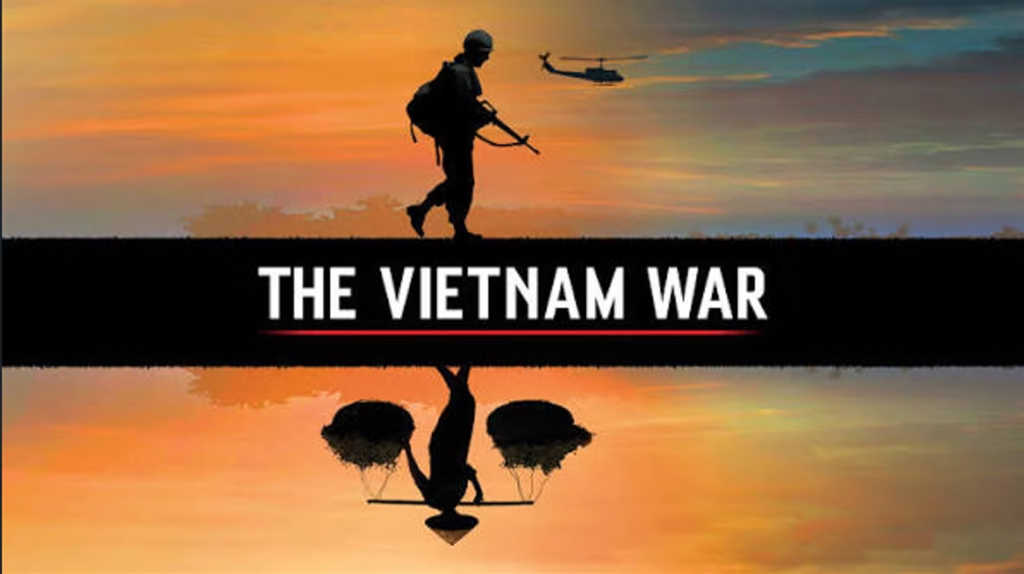
Few historical events have produced as much argument, trauma, political division, and cultural reflection as the Vietnam War, which makes attempting to tell its story in a single documentary an enormous challenge. Ken Burns and Lynn Novick approached that challenge with The Vietnam War, an expansive documentary series written by Geoffrey C. Ward and narrated by Peter Coyote. Premiering on PBS on September 17, 2017, the series consists of ten episodes covering a historical period stretching from the roots of French colonial involvement in Vietnam through the war itself and into the decades of memory and reconciliation that followed.
PBS describes The Vietnam War as a ten-part, roughly 18-hour production built around an immersive narrative and testimony from nearly 80 witnesses representing very different experiences of the conflict. Those voices include American service members, anti-war activists, North Vietnamese and South Vietnamese combatants, civilians, journalists, military families, government personnel, and others whose lives intersected with the war.
That emphasis on personal testimony is one of the most important things to understand before watching. Burns and Novick were not simply interested in producing a chronological military documentary explaining which army moved where and when. They wanted to examine how an extraordinarily complicated geopolitical conflict was experienced by individual human beings.
The result is demanding, emotionally exhausting, frequently disturbing, and deliberately unwilling to reduce the Vietnam War to a simple story about heroes and villains.
The Vietnam War (Documentary) – Official Trailer
What Is The Vietnam War About?
The Vietnam War attempts to reconstruct the conflict from its historical roots rather than beginning with the arrival of large numbers of American combat troops. Its first episode, appropriately titled “Déjà Vu,” covers the period from 1858 through 1961, allowing the documentary to examine French colonial rule, Vietnamese nationalism, Ho Chi Minh and the revolutionary movement, the First Indochina War, the division of Vietnam, Cold War politics, and the increasing involvement of the United States.
From there, the series moves chronologically through the escalating American commitment under John F. Kennedy and Lyndon B. Johnson, the expansion of combat operations, the experiences of American and Vietnamese soldiers, political instability in South Vietnam, North Vietnam’s strategy, the anti-war movement, the Tet Offensive, Richard Nixon’s presidency, Vietnamization, the widening conflict in Cambodia and Laos, the Paris Peace Accords, American withdrawal, and the eventual collapse of South Vietnam.
Yet the documentary continually moves between the enormous and the intensely personal. Presidential recordings can be followed by the memories of a soldier. Military strategy can give way to a grieving family. Political speeches can be contrasted with what people experienced on the ground.
This structure makes the documentary feel less like a traditional history lecture and more like a mosaic.
Individual memories gradually form a much larger picture.
Is The Vietnam War Worth Watching?
For viewers genuinely interested in understanding the Vietnam War, the series offers an unusually extensive starting point, particularly because of the scale of its archival research and firsthand testimony.
It is important, however, not to treat any single documentary as the definitive interpretation of a conflict this complicated. Burns and Novick assembled an extraordinarily broad narrative, but historians, veterans, Vietnamese commentators, and political writers have disputed elements of its framing and emphasis since its release. Those disagreements are themselves worth understanding.
As filmmaking, though, the achievement is substantial.
The documentary combines interviews, photographs, home movies, television broadcasts, government recordings, combat footage, narration, contemporary music, maps, and original scoring without allowing the enormous quantity of information to become completely overwhelming.
Its greatest asset may simply be time.
Approximately 18 hours sounds intimidating, but Vietnam is precisely the sort of subject that suffers when compressed into a conventional two-hour documentary. The length allows political decisions to accumulate gradually, relationships between events to become clearer, and people introduced early in the series to remain part of the narrative years later.
This is not casual background viewing.
It rewards attention.
Why Should You Watch The Vietnam War?
The most compelling reason is its human perspective.
Burns deliberately avoided structuring the documentary primarily around famous historians and recognizable political personalities. The production instead interviewed people who experienced the conflict directly. The source material identifies 79 witnesses, including Americans who fought or protested against the war and Vietnamese combatants and civilians representing both North and South.
That choice fundamentally changes the experience.
History often becomes a sequence of presidents, generals, dates, offensives, treaties, casualty figures, and political decisions. Those things remain essential here, but the documentary repeatedly returns to the people who had to live with their consequences.
The interviewees include figures such as writer and veteran Tim O’Brien, Marine officer and author Karl Marlantes, South Vietnamese military personnel, North Vietnamese veterans, anti-war activists, journalists, prisoners of war, intelligence personnel, military families, nurses, and civilians.
Their experiences frequently contradict one another.
That is not necessarily a weakness.
Memory itself becomes part of the documentary.
Ken Burns and Lynn Novick’s Approach
Ken Burns had already become closely associated with ambitious American historical documentaries through productions such as The Civil War, Baseball, and The War. The Vietnam War reunited him with longtime collaborator Lynn Novick for one of their largest projects.
According to the supplied production material, the series cost approximately $30 million and took more than a decade to make. WETA-TV and Burns’ Florentine Films produced the documentary, with funding coming from numerous organizations and foundations.
PBS’s production history similarly describes the project as ten years in the making and emphasizes the enormous quantity of archival material assembled for it.
That development time becomes understandable when considering the scope.
The filmmakers were not simply assembling American news footage.
They were attempting to construct a story incorporating American, North Vietnamese, South Vietnamese, military, civilian, governmental, journalistic, and anti-war perspectives.
That required finding people.
Finding footage.
Finding photographs.
Finding recordings.
And then somehow transforming all of those sources into one coherent narrative.
The Documentary Uses an Extraordinary Amount of Archival Material
The scale of the research is staggering.
According to the supplied material, researchers accessed more than 24,000 photographs and examined approximately 1,500 hours of archival footage while constructing the documentary. Across the final series, 25 battles are covered, with ten receiving particularly detailed treatment from multiple perspectives.
PBS also highlights digitally remastered footage gathered from sources around the world, historic television broadcasts, home movies, photography from major photojournalists, and secret recordings from inside the Kennedy, Johnson, and Nixon administrations.
Those presidential recordings are particularly effective.
Knowing what political leaders said publicly is one thing.
Hearing private conversations about the war creates an entirely different understanding of the pressures, calculations, doubts, and political considerations surrounding major decisions.
The documentary frequently places those recordings beside what was happening on the battlefield.
The contrast can be uncomfortable.
That discomfort is intentional.
The Vietnam War Is About More Than American Soldiers
One of the documentary’s most significant ambitions was expanding the perspective beyond American combatants.
The series includes North Vietnamese soldiers, Viet Cong/National Liberation Front members, South Vietnamese military personnel, civilians, journalists, refugees, political figures, anti-war activists, and military families.
Among the interviewees listed in the supplied material are former South Vietnamese ambassador Bui Diem, ARVN Colonel Trần Ngọc Châu, North Vietnamese and National Liberation Front veterans, South Vietnamese officers, American veterans, journalists such as Joseph Galloway, CIA personnel, anti-war demonstrators, and numerous civilians.
That breadth matters because calling Vietnam simply an American war distorts what happened.
For Vietnamese people, the conflict involved colonialism, revolution, nationalism, communism, anti-communism, civil conflict, foreign intervention, reunification, displacement, and enormous civilian suffering.
Americans eventually went home.
Vietnamese people could not.
The Interviews Are the Heart of the Documentary
The archival footage may initially attract viewers, but the interviews provide much of the documentary’s emotional power.
People describe fear, anger, patriotism, disillusionment, guilt, grief, survival, political conviction, confusion, and memories that remained vivid decades after the events themselves.
Some believed deeply in what they were doing.
Others gradually stopped believing.
Some opposed the war from the beginning.
Others fought for South Vietnam.
Others fought for North Vietnam or the National Liberation Front.
Some simply tried to survive circumstances created by forces far larger than themselves.
The filmmakers’ decision not to depend primarily on famous political personalities allows lesser-known participants to become recurring characters.
You begin recognizing them.
Then history happens to them.
That can make events viewers already know about feel unexpectedly immediate.
Peter Coyote’s Narration
Peter Coyote provides the narration throughout the series, continuing his long association with Ken Burns documentaries.
His delivery is restrained rather than theatrical.
That restraint is important because the images rarely need additional dramatization.
The material already includes battlefield deaths, wounded soldiers, bombings, political assassinations, devastated communities, protests, executions, grieving families, and testimony from people remembering some of the worst experiences of their lives.
An overly dramatic narrator could easily make those sequences feel manipulative.
Coyote instead functions as a guide.
He provides dates, context, transitions, and historical explanation while allowing the participants and archival material to carry much of the emotional burden.
How Many Episodes Does The Vietnam War Have?
The PBS version consists of 10 episodes, originally broadcast between September 17 and September 28, 2017. Individual episodes vary considerably in length, with several approaching or exceeding two hours.
The episodes are:
- Déjà Vu (1858–1961)
- Riding the Tiger (1961–1963)
- The River Styx (January 1964–December 1965)
- Resolve (January 1966–June 1967)
- This Is What We Do (July–December 1967)
- Things Fall Apart (January–July 1968)
- The Veneer of Civilization (June 1968–May 1969)
- The History of the World (April 1969–May 1970)
- A Disrespectful Loyalty (May 1970–March 1973)
- The Weight of Memory (March 1973–Onward)
The chronology makes the documentary surprisingly accessible despite its size.
Rather than trying to remember dozens of disconnected topics, viewers move through the conflict progressively.
Each episode builds upon decisions made previously.
Episode 1 – Déjà Vu
The opening episode immediately demonstrates that Burns and Novick are unwilling to treat the Vietnam War as something that suddenly appeared during the 1960s.
“Déjà Vu” stretches from 1858 to 1961.
The episode examines French colonialism, Vietnamese resistance, Ho Chi Minh’s revolutionary movement, World War II, the First Indochina War, France’s defeat, the Geneva settlement, the division of Vietnam, and America’s increasing support for South Vietnam.
PBS summarizes the episode around Vietnamese revolutionaries ending nearly a century of French colonial occupation before the intensifying Cold War leaves Vietnam divided and the United States increasingly committed to Ngo Dinh Diem’s government in the South.
This historical foundation is essential.
Without it, America’s later intervention can appear detached from everything that preceded it.
Episode 2 – Riding the Tiger
“Riding the Tiger” covers 1961 through 1963, concentrating heavily on the Kennedy administration and the rapidly deteriorating situation in South Vietnam.
American involvement deepens while Ngo Dinh Diem’s government faces a communist insurgency and increasing domestic opposition, including the Buddhist crisis.
PBS describes Kennedy as wrestling with how deeply the United States should become involved while South Vietnam’s political situation grows increasingly unstable.
The episode demonstrates one of the documentary’s recurring themes.
Political leaders repeatedly face choices between undesirable alternatives.
Those decisions then create the circumstances for the next decision.
Escalation does not happen all at once.
It accumulates.
Episode 3 – The River Styx
The third episode moves into 1964 and 1965, when American involvement transforms dramatically.
This is where the war begins becoming much more recognizable to audiences familiar with iconic images of Vietnam: American combat units, helicopters, jungle warfare, major battles, bombing campaigns, and escalating casualties.
The episode also includes journalist Joseph Galloway, who witnessed the Battle of Ia Drang and later received a Bronze Star with “V” device for helping wounded soldiers during the battle.
By this point, the documentary’s combination of policy and personal testimony becomes particularly effective.
Washington discusses strategy.
Soldiers experience what those strategies mean.
Episode 4 – Resolve
“Resolve” covers January 1966 through June 1967.
American troop levels continue increasing while the conflict becomes more destructive and politically difficult.
The documentary explores battlefield operations alongside the growing gap between official optimism and the experiences of people actually fighting.
This period is particularly important for understanding why public confidence would later deteriorate so dramatically.
Wars are not experienced solely through battlefield outcomes.
They are also experienced through expectations.
If governments repeatedly suggest progress while casualties continue rising, credibility itself becomes part of the conflict.
Episode 5 – This Is What We Do
The fifth episode covers the second half of 1967.
By this stage, the war has become deeply embedded in American politics and culture.
Soldiers continue fighting an extraordinarily difficult conflict while opposition grows at home.
The documentary increasingly explores how the war affected families, journalists, students, veterans, activists, politicians, and communities far from Vietnam itself.
That widening social perspective becomes essential because Vietnam was not merely a foreign-policy crisis.
It transformed American society.
Episode 6 – Things Fall Apart
“Things Fall Apart” covers January through July 1968, one of the most consequential periods in the entire conflict.
The Tet Offensive becomes central to the episode, alongside the enormous military, political, and psychological consequences surrounding it.
Rather than reducing Tet to a simple victory-or-defeat label, the documentary examines the difference between battlefield outcomes and political perceptions.
That distinction is crucial for understanding Vietnam.
Military events could have consequences completely disproportionate to territorial gains or losses.
What Americans believed was happening became almost as politically important as what commanders believed was happening.
Episode 7 – The Veneer of Civilization
Episode seven moves from June 1968 through May 1969.
America is changing politically while the war continues.
Richard Nixon enters the White House promising a different approach, American society remains deeply divided, and soldiers continue facing the immediate realities of combat.
The documentary increasingly confronts the psychological consequences of prolonged warfare.
Its title captures something Burns and Novick repeatedly explore: the frightening speed with which ordinary assumptions about morality and civilization can deteriorate under extreme circumstances.
Episode 8 – The History of the World
“The History of the World” covers April 1969 through May 1970.
Nixon begins withdrawing American troops as morale deteriorates, while revelations about atrocities committed during the war further damage public confidence.
The conflict also expands geographically.
PBS’s episode description highlights the growing debate over the war’s legitimacy and the incursion into Cambodia, which reignited anti-war protests in the United States with deadly consequences.
By this point, the war abroad and political crisis at home have become inseparable.
Episode 9 – A Disrespectful Loyalty
The ninth episode spans May 1970 through March 1973.
Vietnamization increasingly places combat responsibility on South Vietnamese forces while American involvement changes form rather than disappearing immediately.
The documentary covers major military developments, continued bombing, negotiations, domestic political developments, and eventually the agreement that allows American prisoners of war to return home.
PBS describes the episode as ending with Americans returning to a country still deeply divided by what had happened.
The fighting, however, was not over for Vietnam.
That distinction becomes essential heading into the finale.
Episode 10 – The Weight of Memory
The final episode begins in March 1973 and moves beyond the immediate American withdrawal.
It examines the continuing conflict between North and South Vietnam, the fall of Saigon, and what followed for people on every side.
But the episode is also about memory.
What happens after a war ends?
How do veterans interpret what they experienced?
How do families live with loss?
How do refugees rebuild their lives?
How do nations remember a conflict when people cannot even agree about what it meant?
PBS describes the concluding chapter as following Americans and Vietnamese from different sides as they search for healing and reconciliation over the decades that follow.
That makes “The Weight of Memory” an appropriate title.
The fighting eventually stops.
Remembering does not.
The Music Is Exceptional
Music plays an unusually important role throughout The Vietnam War.
Trent Reznor and Atticus Ross created original music for the series after Burns approached them specifically because he wanted something more contemporary than simply relying on period recordings. The supplied production material notes that Reznor initially questioned why their musical style would fit the project before seeing footage and becoming convinced by its emotional power.
The documentary also uses more than 120 popular songs associated with the era, creating an enormous musical landscape around the historical footage.
Artists represented include Bob Dylan, Nina Simone, Jimi Hendrix, Simon & Garfunkel, The Temptations, Creedence Clearwater Revival, Janis Joplin, The Rolling Stones, Marvin Gaye, The Beatles, Buffalo Springfield, and many others.
The music is not merely nostalgic decoration.
These songs were part of the culture surrounding the people experiencing the war.
Hearing them alongside contemporary footage helps restore something documentaries frequently lose.
The period begins to feel lived in rather than reconstructed.
Production and Development
Creating The Vietnam War required years of research, interviewing, archival restoration, writing, editing, music licensing, historical verification, and international collaboration.
Burns and Novick had previously worked together on projects including The War, Baseball: The Tenth Inning, and Prohibition. Their experience with large-scale historical storytelling was particularly important here because Vietnam required balancing political history with individual testimony.
Geoffrey C. Ward wrote the series, while Sarah Botstein joined Burns and Novick as producer. PBS describes the production as a collaboration between Florentine Films and WETA in Washington, D.C.
A companion book also accompanied the documentary.
The Vietnam War: An Intimate History, written by Ward with an introduction by Burns and Novick, runs approximately 640 pages and was published shortly before the television premiere in September 2017.
The existence of such a substantial companion volume says something about the scale of the project.
Eighteen hours still could not contain everything.
Reception and Critical Response
Critical reception was exceptionally strong.
Rotten Tomatoes currently lists The Vietnam War at 96% from 49 critic reviews, with a 94% audience score. The supplied material also records a 90/100 Metacritic score from 19 reviews, categorized as universal acclaim.
Reviewers frequently praised the archival material, emotional power, enormous scope, and willingness to incorporate perspectives from different sides.
James Poniewozik of The New York Times summarized its intellectual and emotional impact in remarkably concise terms, while George Will praised its calm treatment of material still surrounded by political and personal pain.
Audiences also watched in enormous numbers.
PBS later reported that the documentary reached 39 million unique viewers across its premiere and encore broadcasts. Its ten-night premiere run averaged approximately 6.7 million viewers, while all ten episodes accumulated 10 million streams between September and December 2017.
For an approximately 18-hour historical documentary, those figures are remarkable.
The Documentary Was Also Heavily Debated
Critical acclaim did not produce historical consensus.
Some American and South Vietnamese veterans argued that the documentary underrepresented the South Vietnamese military and placed too much emphasis on North Vietnamese perspectives, anti-war activists, or American soldiers who became critical of the conflict. Those objections are documented in the supplied material alongside several other scholarly criticisms.
Historian Mark Moyar argued that Burns and Novick overemphasized American battlefield setbacks during particular periods, insufficiently addressed victories, and did not give enough attention to Chinese and Soviet support for North Vietnam.
Criticism also came from a very different direction.
Scholar Thomas Bass argued that the documentary’s emphasis on reconciliation softened or obscured questions concerning American power and the political origins of South Vietnam. University of Chicago historian Mark Philip Bradley similarly argued that the documentary did not sufficiently explore American empire, race, and broader structures of U.S. global power, while nevertheless praising its ability to tell powerful individual stories.
These criticisms point in different ideological directions.
That is important.
There is no single universally accepted criticism of The Vietnam War.
Different viewers dispute different elements of its framing.
Does The Vietnam War Have a Political Bias?
This is one of the most common questions surrounding the documentary, but reducing the debate to a simple left-wing versus right-wing label misses what actually happened after its release.
Burns himself anticipated criticism from opposing political directions, saying before release that he expected some people to view the production as excessively sympathetic to the left while others would interpret it as conservative.
That prediction largely came true.
Some South Vietnamese and American veterans criticized what they regarded as insufficient representation of their experiences. Historian Mark Moyar challenged elements of its military interpretation. Meanwhile, Thomas Bass and others criticized the documentary from the opposite direction for being too reconciliatory and insufficiently critical of American geopolitical power.
There were also sharply differing Vietnamese reactions. The supplied material records criticism from former South Vietnamese officials and families alongside Huy Duc’s observation that Vietnam’s communist government was also uncomfortable with a documentary that did not conform to its official narrative.
The safest way to approach the series is therefore not as the final authority on Vietnam.
Treat it as an extraordinarily ambitious interpretation supported by a huge body of testimony and archival evidence, and then explore competing historical scholarship if particular questions interest you.
What The Documentary Does Best
Its greatest accomplishment is making an enormous historical event feel personal without completely abandoning the larger political story.
Statistics tell viewers how many people died.
Interviews explain what losing one person meant.
Maps show where battles occurred.
Veterans describe what those places smelled and sounded like.
Government recordings reveal strategic thinking.
Soldiers describe what those decisions looked like from ground level.
That combination is extremely powerful.
The documentary repeatedly reminds viewers that historical decisions are ultimately experienced by individuals who rarely control them.
Presidents decide.
Generals order.
Soldiers move.
Families wait.
And civilians live where the fighting happens.
What The Documentary Cannot Fully Do
No documentary can provide a complete history of the Vietnam War.
Even eighteen hours forces enormous compression.
Vietnamese history alone extends far beyond what the series can explain. French colonialism, Vietnamese nationalism, Cold War geopolitics, American domestic politics, Chinese and Soviet involvement, Cambodian and Laotian dimensions of the conflict, South Vietnamese politics, refugee experiences, race within the American military, economic consequences, postwar repression, reeducation camps, the boat people, unexploded ordnance, Agent Orange, and the long-term political consequences could each support their own documentaries.
Some critics consequently argue that particular subjects received insufficient attention.
That does not automatically make the series inaccurate.
It demonstrates the impossibility of making an entirely comprehensive documentary about Vietnam.
The better question is not whether The Vietnam War tells everything.
It cannot.
The question is whether it gives viewers enough information and perspective to begin asking better questions.
Why The Vietnam War Still Matters
The documentary is ultimately about more than one historical conflict.
It examines what happens when political commitments become difficult to reverse.
It explores the gap between government messaging and battlefield reality.
It demonstrates how military objectives can become entangled with domestic politics.
It examines protest, patriotism, dissent, propaganda, journalism, nationalism, ideology, memory, trauma, and the enormous difficulty societies face when trying to interpret unsuccessful or divisive wars.
Those questions did not disappear in 1975.
That helps explain why Vietnam remains such an important reference point in discussions about later military interventions and foreign policy.
The documentary does not provide a simple formula for avoiding future conflicts.
History rarely does.
But it demonstrates how consequential decisions can accumulate until reversing course becomes extraordinarily difficult.
The Vietnam War’s Legacy as a Documentary
Nearly a decade after its premiere, The Vietnam War remains one of the most substantial mainstream documentary treatments of the conflict.
Its scale alone guarantees continued relevance.
Few viewers will casually watch 18 hours about one war. Those who do are likely to emerge with names, images, testimonies, and questions that remain long after the final episode ends.
Its enormous audience also expanded its cultural impact. PBS reported that the premiere alone eventually reached 11.9 million unique viewers, while the complete series became one of the network’s major documentary events of the decade.
Perhaps its most important legacy, however, is methodological.
Burns and Novick attempted to place memory beside history.
Not above it.
Not instead of it.
Beside it.
People who lived through the same war remember different wars.
The Vietnam War allows many of those memories to coexist.
Frequently Asked Questions
What is The Vietnam War TV series?
The Vietnam War is a ten-part documentary series directed by Ken Burns and Lynn Novick, written by Geoffrey C. Ward, and narrated by Peter Coyote. It chronicles the origins, escalation, conclusion, and aftermath of the Vietnam War using archival material, government recordings, photographs, music, and firsthand testimony.
When was The Vietnam War documentary released?
The first episode premiered on PBS on September 17, 2017, with the ten-part original broadcast concluding on September 28.
How many episodes are in The Vietnam War?
There are 10 episodes.
How long is The Vietnam War documentary?
PBS describes the complete series as approximately 18 hours long.
Who made The Vietnam War?
The series was directed by Ken Burns and Lynn Novick, written by Geoffrey C. Ward, and produced by Sarah Botstein, Novick, and Burns.
Who narrates The Vietnam War?
Peter Coyote narrates the documentary.
How long did The Vietnam War take to make?
PBS describes the finished project as approximately ten years in the making.
How much did the documentary cost?
The supplied production information estimates its cost at approximately $30 million.
Does The Vietnam War only show the American perspective?
No. The documentary deliberately incorporates testimony from Americans alongside North Vietnamese, South Vietnamese, National Liberation Front/Viet Cong participants, civilians, journalists, activists, and military families. PBS says nearly 80 witnesses appear across the documentary.
Does the documentary interview historians?
Burns deliberately avoided making traditional historian “talking heads” the centerpiece. Instead, the series focuses primarily on people who directly experienced the conflict.
Does The Vietnam War use real footage?
Yes. Researchers examined approximately 1,500 hours of archival footage and more than 24,000 photographs, according to the supplied production information.
Who composed the music?
Trent Reznor and Atticus Ross created original music for the documentary, while the series also incorporates additional compositions and a huge collection of period music.
How many songs are used?
PBS describes the series as featuring more than 100 iconic musical recordings, while the supplied material specifies more than 120 period songs.
What is The Vietnam War’s Rotten Tomatoes score?
Rotten Tomatoes currently lists the documentary at 96% from 49 critic reviews, with a 94% audience score.
Is The Vietnam War documentary controversial?
Yes. Although critically acclaimed, aspects of its framing have been challenged by historians, American veterans, South Vietnamese veterans and commentators, and critics approaching the war from different ideological perspectives. The disagreements concern subjects such as battlefield interpretation, South Vietnamese representation, American political responsibility, foreign support for North Vietnam, and the broader geopolitical framing of the conflict.
Is The Vietnam War historically accurate?
The documentary is based on extensive archival research and firsthand testimony, but interpretations of the Vietnam War remain contested. Scholars and participants have disputed particular emphases and omissions in the series. It is therefore best treated as a major documentary interpretation rather than the only source someone should consult about the conflict.
Where can I watch The Vietnam War?
PBS currently lists the documentary as available to stream through PBS.org and the PBS app.
Conclusion
The Vietnam War is enormous because its subject demands scale.
Across ten episodes and roughly 18 hours, Ken Burns and Lynn Novick attempt something far more ambitious than reconstructing battles. They examine how colonialism, nationalism, communism, anti-communism, the Cold War, American politics, Vietnamese politics, military strategy, domestic protest, journalism, personal conviction, fear, grief, and memory became entangled in one of the most divisive conflicts of the twentieth century.
The documentary’s extraordinary archive gives that history visual power. More than 24,000 photographs were accessed and approximately 1,500 hours of archival footage examined during production. Yet footage alone is not what makes the series memorable.
The people do.
A soldier remembers being terrified.
A family remembers waiting.
A protester remembers becoming convinced the war had to end.
A North Vietnamese veteran remembers fighting for what he believed was national liberation.
A South Vietnamese participant remembers fighting for a country that ultimately ceased to exist.
An American veteran remembers coming home to a society still fighting over what his service meant.
Those memories do not always fit neatly together.
Neither does history.
That is arguably the documentary’s greatest strength.
Burns and Novick do not resolve every argument surrounding Vietnam, and critics have identified meaningful omissions and disputed interpretations from multiple directions. The series should not replace serious historical scholarship, Vietnamese perspectives outside the documentary, or competing interpretations of American decision-making.
But that does not diminish what the production accomplishes.
It gives viewers enough time to understand that America’s involvement in Vietnam did not begin with helicopters arriving in the jungle. It gives Vietnamese participants space to exist as people rather than merely figures on opposing sides of American history. It demonstrates how decisions made in government offices eventually reached villages, families, soldiers, prisoners, protesters, and civilians thousands of miles away.
And it refuses to pretend that the consequences disappeared when the shooting stopped.
The final subject of The Vietnam War is therefore not really war.
It is memory.
Who remembers?
What do they remember?
What does a country choose to forget?
And what happens when millions of people remember the same historical event differently?
Nearly sixty years after the height of American involvement in Vietnam, those questions remain difficult.
The Vietnam War does not provide one final answer.
It shows why there could never be just one.
If you don’t know where to watch this Series for FREE make sure to contact me via E-mail, or in the comments below. Thank you for reading and make sure to bookmark the site.
How useful was this post?
Click on a star to rate it!
Average rating 0 / 5. Vote count: 0
No votes so far! Be the first to rate this post.